How to Set Up Granular Permissions for AI Workspaces
Granular permissions for AI workspaces make sure agents only touch the files they need for their specific jobs. By setting up a clear hierarchy and fixing delegation gaps, teams can lower security risks by multiple%. This guide shows you how to define agent roles and audit automated access in shared folders without slowing down your workflow.


The Shift Toward Granular Control in AI Workspaces
AI agents are now part of technical teams, which means the old "all-or-nothing" access model doesn't work anymore. Agents usually need to see specific datasets or client files without having full control over the whole organization. Setting up specific permissions for AI workspaces is the best way to keep things secure while letting agents do their work.
Security reports show that using Role-Based Access Control (RBAC) cuts down on unnecessary access by multiple%, which helps stop internal data leaks. In automated workflows, AI workspaces need much tighter controls than human folders. Agents process data much faster than people, so one wrong permission can lead to a massive data exposure in a few seconds.
By moving away from broad folder access to file-level control, you build a safe space where agents are productive but not a risk. This follows the Principle of Least Privilege (PoLP). It ensures every automated process has the minimum access needed to finish its task.
Helpful references: Fastio Workspaces, Fastio Collaboration, and Fastio AI.
Related guides
- How to Set Up Secure RAG Document Storage for AI AgentsSecure RAG document storage keeps original files, vector embeddings, and retrieval safe for AI agents in production....
- How to Implement Secure Storage for AI AgentsSecure storage for AI agents protects their long-term memory and toolsets with encryption at rest. With agent storage...
- How to Implement Secure File Locks for Multi-Agent SystemsFile locks in multi-agent systems keep AI agents from overwriting each other's files. In Fastio, agents acquire an...
- How to Implement Zero-Trust AI File SharingZero-trust architecture assumes breach and verifies every access. Traditional file sharing trusts users and networks,...
- How to Set Up a Compliance Document Portal That Passes AuditsA compliance document portal centralizes the collection, organization, and auditing of regulatory and policy documents....
- How to Set Up a Data Room for Your Startup FundraiseA startup data room is a secure online space where founders share financial documents, legal agreements, and company...
More on this subject: Security and Access Control (32 guides)
The Agent Delegation Gap: Why Standard RBAC Isn't Enough
A major gap in AI security today is the lack of agent delegation rules. Most platforms let you give an agent access to a file, but they don't say if that agent can share it with others. This creates a blind spot and lets access spread further than intended. In many cloud storage setups, an "Editor" can create shared links or invite new people. For an autonomous agent, this can be dangerous if it decides sharing a sensitive file is the fast way to hit a goal.
To fix this, your permission model needs specific flags for sharing. At Fastio, we use an organization-first model where files belong to the company, not individual accounts. This means even if an agent starts a workspace, the root control stays with the human admin. We separate the "Write" permission from the "Share" permission. An agent can be trusted to edit a document without being allowed to send it to anyone else.
Fixing this gap allows for better workflows like Ownership Transfer. An agent can build a workspace, organize files, and then hand the whole thing over to a human client while keeping only the access needed for maintenance. This handoff is great for agencies where an AI sets up a data room. The agent does the hard work of organizing, but the human keeps the keys to the kingdom.


Secure Your AI Workflow with Granular Control
Connect your agents to a consolidated MCP toolset and granular workspace controls with our 14-day Business Trial. Built for secure AI workflows.
Step-by-Step Guide to Implementing Granular Access
Setting up granular control takes a structured approach that balances safety with speed. Follow these steps to secure your agent workflows.
Step 1: Define Agent Roles
Start by grouping your agents by what they do. A Research Agent might only need to see documents, while a Deployment Agent needs to edit specific config folders. Don't use generic Admin roles for agents unless they are managing the workspace itself. Think about the "blast radius" of the agent. If its credentials were stolen, how much data could be taken? By limiting agents to specific sub-folders, you lower this risk.
Step 2: Set Workspace Boundaries
Instead of one big AI folder, create project-specific workspaces. This keeps sensitive data separate. For example, a legal team can have different workspaces for different cases. This ensures an agent working on Case A can't see anything from Case B. Each workspace has its own members. This "compartmentalization" stops an agent from moving through your entire file system.
Step 3: Set Tool-Level Permissions
In an AI-focused setup, permissions go beyond reading and writing. Using the Model Context Protocol (MCP), you can control which tools an agent can use in a workspace. You can let an agent search for files but block it from deleting them. For example, you might restrict file deletion for an "Archive" folder while permitting it in a "Temporary" folder. This level of control is built into Fastio.
Step 4: Turn on Intelligence Mode Selectively
Fastio's Intelligence Mode indexes files for AI chat. You should only turn this on for workspaces where you actually need search and chat. By keeping it off for sensitive storage, you add a layer of protection against automated indexing. Once a file is indexed, the AI can read its content. If you have files with private info that an agent doesn't need to "understand," keep Intelligence Mode off for that workspace.
Evidence and Benchmarks: The Impact of Precise Permissions
Data on access control shows a clear trend in security. Research from IBM shows that teams using RBAC models see a 75% drop in security incidents. Also, the National Institute of Standards and Technology (NIST) notes that RBAC makes it much faster to change or pull back permissions. In a fast-moving world where agents are created for single tasks, being able to cut off access in seconds is a key defense.
The numbers show that the cost of setting up granular control is much lower than the cost of a data breach. For teams using many automated agents, the risk of an old permission leading to a problem grows fast. Automating the permission lifecycle is the next step. A "just-in-time" (JIT) access model ensures agents only have access while they are working on a task, which keeps your data safer.

Best Practices for Human-Agent Collaboration
Security works best when human managers and automated systems work together. Even a great system fails if the handoff is messy. To keep things safe, try these practices:
- Watch Real-Time Presence: Check agent activity in the same window you use for people. Seeing an agent's avatar tells you which automated tasks are running. If you see an agent where it doesn't belong, you can stop its access right away.
- Use File Locks: When agents and people work in the same space, use File Locks to coordinate edits to the same file. A lock shows exactly who is working on a file, others can wait for it, and version history keeps every version. This is important for agents that transform data in several steps.
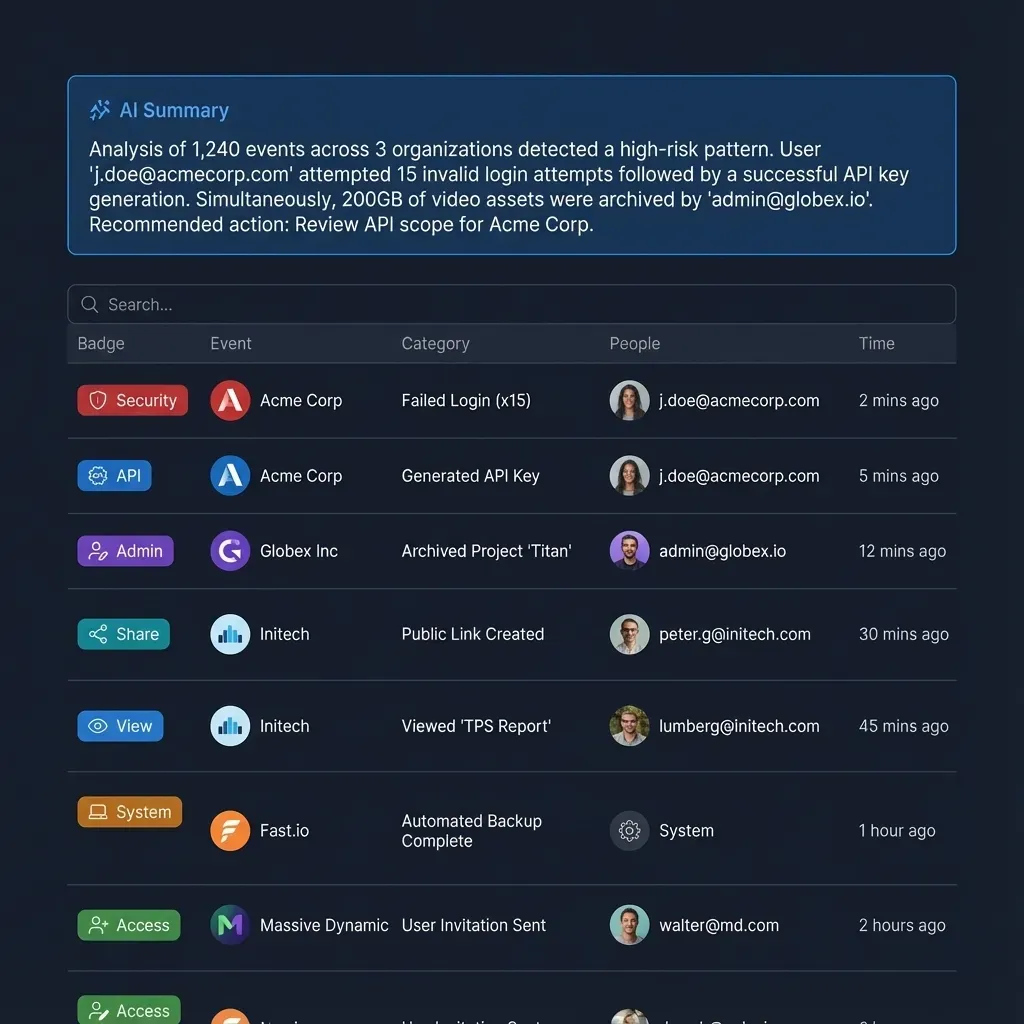
- Audit with Activity Tracking: Review your audit trails often. Fastio tracks every join, upload, and permission change. This gives you a history of how agents use your data. You can export these logs to your security tools for automated threat detection.
- URL Import Security: When agents bring in files from Google Drive or OneDrive, make sure they use secure connections that follow the source's rules. This stops agents from becoming a back door for unauthorized data.
Future-Proofing Your AI Security Model
As AI gets better, your security needs to stay flexible. We are moving toward "nested agents," where one main agent gives tasks to smaller agents. In this setup, granular permissions are even more important. You need to define what the main agent can see and what it is allowed to pass to the smaller agents.
A good model also looks at how permissions can adapt. Imagine access that changes based on what an agent is doing. For example, an agent might be an "Editor" during the day but only a "Viewer" at night. Or access might be cut if an agent starts pulling files too fast. While this is still early, the foundation is built on the file and folder controls we have now.
Finally, make Ownership Transfer a core part of your work. By building systems where agents hand off their work to humans, you make sure no automated process stays an "admin" forever. This human-in-the-loop approach is a great fail-safe. It lets you use the speed of AI while keeping the judgment of your human team. Scale should not come at the cost of oversight.
Sources
References used to verify factual claims in this guide.
-
Implementing RBAC can reduce security incidents by up to 75%.
-
Advanced access control mechanisms can lead to a 72% decrease in unauthorized access.
Frequently Asked Questions
What are granular permissions for AI workspaces?
Granular permissions are specific access controls that let you define exactly what an AI agent can do with files or folders. Instead of broad access, these permissions limit agents to the data they need, like letting them see files in one project while blocking the rest of the company.
How do I manage agent workspace access control?
You manage access by giving agents roles like Viewer, Editor, or Admin in a workspace. At Fastio, you can also use MCP tools to check and enforce these permissions, making sure agents only do things like searching or uploading within their set boundaries.
Why do AI agents need finer controls than human users?
Agents need tighter controls because they work much faster than humans. A person might look at a few files, but an agent can scan thousands in seconds. Granular controls stop an agent from accidentally exposing or using too much data if its job is set up wrong.
What is the agent delegation gap?
The agent delegation gap happens when a system can't control if an agent shares its access with others. To fix this, you need rules that say if an automated account is allowed to share files, ensuring it can't give access to unauthorized people or other agents.
Can I use RBAC for both humans and agents in the same workspace?
Yes. Workspaces like Fastio let people and agents work together using the same Role-Based Access Control model. This creates a single security setup where every action is logged in one audit trail, whether a person or a script did it.
Related Resources

Secure Your AI Workflow with Granular Control
Connect your agents to a consolidated MCP toolset and granular workspace controls with our 14-day Business Trial. Built for secure AI workflows.