How End-to-End Encrypted File Sharing Works (and When You Actually Need It)
End-to-end encrypted file sharing ensures that only the sender and recipient can read a file, with the service provider locked out entirely. This guide breaks down how E2E encryption works, how it compares to transport and server-side encryption, and when each approach makes sense for your workflow.

What End-to-End Encrypted File Sharing Actually Means
End-to-end encrypted file sharing means files are encrypted on the sender's device and can only be decrypted by the intended recipient. The service provider never sees the plaintext. Even if someone compromises the server, intercepts the data in transit, or serves a legal subpoena, the encrypted content remains unreadable without the recipient's private key.
This is different from what most cloud storage services do. When you upload a file to Google Drive or Dropbox, the provider encrypts your file on their servers using keys they control. They can decrypt it whenever they need to, whether for indexing, AI features, or responding to a government request. With true E2E encryption, that access is mathematically impossible.
The distinction matters more than most people realize. According to the 2026 Thales Data Threat Report, 53% of sensitive cloud data remains unencrypted. And among organizations that do encrypt, many rely solely on transport encryption (TLS), which only protects data while it moves between your device and the server.
Related guides
- How to Share Files Securely with EncryptionEncrypted file sharing protects files with cryptographic algorithms during transfer and storage, ensuring only...
- How to Password Protect Files Before Sharing ThemPassword protected file sharing adds an authentication layer to shared files, requiring recipients to enter a password...
- How to Set Up Secure File Sharing for Your BusinessSecure file sharing for business is the practice of transferring sensitive documents between team members, clients, and...
- How to Choose a Secure File Sharing PlatformPicking a secure file sharing platform means understanding what "secure" actually requires for your team. This guide...
- How to Transfer Files Securely OnlineSecure file transfer is the process of sending files using encryption and access controls to prevent unauthorized...
- How to Share Files SecurelySending sensitive documents through email or public cloud links exposes your data to interception and unauthorized...
More on this subject: Security and Access Control (32 guides)
Three Types of Encryption (and Why People Confuse Them)
Most guides about encrypted file sharing blur the lines between three distinct approaches. Understanding the differences is the first step to choosing the right one.
Transport encryption (TLS) protects files only while they travel between your device and the server. Once the file arrives, the server decrypts it and can read the contents. Every reputable cloud service uses TLS, but it does not protect your data at rest. Think of it as an armored truck: your package is safe during delivery, but the warehouse staff can open it.
Server-side encryption (SSE) encrypts files on the server's storage drives using keys the provider manages. This protects against physical theft of hard drives and unauthorized access to the storage layer. AWS S3, Google Cloud Storage, and most enterprise platforms use SSE by default. The limitation is that the provider holds the keys, so they can decrypt your files for search indexing, malware scanning, or legal compliance.
End-to-end encryption (E2EE) encrypts files on your device before upload. The server stores ciphertext it cannot decrypt. Only the intended recipient, who holds the matching private key, can read the file. The provider is mathematically excluded from accessing content.
The Trade-offs Most Guides Skip
E2E encryption sounds like an obvious win, but it comes with real costs that affect daily workflows. Choosing the right encryption model means understanding what you give up, not just what you gain.
No server-side search or indexing. When the server cannot read your files, it cannot build a search index. Services like Tresorit and Proton Drive offer limited search, typically restricted to file names and metadata. Full-text search across encrypted documents requires decrypting everything on your local device, which is slow and impractical for large libraries.
No AI features on the server. Smart categorization, auto-tagging, content summarization, and semantic search all require the server to read file contents. E2E encryption makes these features impossible at the server level. Some providers have started running AI locally on user devices, but this approach is resource-intensive and limited in scope.
Key management falls on you. If you lose your private key or recovery phrase, your data is gone permanently. There is no "forgot password" flow that preserves true E2E encryption. Organizations need their own key escrow and recovery procedures, which adds operational overhead.
Malware scanning becomes harder. Data Loss Prevention (DLP) tools, virus scanners, and content filters typically run on the server side. With E2E encryption, these tools cannot inspect file contents, shifting the security burden to endpoint devices.
Performance takes a hit. Encrypting and decrypting files on your device adds computational overhead. For small documents, the difference is negligible. For large file transfers (100GB+), E2E encryption can significantly slow upload and download speeds compared to TLS-only transfers.


Need searchable, secure file sharing for your team?
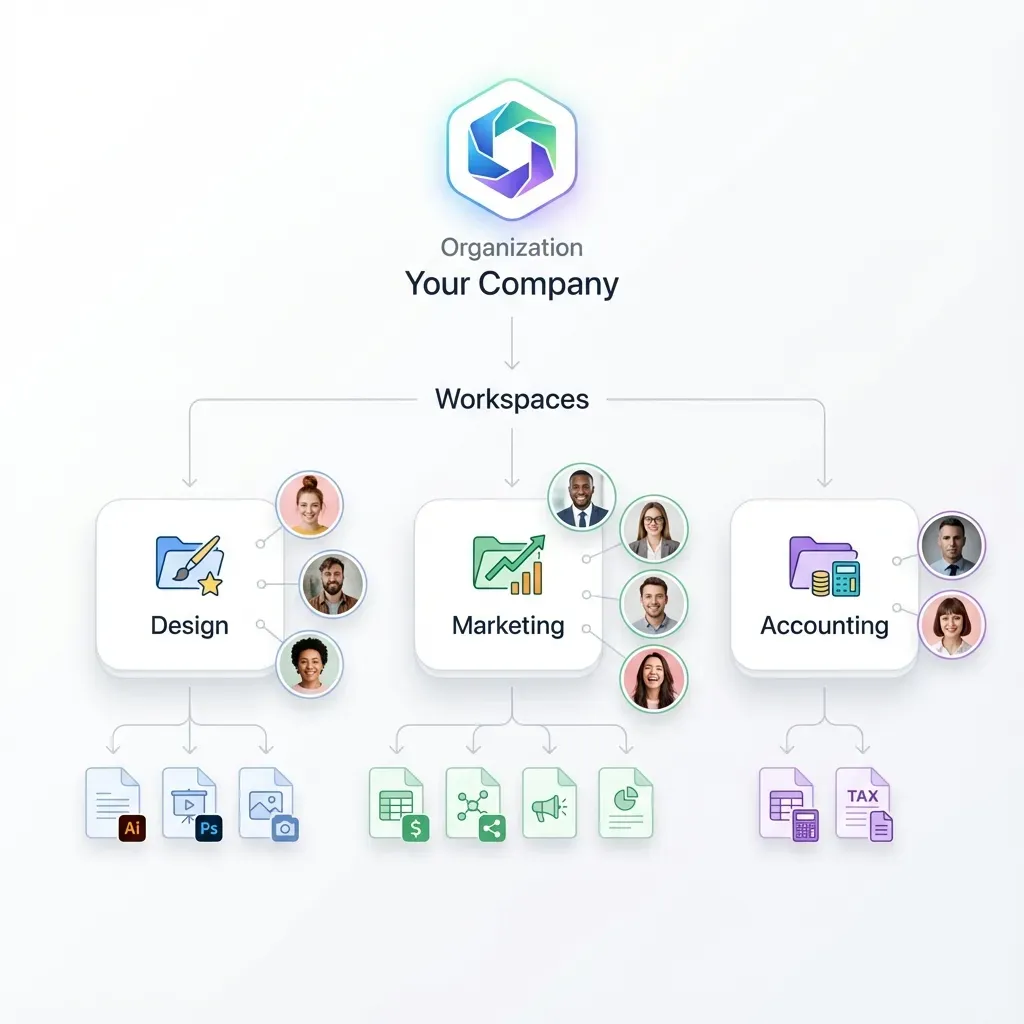
Fastio gives you server-side encryption with intelligent workspaces, semantic search, and audit trails. generous storage.
When E2E Encryption Is Worth the Trade-offs
Not every file needs E2E encryption. The right approach depends on what you are protecting and who you are protecting it from.
Legal and compliance documents. Attorney-client privilege, merger documents, and regulatory filings contain information where even the storage provider should not have access. Law firms and financial institutions handling these files have a strong case for E2E encryption.
Healthcare records. Patient data carries strict privacy requirements. While regulations like HIPAA do not mandate E2E encryption specifically, the zero-access model provides the strongest technical guarantee that patient data stays private.
Whistleblower and journalist communications. Sources sharing sensitive documents need assurance that no third party, including the platform operator, can identify them or read their files. E2E encryption is non-negotiable in these scenarios.
Intellectual property in competitive industries. Trade secrets, unreleased product designs, and proprietary research benefit from E2E encryption when the cost of a breach outweighs the convenience of server-side features.
For most business file sharing, though, server-side encryption with strong access controls provides a better balance. You get searchable workspaces, AI-powered organization, and collaboration features, while still protecting files from external threats. The question is whether you trust your cloud provider more than you trust the mathematical impossibility of decryption.

E2E Encrypted File Sharing Services Compared
Several services offer genuine end-to-end encrypted file sharing. Here is how the main options stack up.
Tresorit is the most established E2E encrypted collaboration platform. It is owned by Swiss Post, offers zero-knowledge encryption, and supports GDPR and HIPAA workflows. Business plans start around $14.50 per user per month with 1-2 TB of storage per user. The trade-off is limited search capability and no server-side AI features.
Proton Drive is part of the Proton ecosystem (alongside ProtonMail and ProtonVPN). It uses zero-access encryption and has expanded rapidly, adding Proton Sheets and local AI writing tools. Proton's suite pricing starts at $12.99 per user per month. It is a strong choice if you already use Proton's other products.
Internxt is an open-source, audited platform based in Spain. It differentiates by shipping post-quantum encryption, preparing for the day quantum computers can break current encryption standards. Internxt offers lifetime plans starting around EUR 180 for 2 TB, making it one of the more affordable options.
Sync.com is a Canadian provider focused on privacy and E2E encryption. It offers a straightforward interface and competitive pricing, though its collaboration features are more limited than Tresorit or Proton Drive.
Mega provides E2E encrypted storage with a generous 20 GB free tier. User-controlled encryption keys give you full ownership of your data security. Mega works well for personal use but its business collaboration tools are basic compared to dedicated enterprise platforms.
For teams that need searchable, AI-powered workspaces rather than zero-knowledge encryption, platforms like Fastio take a different approach. Fastio uses server-side encryption with granular permissions, audit trails, and two-factor authentication, while enabling Intelligence Mode for semantic search and citation-backed chat across your files. When your workflow requires finding information quickly and collaborating with both humans and AI agents, the ability to search and query your files matters more than locking the provider out entirely.
How to Choose the Right Encryption Model
Start with two questions: What is the sensitivity of your files? And what do you need to do with them once they are stored?
If your files contain information so sensitive that even your cloud provider should not see it, and you are willing to give up server-side search, AI features, and easy key recovery, E2E encryption is the right choice. Tresorit and Proton Drive are the strongest options for teams.
If your files are sensitive but you need to search, organize, and collaborate on them actively, server-side encryption with strong access controls is the better fit. Look for platforms with granular permissions (down to the file level), comprehensive audit trails, and two-factor authentication. Fastio, for example, provides shared workspaces where both humans and AI agents can search and query files through Intelligence Mode, with full audit trails tracking every access event.
If you are transferring files one-time and need simple E2E protection, tools like Wormhole offer encrypted sharing with auto-expiring links. No account required, no ongoing storage to manage.
For most organizations, the practical answer is a mix. Use E2E encrypted services for your most sensitive documents (legal, compliance, IP protection) and server-side encrypted platforms with intelligent features for everyday collaboration. The two approaches are not mutually exclusive.
Whatever you choose, avoid the common mistake of assuming TLS alone is enough. Transport encryption protects your files in transit, but once they reach the server, you are relying on the provider's security practices. At minimum, confirm your cloud storage uses encryption at rest (AES-256 is the standard) in addition to TLS.
Sources
References used to verify factual claims in this guide.
-
53% of sensitive cloud data remains unencrypted
-
Only 8% of organizations encrypt 80% or more of their sensitive cloud data
Frequently Asked Questions
What is end-to-end encrypted file sharing?
End-to-end encrypted file sharing means files are encrypted on the sender's device before upload and can only be decrypted by the intended recipient. The service provider stores encrypted data it cannot read, even if compelled by a court order or compromised by an attacker.
Is end-to-end encryption the same as SSL/TLS?
No. SSL/TLS encrypts data only while it travels between your device and the server. Once the file arrives at the server, it is decrypted and the provider can access it. End-to-end encryption keeps files encrypted from sender to recipient, with the server never seeing the plaintext content.
Can you search files that are end-to-end encrypted?
Not on the server side. Because the server cannot read encrypted file contents, it cannot build search indexes. Some E2E encrypted services offer limited search by file name or metadata, but full-text search requires decrypting files locally on your device, which is slow for large file collections.
What is the best end-to-end encrypted file sharing service?
Tresorit and Proton Drive are the strongest options for teams needing true E2E encryption. Tresorit offers more mature collaboration features, while Proton Drive integrates well with the broader Proton privacy ecosystem. For teams that prioritize searchability and AI features over zero-knowledge encryption, platforms like Fastio offer server-side encryption with intelligent workspaces.
Does Fastio use end-to-end encryption?
Fastio uses server-side encryption with granular permissions, audit trails, and two-factor authentication rather than end-to-end encryption. This approach enables Intelligence Mode, which indexes files for semantic search and AI-powered chat with citations. The trade-off is that Fastio can access file contents for indexing, but this is what makes features like search and AI chat possible.
Related Resources

Need searchable, secure file sharing for your team?
Fastio gives you server-side encryption with intelligent workspaces, semantic search, and audit trails. generous storage.