How to Implement Data Governance in Claude Cowork
Data governance in Claude Cowork establishes the rules, audit trails, and access controls needed to deploy AI agents safely in enterprise environments. This guide explains how to secure your workspaces, monitor autonomous agent activity, and build a safe foundation for human-agent collaboration while reducing the risks of unrestricted local file access.


Why Data Governance Matters for AI Agents
Data governance in Claude Cowork establishes the rules, audit trails, and access controls needed to deploy AI agents safely in enterprise environments. When organizations move from simple chat interfaces to autonomous agents that can read, modify, and delete local files, the security stakes increase. The value of agentic workflows is their autonomy. However, that same autonomy introduces serious risks if you don't manage it.
Without a structured way to manage AI agent access, organizations face real problems. An agent might accidentally modify a production database configuration file while attempting to improve a script. It might summarize and share a sensitive financial projection document with an unauthorized user group because the prompt was too broad. Or, an agent might delete an entire directory of unbacked up project assets because it misunderstood a cleanup instruction. These things happen when intelligent systems have unrestricted file system access without proper rules.
Traditional data governance frameworks were designed only for human employees. Humans understand nuance. They recognize sensitive file names and follow business protocols out of professional obligation. AI agents process large amounts of data quickly, but they lack internal organizational context. They execute their instructions literally. They will access any file they are allowed to reach to complete a given task. They do not naturally stop to ask if reading the CEO's compensation file makes sense when summarizing the weekly team meeting notes.
You have to change your security posture. You can no longer rely on reactive monitoring or assumed employee discretion. Instead, you need proactive, cryptographic access control. Your architecture should assume the agent will try to read any accessible file during its reasoning process.
Effective governance for Claude Cowork requires a clear view of what the agent can see, what it is allowed to do, and what actions it has taken. This detailed tracking and control is not just a best practice. It is required for deploying AI agents in regulated industries like healthcare, finance, legal services, and government contracting. Without it, the risk of deploying autonomous systems outweighs the potential productivity gains.
Helpful references: Fastio Workspaces, Fastio Collaboration, and Fastio AI.
Related guides
- Best OpenClaw Tools for Data AnalysisOpenClaw agents automate local data analysis tasks like SQL querying, data cleaning, and visualization. Developers can...
- How to Implement Semantic Search in OpenClawOpenClaw semantic search uses vector embeddings for intelligent file retrieval in Fastio workspaces. Combine OpenClaw...
- Claude Cowork vs Claude Code: Which One Should You Use?Claude Code now accounts for roughly 4% of all public GitHub commits, and Claude Cowork went generally available in...
- How to Create a Claude Cowork Shared Workspace for TeamsA Claude Cowork Shared Workspace lets teams and AI agents manage files together in one place. The standard Claude app...
- How to Build a RAG Pipeline with Claude CoworkAI agents need access to your files to answer questions accurately. A RAG pipeline in Claude Cowork connects Claude to...
- How to Automate Document Analysis with Claude CoworkDocument analysis in Claude Cowork uses your shared workspace to let agents autonomously extract, summarize, and...
More on this subject: Claude and Claude Code (280 guides)
What to check before scaling claude cowork data governance
Before you can build a strong enterprise governance framework, you need to understand how Claude Cowork operates by default. Cowork acts mainly as a local desktop assistant. It interacts directly with the files, directories, and applications located on a user's machine. This local architecture provides specific privacy benefits but introduces major governance challenges at scale.
By design, Cowork stores conversation history and processes documents locally on the host machine. The data it accesses does not leave the user's computer for model training, and it isn't automatically synced to Anthropic's cloud storage. This local processing means your daily activity and the files the agent reads are not subject to external data retention policies or third-party visibility. The system operates within an isolated virtual machine environment on the user's computer. Users must give the Cowork application permission to access specific folders on their hard drive.
Users maintain direct control over which files Claude can access at any given time. The system is also designed to pause and require user review before executing risky operations. For instance, if an agent decides it needs to delete a file or overwrite an important document, it will show that plan to the user and wait for confirmation before proceeding.
While these native constraints provide a baseline level of safety for consumers, they are not enough for true enterprise governance requirements. Because Cowork acts as a local application, its activity is decentralized. There are no centralized, organization-wide audit logs capturing every file read or modified. There is no full compliance API available to export agent activity into corporate security information and event management platforms. If a security auditor asks you to prove exactly what files an agent accessed on a specific employee's laptop three months ago, you cannot do it easily or reliably.
For regulated workloads and large-scale deployments, this lack of centralized visibility is a major problem. You cannot rely on individual users to maintain perfect oversight of their local agent's activities. You also can't trust local logs that could be accidentally deleted or tampered with. Organizations need a higher-level governance system. They require an architecture that records every file interaction permanently, enforces access boundaries globally across all users, and provides a centralized record of agent behavior that passes strict compliance audits.
The Four Pillars of AI Agent Data Governance
A complete, enterprise-grade data governance strategy for AI agents relies on four main pillars. These elements must work together smoothly to create a secure environment where agents can operate autonomously, deliver productivity gains, and remove the risk to data integrity.
1. Identity and Cryptographic Access Control
Every AI agent operating within your organization must have a clear, verifiable identity. You cannot treat agent access as a mere extension of the human user's access profile. If a human employee has broad, unrestricted access to an entire company shared drive, giving an agent that same broad access is a security risk.
Agents must operate under the principle of least privilege. They should only have access to the specific files, isolated folders, and APIs needed for their current task. When that specific task is complete, that access must be revoked automatically and immediately. This requires the implementation of dynamic, time-bound permission systems rather than traditional, static access control lists that remain open.
2. Immutable Activity Audit Trails
You must maintain an immutable, centralized record of every action an agent takes across your network. This audit trail must capture every file read, modified, created, or deleted by any agent. Importantly, the audit trail must also record the specific prompt or instruction that triggered the action, the exact timestamp, the identity of the human who authorized the task, and a hash of the final state of the modified file.
Relying on local logs stored on individual employee machines is not enough for enterprise governance. Audit trails must be streamed securely to a central, tamper-proof repository. This centralized logging is the only way to satisfy strict compliance audits and conduct accurate forensic investigations if a security incident occurs.
3. Strict Retention and Lifecycle Policies
AI agents generate a large amount of intermediate data during their operations. They create temporary scratch files, draft documents, parsing logs, and reasoning traces. Your data governance framework must state how long this agent-generated data is retained before it is deleted.
You need automated lifecycle policies that automatically sweep and delete temporary agent files after a set period, such as 24 or 48 hours. You also need policies that identify, tag, and permanently archive the final, approved outputs of an agent's work into official corporate records. Without automated lifecycle management, agent workspaces quickly turn into messy folders of redundant files that increase storage costs and compliance liabilities.
4. Data Privacy and Boundary Enforcement
Agents often process sensitive information, including personally identifiable information, confidential financial records, and proprietary source code. Your governance model must ensure this data remains encrypted both in transit and at rest, regardless of where the agent is operating.
You must establish strict boundaries around what types of data specific agents are permitted to process. If an agent is tasked with summarizing general customer feedback from a public forum, the system architecture must ensure it is physically impossible for that agent to accidentally access the secure folder containing raw credit card numbers or internal payroll data.
Building a Secure Governance Architecture
Implementing the four pillars of data governance requires a technical architecture designed specifically for agentic workflows. You cannot retrofit legacy file servers or consumer-grade cloud storage to handle the speed and volume of autonomous agent interactions. You need a dedicated workspace layer engineered for machine-to-machine and human-to-machine collaboration.
Creating Cryptographically Isolated Agent Workspaces
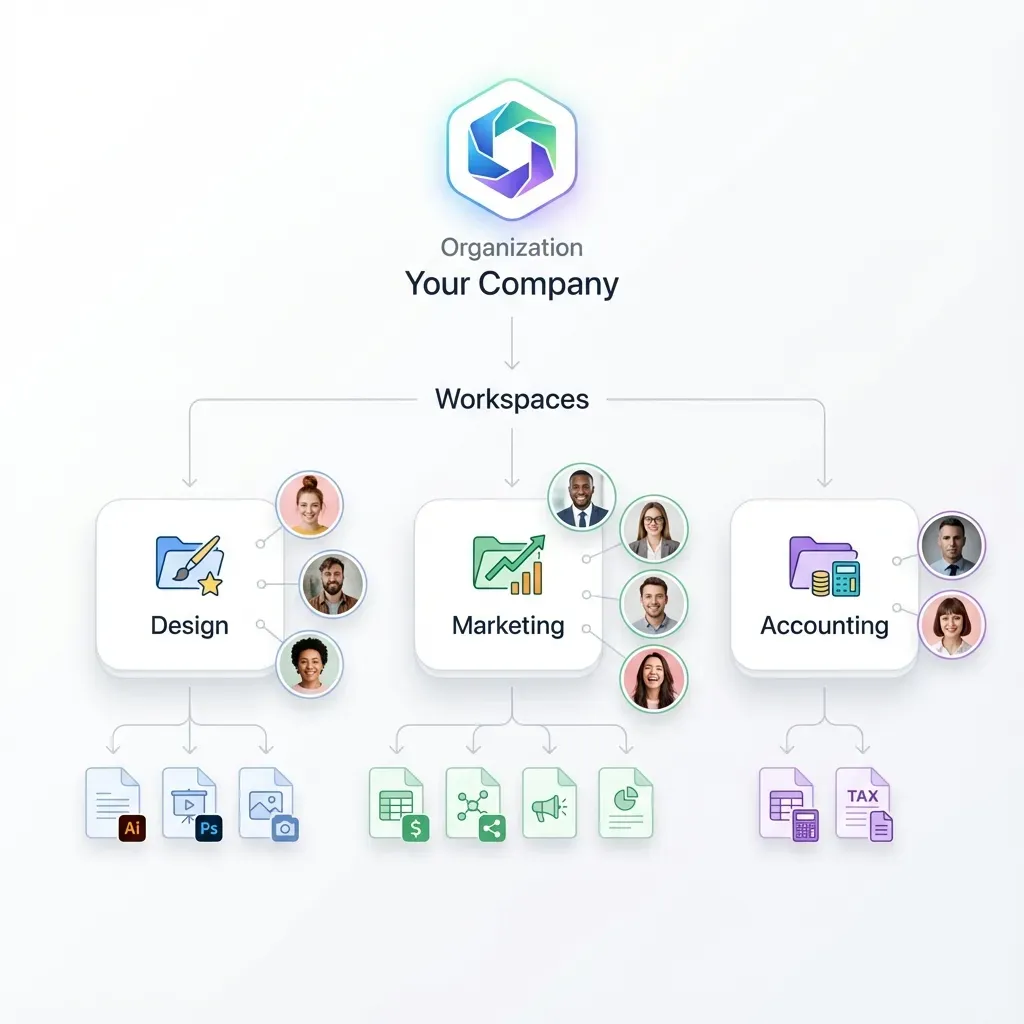
The first and most important step in building a secure architecture is moving agent operations out of local user directories. Instead of granting Claude Cowork access to an internal machine, you must create a dedicated, secure, cloud-managed workspace specifically for a task like financial reporting.
You then populate this isolated workspace only with the specific files the agent requires to complete its objective. This creates a cryptographic boundary. The agent physically cannot access anything outside this narrowly defined workspace. This architectural decision removes the risk of collateral damage, accidental data exposure, or the agent moving into unauthorized directories during its reasoning process.
Implementing the Principle of Least Privilege
Within these isolated workspaces, you must implement detailed permissions. An agent should rarely require full read and write access to an entire workspace. For example, if an agent is tasked with reviewing contracts and extracting key clauses, it only needs read-only access to the folder containing the original contracts. It should only have write access to a specific, designated output folder where it saves the extracted summaries.
By enforcing this level of detail, you ensure that even if an agent's reasoning process fails or it misinterprets a prompt, the potential damage is limited to the specific output folder. The original source documents remain safe.
Establishing Mandatory Human-in-the-Loop Safeguards
Even within highly isolated, restricted workspaces, high-risk actions require mandatory human oversight. Your architecture must support smooth human-in-the-loop workflows.
Consider a scenario where an agent is permitted to read hundreds of internal financial documents and draft a consolidated, public-facing quarterly report. The agent can do this work on its own. However, the action of actually publishing that report or sharing it with an external client must be gated behind a mandatory human approval step. The governance system must automatically pause the agent's workflow, notify a designated human reviewer, present the proposed final action and the associated document, and wait for cryptographic sign-off from the human before the agent can proceed.
Integrating Fastio for Enterprise Governance
Fastio provides the exact central governance layer necessary to bring enterprise-grade security and compliance to Claude Cowork and other advanced AI agents. While Cowork handles the local intelligence, complex reasoning, and execution, Fastio provides the secure, auditable workspace environment where that execution happens safely at scale.
Instead of giving Claude access to local employee hard drives, you connect Claude directly to Fastio workspaces using the standardized Model Context Protocol (MCP). This integration changes how you manage agent access, monitor activity, and maintain visibility across your global organization.
Real-Time Centralized Audit Logging
Every interaction an agent has with any file in a Fastio workspace is automatically recorded in a centralized activity log. You can see exactly when an agent read a specific document, what changes it made to a spreadsheet, and who originally authorized the agent's access to that workspace. This data is available for compliance reporting, security audits, and forensic analysis, solving the primary limitation of local-only agent deployments.
Detailed Permission Controls and Version History
Fastio allows you to enforce the principle of least privilege with programmatic control. You can programmatically create a workspace, grant an agent read-only access to a specific set of confidential reference documents, and provide write access only to a tightly controlled output folder.
Importantly, Fastio provides advisory file locks alongside complete file version history with restore capabilities to coordinate work when multiple autonomous agents or human employees collaborate on documents concurrently. An agent can acquire a file lock before updating a file, heartbeat the lease while working, and release it upon completion, while version history and audit logs capture every revision.
The Business Trial for Rapid Validation
Getting started with proper agent governance does not require a large enterprise contract or a lengthy procurement process. Fastio offers a 14-day Business Trial requiring a credit card, with details available on the pricing page.
This trial allows your development and security teams to build, test, and validate secure agent workflows before rolling them out to the wider organization. You can experiment safely with Model Context Protocol integrations, explore activity polling and WebSocket event feeds, and refine your access policies without risking production systems.
Secure Ownership Transfer Workflows
A useful governance feature of Fastio is the ability to handle workspace ownership transfers securely. An autonomous agent can create a workspace, generate a set of deliverables, reports, or codebases, and then securely transfer full ownership of that workspace directly to a human client, project manager, or external stakeholder. The agent retains only the specific, limited admin permissions required for future maintenance or updates, ensuring clear lines of human accountability and strict data ownership.



Give Your AI Agents Persistent Storage
Provide your autonomous agents with isolated, fully auditable workspaces. Enforce strict access controls, monitor activity in real-time, and maintain absolute compliance effortlessly.
Best Practices for Regulated Workloads
Deploying AI agents in regulated environments like global finance, healthcare, legal services, and government contracting requires following strict operational standards. You must be able to prove to external regulators and internal compliance teams that your AI systems are controlled, predictable, and auditable at all times.
First, you must establish a strict policy: always disable default local storage access for enterprise agents. Agents should never be permitted to read or write directly to an employee's local user folders. All agent operations must occur only within centrally managed, cloud-backed workspaces where security policies can be enforced globally and activity can be logged.
Second, implement mandatory peer review for all agent prompts that access regulated or sensitive data. A single poorly phrased, broad prompt can cause an agent to summarize and expose large amounts of data it shouldn't have analyzed. You must treat agent prompts with the same level of strict scrutiny, testing, and version control as you would production database queries or core application code.
Third, establish distinct, separated development, staging, and production environments for all your agent workflows. An agent should be tested thoroughly against synthetic, anonymized data in a secure staging workspace before it is ever granted access to production workspaces containing real customer information, financial records, or patient data.
Fourth, conduct regular, automated audits of all agent permissions across your organization. Use automated scripts to query your workspace management system and identify any agents that have retained access to sensitive folders longer than necessary. Stale permissions are one of the most common and easily preventable vectors for data exposure in agentic systems.
Finally, ensure your organizational incident response plan covers AI agent anomalies. Your security team must know exactly how to quickly revoke an agent's access globally, quarantine its active workspaces, halt its reasoning processes, and export its full audit trail for immediate forensic analysis in the event of unexpected behavior or a suspected security breach.
Common Governance Challenges and Solutions
Even with a strong architecture in place, organizations often encounter specific, predictable challenges when scaling AI agent deployments from pilot projects to enterprise-wide adoption. Understanding these common hurdles allows you to address them proactively rather than reacting to crises.
The "Over-Privileged Agent" Problem
The most common and dangerous mistake organizations make is granting an agent access to a large parent directory because it is easier and faster than specifying individual, required subfolders. This approach exposes large amounts of irrelevant, potentially sensitive data to the agent. It increases the risk of the agent behaving unpredictably based on irrelevant context or accidentally leaking data it never should have seen.
The Solution: Adopt a strict "just-in-time" access model enforced by automation. Use automated workflows to create a new, isolated workspace for each specific task. The system should programmatically copy only the necessary files into this temporary workspace, allow the agent to execute its task, and then automatically destroy the workspace and revoke the agent's access when the task is complete.
Managing Version Control Conflicts
When multiple autonomous agents and human employees work on the same documents concurrently, version conflicts and data overwrites are inevitable. An agent might rapidly overwrite a human's recent edits, or two agents might attempt to modify an important configuration file simultaneously, leading to corruption.
The Solution: Rely on advisory file locks, granular permissions, and automatic file version history at the storage layer. Agents can acquire an advisory lock on a file before writing, alerting others that the file is in use. If another collaborator attempts to acquire the lock, they receive an HTTP 409 and can wait. If a worker disconnects, the lease expires automatically, and anyone with write permission can override it. Fastio's version history preserves every revision as a safety net.
Handling Unstructured Data Discovery
Agents are often effective at organizing large amounts of unstructured data, such as a messy, decade-old shared drive of legacy project files. However, governance becomes hard because you do not know exactly what sensitive data might be hidden in those files until the agent actually processes them.
The Solution: Run a preliminary, specialized "classification agent" first. This agent must be granted read-only access and is instructed only to scan, identify, and flag files containing potentially sensitive information without modifying or summarizing them. Once this classification agent has analyzed the unstructured repository and the sensitive data is quarantined or moved to appropriately secured tiers, your operational agents can then safely process the sanitized data without risk of exposure.
Sources
References used to verify factual claims in this guide.
-
Fastio plans start with a 14-day Business Trial requiring a credit card.
Frequently Asked Questions
How do you govern AI agents effectively in an enterprise?
You govern AI agents by moving their operations out of local environments and into centralized, auditable workspaces. Effective governance requires enforcing the principle of least privilege, demanding explicit human-in-the-loop approval for destructive or high-risk actions, and maintaining immutable, centralized audit logs of every file interaction the agent performs.
Is Claude Cowork safe for processing confidential enterprise data?
Claude Cowork processes data locally, which provides a strong baseline level of privacy against third-party observation. However, for true enterprise safety with highly confidential data, Cowork must be paired with a dedicated governance layer like Fastio. This combination provides the necessary audit trails, centralized access controls, and compliance reporting that local applications lack.
Can autonomous AI agents bypass standard security permissions?
AI agents cannot bypass security permissions if they are properly isolated at the storage layer. By using dedicated cloud workspaces and standardized integration frameworks like the Model Context Protocol (MCP), agents are cryptographically restricted to accessing only the specific files and folders they have been granted permission to see. This prevents unauthorized system exploration or lateral movement.
What is the most effective way to monitor autonomous agent activity?
The most effective approach is connecting your agents to a smart storage platform that automatically logs all file interactions natively. This provides a real-time record of exactly what the agent read, modified, or deleted. This allows security teams to monitor behavior fully without having to trust the agent to report its own actions accurately.
How do I prevent an AI agent from accidentally deleting important files?
You prevent accidental deletion by configuring the agent's workspace connection with strict read-only or append-only permissions for all important directories. For folders where the agent requires write access, Fastio preserves complete version history so any overwritten or deleted file can be restored, backed by a detailed activity log of all agent actions.
Related Resources

Give Your AI Agents Persistent Storage
Provide your autonomous agents with isolated, fully auditable workspaces. Enforce strict access controls, monitor activity in real-time, and maintain absolute compliance effortlessly.