How to Build and Distribute Digital Board Books
Board book software helps organizations compile, format, and securely distribute the document packages that board members review before meetings. This guide walks through the full board book workflow, from collecting contributor reports to giving directors secure access on any device, and compares the tools available for each stage.


What Is a Board Book and Why Does It Matter?: board book software
A board book is the compiled package of documents that directors receive before a board meeting. It typically includes the meeting agenda, minutes from the previous session, financial statements, committee reports, management updates, and any materials related to upcoming votes or decisions.
The name comes from the physical binders that corporate secretaries used to assemble and courier to each director. A typical board book runs 100 to 300 pages, and organizations with complex governance structures sometimes exceed that range. Every quarter, the person responsible for board administration collects inputs from the CEO, CFO, general counsel, and committee chairs, then formats everything into a single coherent package.
Board books matter because they're the primary information channel between management and the board. Directors use them to prepare for meetings, form opinions on agenda items, and fulfill their fiduciary duties. A poorly organized board book wastes director time and leads to meetings that cover ground directors should have absorbed beforehand. A well-structured one lets the board focus on strategic discussion rather than status reporting.
The shift from physical to digital board books started in the early 2010s and accelerated during COVID. According to a 2024 Diligent survey, adoption of board portal software grew substantially as organizations moved to hybrid and remote board meetings. The core problem hasn't changed though: someone still needs to collect, organize, and distribute the materials. Software just changes how.
Helpful references: Fastio Workspaces, Fastio Collaboration, and Fastio AI.
Related guides
- How to Choose Board Meeting Software That Directors Will Actually UseBoard meeting software handles the full meeting lifecycle, from building agendas and distributing board packs to...
- How to Compare Board Portal Software and Pick the Right OneBoard portals vary widely in pricing, features, and target audience. This guide compares the leading platforms across...
- How to Choose Board Portal Software for Your OrganizationBoard portal software replaces email attachments and shared drives with a secure, purpose-built platform for board...
- How to Evaluate Board Governance Software for Your OrganizationBoard governance software helps organizations enforce corporate governance policies by tracking director terms,...
- How to Pick Board Reporting Software That Saves Your Team Days of WorkBoard reporting software consolidates financial data, KPIs, and committee updates into structured reports that...
- How to Streamline Board Meeting Agendas with the Right SoftwareBoard agenda software replaces the manual cycle of drafting, revising, and distributing meeting agendas with a...
More on this subject: Data Rooms and Due Diligence (53 guides)
The Board Book Assembly Workflow
Understanding the workflow helps you evaluate what kind of tool you actually need. Here's what a typical quarterly board book cycle looks like.
1. Collect contributor materials
Four to six weeks before the meeting, the board administrator (often the corporate secretary or an executive assistant) contacts each contributor. The CFO submits financial statements. Committee chairs submit their reports. The CEO provides a management update. Legal submits any resolutions requiring a vote.
These arrive in different formats: Word documents, Excel spreadsheets, PowerPoint decks, PDFs. The first bottleneck is getting everyone to submit on time.
2. Organize and format
Once materials arrive, the administrator assembles them into the meeting agenda structure. This means converting everything to a consistent format (usually PDF), adding section dividers and a table of contents, applying page numbering, and ensuring the reading order matches the agenda.
For organizations still doing this manually, this step alone can take 10 to 20 hours per quarter. Last-minute changes from contributors compound the problem. When the CFO revises a figure after the book is "finalized," the administrator has to recompile, re-paginate, and redistribute.
3. Review and approve
Before distribution, the board book typically goes through an internal review. The CEO or board chair reviews the final package and requests changes. Some organizations route the book through legal review. This approval step catches errors but adds another potential delay.
4. Distribute securely
Board materials are confidential. They contain financial data, strategic plans, and information that could affect stock prices for public companies. Distribution needs to be both secure and accessible.
Traditional distribution meant printing, binding, and couriering physical binders. Digital distribution means uploading to a secure portal, setting permissions, and notifying directors. The "one-week rule" in most governance best practices requires delivery at least seven days before the meeting.
5. Support director review
Directors need to read the materials, annotate them, and prepare questions. They do this on planes, in home offices, and between other meetings. Mobile access and offline reading are not nice-to-haves for this audience.
6. Post-meeting updates
After the meeting, minutes are drafted, action items are assigned, and the cycle starts again for the next quarter.
Dedicated Board Portals vs. General-Purpose Tools
The market for board book distribution splits into two camps: dedicated board portal software and general-purpose document platforms used for board work. Each has clear trade-offs.
Dedicated board portals
Vendors like Diligent, OnBoard, Nasdaq
Boardvantage, Azeus Convene, and BoardEffect build specifically for board governance. Their products include agenda builders, integrated voting, annotation tools synced across devices, and minutes management. Diligent alone serves over 700,000 board members and claims more than half of the Fortune 1000 as customers.
The advantage is a purpose-built workflow. The agenda builder structures your board book automatically. Directors get a familiar interface designed for their specific use case. Compliance features like audit trails and access controls are built in.
The disadvantage is cost and rigidity. Board portal pricing typically runs $10,000 to $50,000+ per year, with per-user fees on top. You're also locked into the vendor's workflow. If your organization's governance process doesn't match their assumptions, you'll spend time working around the tool rather than with it.
General-purpose document platforms
Many organizations use tools they already have: SharePoint, Google Drive, Dropbox, or dedicated secure-sharing platforms like Fastio. The board book gets assembled in a shared workspace or folder, then distributed through a secure link or portal.
The advantage is flexibility and cost. You're not paying a governance-specific premium, and you can adapt the workflow to match your process rather than conforming to a vendor's model. Platforms with built-in portals, permissions, and audit trails can cover the security requirements without the board-specific price tag.
The disadvantage is that you build the workflow yourself. There's no agenda builder template, no integrated voting module, no purpose-built annotation sync. Whether that matters depends on your board's complexity and expectations.
How to choose
If your organization is publicly traded, heavily regulated, or has a board of 15+ directors with complex committee structures, a dedicated board portal probably justifies its cost. The governance-specific features save enough administrative time to offset the premium.
If you're a private company, nonprofit, startup board, or advisory board, a well-configured document platform with strong permissions and audit trails handles the job at a fraction of the cost.



Simplify Your Board Book Workflow
Set up a branded, secure portal for your board materials in minutes. Fastio gives you granular permissions, full audit trails, and AI-powered document intelligence so directors can search and query their board books. Built for board book software workflows.
How to Build a Digital Board Book Step by Step
Here's a practical process for assembling and distributing a digital board book, regardless of the specific tool you use.
Set up your structure
Create a dedicated workspace or folder for board materials. Organize it by meeting date, with subfolders matching your standard agenda structure. A typical layout looks like this:
- Q1 2026 Board Meeting
- Call to Order and Agenda
- Previous Minutes
- CEO Report
- Financial Review
- Committee Reports
- New Business
- Executive Session
Reuse this structure each quarter. Consistency helps directors find what they need quickly.
Create a contributor timeline
Work backward from your target distribution date. If the meeting is April 15 and you want materials distributed by April 8 (one week prior), set contributor deadlines for March 25 to give yourself two weeks for assembly and review. Send calendar invites, not just emails. Contributors who miss deadlines are the number one cause of rushed board books.
Standardize submission formats
Give contributors a template or at minimum a formatting guide. Specify font sizes, header styles, and page orientation. When everyone submits in different formats, the administrator spends hours just making things look consistent. PDF is the safest final format since it preserves formatting across devices.
Assemble and paginate
Merge contributor materials into the agenda structure. Add a cover page, table of contents with page numbers, and section dividers. Number pages continuously through the entire book so directors can reference specific pages during the meeting. If your tool doesn't automate pagination, Adobe Acrobat Pro handles the merge-and-paginate workflow well.
Route for internal review
Before distributing to directors, have the CEO or board chair review the complete package. Flag any sections that are incomplete or that need additional context. In Fastio, reviewers can leave comments anchored to specific pages, and the activity log records each change.
Distribute with proper access controls
Upload the final board book to your secure portal or workspace. Set permissions so each director can view and annotate but not edit or redistribute. Enable download for offline access if your directors travel frequently. Set the access to expire after the meeting date so stale materials don't linger.
For platforms like Fastio, content portals work well here. Create a branded portal with your organization's logo, set password protection, and send each director an access link. Guest access means directors don't need to create an account.
Notify directors
Send a clear notification that materials are available. Include the meeting date, a direct link to the portal, and a reminder of any items requiring a vote. Don't bury the link in a paragraph of text.
Security Requirements for Board Materials
Board books contain material nonpublic information for public companies and sensitive strategic data for all organizations. Security isn't optional.
Access controls
Every director should have individual access, not a shared password. This lets you track who has accessed the materials and revoke access for individual directors if needed (for example, when a director has a conflict of interest on a specific agenda item). Granular permissions at the folder and file level let you share committee-specific materials with only the relevant committee members.
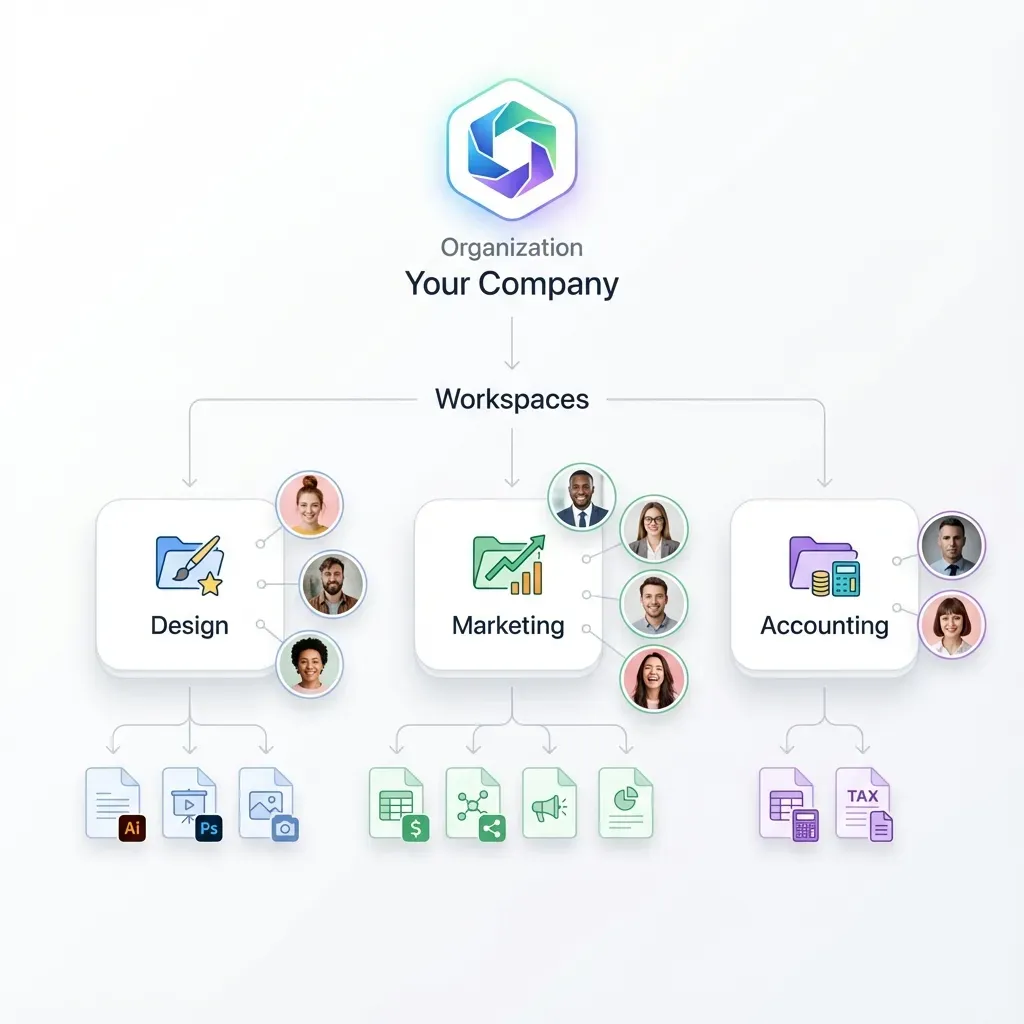
Fastio handles this through layered permissions at the organization, workspace, share, folder, and file level. Each layer can restrict access independently.
Audit trails
You need a record of who accessed which documents and when. This matters for regulatory compliance, especially for public companies where the timing of information access can have legal implications. Good audit trails cover login attempts, file views, downloads, and permission changes.
Encryption
Files should be encrypted both in transit (TLS) and at rest (AES-256). This is standard across most cloud platforms today, but verify it explicitly with any tool you're evaluating.
Device management
Directors access board materials on personal devices. If a director's laptop or tablet is lost or stolen, you need the ability to revoke access remotely. Cloud-based platforms handle this inherently since revoking portal access prevents further viewing. Platforms with offline access should encrypt the local cache.
Retention and disposal
Board materials from previous meetings should be archived or removed on a defined schedule. Leaving years of board books accessible creates unnecessary risk. Set expiration dates on portal access and archive materials to a separate, restricted workspace after each meeting cycle.

Making Board Books More Useful
The shift from physical to digital isn't just about convenience. Digital board books open up possibilities that printed binders can't match.
Executive summaries and AI-powered search
Directors consistently report that board books are too long. A 300-page book where only 50 pages require active decision-making wastes preparation time. Adding executive summaries at the start of each section helps directors prioritize their reading.
If your platform supports intelligence features, directors can search across the entire board book by keyword or even ask questions about the content. Fastio's Intelligence mode automatically indexes uploaded files for semantic search and AI-powered chat with citations, so a director could ask "What are the key risks flagged in the audit committee report?" and get an answer pointing to the specific pages.
Annotations that persist
Digital annotations beat sticky notes. Directors can highlight passages, add private notes, and flag questions for the meeting. The best tools sync annotations across devices so notes made on a tablet appear on a laptop. Private annotations stay private by default, with the option to share specific notes with other directors.
Version control for last-minute changes
When the CFO updates a number the day before distribution, version control becomes critical. Rather than redistributing the entire book, update the specific section and notify directors of the change. File versioning ensures everyone sees the latest materials while preserving a record of what changed and when.
Post-meeting continuity
Link meeting minutes and action items back to the board book sections that generated them. This creates a continuous record that directors and the corporate secretary can reference in future meetings. When a director asks "What did we decide about the acquisition proposal in Q2?" the answer should be findable without digging through email.
Platforms with workspace-level intelligence can make this searchable. Upload minutes alongside the board book, enable indexing, and the entire meeting history becomes queryable.
Sources
References used to verify factual claims in this guide.
-
Diligent serves over 700,000 board members and more than half of the Fortune 1000
-
Board portal market valued at approximately $3.3-3.7 billion in 2025-2026 with 11-13% CAGR
Frequently Asked Questions
What is a board book in corporate governance?
A board book is the compiled package of documents distributed to directors before a board meeting. It typically includes the agenda, previous meeting minutes, financial statements, committee reports, management updates, and materials related to upcoming votes. The name comes from the physical binders that organizations used to assemble and courier to each director.
How do you create a digital board book?
Start by setting up a workspace with folders matching your agenda structure. Collect materials from contributors (CEO, CFO, committee chairs) in advance with firm deadlines. Assemble everything into a consistent format, add a table of contents and page numbers, route the package through internal review, then upload to a secure portal with appropriate access controls for each director.
What should be included in a board book?
A standard board book includes: the meeting agenda, minutes from the previous meeting, CEO or management report, financial statements and commentary, committee reports (audit, compensation, governance), any resolutions requiring a vote with supporting materials, and a consent agenda for routine approvals. Some organizations also include industry benchmarks, competitive updates, and regulatory developments relevant to upcoming decisions.
How do you distribute board books securely?
Use a secure portal or workspace with individual access for each director rather than shared passwords. Set granular permissions so directors can view and annotate but not redistribute. Enable audit trails to track who accessed which documents. Set access expiration after the meeting. For directors who travel, ensure the platform supports encrypted offline access.
How far in advance should board books be distributed?
Governance best practices recommend distributing board books at least seven days before the meeting. This gives directors adequate time to review materials, prepare questions, and fulfill their fiduciary duty to be informed. Working backward, set contributor deadlines two to three weeks before the meeting to allow time for assembly, formatting, and internal review.
How much time does board book preparation take?
Manual board book preparation typically takes 10 to 20 hours per quarter for the administrator, spread across contributor follow-ups, document formatting, compilation, and distribution logistics. Last-minute changes from contributors can add significant time. Board portal software and document platforms with templates and automated formatting reduce this to a few hours per cycle.
Related Resources

Simplify Your Board Book Workflow
Set up a branded, secure portal for your board materials in minutes. Fastio gives you granular permissions, full audit trails, and AI-powered document intelligence so directors can search and query their board books. Built for board book software workflows.