Best Secure File Sharing for AI Teams in 2026
AI teams face unique security challenges when sharing sensitive training data, proprietary model weights, and research outputs. This guide evaluates the best secure file sharing platforms based on encryption strength, large file support, access controls, and API integration for ML workflows.

Why AI Teams Need Specialized File Sharing: best secure file sharing for AI teams
Secure file sharing for AI teams refers to platforms that enable data scientists, ML engineers, and AI developers to safely exchange sensitive datasets, model weights, training data, and research outputs with encryption, access controls, and audit trails. AI teams handle some of the most sensitive data in organizations including personally identifiable information (PII), proprietary models, and trade secrets. Over 40% of data breaches involve insider threats or accidental exposure, making security a top priority. Traditional file sharing services fail AI teams in three critical ways:
- File size limits - Most platforms cap uploads at 2-15GB, while PyTorch models routinely exceed 20GB and training datasets hit hundreds of gigabytes
- Generic security - Legal-focused tools emphasize compliance certifications over the granular API access controls ML pipelines require
- No ML integration - Lack of programmatic access forces manual uploads, breaking automated training and deployment workflows
The right platform balances security features with the technical requirements AI teams actually need: large file support, API access, and integration with existing ML infrastructure.
Helpful references: Fastio Workspaces, Fastio Collaboration, and Fastio AI.
Related guides
- How to Secure File Sharing for AI AgentsAI agents need secure file access just like human teammates do, but their autonomous nature creates unique risks. This...
- How to Secure Files Accessed by AI AgentsAI agent file security includes the access controls, encryption, and audit mechanisms that protect sensitive documents...
- How to Add File Watermarking to Your AI Agent PipelineAI agent file watermarking is the automated process of embedding visible or invisible identifiers into documents,...
- Top 5 File Sharing Tools for AI WorkflowsOver 60% of AI workflows involve document or file processing. Multi-agent systems can generate hundreds of artifacts...
- Multi-Agent File Sharing: Patterns, Storage & CodeHow multiple AI agents share, read, write, and collaborate on files in production systems. Covers storage...
- GitHub File Size Limits Explained for Teams and CopilotGitHub hard-blocks any single file larger than 100 MiB in normal Git history, warns above 50 MiB, and caps browser...
More on this subject: Agent File and Document Workflows (325 guides)
Security Requirements for AI Model Storage
Before evaluating specific platforms, understand what security features actually matter for ML workflows.
Encryption at rest and in transit is table stakes. Files should be encrypted with AES-256 during storage and TLS 1.3 during transfer. Some teams working with highly sensitive research require zero-knowledge encryption where even the storage provider cannot decrypt files.
Granular access controls matter more than broad permissions. You need to restrict access at the file level, not just folder level. A contractor helping with data labeling should access training images without seeing model checkpoints. API keys should have scoped permissions limiting what automated systems can read or write.
Audit trails track who accessed what and when. For regulated industries or academic research, you need timestamped logs showing file views, downloads, permission changes, and sharing events. These logs become evidence during security audits or intellectual property disputes.
Version control prevents accidental overwrites when multiple researchers work on the same model. The ability to restore previous file versions saves hours when a training run corrupts a checkpoint.
How We Evaluated These Platforms
We tested each platform against criteria that matter for AI development teams:
- Maximum file size - Can it handle model checkpoints over 10GB?
- API quality - Do upload/download endpoints support chunked transfers and rate limiting?
- Encryption strength - What encryption algorithms protect data at rest and in transit?
- Access controls - Can you set permissions programmatically via API?
- Cost structure - Does pricing scale with team size or usage?
- Integration ecosystem - Does it connect to S3, GCS, or ML platforms? Every platform below supports at least AES-256 encryption and TLS. We focus on differentiators that actually impact daily workflows.
1. Fastio - Cloud Storage Built for AI Agents
Fastio is cloud storage designed for AI teams and autonomous agents, with persistent workspaces, full API access, and plans starting with 250 GB of storage.
Key strengths:
- Business Trial - 14-day trial (credit card required) to evaluate workspaces with any LLM
- Consolidated MCP toolset - Official Model Context Protocol server via Streamable HTTP transport
- Intelligence Mode - Built-in RAG that auto-indexes files for semantic search with citations
- Ownership transfer - Agents build workspaces and transfer them to human users while keeping admin access
- Advisory file locks and versioning - Acquire leases before writes so agents coordinate cleanly, with full version restoration
- Real-time events - A WebSocket events feed (or long-poll) surfaces file changes as they happen
Security features:
- Encryption at rest and in transit
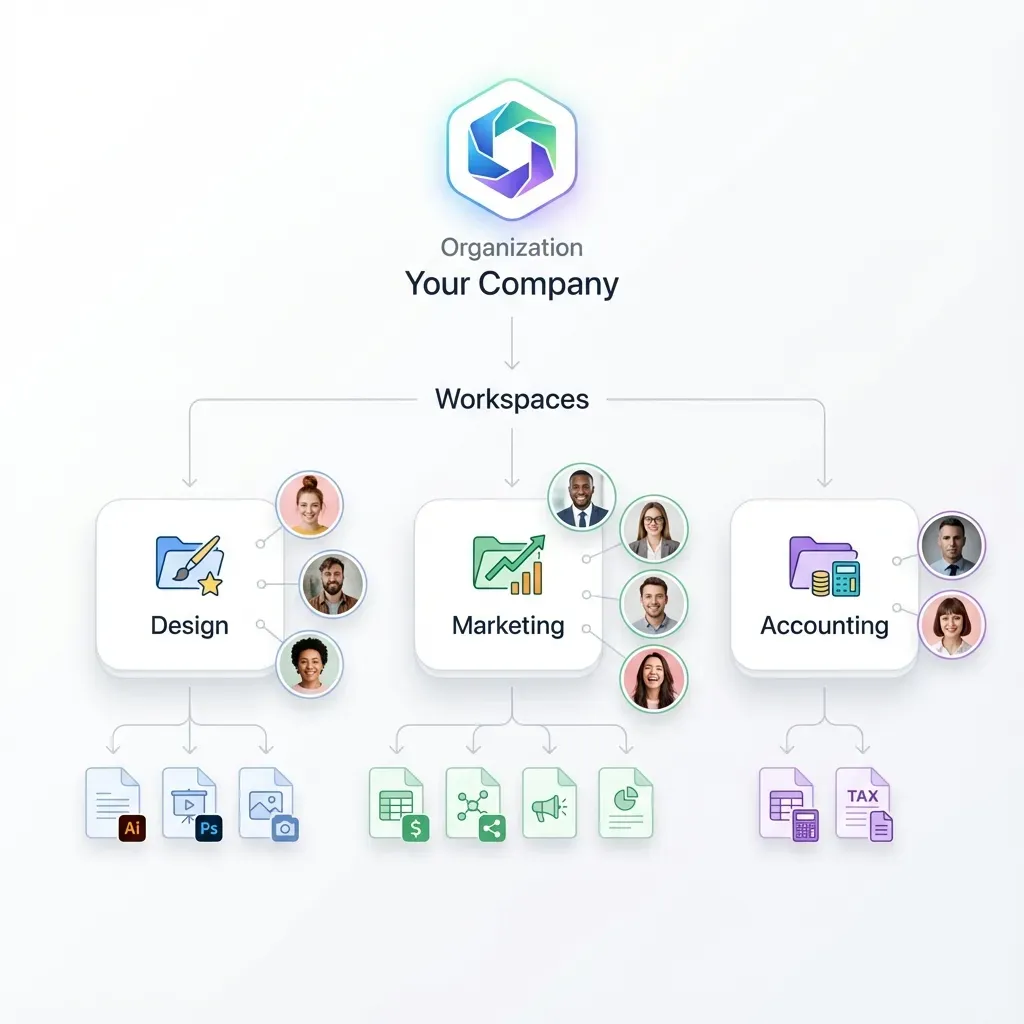
- Granular permissions at organization, workspace, folder, and file levels
- SSO/SAML integration (Okta, Azure AD, Google)
- Complete audit logs tracking views, downloads, permission changes
- Password protection and expiration dates for external shares
- Multi-factor authentication support
Best for: Teams building agentic AI workflows who need persistent storage that works across Claude, GPT-4, Gemini, LLaMA, and local models. Persistent workspaces make it practical to give each agent its own storage account.
Pricing: 14-day trial (credit card required), then plans from $9.99/mo with seats and storage included.

2. AWS S3 with IAM Policies - Infrastructure for ML Pipelines
AWS S3 remains the backbone of many ML infrastructure stacks, offering generous storage, server-side encryption, and fine-grained IAM policies that works alongside SageMaker, Lambda, and EC2. Key strengths:
- Massive scale - Store petabytes with 99.999999999% durability
- IAM integration - Define who can access what using role-based policies
- Lifecycle rules - Automatically archive old training runs to Glacier
- Versioning - Recover from accidental deletes or corrupted uploads
Security features:
- SSE-S3, SSE-KMS, or SSE-C encryption options
- Bucket policies and access control lists
- CloudTrail logging for audit trails
- VPC endpoints for private network access
Best for: Teams already on AWS who need storage integrated with their training pipelines. Works well when combined with SageMaker for end-to-end ML workflows.
Limitations: Requires DevOps expertise to configure correctly. Misconfigurations led to high-profile breaches (Capital One, Uber). No built-in file preview or collaboration features.
Pricing: Pay-per-use starting at $0.023/GB/month for S3 Standard, plus data transfer costs.
3. Google Cloud Storage - Best for Cloud-Native ML
For teams running ML workloads on Google Cloud, GCS is the natural choice, integrating directly with Vertex AI, BigQuery, and Colab notebooks.
Key strengths:
- Native Vertex AI integration - Training jobs read/write directly from buckets
- large file size limit - Handles even the largest foundation models
- Global edge caching - Low latency access from research offices worldwide
- Object lifecycle management - Auto-delete ephemeral experiment artifacts
Security features:
- Encryption at rest (Google-managed or customer-managed keys)
- IAM roles and service accounts for programmatic access
- Audit logs via Cloud Logging
- VPC Service Controls for data perimeter enforcement
Best for: Teams standardized on Google Cloud infrastructure who want smooth integration with BigQuery datasets and Colab notebooks.
Limitations: Like S3, requires infrastructure knowledge. Costs add up quickly for large datasets due to egress fees.
Pricing: Pay-per-use starting at $0.020/GB/month for Standard storage, plus egress charges.
4. Tresorit - Zero-Knowledge Encryption for Research Labs
Tresorit offers the strongest encryption model: zero-knowledge architecture where even Tresorit employees cannot decrypt your files. This makes it ideal for research labs handling pre-publication work or proprietary models.
Key strengths:
- Client-side encryption - Files encrypted on your device before upload
- Zero-knowledge architecture - Provider cannot access file contents
- DRM controls - Disable downloads or screenshots for shared files
- Detailed analytics - See who accessed files and for how long
Security features:
- AES-256 encryption
- End-to-end encrypted sharing links
- Two-factor authentication
- Remote wipe capabilities
Best for: Academic research labs or companies with strict IP protection requirements who need absolute certainty that cloud providers cannot access file contents.
Limitations: large file size limit makes it unusable for large model checkpoints. Expensive compared to cloud storage providers.
Pricing: Business plans are priced per user per month; see the vendor's pricing page.


Give Your AI Agents Persistent Storage
Fastio offers cloud storage built for AI teams. Consolidated MCP toolset. Built-in RAG once Intelligence is enabled. Start building agent workflows today.
5. Box with Advanced Security - Enterprise Collaboration
Box is an enterprise content management platform with strong security certifications and built-in AI features powered by OpenAI, Anthropic, and Google models.
Limitations: Per-user pricing becomes expensive at scale. large file limit (50GB on Enterprise Plus). Complex permission system has a learning curve.
Pricing: Business Plus requires a paid per-user subscription (see vendor pricing), with custom Enterprise pricing available. Security is not just about checking boxes on a features list. It requires encryption at rest and in transit, granular access controls, and comprehensive audit logging. Look for platforms that build security into the architecture rather than bolting it on as an afterthought.
Security is not just about checking boxes on a features list. It requires encryption at rest and in transit, granular access controls, and comprehensive audit logging. Look for platforms that build security into the architecture rather than bolting it on as an afterthought.
6. Hugging Face Hub - Purpose-Built for ML Artifacts
While not general-purpose storage, Hugging Face Hub deserves mention as the standard for sharing ML models and datasets within the AI research community.
Key strengths:
- Git-based versioning - Track model changes like code
- Dataset viewer - Preview parquet, CSV, and image datasets in browser
- Model cards - Document training data, architecture, and limitations
- Private repositories - Share within teams before public release
Security features:
- Access tokens with read/write scopes
- Private repos for proprietary models
- Organization-level team management
- Git-LFS for large file handling
Best for: Research teams who want to version control models alongside code and share work publicly or within organizations.
Limitations: Not suitable for general file storage. No encryption beyond HTTPS. Limited to ML artifacts (models, datasets, demos).
Pricing: Free for public repos, with paid subscription tiers for private repos and teams.
7. MASV - Certified for Large Dataset Transfers
Limitations: Expensive at scale ($0.25/GB). Focused on transfers, not long-term storage. No API for automation.
Pricing: Pay per GB transferred at $0.25/GB, volume discounts available. Transfer speed depends on more than just your internet connection. The platform architecture matters too: chunked uploads with automatic retry handle interruptions gracefully, while cloud-native storage eliminates the sync overhead that slows down traditional platforms. For large files, look for solutions that maintain speed regardless of file size.
Transfer speed depends on more than just your internet connection. The platform architecture matters too: chunked uploads with automatic retry handle interruptions gracefully, while cloud-native storage eliminates the sync overhead that slows down traditional platforms. For large files, look for solutions that maintain speed regardless of file size.
8. MinIO - Self-Hosted S3-Compatible Storage
MinIO is an S3-compatible object store you run on your own infrastructure, providing total control for on-premise AI workflows or air-gapped environments.
Key strengths:
- S3 API compatibility - Drop-in replacement for AWS S3
- Your infrastructure - Run on bare metal, VMs, or Kubernetes
- No egress fees - Pay only for hardware and bandwidth you control
- Active-active replication - Multi-site disaster recovery
Security features:
- Encryption at rest with KMS integration
- IAM-compatible identity management
- Versioning and object locking
- Network encryption via TLS
Best for: Organizations with strict data residency requirements, air-gapped research facilities, or teams wanting to avoid cloud vendor lock-in.
Limitations: You manage infrastructure, updates, and security patches. Requires dedicated DevOps resources.
Pricing: Free open-source software, but you pay for hardware, networking, and operations.

9. Databricks Delta Sharing - Secure Data Product Distribution
Databricks provides tools to share data and AI assets securely using Delta Sharing for direct data sharing, Marketplace for open data product distribution, and Clean Rooms for privacy-preserving collaboration.
Key strengths:
- Live data sharing - Recipients query your data without copying it
- Unity Catalog integration - Centralized governance across clouds
- Clean Rooms - Collaborate on joint datasets without exposing raw data
- Change data capture - Share only updated records, not full snapshots
Security features:
- Fine-grained access controls
- Audit logging of data access
- Privacy-preserving computation
- Cross-cloud sharing (AWS, Azure, GCP)
Best for: Organizations building data products or sharing curated datasets with external partners while maintaining governance and lineage.
Limitations: Requires Databricks infrastructure. Overkill for simple file transfers. Learning curve for Delta Sharing protocol.
Pricing: Custom enterprise pricing based on usage and deployment.
Comparison Summary
Choose based on your primary constraint: If budget is tight, start with Fastio's Business Trial or Hugging Face for public models. If compliance is mandatory, Box or MASV provide certifications. If you need absolute control, self-host MinIO.
Which Platform Should You Choose?
The right choice depends on your team's specific constraints and workflows.
For agentic AI development teams: Fastio offers the best balance of features for modern AI workflows. Persistent workspaces, remote MCP integration, and built-in RAG once Intelligence is enabled make it practical to give each agent its own storage account. Ownership transfer lets agents build complete data rooms and hand them off to human clients.
For AWS-native ML pipelines: Stick with S3 if your training jobs already run on SageMaker and you have DevOps expertise. The tight integration with AWS services outweighs the configuration complexity.
For Google Cloud teams: GCS is the obvious choice when using Vertex AI, BigQuery, or Colab. The native integration saves hours of data movement overhead.
For zero-trust research labs: Tresorit's zero-knowledge encryption provides mathematical certainty that your research stays private, even from the cloud provider. Accept the large file limit and higher cost as the price of absolute confidentiality.
For public model sharing: Hugging Face Hub is the standard for sharing models with the research community. Use it for open research while keeping sensitive work on private infrastructure.
For massive one-time transfers: MASV handles terabyte-scale dataset shipments with compliance documentation, but the per-GB pricing makes it impractical for routine storage.
For on-premise requirements: MinIO gives you S3-compatible storage you control completely, ideal for air-gapped labs or strict data residency rules.
For governed data products: Databricks Delta Sharing lets you share curated datasets with external partners while maintaining centralized governance and audit trails. Most teams end up using multiple solutions: S3 for long-term training data storage, Fastio for agent collaboration and client deliverables, and Hugging Face for public model releases. The key is matching each tool to its strengths.
Sources
References used to verify factual claims in this guide.
-
Over 40% of data breaches involve insider threats or accidental exposure
-
Files should be encrypted with AES-256 during storage and TLS 1.3 during transfer
-
Model checkpoints over 10GB
-
Fastio offers shared workspaces and remote MCP access for AI teams Fastio cloud storage designed for AI teams and autonomous agents with persistent workspaces and MCP access Fastio MCP integration with built-in RAG and persistent agent workspaces
-
Fastio provides a consolidated MCP toolset for AI agents across Claude GPT-4 Gemini and local models Teams building agentic workflows persistent storage works across Claude GPT-4 Gemini LLaMA local models
-
AWS S3 massive scale petabytes 99.999999999% durability
-
AWS S3 pay-per-use $0.023/GB/month Standard data transfer costs AWS S3 GCS charge per GB stored bandwidth typically $0.02-0.03/GB/month AWS S3 pricing pay-per-use starting storage Standard plus data transfer costs
-
Google Cloud Storage $0.020/GB/month Standard storage egress charges GCS Standard storage $0.020/GB/month plus egress charges pricing
-
Box large file limit 50GB Enterprise Plus
-
MASV pay per GB transferred $0.25/GB volume discounts large dataset transfers MASV expensive scale $0.25/GB focused transfers dataset MASV pricing transferred volume discounts available per GB
-
Cloud object storage S3 GCS MinIO handles files up to 5TB
-
Dropbox caps 2TB per file Box 15-50GB Tresorit 10GB
-
Fastio offers generous storage and flat plans with seats included for agentic teams
-
Every platform supports AES-256 encryption and TLS for secure transfers
-
MASV AES-256 large dataset transfers $0.25/GB unlimited
-
Server-side AES-256 encryption granular IAM policies workspace-level permissions
-
TLS 1.3 transfers enable audit logging security
-
Research labs startups strong security features AES-256 encryption audit logs access controls certifications
-
Prioritize encryption rest transit AES-256 TLS 1.3 granular access controls file level audit logs programmatic permissions
Frequently Asked Questions
How do AI teams securely share files?
AI teams use encrypted file sharing platforms with API access, granular permissions, and large file support. Most teams combine cloud object storage (S3, GCS) for training data with collaboration platforms (Fastio, Box) for model deliverables and client work. The best solutions offer encryption at rest and in transit, detailed audit logs, and programmatic access for automated ML pipelines.
What is the highly secure way to share ML datasets?
The highly secure approach uses zero-knowledge encryption where files are encrypted on your device before upload, ensuring the storage provider cannot decrypt them. Tresorit and Proton Drive offer this model. For teams needing API access, combine server-side AES-256 encryption with granular IAM policies (AWS S3, GCS) or workspace-level permissions (Fastio). Always use TLS 1.3 for transfers and enable audit logging.
How do you protect AI model files when sharing?
Protect model weights by combining encryption, access controls, and audit trails. Use platforms that support file-level permissions so you can share training data with contractors while restricting model checkpoint access to core team members. Enable versioning to recover from accidental overwrites. Add watermarking or download restrictions for highly sensitive models. Fastio's ownership transfer feature lets agents build workspaces and transfer them to humans while maintaining admin access.
What file sharing tools do AI companies use?
Most AI companies use a combination: AWS S3 or Google Cloud Storage for training data and model storage, Hugging Face Hub for versioning and sharing models within the research community, and collaboration platforms like Fastio or Box for client deliverables and external sharing. The specific mix depends on cloud provider, compliance requirements, and whether the team builds agentic systems.
Do small teams need certifications or strong security features?
For research labs or startups, strong security features (AES-256 encryption, audit logs, access controls) matter more than certifications.
Can AI agents access secure file storage programmatically?
Yes. Modern platforms offer REST APIs for programmatic file operations. Fastio provides a consolidated MCP toolset specifically designed for AI agents, with persistent workspaces and support for Claude, GPT-4, Gemini, and local models. AWS S3 and Google Cloud Storage offer comprehensive APIs but require more infrastructure setup. Hugging Face Hub supports Git-based access and Python libraries for model and dataset management.
What's the maximum file size for AI model storage?
Cloud object storage (S3, GCS, MinIO) handles files up to 5TB. Traditional file sharing services have much lower limits: Dropbox caps at 2TB per file, Box at 15-50GB, Tresorit at 10GB. For AI teams, use cloud object storage for large model checkpoints and training datasets, reserving collaboration platforms for smaller deliverables and documentation.
How much does secure file sharing for AI teams cost?
Costs vary widely. AWS S3 and GCS charge per GB stored plus bandwidth, typically $0.02-0.03/GB/month. Box charges per user monthly. MASV charges $0.25 per GB transferred.
What security features matter most for ML model sharing?
Prioritize encryption at rest and in transit (AES-256, TLS 1.3), granular access controls that work at the file level, complete audit logs showing who accessed what and when, and API support for programmatic permissions. Versioning prevents accidental overwrites. For teams building agentic systems, granular permissions, file version history, and audit logging track changes and prevent concurrent conflicts.
Can multiple AI agents access the same files simultaneously?
Yes, when using platforms with advisory file locking and version history. Fastio lets agents acquire per-file advisory leases via MCP storage actions (lock-acquire, lock-status, lock-release) before writing. Other agents receive an HTTP 409 and can wait, while full version history keeps every write safe.
Related Resources

Give Your AI Agents Persistent Storage
Fastio offers cloud storage built for AI teams. Consolidated MCP toolset. Built-in RAG once Intelligence is enabled. Start building agent workflows today.