Best Secret Management Tools for AI Agents
AI agents need API keys, database credentials, and service tokens to do their work. Hardcoding those secrets into agent code is a well-documented path to credential leaks and security breaches. This guide compares seven secret management tools that solve the problem, with a focus on how each one integrates with agent frameworks like LangChain and CrewAI.


Why AI Agents Make Secret Management Harder
Traditional applications have a predictable relationship with credentials. A web server loads its database password at startup and uses it until the process restarts. AI agents break that pattern in several ways.
First, agents are autonomous. They decide which tools to call at runtime, which means they need access to credentials for services they might not use in every run. A coding agent might need GitHub tokens, cloud provider keys, and LLM API keys all in a single session.
Second, agents are vulnerable to prompt injection. A December 2025 vulnerability in LangChain Core (CVE-2025-68664, CVSS 9.3) demonstrated this: an attacker could inject prompts that triggered LangChain's serialization system to dump environment variables, exposing every secret stored there. The attack worked because the agent had direct access to raw credentials in its runtime environment.
Third, agents scale differently. When you run 50 concurrent agent instances processing a backlog of tasks, each instance needs credentials. Static API keys shared across all instances create a blast radius problem: one compromised instance exposes every service the agent can reach.
The numbers back this up. GitGuardian found that a typical company with 400 developers discovers over 1,000 unique leaked secrets when scanning its repositories for the first time. Truffle Security identified nearly 12,000 live secrets in Common Crawl's web dataset, with 63% of keys reused across domains. AI agents amplify these risks because they generate and consume credentials programmatically, often without human review.
Related guides
- Best Guardrails Tools for AI Agents in 2026AI guardrails are validation layers that sit between the LLM and the application to prevent hallucinations, block...
- Best AI Agent Security Tools in 2026Autonomous AI agents introduce new attack vectors like prompt injection, unauthorized actions, and data exfiltration....
- How to Manage AI Agent Secrets and API CredentialsAI agent secrets management is about securely storing, rotating, and accessing API keys and tokens that autonomous...
- How to Configure AI Agent Granular PermissionsGranular permissions are the defense layer between an autonomous AI agent and your sensitive data. With identity...
- How to Build an AI Agent Credential VaultAn AI agent credential vault is a specialized security system designed to manage, rotate, and inject secrets for...
- Dynamic Secrets for AI Agents: How to Implement Runtime Injection and RotationStatic credentials are a major liability for automated systems, especially for agents with broad permissions. This...
More on this subject: Agent Security and Governance (65 guides)
How We Evaluated These Tools
We compared each tool across five dimensions that matter specifically for AI agent deployments:
- Dynamic secret generation: Can the tool create short-lived, scoped credentials on demand rather than storing static keys?
- Agent framework integration: Does it work with LangChain, CrewAI, AutoGPT, or similar orchestration frameworks? Are there SDKs for Python, Go, and JavaScript?
- Credential injection architecture: Can secrets be injected at runtime without the agent process ever holding the raw credential?
- Rotation and expiry: Does it support automatic rotation, and can you set TTLs (time-to-live) on generated credentials?
- Audit and access control: Can you see which agent accessed which secret, when, and enforce least-privilege policies?
Pricing is noted for each tool, but we focused on the free tier and small-team plans since many agent projects start as experiments before scaling.
The 7 Best Secret Management Tools for AI Agents
1. HashiCorp Vault
Vault is the most established secrets management platform, and its dynamic secrets engine is what sets it apart for agent workloads. Instead of storing a database password, Vault generates a temporary credential with a 1-hour TTL when your agent requests access. When the TTL expires, the credential is automatically revoked.
Key strengths:
- Dynamic secrets for AWS, databases, SSH, PKI, and dozens of other backends
- Fine-grained ACL policies that can scope credentials per agent role
- AppRole and Kubernetes auth methods work well for automated agent deployments
- Self-hosted or HCP (HashiCorp Cloud Platform) managed option
Limitations:
- Steep learning curve with substantial setup and policy configuration time
- BSL license (no longer open source as of August 2023)
- Operational overhead for self-hosted deployments: unsealing, HA configuration, storage backend management
Best for: Teams running agents in production at scale who need dynamic, short-lived credentials with granular access policies.
Pricing: Open source (BSL) for self-hosted. HCP Vault starts with a free tier (25 secrets), with paid plans scaling by client count and secret operations.
2. Infisical
Infisical is the most popular open-source secrets manager on GitHub (over 12,700 stars, MIT license). It covers the full lifecycle: encrypted storage with version control, rotation, syncing to infrastructure, and secret scanning to catch leaks before they ship.
For AI agents specifically, Infisical added MCP endpoint governance, letting you control how agents access tools and external systems through centralized policy enforcement.
Key strengths:
- MIT-licensed and self-hostable with a generous cloud free tier
- Native integrations with 35+ destinations including AWS Parameter Store, Kubernetes, Vercel, and Terraform Cloud
- Dynamic secrets with just-in-time access and approval workflows
- Secret scanning and leak prevention built in
- Python, Node.js, and Go SDKs for direct agent integration
Limitations:
- Dynamic secrets support covers fewer backends than Vault
- Enterprise features (SAML SSO, audit log streaming) require paid plans
Best for: Developer teams who want an open-source-first approach with modern UX and solid SDK support for Python-based agent frameworks.
Pricing: Free for up to 5 team members with unlimited secrets. Team plan at $6/member/month. Enterprise pricing is custom.
3. Doppler
Doppler takes a developer-experience-first approach. Where Vault requires you to understand policy syntax and auth backends, Doppler gives you a dashboard where you organize secrets by project and environment (development, staging, production), then sync them to wherever your agents run.
Key strengths:
- Fastest setup time of any tool on this list, from signup to injected secrets in under 10 minutes
- Automatic syncing to AWS, GCP, Azure, Kubernetes, Vercel, and CI/CD pipelines
- Change requests with review and approval workflows
- Secret referencing to reduce duplication across environments
- CLI that wraps any process:
doppler run -- python agent.pyinjects secrets as environment variables
Limitations:
- Closed source with no self-hosted option
- No dynamic secret generation, so you handle rotation schedules yourself or use their automated rotation for supported credential types
Best for: Small to mid-size teams who want a managed solution with minimal setup. Works well when your agents run as Python scripts that read environment variables.
Pricing: Free for up to 3 users with unlimited secrets. Team plan at $21/user/month. Enterprise pricing available.


Give Your Agents a Persistent Workspace
Secret management handles credentials. Fastio handles everything after. Get versioned, auditable storage with MCP-native access for your AI agents.
More Top Picks and the Workspace Layer
4. Akeyless
Akeyless uses a cryptographic approach called Distributed Fragment Cryptography, where the encryption key is split into fragments that never exist in the same location. This eliminates the single root key that Vault requires you to protect and unseal.
Key strengths:
- SaaS-native with no infrastructure to manage and no unsealing ceremony
- Universal Secrets Connector manages secrets across AWS, Azure, GCP, Kubernetes, and existing HashiCorp Vault instances from one interface
- Dynamic secrets and automatic rotation for databases and cloud providers
- Built-in secure remote access and certificate management
Limitations:
- Smaller community and ecosystem compared to Vault or Infisical
- Usage-based pricing model tied to clients, secrets, and transactions can be hard to predict
Best for: Teams running agents across clouds who want a managed platform without the operational burden of self-hosting Vault.
Pricing: Starts at $40/month for 4 clients and 50 secrets. Enterprise pricing is custom.
5. 1Password Unified Access
1Password launched Unified Access in early 2026, specifically targeting the AI agent credential problem. The platform provides SDKs (Python, Go, JavaScript) that let agents read, write, share, and rotate secrets at runtime through 1Password vaults.
The standout feature is just-in-time credential delivery. Rather than handing an agent a long-lived API key, Unified Access evaluates the access request in context and provides credentials only when needed. This pairs with TOTP (time-based one-time password) support, so agents can complete MFA flows without human intervention.
1Password is collaborating with Anthropic, Cursor, GitHub, Perplexity, and Vercel on agent security integrations.
Key strengths:
- Just-in-time credential injection where the agent never holds persistent secrets
- SDKs for Python, Go, and JavaScript with service account scoping
- TOTP support for automated MFA in agent workflows
- Active partnerships with major AI agent platforms
Limitations:
- Newer to the secrets-for-agents space, with the SDK still evolving
- Requires 1Password business subscription for service accounts
- No self-hosted option
Best for: Teams already using 1Password who want to extend their existing credential infrastructure to AI agents without adopting a separate tool.
Pricing: Business plan at $7.99/user/month includes service accounts. Enterprise pricing available.
6. AWS Secrets Manager
If your agents run on AWS infrastructure, Secrets Manager offers the path of least resistance. It integrates natively with IAM roles, Lambda, ECS, and EKS, so your agents inherit credential access through their execution environment rather than managing API keys directly.
Key strengths:
- Native integration with AWS services where Lambda functions and ECS tasks access secrets through IAM roles without credential management code
- Automatic rotation for RDS, Redshift, and DocumentDB credentials out of the box
- Multi-region secret replication for disaster recovery
- Cross-account sharing for multi-account setups
Limitations:
- AWS-only scope. If your agents call services outside AWS, you still need another solution for those credentials
- Pricing based on API calls can surprise you at scale ($0.05 per 10,000 API calls plus $0.40/secret/month)
- No built-in secret scanning or leak prevention
Best for: AWS-native teams running agents on Lambda, ECS, or EKS who want zero-setup credential management within the AWS ecosystem.
Pricing: $0.40 per secret per month plus $0.05 per 10,000 API calls.
7. Fastio (Agent Workspace with Built-in Audit)
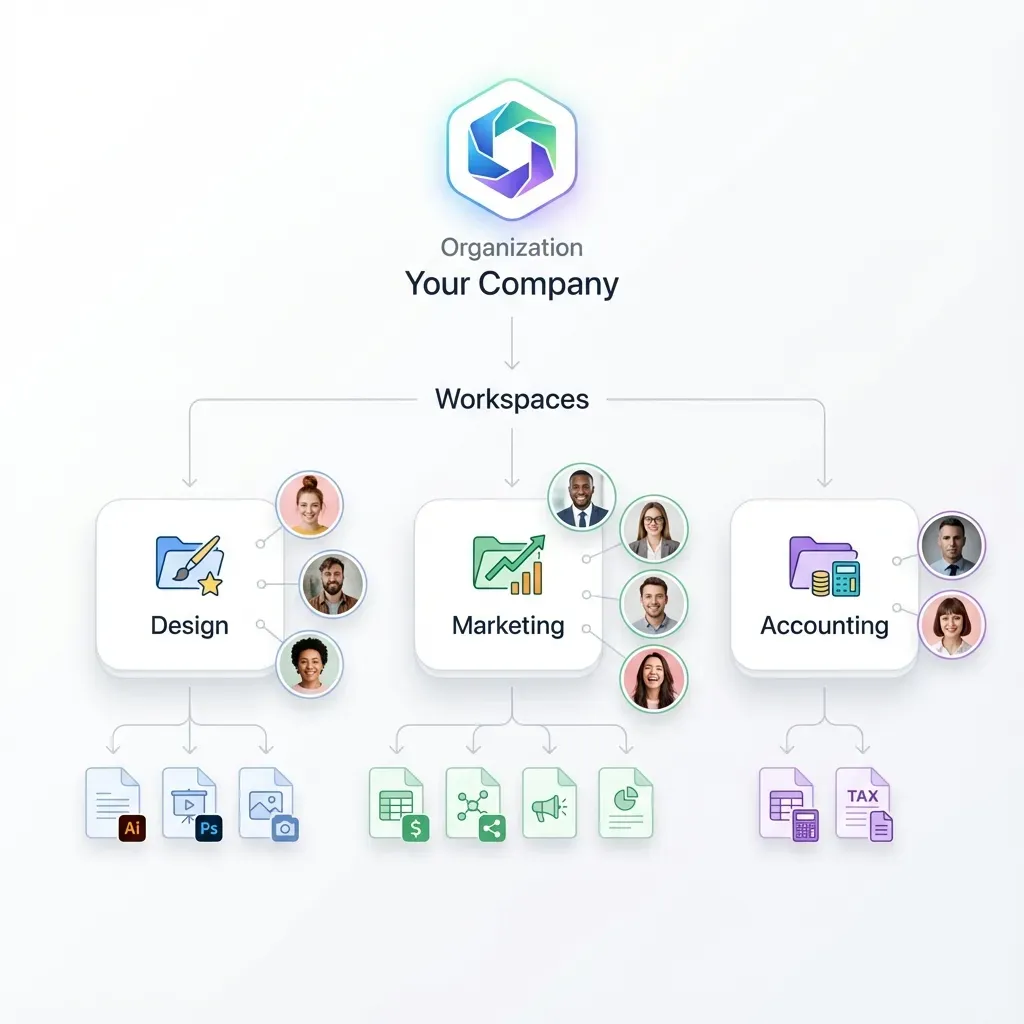
Fastio approaches the problem from a different angle. Rather than being a dedicated secrets vault, it is an intelligent workspace for AI agents that handles credential-adjacent concerns: audit trails, granular permissions, file versioning, and ownership transfer. Agents use the Fastio API or MCP server to manage files and collaborate with humans in shared workspaces.
Where Fastio fits in a secrets management stack: your agents use Vault, Doppler, or Infisical for credential storage, and Fastio for everything that happens after authentication. Agent output goes into versioned workspaces with full audit logs tracking which agent wrote what and when. When the work is done, ownership transfers to a human through a claim link.
Key strengths:
- MCP-native access with a consolidated MCP toolset for workspace, storage, and intelligence operations
- Built-in Intelligence Mode with automatic RAG indexing, no separate vector database needed
- Granular permissions at org, workspace, folder, and file levels with audit trails
- Ownership transfer: agent builds the workspace, human receives it
- Advisory file locks (acquire, heartbeat, release) to coordinate concurrent multi-agent writes, backed by version history
Limitations:
- Not a secrets vault. You still need a dedicated tool for credential storage and rotation
- Focused on file and workspace operations, not credential lifecycle management
Best for: Teams that have secrets management handled and need a persistent, auditable workspace where agents store their output and collaborate with humans.
Pricing: A 14-day Business Trial, card required; see /pricing/. Paid plans start with Starter at $9.99/mo.

Integrating Secret Management with Agent Frameworks
The gap that most articles miss is the practical wiring: how do you connect a secrets manager to your agent code? Here are patterns that work across popular frameworks.
Environment variable injection (works with any framework):
The simplest pattern works with Doppler, Infisical, and most other tools. Wrap your agent process so secrets are injected as environment variables at startup:
doppler run -- python my_agent.py
# or
infisical run -- python my_agent.py
Your agent code reads os.environ["OPENAI_API_KEY"] without ever seeing where the value came from. This works with LangChain, CrewAI, AutoGPT, and any Python agent.
SDK-based retrieval (for dynamic secrets):
When you need short-lived credentials, use the secrets manager's SDK directly:
import hvac  # HashiCorp Vault client

client = hvac.Client(url="https://vault.example.com")
creds = client.secrets.database.generate_credentials(
    name="agent-db-role"
)
db_user = creds["data"]["username"]
db_pass = creds["data"]["password"]
# These credentials auto-expire after the configured TTL
Credential injection layer (recommended for production):
The most secure pattern keeps credentials out of the agent process entirely. A sidecar or middleware handles authentication, and the agent makes requests through it. The agent never sees raw API keys, which neutralizes prompt injection as a credential theft vector.
This is the architecture that 1Password Unified Access and Aembit promote. Your agent calls an internal endpoint, the injection layer authenticates on its behalf, and the response flows back. If an attacker tricks the agent into dumping its environment, there are no credentials to find.
A note on the LangChain vulnerability: The December 2025 CVE-2025-68664 in langchain-core allowed attackers to extract environment variables through serialization injection. LangChain patched this by setting secrets_from_env to False by default and blocking Jinja2 templates. If you are using LangChain, update to the patched version and consider a credential injection architecture that keeps secrets out of the agent's environment entirely.
Which Tool Should You Choose?
Start with your constraints, not the feature list.
If your agents run on AWS and you want minimal setup, use AWS Secrets Manager. IAM role-based access means your Lambda functions and ECS tasks get credentials without any secrets management code.
If you want open source and self-hosting, use Infisical. The MIT license, strong SDK support, and modern developer experience make it the best starting point for teams building Python-based agents.
If you need dynamic secrets at enterprise scale, use HashiCorp Vault. The learning curve is real, but no other tool matches its breadth of secret backends and policy engine.
If you want the fastest path from zero to working, use Doppler. The CLI wrapper (doppler run --) works with any agent framework and takes minutes to configure.
If you already use 1Password, extend it with Unified Access. The just-in-time credential delivery and TOTP support are purpose-built for agent workflows.
If you need a workspace where agents store and share their output, add Fastio alongside your secrets tool. The 14-day Business Trial gives you versioned, auditable storage with MCP-native access, and agents and humans share the same intelligence layer.
Most production agent deployments combine two tools: a secrets manager (Vault, Infisical, or Doppler) for credential lifecycle, and a workspace platform like Fastio for everything agents produce after they authenticate.
Sources
References used to verify factual claims in this guide.
-
GitGuardian found that a typical company with 400 developers discovers over 1,000 unique leaked secrets when scanning repositories
-
Truffle Security identified nearly 12,000 live secrets in Common Crawl's dataset, with 63% of keys reused across domains
-
LangChain Core vulnerability CVE-2025-68664 with CVSS score 9.3
-
1Password launched Unified Access in early 2026 with partnerships including Anthropic, Cursor, GitHub, Perplexity, and Vercel
-
Infisical has over 12,700 GitHub stars and MIT license
Frequently Asked Questions
How do I securely store API keys for my AI agent?
Use a secrets manager like HashiCorp Vault, Infisical, or Doppler to store keys outside your codebase. Inject them at runtime through environment variables or SDK calls. Never hardcode keys in agent source code or configuration files. For production deployments, use a credential injection architecture where the agent process never holds raw credentials.
What is the best way to manage secrets in Python agents?
The simplest approach is CLI-based injection: tools like Doppler and Infisical wrap your Python process and inject secrets as environment variables. For dynamic secrets, use the HashiCorp Vault Python client (hvac) or Infisical's Python SDK to generate short-lived credentials at runtime. Both approaches work with LangChain, CrewAI, and other Python agent frameworks.
What are dynamic secrets and why do they matter for agents?
Dynamic secrets are credentials generated on demand with a built-in expiration time. Instead of storing a permanent database password, the secrets manager creates a temporary credential that auto-revokes after a set period, such as one hour. This limits the blast radius if an agent is compromised, since the stolen credential expires quickly.
Can AI agents be tricked into leaking their credentials?
Yes. Prompt injection attacks can coerce agents into revealing environment variables or configuration data. The December 2025 LangChain vulnerability (CVE-2025-68664) demonstrated this risk. The mitigation is a credential injection architecture where secrets are handled by a sidecar or middleware layer, so the agent process has no credentials to leak even if compromised.
Do I need a paid secrets manager for a small agent project?
Not necessarily. Infisical offers a free tier for up to 5 team members with unlimited secrets. Doppler is free for up to 3 users. AWS Secrets Manager charges per secret and API call but has no minimum commitment. For personal projects, environment variables loaded from a .env file (excluded from version control) can work, though you lose rotation, auditing, and access control.
Related Resources

Give Your Agents a Persistent Workspace
Secret management handles credentials. Fastio handles everything after. Get versioned, auditable storage with MCP-native access for your AI agents.