10 Best Platforms for Scaling AI Agent Fleets
Platforms manage AI agent fleets from 1 to 1000+ concurrent agents. Production scaling often fails due to state management, collaboration gaps, or infrastructure limits. Top platforms stack up on scalability, multi-tenancy, pricing, and shared workspaces for human-agent teams like Fastio.


What Makes a Platform Great for AI Agent Scaling?
To scale AI agents, you need concurrent execution, persistent state, workflow orchestration, monitoring, and multi-tenancy. Look for distributed compute, tool integrations, and human collaboration.
Poor state management is a major cause of production issues. Most competitors lack multi-tenant workspaces. Rankings based on concurrency (1000+ agents), multi-tenancy, pricing, ease of deployment, observability, and human-agent collaboration.
Define clear tool contracts and fallback behavior so agents fail safely when dependencies are unavailable. This improves reliability in production workflows.
Key Metrics
- Concurrency: 1000+ agents
- State: Persistent memory across runs
- Tools: MCP/API integrations
- Cost: Pay-per-use, free tiers
- Collab: Multi-tenant workspaces
Related guides
- Top AI Agent Scaling Platforms Ranked for 2026AI agent scaling platforms handle load balancing, state sync, and auto-scaling for fleets of agents. These tools let...
- Best AI Agent Hosting Platforms in 2026AI agent hosting platforms provide compute, storage, and orchestration for deploying autonomous agents in production....
- Best Self-Hosted AI Agent Platforms (2026 Guide)Self-hosted AI agent platforms let teams run agents on their own infrastructure, keeping data on-premise and avoiding...
- Best Serverless GPU Providers for AI Agents and Scaling WorkflowsServerless GPU platforms let developers run compute-intensive AI workloads like model fine-tuning or inference without...
- Top 10 AI Agent Infrastructure Platforms in 2026AI agent infrastructure platforms build backends for multi-agent systems. The market is expected to grow from $7.63...
- Top LLM Agent Hosting Platforms ReviewedDiscover the top LLM agent hosting platforms that handle inference, tools, and state for production language model...
More on this subject: Agent Infrastructure and Deployment (55 guides)
Platform Comparison Table



Give Your AI Agents Persistent Storage
Fastio gives teams shared workspaces, MCP tools, and searchable file context to run best platforms for ai agent scaling workflows with reliable agent and human handoffs.
1. Ray
Ray is a distributed computing framework for scaling Python apps and ML workloads.
Pros:
- Handles 10k+ GPUs
- Ray Serve for model deployment
- OSS with Anyscale managed
Cons:
- Steep learning curve
- Heavy infrastructure, no built-in collaboration
Best for: High-compute agent fleets. Pricing: OSS free, Anyscale pay-per-use.
Example: Training a large language model across a GPU cluster. Constraint: Requires managing the underlying cluster infrastructure. Outcome: Reduced training time from weeks to days.
2. Modal
Modal provides serverless GPU compute for AI apps.
Pros:
- Sub-second cold starts
- Multi-cloud GPUs
- Python-native
Cons:
- Compute-focused, limited orchestration
Best for: Inference/batch scaling. Modal's serverless GPUs handle bursty ML workloads without DevOps overhead. Pricing: Usage-based GPUs.
Example: Deploying a Whisper transcription API that scales to zero. Constraint: Cold starts can still impact real-time latency slightly. Outcome: Zero infrastructure cost when no requests are active.
3. CrewAI
CrewAI handles multi-agent orchestration.
Pros:
- Role-based agents
- Simple workflows
- Enterprise support
Cons:
- New platform
- Scales with cloud plans
Best for: Agent teams working together. YAML configs enable quick setup of multi-agent crews. Pricing: OSS free, paid plans available.
Example: A team of agents researching and writing blog posts automatically. Constraint: Managing context window limits across multiple agents. Outcome: Automated content pipeline producing drafts daily.
4. LangSmith
LangSmith traces and deploys LangChain agents.
Pros:
- Strong observability
- Easy deployment
- Works with LangChain
Cons:
- Ties you to their ecosystem
- LangChain only
Best for: LangChain users. Playground for testing chains before scaling. Pricing: Usage-based.
Example: Tracing a RAG pipeline to identify retrieval bottlenecks. Constraint: Best suited for the LangChain ecosystem. Outcome: Improved retrieval accuracy by pinpointing failed queries.
5. Helicone
Helicone offers LLM observability and caching.
Pros:
- Cuts costs
- Prompt caching
- Good analytics
Cons:
- LLM focus, no full orchestration
Best for: Controlling scaling costs. Proxy integration reduces LLM expenses across providers. Pricing: Free tier (Hobby), Pro $79/mo.
Example: Caching frequent identical queries to an LLM. Constraint: Requires routing all traffic through Helicone's proxy. Outcome: Reduced OpenAI bills through caching.
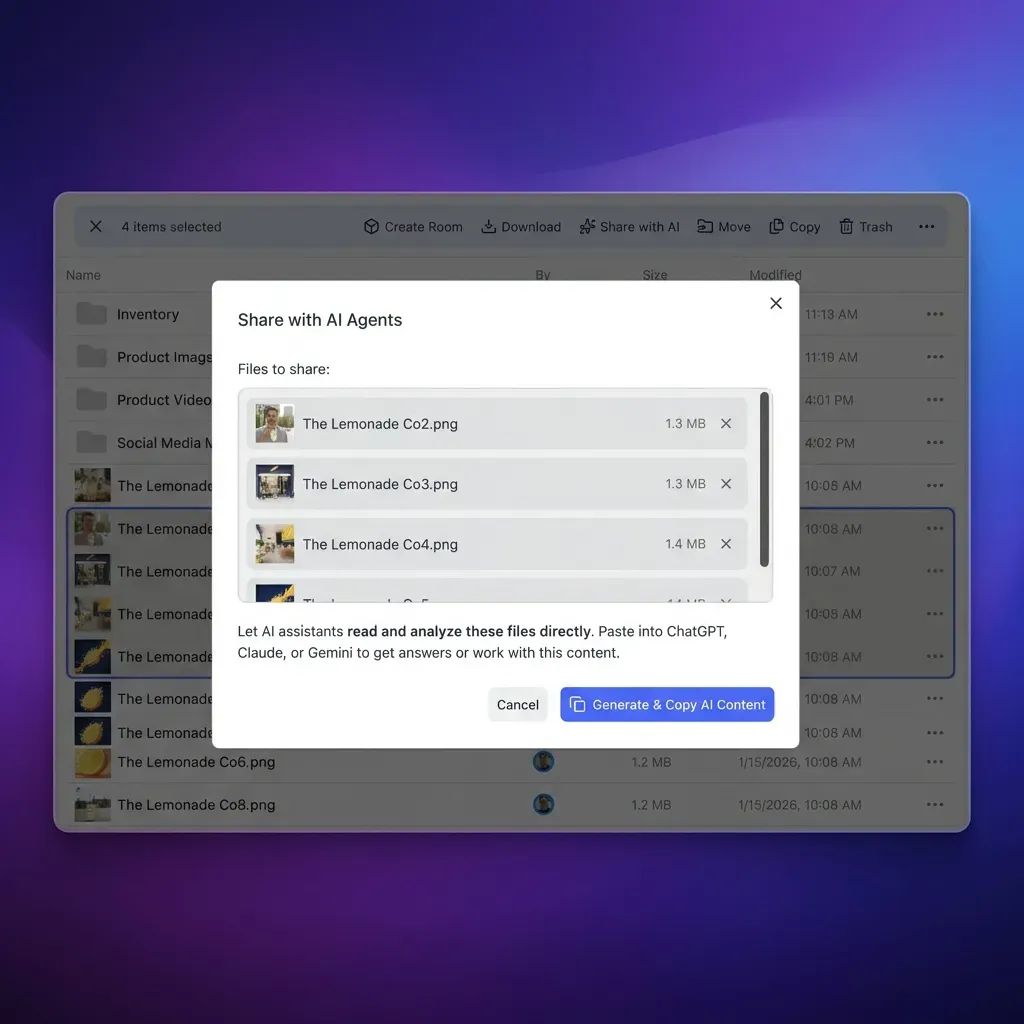
6. Fastio
Fastio provides multi-tenant workspaces for agent fleets.
Pros:
- Shared multi-tenant workspaces
- Consolidated MCP toolset (Streamable HTTP/SSE)
- Plan-included storage, seats, and monthly credits
- RAG, ownership transfer, advisory file locks, and version history
- Human-agent collaboration
Cons:
- Emphasizes storage/workspaces over raw compute
Best for: Fleets that need ongoing collaboration workspaces. Pricing: Plans from $9.99/mo (3 seats, 250 GB, 100k credits). Credits meter AI work, while storage and seats come with the plan.
Example: Agents sharing a persistent file system for long-running research tasks. Constraint: an organization needs a card and either a 14-day trial or a subscription. Outcome: Agents can resume work after interruptions without data loss.

7. Phoenix (Arize)
Phoenix specializes in agent observability.
Pros:
- Evaluations and metrics
- Data visualization
Cons:
- Monitoring only
Best for: Monitoring after deployment. Rich eval metrics and visualizations for agent performance. Pricing: Usage-based.
Example: Monitoring RAG retrieval quality in production. Constraint: Primarily focuses on evaluation metrics rather than orchestration. Outcome: Detected and fixed a drift in answer relevance.
8. Langfuse
Open-source tracing for LLM apps.
Pros:
- OSS or self-host
- Detailed tracing
Cons:
- You manage infrastructure
Best for: Custom tracing setups. Self-hosting ensures data sovereignty for sensitive apps. Pricing: Usage-based.
Example: Self-hosting traces for a healthcare AI app to ensure data privacy. Constraint: Requires managing your own Docker deployment. Outcome: Full visibility into agent reasoning without data leaving your VPC.
9. Dify
No-code platform for building agents.
Pros:
- Visual workflow builder
Cons:
- Scaling limitations
Best for: Teams without developers. Visual builders speed up agent prototyping . Pricing: $59/mo.
Example: Building a customer support bot with a visual drag-and-drop interface. Constraint: Less flexibility than code-based frameworks. Outcome: Deployed a working bot in hours instead of weeks.
10. Vercel AI
Deploys agents at the edge.
Pros:
- Quick deployments
Cons:
- Geared toward web apps
Best for: Frontend-focused agents. Next.js integration enables fast edge-deployed agents. Pricing: $20/mo Pro.
Example: Streaming an LLM response to a Next.js frontend. Constraint: Serverless function timeouts for long-running agents. Outcome: Instant UI feedback for users.
AI Agent Scaling Checklist
- Check observability needs (LangSmith, Helicone)
- Pick infrastructure (Ray, Modal)
- Orchestrate agents (CrewAI)
- Add RAG and workspaces (Fastio)
- Monitor costs (scaling often fails)
- Enable human-agent collaboration
- Test in production Follow this checklist to build scalable agent systems that integrate human collaboration effectively.
Capture these lessons in a shared runbook so new contributors can follow the same process. Consistency reduces regression risk and makes troubleshooting faster.
Sources
References used to verify factual claims in this guide.
-
Platforms manage AI agent fleets from 1 to 1000+ concurrent agents Fastio plans start at $9.99/mo with 3 seats, 250 GB of storage, and 100,000 monthly credits Fastio provides a consolidated MCP toolset for agent file operations
-
Ray handles 10k+ GPUs for distributed compute
-
Vercel AI deployment free tier $20/mo Pro edge deployment
-
Helicone free tier (Hobby) Pro $79/mo pricing
-
Dify pricing starts at $59/mo
-
Fastio multi-tenant workspaces for agents with a consolidated MCP toolset and plan-included storage
Frequently Asked Questions
Best platforms for AI agent scaling?
Ray for raw compute power, Fastio for workspaces, CrewAI for orchestration, Modal for serverless setups. Choose based on your concurrency and multi-tenancy needs.
What is horizontal scaling for agents?
Spreading agents across machines for more concurrency. Ray and Modal do this well. Fastio adds shared workspaces on top.
How does Fastio support agent scaling?
Multi-tenant workspaces for agent fleets, a consolidated MCP toolset, plan-included storage and credits, built-in RAG, advisory file locks, and version history with audit logging for smooth collaboration.
Free tiers for agent scaling?
Ray and Modal offer open-source free versions, and most others run trials. Fastio's monthly plans start with a trial of up to 14 days (credit card required); annual plans have no trial. Plans are Starter at $9.99/mo, Business at $49.99/mo, and Enterprise at $199.99/mo.
Common scaling pitfalls?
State loss between runs, no team collaboration (fails many projects), getting locked into one vendor. Tools with persistent workspaces like Fastio help.
Related Resources

Give Your AI Agents Persistent Storage
Fastio gives teams shared workspaces, MCP tools, and searchable file context to run best platforms for ai agent scaling workflows with reliable agent and human handoffs.