10 Best MCP Servers for AI Agents in 2026
Model Context Protocol (MCP) servers connect AI models to real tools and data. They give agents access to file systems, databases, and APIs through a standard interface. We've tested and ranked the best MCP servers available today.


What Are MCP Servers?
MCP servers are specialized endpoints that provide AI agents with structured access to tools, data sources, and external services through the Model Context Protocol. They're API wrappers designed for Large Language Models (LLMs). Instead of writing custom integration code for every tool, you install an MCP server that exposes that tool's capabilities in a standardized format. According to recent industry data, MCP adoption has grown rapidly, with numerous servers now available in public registries. This standardization means a single agent can now easily connect to databases, file systems, and SaaS platforms simultaneously. The features that matter most depend on your specific use case. Rather than chasing the longest feature list, focus on the capabilities that directly impact your daily workflow. A well-executed core feature set beats a bloated platform where nothing works particularly well.
Helpful references: Fastio Workspaces, Fastio Collaboration, and Fastio AI.
Related guides
- Top 7 Open Source MCP Servers for AI Agents in 2026Open source MCP servers give AI agents direct access to files, databases, and APIs without black-box proprietary...
- Best MCP Servers for LLM Workflows in 2026Model Context Protocol servers give LLMs standardized access to tools, data, and services. With over 10,000 public...
- Best MCP Servers for Search: Connecting AI Agents to Real-Time DataSearch MCP servers connect AI agents to real-time web data, which cuts down on hallucinations and helps agents retrieve...
- 8 Best MCP Servers for Video Processing in 2026MCP servers for video processing let AI agents transcode, analyze, edit, and stream video through Model Context...
- 8 Best MCP Servers for Document Management in 2026MCP servers for document management give AI agents structured access to document repositories with capabilities like...
- Best MCP Servers for File Storage: Top 8 Tools for 2026MCP (Model Context Protocol) servers for file storage give AI agents persistent, structured access to cloud storage...
More on this subject: MCP and Model Context Protocol (244 guides)
1. Fastio MCP Server
Best for: AI Agent Storage & File Operations
The Fastio MCP server is the most comprehensive tool for file management and agent memory. Unlike local filesystem servers, it provides a cloud-native storage environment where agents are first-class citizens. It exposes a consolidated MCP toolset to your agent, covering everything from basic file operations to advanced semantic search once Intelligence is enabled.
Key Features:
- Cloud-Native Storage: Agents get persistent cloud storage that doesn't disappear when the session ends, starting at 250 GB on the Starter plan.
- Built-in RAG: Toggle "Intelligence Mode" to automatically index files for semantic search and citation.
- Universal File Access: Supports streaming and previews for professional media formats (video, RAW images, CAD).
- Ownership Transfer: Agents can build workspaces and transfer full ownership to human clients.
Verdict: If your agent needs to read, write, or organize files, this is the essential infrastructure layer. It solves the "amnesic agent" problem by providing persistent, structured memory.
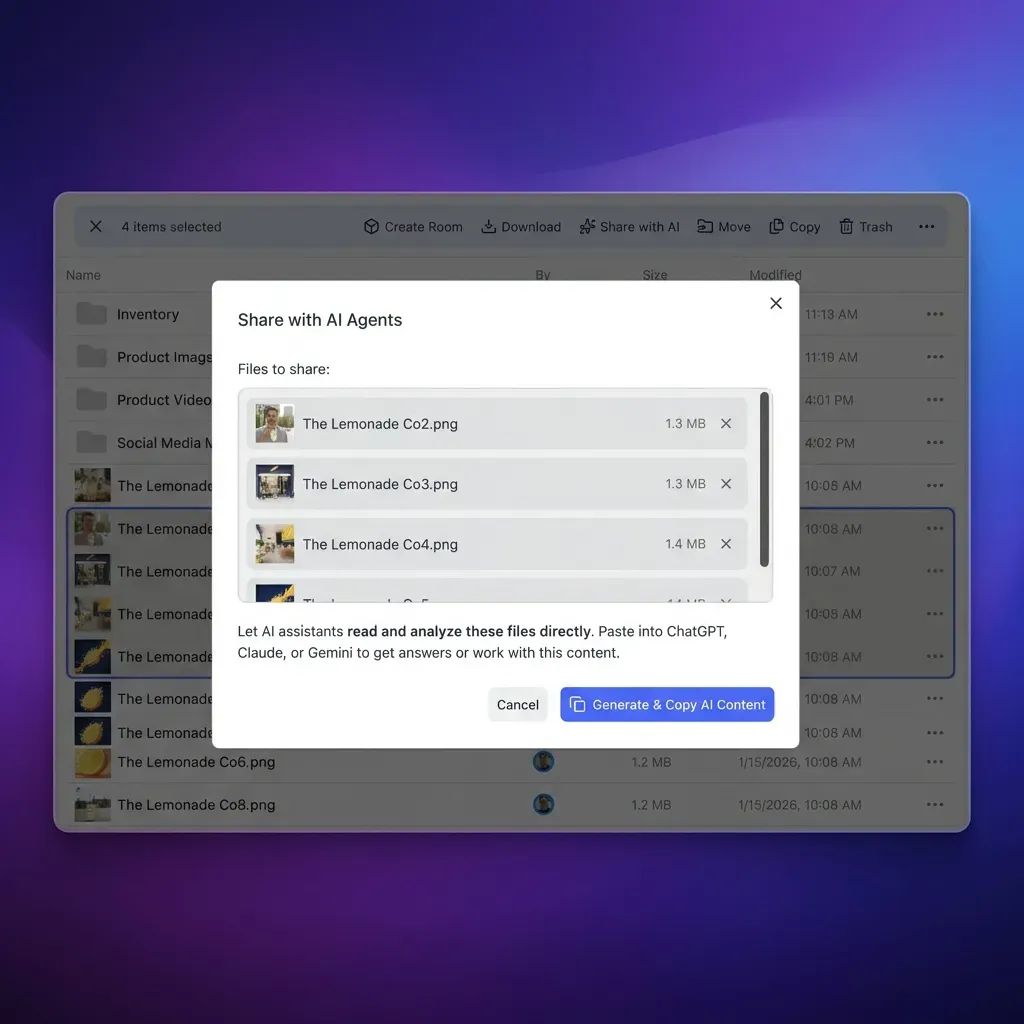


Give Your AI Agents Persistent Storage
Stop relying on ephemeral context windows. Connect your agent to persistent cloud storage with the Fastio MCP server.
2. GitHub MCP Server
Best for: Coding & Repository Management
For coding agents, the official GitHub MCP server is essential. It allows agents to search code, read pull requests, manage issues, and even commit changes directly to repositories. This server transforms an LLM from a code generator into an autonomous developer that can navigate a codebase and contribute to projects.
Key Features:
- Semantic Code Search: Find relevant code snippets across repositories.
- Issue Management: Create, update, and close issues and PRs.
- File History: Read commit history and blame data to understand code evolution.
Verdict: Essential for any agent integrated into a software development workflow. Consider how this fits into your broader workflow and what matters most for your team. The right choice depends on your specific requirements: file types, team size, security needs, and how you collaborate with external partners. Testing with a free account is the fast way to know if a tool works for you.
3. PostgreSQL MCP Server
Best for: Structured Database Access
This server gives agents safe, structured access to PostgreSQL databases. Instead of giving an agent raw SQL access (which can be risky), the MCP server exposes schemas and safe query tools. This allows agents to answer business intelligence questions, retrieve user data, or manage application state without direct database connection strings.
Key Features:
- Schema Inspection: Agents can read table structures to understand the data model.
- Read-Only Modes: Configure strict read-only access for analytical agents.
- Natural Language Querying: Pairs with tools that translate questions to SQL. Consider how this fits into your broader workflow and what matters most for your team. The right choice depends on your specific requirements: file types, team size, security needs, and how you collaborate with external partners. Testing with a free account is the fast way to know if a tool works for you.
4. Brave Search MCP Server
Best for: Web Access & Research
While many models have "browsing" capabilities, the Brave Search MCP server provides a programmatic, API-first way for agents to query the web. It respects privacy and delivers structured search results that are easier for models to parse than raw HTML scraping.
Key Features:
- Local & Web Search: Search specifically for local businesses or general web results.
- Clean Data: Returns JSON-structured results rather than full HTML pages.
- Privacy-Focused: No tracking of agent queries. As your file library grows, finding what you need becomes the bottleneck. Folder hierarchies help, but they break down at scale. AI-powered semantic search lets you describe what you are looking for in plain language rather than remembering exact filenames or folder paths.
5. Filesystem MCP Server
Best for: Local Desktop Automation
For agents running locally on your machine (like via Claude Desktop), the Filesystem MCP server grants access to your local hard drive. This is powerful for organizing your "Downloads" folder or analyzing local logs, but limited compared to cloud solutions like Fastio since the data isn't accessible to other agents or teammates.
Key Features:
- Direct Local Access: Read and edit files on your computer.
- Simple Setup: Often built-in to desktop agent runners.
- Privacy: Data never leaves your local machine. Consider how this fits into your broader workflow and what matters most for your team. The right choice depends on your specific requirements: file types, team size, security needs, and how you collaborate with external partners. Testing with a free account is the fast way to know if a tool works for you.
6. Slack MCP Server
Best for: Team Communication
The Slack MCP server allows agents to participate in team channels. They can read message history to catch up on context, send notifications, or reply to user queries directly in threads. This matters for "employee" agents that need to collaborate with humans where they work.
Key Features:
- Channel History: Agents can read past conversations to understand context.
- Direct Messaging: Send private reports or updates to specific users.
- Thread Support: Maintain organized conversations without spamming channels. Consider how this fits into your broader workflow and what matters most for your team. The right choice depends on your specific requirements: file types, team size, security needs, and how you collaborate with external partners. Testing with a free account is the fast way to know if a tool works for you.
7. Linear MCP Server
Best for: Project Management
Linear's MCP server lets agents manage project tracking. An agent could, for example, read a GitHub PR and automatically update the corresponding Linear ticket status. It connects technical work with project tracking, reducing administrative overhead for engineering teams.
Key Features:
- Issue Tracking: Create, update, and query issues.
- Roadmap Awareness: Agents can check project deadlines and priorities.
- Team Assignment: Auto-assign tasks based on context. Consider how this fits into your broader workflow and what matters most for your team. The right choice depends on your specific requirements: file types, team size, security needs, and how you collaborate with external partners. Testing with a free account is the fast way to know if a tool works for you.
8. Memory MCP Server
Best for: Simple Knowledge Graph
The Memory MCP server provides a lightweight knowledge graph for agents. It allows them to store "facts" (entities and relationships) that persist across sessions. While less powerful than a full vector database or Fastio's RAG, it's excellent for keeping track of user preferences or simple project details.
Key Features:
- Entity Extraction: Stores facts as "Subject-Predicate-Object" triples.
- Lightweight: Runs locally with minimal overhead.
- Session Persistence: Remembers context between chat sessions. Consider how this fits into your broader workflow and what matters most for your team. The right choice depends on your specific requirements: file types, team size, security needs, and how you collaborate with external partners. Testing with a free account is the fast way to know if a tool works for you.
9. Puppeteer MCP Server
Best for: Browser Automation
When an API isn't available, the Puppeteer server allows agents to control a headless Chrome browser. They can click buttons, fill forms, and take screenshots of websites. It works with any website, including legacy tools that lack APIs.
Key Features:
- Visual Interaction: Click, type, and scroll on real web pages.
- Screenshots: Capture visual proof of actions or errors.
- Scraping: Extract data from dynamic, JavaScript-heavy sites. Consider how this fits into your broader workflow and what matters most for your team. The right choice depends on your specific requirements: file types, team size, security needs, and how you collaborate with external partners. Testing with a free account is the fast way to know if a tool works for you.
10. Sentry MCP Server
Best for: Observability & Debugging
The Sentry MCP server connects agents to your error tracking. An agent can monitor for new exceptions, analyze stack traces, and even correlate errors with recent code changes (if combined with the GitHub server). It's a powerful tool for autonomous triage agents.
Key Features:
- Error Monitoring: Watch for new issues in real-time.
- Stack Trace Analysis: Retrieve full details for debugging.
- Issue Assignment: Route bugs to the correct team member. Consider how this fits into your broader workflow and what matters most for your team. The right choice depends on your specific requirements: file types, team size, security needs, and how you collaborate with external partners. Testing with a free account is the fast way to know if a tool works for you.
How to Choose the Right MCP Server
Selecting the right servers depends on your agent's goal. For a coding agent, combine GitHub, Linear, and PostgreSQL. For a creative assistant, start with Fastio for asset management and Brave Search for research. The power of MCP is composability. You don't have to pick just one. Most agent runtimes allow you to install multiple servers, giving your agent access to exactly the tools it needs. Start with the basics (storage and search), then add specialized tools as your agent's responsibilities grow. Getting started should be straightforward. A good platform lets you create an account, invite your team, and start uploading files within minutes, not days. Avoid tools that require complex server configuration or IT department involvement just to get running.
Sources
References used to verify factual claims in this guide.
-
Fastio MCP Server exposes a consolidated toolset for persistent agent storage.
-
Fastio plans start at 250 GB with a 14-day Business Trial.
Frequently Asked Questions
What is the most popular MCP server?
The Filesystem MCP server is currently the most widely installed due to its inclusion in default starter kits. However, for production use cases, the GitHub and Fastio servers are rapidly becoming standards for code and file management respectively.
Are MCP servers free?
Most open-source MCP servers (like Filesystem, Memory) are free. Service-connected servers like Fastio provide a 14-day Business Trial with paid plans starting at $9.99/mo, while others may require a subscription to the underlying SaaS platform (like Linear or Jira).
How do I install an MCP server?
Installation depends on your client. For Claude Desktop, you modify a JSON configuration file to point to the server's script. For Fastio, clients connect directly via its remote MCP server URL at https://mcp.fast.io/mcp/tools (coding agents use https://mcp.fast.io/mcp/code) using Streamable HTTP, signing in with OAuth or sending a scoped API key as a Bearer header.
Related Resources

Give Your AI Agents Persistent Storage
Stop relying on ephemeral context windows. Connect your agent to persistent cloud storage with the Fastio MCP server.