Best MCP Servers for LLM Workflows in 2026
Model Context Protocol servers give LLMs standardized access to tools, data, and services. With over 10,000 public servers now available, choosing the right ones for your workflow matters. This guide ranks the most useful MCP servers for developers building agent pipelines, from documentation retrieval to browser automation to persistent file storage.


What MCP Servers Actually Do
Model Context Protocol is an open standard created by Anthropic in November 2024 and donated to the Linux Foundation's Agentic AI Foundation in December 2025. It standardizes how LLMs connect to external tools, data sources, and services through a client-server architecture using JSON-RPC.
MCP servers for LLM workflows standardize tool access across models. Instead of writing custom integrations for each AI provider, you write one MCP server and it works with Claude, ChatGPT, Gemini, Copilot, Cursor, and local models running through compatible clients.
The protocol defines three primitives: Tools (functions the model can call), Resources (data the application provides), and Prompts (templates users can invoke). A single MCP server might expose dozens of tools. Your LLM client discovers them automatically through the protocol's built-in discovery mechanism.
Why does this matter for production workflows? Before MCP, every tool integration was bespoke. You'd write one function-calling schema for OpenAI, another adapter for Claude, and maintain both. MCP eliminates that duplication. The server becomes a reusable, testable component that any compatible client can consume.
Related guides
- Top 7 MCP Servers for GitOps WorkflowsMCP servers let AI agents use GitOps tools like Argo CD and Flux through one protocol. We rank the top 7 by Argo/Flux...
- Top 7 Open Source MCP Servers for AI Agents in 2026Open source MCP servers give AI agents direct access to files, databases, and APIs without black-box proprietary...
- 7 Best MCP Servers for Creative AIMCP servers extend creative AI with file-aware tools. Top MCP servers for creative AI handle art generation, video...
- Best MCP Servers for Search: Connecting AI Agents to Real-Time DataSearch MCP servers connect AI agents to real-time web data, which cuts down on hallucinations and helps agents retrieve...
- 8 Best MCP Servers for Video Processing in 2026MCP servers for video processing let AI agents transcode, analyze, edit, and stream video through Model Context...
- 8 Best MCP Servers for Document Management in 2026MCP servers for document management give AI agents structured access to document repositories with capabilities like...
More on this subject: MCP and Model Context Protocol (238 guides)
How We Evaluated These Servers
We scored these servers on six criteria:
- Production readiness. Active maintenance, clear documentation, and stable releases. Official servers maintained by the service vendor scored higher than community forks.
- LLM compatibility. Servers that work across Claude, GPT-4, Gemini, and local models ranked above single-provider solutions.
- Tool coverage. Does the server expose enough functionality to replace direct API calls? A GitHub MCP server that only reads repos is less useful than one covering PRs, issues, and actions.
- Security model. Token scoping, audit trails, and permission isolation matter for agent workflows where an LLM has autonomous access.
- Setup complexity. Docker support, clear auth flows, and minimal configuration earn points.
- Community adoption. Install counts, GitHub stars, and real usage signal whether the server works in practice.
Here's a quick comparison of the servers we cover:
The 10 Best MCP Servers for LLM Workflows
1. Context7
Context7 fetches version-specific documentation and injects it directly into prompt context. Instead of relying on an LLM's potentially stale training data, your agent gets current API docs for whatever library it's working.
Key strengths:
- Most installed MCP server in the ecosystem (690+ installs on FastMCP, 11,000+ views)
- Solves the outdated training data problem for coding assistants
- Zero configuration beyond the initial install
Limitations: Narrowly focused on documentation retrieval. Not a general-purpose tool server.
Best for: Developers using AI coding assistants who need accurate, current library docs.
Pricing: Free and open source.
2. Playwright MCP (Browser Automation)
Microsoft's Playwright MCP server lets AI agents automate web browsers using accessibility snapshots rather than visual screenshots. This makes interactions more deterministic and reliable than pixel-based approaches.
Key strengths:
- Uses the accessibility tree for reliable element targeting
- Full browser automation: navigation, form filling, clicking, data extraction
- Maintained by Microsoft with active development
Limitations: Requires the Playwright runtime. Resource-intensive for large-scale automation tasks.
Best for: Agents that need to interact with web UIs, run end-to-end tests, or scrape JavaScript-rendered pages.
Pricing: Free and open source.
3. GitHub MCP Server
GitHub's official MCP server exposes the full GitHub API: repositories, pull requests, issues, code search, and workflow automation. It's the most direct way to give an LLM agent access to your GitHub workflow.
Key strengths:
- Official server maintained by GitHub
- Deep coverage of the GitHub platform (repos, PRs, issues, actions, code search)
- Well-documented auth flow using personal access tokens
Limitations: Rate-limited by GitHub's API. Requires a personal access token with appropriate scopes.
Best for: Any developer who wants AI agents to manage repositories, review pull requests, or automate GitHub workflows.
Pricing: Free and open source.
4. Fastio MCP Server
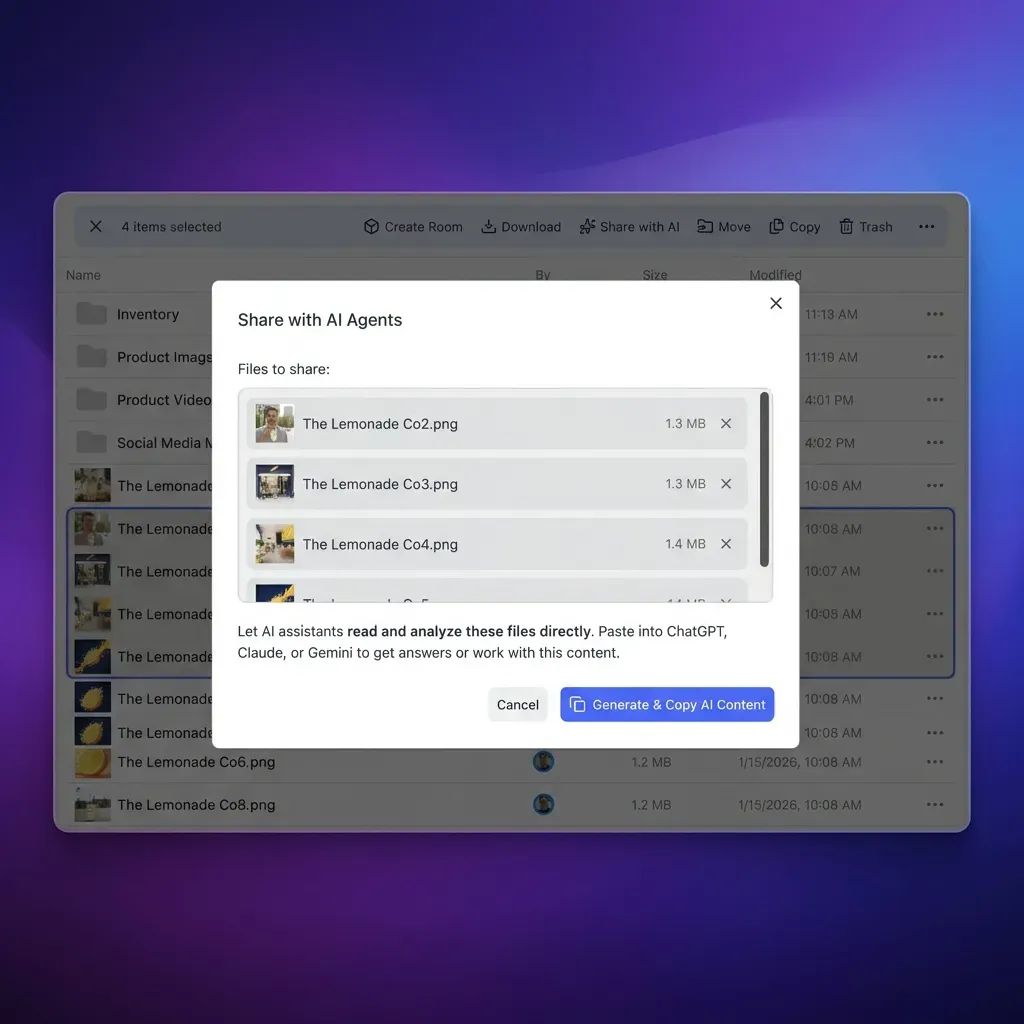
Fastio provides persistent cloud storage with built-in RAG for AI agent workflows. Where most MCP servers connect to a single service, Fastio combines file operations, semantic search, AI chat, branded sharing, and collaborative workspaces in one server.
Key strengths:
- Built-in Intelligence Mode auto-indexes uploaded files for semantic search and citation-backed chat, no separate vector database needed
- Comprehensive MCP toolset covering storage, AI, shares, and org management
- Ownership transfer lets agents build workspaces and hand them to humans
- Streamable HTTP at
/mcpand legacy SSE at/sse
Limitations: Focused on file storage and collaboration workflows. Not a general compute or code execution environment.
Best for: Agent pipelines that need persistent file storage, document Q&A, or human handoff. Especially useful for multi-agent systems where output needs to survive beyond a single session.
Pricing: 14-day Business Trial; Starter ($9.99/mo), Business ($49.99/mo), Enterprise ($199.99/mo). See pricing and MCP documentation.
5. Firecrawl MCP Server
Firecrawl gives LLM agents web scraping, crawling, search, and structured data extraction. The standout feature is firecrawl_agent, which can autonomously browse the web using natural language without needing a specific URL.
Key strengths:
- Autonomous web browsing with natural language queries
- Deep research tool that explores sources and builds comprehensive analysis
- Structured data extraction with JSON schema support
Limitations: Free tier is limited to 500 lifetime credits (roughly 50 scrapes). Paid plans start at $83/month.
Best for: SEO researchers, content teams, and agents that need real-time web data or competitive intelligence.
Pricing: Free tier (500 lifetime credits). Standard plan at $83/month for 100K pages.
More MCP Servers Worth Considering
6. Supabase MCP Server
Supabase's official MCP server bridges AI tools to Supabase projects. Create databases, design tables, run SQL queries, manage branches, and retrieve logs through natural language.
Key strengths:
- 20+ tools for database design, querying, and project management
- Scaffold entire backend infrastructure through conversation
- Official support from the Supabase team
Limitations: Supabase-specific. Requires an active Supabase project.
Best for: Developers building on Supabase who want AI-assisted database design and management.
Pricing: Free and open source (requires Supabase account).
7. Cloudflare MCP Server
Cloudflare's MCP server covers their entire API surface (2,500+ endpoints) through just two tools: search() and execute(). It uses a "Codemode" approach where the model writes JavaScript against a typed OpenAPI spec, keeping token overhead around 1,000 tokens regardless of how many endpoints are available.
Key strengths:
- Two tools cover 2,500+ Cloudflare API endpoints (DNS, Workers, R2, Zero Trust)
- Minimal token overhead through code generation against typed specs
- Official Cloudflare maintenance
Limitations: Cloudflare-specific. Only useful if you're already on the Cloudflare platform.
Best for: DevOps and platform engineers managing Cloudflare infrastructure through AI agents.
Pricing: Free and open source (requires Cloudflare account).
8. Sequential Thinking
Built by Anthropic, Sequential Thinking provides structured step-by-step reasoning for LLMs. It gives models a "scratchpad" for dynamic thought chains that can branch and revise, improving performance on complex multi-step problems.
Key strengths:
- Improves LLM accuracy on complex reasoning, planning, and analysis tasks
- Dynamic thought chains can branch and backtrack
- Built and maintained by Anthropic
Limitations: Adds latency to responses. Overkill for simple queries.
Best for: Complex problem-solving workflows: multi-step analysis, mathematical reasoning, or planning tasks where accuracy matters more than speed.
Pricing: Free and open source.
9. Notion MCP Server
Notion's official MCP server lets agents search, read, create, and update pages, databases, and comments across Notion workspaces. Semantic search extends to connected sources like Slack, Google Drive, and Jira.
Key strengths:
- Official server from Notion with semantic search
- Cross-source search across Notion and connected integrations
- Enhanced Markdown output for clean context injection
Limitations: Limited to Notion's API capabilities. Requires a Notion integration token.
Best for: Teams using Notion as their knowledge base who want agents to query and update workspace content.
Pricing: Free and open source (requires Notion account).
10. Brave Search MCP Server
An official reference server from the MCP project, Brave Search gives LLMs web and local search through Brave's privacy-focused API.
Key strengths:
- Privacy-focused search with no tracking
- Supports both web search and local business search
- Official reference implementation from the MCP project
Limitations: Search quality differs from Google for some queries.
Best for: Agents that need web search without Google dependency, particularly in privacy-sensitive contexts.
Pricing: Free tier available. Paid plans for higher volume.


Give Your Agents Persistent Storage and Built-in RAG
Fastio's MCP server gives LLM agents persistent, searchable file storage. Upload files, query with citations once Intelligence is enabled, and hand off workspaces.
Building Multi-Server Workflows
The real power of MCP shows up when you combine servers. A typical agent pipeline might use Context7 for documentation, GitHub MCP for code management, and Fastio for persistent storage and human handoff, all in the same session.
Here's what a practical multi-server workflow looks like:
- Research phase. The agent uses Brave Search or Firecrawl to gather information, then stores findings in a Fastio workspace where Intelligence Mode indexes them for later retrieval once enabled.
- Build phase. GitHub MCP handles code operations. Context7 provides up-to-date library docs. Sequential Thinking helps with architectural decisions.
- Delivery phase. The agent creates a branded share through Fastio, uploads deliverables, and transfers ownership to the human client.
This composability is what separates MCP from monolithic tool-calling setups. Each server handles what it's good at, and the protocol handles discovery and routing.
For persistence across sessions, you need a server that stores state beyond the conversation window. Local file systems work for single-machine setups, but multi-agent systems need shared storage. Fastio's MCP server fills that gap: agents write output to workspaces, other agents or humans pick it up later, and the built-in RAG layer makes everything searchable without a separate vector database.

Which MCP Server Should You Choose?
The answer depends on what your agent pipeline actually needs. Most production workflows will use three to five servers together.
If you're building a coding assistant, start with Context7 (for current docs), GitHub MCP (for repo access), and Playwright MCP (for testing). Add Sequential Thinking if your agent handles complex architectural decisions.
If you're building a research agent, Firecrawl or Brave Search handles web data collection. Pair it with Notion MCP if your team's knowledge lives in Notion, or Fastio if you need persistent storage with built-in RAG that agents can share.
If you're building an agent-to-human delivery pipeline, Fastio's ownership transfer and branded shares let agents build complete project workspaces and hand them off. Fastio offers a 14-day Business Trial for teams and agents to evaluate the platform.
If you're managing infrastructure, Cloudflare MCP and Supabase MCP let agents handle DevOps tasks through natural language instead of manual API calls.
The MCP ecosystem is growing fast. In February 2026 alone, 301 new servers were published. The servers listed here have proven themselves through adoption and active maintenance, but check the MCP server registries regularly for new options that fit your specific workflow.
Sources
References used to verify factual claims in this guide.
-
Anthropic created MCP in November 2024
-
MCP donated to Linux Foundation's Agentic AI Foundation in December 2025 MCP SDK downloads exceed 97 million per month Over 10,000 active public MCP servers
-
301 new MCP servers published in February 2026
-
PulseMCP tracks over 8,500 servers
-
Firecrawl paid plans start at $83/month
Frequently Asked Questions
What is MCP for LLMs?
Model Context Protocol (MCP) is an open standard that lets LLMs connect to external tools, data sources, and services through a unified client-server protocol. Created by Anthropic and now governed by the Linux Foundation's Agentic AI Foundation, MCP works across Claude, ChatGPT, Gemini, Copilot, and other compatible clients. It defines three primitives: Tools (functions the model calls), Resources (data the app provides), and Prompts (user-invoked templates).
Which MCP server works best with LangChain?
LangChain supports MCP through its MCP adapter, which lets you connect any MCP server as a LangChain tool. Context7 is popular for documentation retrieval in LangChain chains. For persistent file storage and RAG, Fastio's MCP server works with LangChain agents through the standard MCP transport. GitHub MCP and Firecrawl are also commonly used in LangChain pipelines for code management and web research.
Are MCP servers free to use?
Most MCP servers are open source and free. Context7, Playwright MCP, GitHub MCP, Sequential Thinking, and Brave Search MCP are all free with no usage limits beyond rate limits from the underlying API. Firecrawl offers a limited free tier (500 lifetime credits) with paid plans starting at $83/month. Fastio provides a 14-day Business Trial with paid plans starting at $9.99/month.
How many MCP servers are available?
As of early 2026, over 10,000 public MCP servers exist. The PulseMCP registry tracks over 8,500, and the FastMCP directory lists over 1,800. The ecosystem is growing at roughly 300 new servers per month, with MCP SDK downloads exceeding 97 million per month.
Can I use multiple MCP servers together?
Yes. MCP clients like Claude Desktop, Cursor, and VS Code support connecting to multiple MCP servers simultaneously. A typical production setup might use three to five servers together, for example Context7 for docs, GitHub MCP for repos, and Fastio for persistent storage. The protocol handles tool discovery and routing automatically.
What is the difference between MCP and function calling?
Function calling (like OpenAI's tool-use API) requires you to define tool schemas inline in your application code, and the format differs between providers. MCP is a protocol-level standard where tool definitions live in external servers. The tradeoff: function calling is faster to set up for simple integrations, but MCP servers are reusable, testable, and provider-agnostic. Write one MCP server and it works with Claude, GPT-4, Gemini, and local models.
Related Resources

Give Your Agents Persistent Storage and Built-in RAG
Fastio's MCP server gives LLM agents persistent, searchable file storage. Upload files, query with citations once Intelligence is enabled, and hand off workspaces.