Best MCP Servers for CRM Integration: Salesforce, HubSpot & Zendesk
CRM MCP servers let AI agents access and update customer records without complex API integration. This guide compares the top servers for connecting LLMs to Salesforce, HubSpot, and other CRM platforms, including security tips and setup guides.

How to implement best mcp servers for crm reliably
Integrating CRM data with external tools used to mean two things: expensive, fragile API integrations built by engineering teams, or manual CSV exports that were stale the moment they were downloaded.
The Model Context Protocol (MCP) changed this. Instead of building custom connectors for every AI tool, MCP provides a universal standard, like a USB port for your data. By running a CRM MCP server, you expose your customer records, deal pipelines, and support tickets to any MCP-compliant AI agent (like Claude Desktop, Cursor, or Devin Desktop (formerly Windsurf)) securely and instantly.
Why it matters:
- Live Context: Agents can answer "What's the status of the Acme deal?" with real-time data, not stale training data.
- Actionability: Agents can update records, log notes, and move deals through stages without leaving their interface.
- Security: Unlike giving an LLM your login credentials, MCP servers run locally or on your controlled infrastructure, respecting your existing permissions.
According to Salesforce Ben, the shift to agentic CRM interaction is driven by the need for "live" data access, allowing agents to act on information that changes by the minute. This guide covers the best servers available today to bridge your AI agents with your customer data.
Helpful references: Fastio Workspaces, Fastio Collaboration, and Fastio AI.
Related guides
- Best MCP Servers for Automation in 2026MCP servers for automation let AI agents trigger workflows, schedule tasks, and coordinate actions across external...
- How to Choose the Best MCP Servers for Sales TeamsSales teams today juggle an average of 10 different tools to close deals, creating data silos that slow down outreach....
- How to Choose the Best Serverless MCP Servers for Effortless DeploymentRunning your own Model Context Protocol (MCP) servers gives your AI agents custom capabilities, but managing...
- How to Automate Social Media with MCP ServersSocial media MCP servers connect AI agents to X, LinkedIn, and Instagram. Agents used to just write text. Now they read...
- Top MCP Servers for E-commerce Operations: Automate Your StoreE-commerce MCP servers let AI agents handle tasks like inventory management and order processing automatically....
- How to Integrate Fastio MCP with OpenAI SwarmFastio MCP integration provides OpenAI Swarm agents with a unified, persistent workspace to share context, lock files...
More on this subject: MCP and Model Context Protocol (238 guides)
What to check before scaling best mcp servers for crm
HubSpot has focused on AI integration, releasing one of the most reliable official MCP implementations available. For teams already using HubSpot, this is the default starting point.
Official vs. Community Options While several community wrappers exist, the Official HubSpot MCP Server (beta) is recommended because it is maintained directly by HubSpot's developer relations team. It supports the latest API endpoints and handles rate limiting gracefully, which matters when an enthusiastic AI agent tries to read multiple contacts in seconds.
Key Capabilities:
- Object Access: Read and write access to standard objects (Contacts, Companies, Deals, Tickets) and custom objects.
- Schema Discovery: The server allows the agent to "inspect" your CRM schema. If you have a custom property called
contract_renewal_date, the agent can find it and use it in queries without being explicitly programmed to know it exists. - Natural Language Search: It translates natural language queries ("Show me all enterprise deals in California closing this month") into precise HubSpot CRM search filters.
Setup Complexity: Low. It typically requires setting up a HubSpot Private App to generate an access token, then running the server via npx or Docker.
Best For: Growth teams and developers who want a "just works" experience with full vendor support.
2. Salesforce MCP Solutions: Enterprise Options
Salesforce is a major part of enterprise sales, but its size and complexity make AI integration hard. Unlike HubSpot's single official server, the Salesforce ecosystem relies on a mix of official tools and powerful third-party solutions.
The Landscape:
- Salesforce DX MCP (Official/Dev): Focused on metadata and code. Excellent for Salesforce developers who want an AI coding assistant to help write Apex or LWC, but less useful for sales agents needing customer data.
- CData MCP Server: A commercial-grade solution that works well for data connectivity. It exposes Salesforce data as a SQL-like interface. This is useful for analysis agents, you can ask your agent to "JOIN Opportunities with Accounts and group by Region," and CData handles the complex SOQL translation.
- Merge.dev MCP: A unified API approach. If your organization uses multiple CRMs (e.g., Salesforce for sales, HubSpot for marketing), Merge provides a single MCP server that talks to both.
Enterprise Security Constraints: Salesforce admins are rightly careful about data exfiltration. The advantage of MCP here is local execution. You can run the Salesforce MCP server on a local machine or a private VPC. The OAuth tokens never leave your controlled environment, and the AI agent (like Claude) only sees the specific data fields you allow it to fetch.
Best For: Large enterprises requiring granular permission controls and complex data querying capabilities.
3. Zendesk MCP: Support Triage
Customer support is often the first department to adopt AI automation. Connecting Zendesk via MCP allows you to build triage agents that can sort tickets before a human ever sees them.
Top Use Cases:
- Summaries: An agent reads a ticket thread with multiple back-and-forth emails and posts a private internal note: "User is frustrated about a billing error on Invoice #1042. Requires Finance approval."
- Knowledge Base Linking: The agent scans incoming tickets and suggests relevant Help Center articles to the support rep (or drafts the reply directly).
- Sentiment Analysis: Automatically tag tickets as "High Churn Risk" based on the tone of the customer's messages.
Implementation Note: Most Zendesk MCP servers rely on the Zendesk REST API. You will need to generate an API token in the Zendesk Admin Center. Be careful to restrict this token's scope, don't give it "delete" permissions unless necessary.
Best For: Support operations teams looking to reduce handle time (AHT) and improve agent efficiency.
4. Fastio & OpenClaw: Agent Workspaces
Connecting your agent to a CRM is only half the battle. Once your agent extracts a report, generates a strategy document, or cleans a contact list, where does that data go?
If the agent saves it to your local laptop, it's trapped. If it tries to email it, version control is lost.
The Fastio MCP Server provides the "hard drive" and "collaboration layer" for your CRM agents.
The Integrated Workflow:
- Extraction: Your agent uses the Salesforce MCP tool to pull a list of multiple "At Risk" accounts.
- Processing: The agent analyzes the activity logs for these accounts to identify common patterns.
- Storage: The agent uses the Fastio MCP server to save a "Churn_Risk_Analysis.md" report to a shared workspace.
- Intelligence: Fastio's Intelligence Mode automatically indexes this report. Now, a human sales director can ask, "What are the top churn risks this week?" and Fastio answers using the data the agent just saved.
This creates a workflow where agents and humans contribute to a shared knowledge base. Fastio supports multiple MCP tools, allowing agents to manage files, search content, and even hand off ownership of entire workspaces to human teams.
Best For: Teams that need a persistent, shared memory for their AI agent operations.
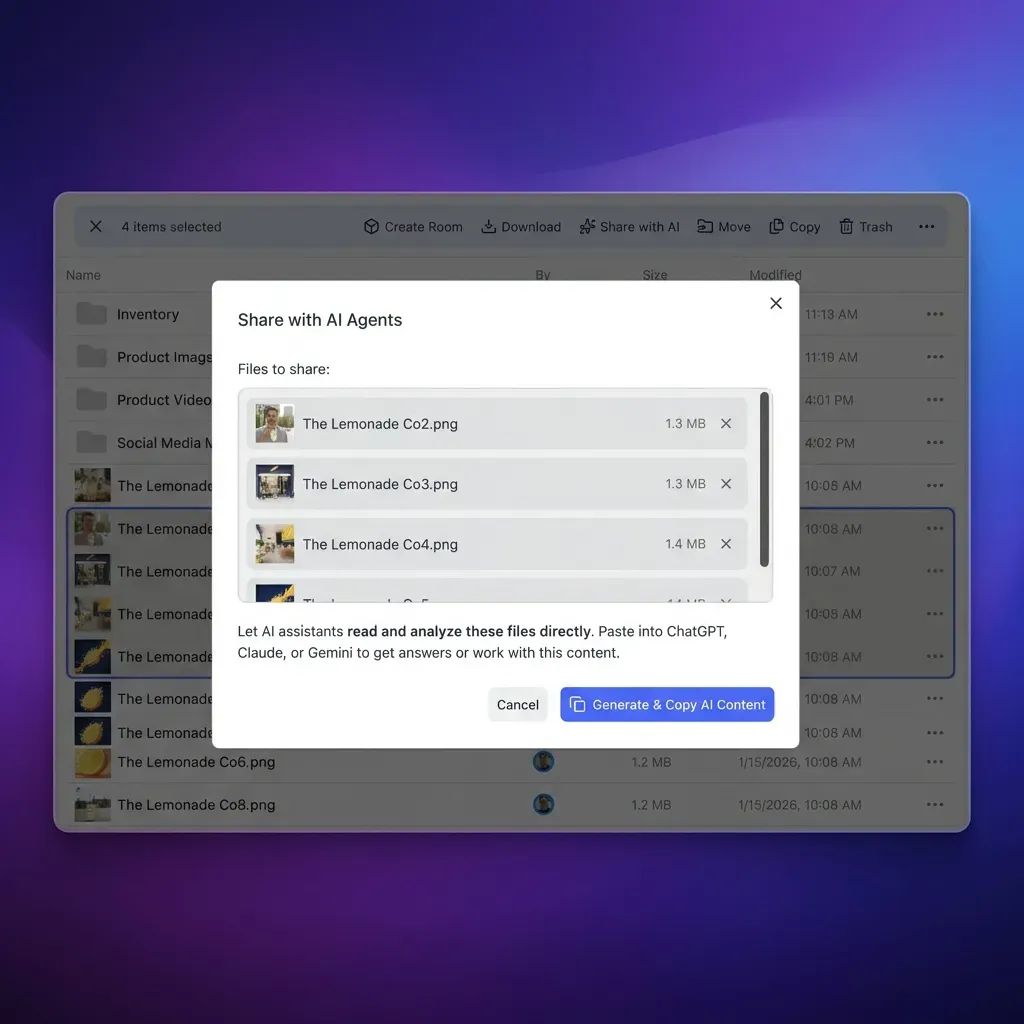


Give Your Agents a Home
Stop letting your agents work in silos. Connect them to Fastio storage to organize, share, and index their CRM reports automatically. Built for mcp servers crm workflows.
5. Pipedrive & Zoho: SMB Options
For small and medium businesses, the overhead of Salesforce is often unnecessary. Pipedrive and Zoho CRM are popular alternatives, and the MCP community has built support for them.
Pipedrive MCP: Community servers for Pipedrive focus heavily on Deal and Activity management. A common workflow is an "Inbox Zero" agent that reads your emails, matches them to Pipedrive deals, and logs the activity automatically, saving sales reps hours of data entry every week.
Zoho CRM:
Zoho's ecosystem is large, but MCP servers typically focus on the core CRM module. Given Zoho's API complexity, using an MCP server simplifies the interaction for the AI, presenting a clean set of tools like get_lead and create_task.
Best For: Agile sales teams who value speed and automation over complex reporting.
Comparison: Which Server is Right for You?
Choosing the right MCP server depends on your technical resources and specific needs.
Summary:
- HubSpot Official: Best for ease of use. High stability, official support, easy setup.
- Salesforce (CData/Merge): Best for data depth. Strong SQL querying, enterprise security features, but higher complexity.
- Zendesk (Community): Best for support flows. Excellent for text analysis and sorting, but requires careful scope management.
- Fastio (Storage): Best for collaboration. Essential for storing agent outputs and sharing them with the team.
Cost Considerations: Most official and community MCP servers are free to use (MIT or Apache licensed). However, third-party wrappers like CData or Merge often require a subscription for their enterprise-grade connectors. Weigh the cost of a subscription against the engineering time required to maintain a self-hosted open-source server.
Security & Governance Best Practices
Connecting an autonomous intelligence to your customer database is a decision that requires careful security planning.
1. The Principle of Least Privilege
Never use a "Super Admin" API key for an MCP server. Create a dedicated Integration User in your CRM. Grant this user Read-Only access initially. Only add "Write" or "Edit" permissions to specific fields (e.g., Deal_Notes) after you have verified the agent's behavior.
2. Token Management Use OAuth 2.0 whenever possible. This ensures that the agent acts on behalf of a specific user, and actions are logged in the CRM's audit trail as "Updates by AI Agent (via Tom)." This accountability is important for compliance.
3. Human-in-the-Loop (HITL) For high-stakes actions, like deleting records, merging contacts, or sending emails, configure your agent to "draft" the action rather than execute it. The agent can create a "Draft Email" in HubSpot, which a human rep must review and click "Send." 4. Data Residency Ensure your MCP server runs in a location that complies with your data residency laws (privacy requirements, privacy requirements). Since MCP servers can run locally on your machine, you often have better control over data sovereignty than with cloud-based AI automation platforms.
The Future: Agentforce vs. MCP
Salesforce has heavily marketed "Agentforce," its native platform for building AI agents. This raises the question: Do you need MCP if you use Agentforce?
The answer is yes, for two reasons: Orchestration and Independence.
Agentforce is excellent for actions inside Salesforce. But modern work happens everywhere. You might need an agent to read a Salesforce opportunity, check a Jira ticket for deployment status, and update a Fastio project plan.
MCP is the only standard that bridges these silos. An MCP-enabled agent can use a "Salesforce Tool," a "Jira Tool," and a "Fastio Tool" at the same time, running complex workflows across your entire stack. While proprietary agent platforms will always exist, the flexibility of the open MCP standard ensures it will remain the connectivity layer of choice for advanced cross-platform automation.
Sources
References used to verify factual claims in this guide.
-
Salesforce and HubSpot capture 90% of enterprise MCP interest
-
HubSpot provides two primary MCP server options: Remote and Developer
-
Salesforce offers a DX MCP Server for metadata interaction
-
MCP provides a standardized 'socket' for AI connections
Frequently Asked Questions
What is a CRM MCP server?
A CRM MCP server is software that translates the Model Context Protocol (used by AI agents like Claude or Cursor) into the specific API calls of a CRM like Salesforce or HubSpot. It allows the agent to 'see' your CRM data as a set of tools (e.g., 'get_contact', 'update_deal') that it can use to answer questions or perform tasks.
Is there an official Salesforce MCP server?
At the time of writing, Salesforce primarily focuses on its internal 'Agentforce' platform. However, they offer a developer-focused DX MCP server, and reliable third-party options exist from providers like CData and Merge, as well as open-source community projects.
Can Claude Desktop connect to HubSpot?
Yes. By running the HubSpot MCP server locally (or via a secure host), you can configure Claude Desktop to see your HubSpot data as a set of tools. You can then ask Claude, 'Show me the latest deals for Acme Corp,' and it will query your CRM in real-time.
How much do CRM MCP servers cost?
Most open-source MCP servers (like the official HubSpot one or community Zendesk ones) are free to use. Enterprise connectors from vendors like CData or Merge often charge a subscription fee for their hosted or supported versions, which may include SLAs and advanced security features.
Is it safe to give AI access to my CRM?
It is safe if you follow security best practices. Always use scoped API keys (never root/admin keys), limit permissions to read-only where possible, and run the server in a controlled environment. Also, ensure your AI client (the LLM) has appropriate data privacy guarantees.
Does Fastio replace Salesforce?
No. Fastio is the intelligent workspace where your agents store the files, reports, and artifacts they generate *from* Salesforce. It acts as the collaboration and memory layer between your raw CRM data and your human team, ensuring agent work is saved, indexed, and searchable.
Can I use multiple MCP servers at once?
. One of the core strengths of MCP is composability. You can configure your AI agent to connect to a Salesforce server, a Fastio server, and a Slack server simultaneously, allowing it to read a deal, write a report, and notify the team in one workflow.
Related Resources

Give Your Agents a Home
Stop letting your agents work in silos. Connect them to Fastio storage to organize, share, and index their CRM reports automatically. Built for mcp servers crm workflows.