Best MCP Servers for Communication in 2026
MCP servers for communication give AI agents the ability to send messages, manage threads, handle email, and interact across Slack, Discord, Teams, and other platforms. This guide ranks the best options and explains when to use each one.

What Are Communication MCP Servers?
MCP (Model Context Protocol) servers for communication are standardized connectors that let AI agents read and send messages on platforms like Slack, email, Discord, and SMS. Instead of writing custom API integrations for every channel, you connect an MCP server and your agent gains messaging capabilities through standard tool calls.
Communication MCP servers cover most business messaging platforms, from internal chat tools to customer-facing channels. They manage authentication, rate limiting, and message formatting so your agent can focus on deciding what to say rather than how to deliver it.
The servers on this list range from official, first-party integrations (Slack's own MCP server) to community-built bridges for platforms that don't yet offer native MCP support. We evaluated each one based on reliability, feature coverage, setup complexity, and active maintenance.
Related guides
- Best MCP Servers for Image Processing: Top 9 Tools for AI AgentsImage processing MCP servers give AI agents tools to read, analyze, edit, and generate images. This guide reviews 9 top...
- How to Choose the Best MCP Servers for Logistics and Supply ChainLogistics MCP servers give AI agents direct access to supply chain data, inventory files, and shipping documents. By...
- How to Automate Social Media with MCP ServersSocial media MCP servers connect AI agents to X, LinkedIn, and Instagram. Agents used to just write text. Now they read...
- Top 10 MCP Servers for Production AI AgentsMCP servers help production AI agents call tools securely via the Model Context Protocol. They use streamable HTTP or...
- How to Choose the Best MCP Servers for Data AnalysisData analysis MCP servers allow LLMs to directly query databases and execute analysis scripts securely. By connecting...
- Top 7 Open Source MCP Servers for AI Agents in 2026Open source MCP servers give AI agents direct access to files, databases, and APIs without black-box proprietary...
More on this subject: MCP and Model Context Protocol (238 guides)
How We Evaluated These Servers
We tested each MCP server against five criteria:
- Feature coverage: Can the server read messages, send messages, manage threads, handle reactions, and search history? Servers that only support sending scored lower than those with full bidirectional communication.
- Setup complexity: How many steps from installation to first message? We preferred servers with clear documentation and minimal configuration.
- Reliability: Does the server handle rate limits, retries, and authentication refreshes without breaking? Production-ready servers scored higher.
- Active maintenance: When was the last commit? Is the maintainer responsive to issues? Abandoned projects were excluded.
- LLM compatibility: Does the server work across Claude, GPT-4, Gemini, and open-source models, or is it locked to one provider?
Top Communication MCP Servers
Here are the top MCP servers for giving AI agents communication capabilities, ranked by overall utility and reliability.
Define clear tool contracts and fallback behavior so agents fail safely when dependencies are unavailable. This improves reliability in production workflows.
Define clear tool contracts and fallback behavior so agents fail safely when dependencies are unavailable. This improves reliability in production workflows.
Slack MCP Server (Official)
Slack's first-party MCP server is the most mature communication integration on this list. It connects AI agents directly to your workspace with support for channels, threads, direct messages, and file uploads.
Key strengths:
- Official Slack support with regular updates
- Read channel history and thread context before responding
- Post messages, react with emojis, and upload files
- Workspace admins control which MCP clients can connect
Limitations:
- Requires Slack workspace admin approval for installation
- Free Slack plans have limited message history access
Best for: Internal team automation, DevOps notifications, and customer support triage.
Setup: Configure via your MCP client's settings file. Slack provides a dedicated MCP server guide with OAuth scopes and permissions.
AgentMail
AgentMail gives AI agents their own email inboxes, built specifically for automated communication. Unlike connecting to a personal Gmail account, AgentMail provides disposable addresses, structured parsing, and webhook notifications designed for agent workflows.
Key strengths:
- Create dedicated inboxes per agent or per task
- Webhook and WebSocket notifications for incoming mail
- Clean HTML-to-text conversion optimized for LLM context windows
- Multi-tenant isolation with pods for different projects
Limitations:
- Newer service with a smaller community than Gmail integrations
- No calendar or contacts integration (email-only)
Best for: Outbound campaigns, processing inbound inquiries, transactional notifications, and any workflow where agents need their own email identity.
Discord MCP Server
Community-built Discord MCP servers let agents participate in Discord servers, read message history, and respond in channels and threads. Several implementations exist, with the most popular ones wrapping Discord.js or the Discord REST API.
Key strengths:
- Send and read messages across channels and threads
- Manage server roles and permissions
- Handle rich embeds, reactions, and file attachments
- Good fit for community management and moderation bots
Limitations:
- No official Discord-maintained MCP server yet (community-driven)
- Bot token management requires careful scoping
- Rate limits can be aggressive for high-volume use
Best for: Community management, developer support bots, and gaming/web3 communities where Discord is the primary communication channel.
Google Workspace MCP (Gmail + Calendar)
The Google Workspace MCP server connects agents to Gmail, Google Calendar, and Google Drive. If you're building a personal assistant agent that manages a human's inbox and schedule, this is the one to use.
Key strengths:
- Read, compose, and reply to Gmail threads
- Create and manage calendar events
- Access Google Drive files alongside email context
- Search email history with Gmail's full query syntax
Limitations:
- OAuth setup is more involved than most MCP servers
- Google's API rate limits can throttle high-volume agents
- Agents sharing a human's inbox raises security concerns
Best for: Executive assistants, scheduling bots, and agents that need to coordinate across email and calendar.
Microsoft Teams MCP Server
For organizations on Microsoft 365, the Teams MCP server lets agents participate in channels, send adaptive cards, and interact with Teams workflows. Several community implementations wrap the Microsoft Graph API.
Key strengths:
- Post messages and adaptive cards to Teams channels
- Read channel and chat history
- works alongside the broader Microsoft 365 ecosystem (SharePoint, OneDrive)
- Support for Teams webhooks and connectors
Limitations:
- Microsoft Graph API permissions can be complex to configure
- No official Microsoft-maintained MCP server yet
- Enterprise Azure AD setup required for production use
Best for: Enterprise environments already using Microsoft 365 where Teams is the primary internal communication tool.
Telegram MCP Server
Telegram's bot API has always been developer-friendly, and MCP servers extend this to modern LLM workflows. Agents can send text, images, and files to individual users or group chats.
Key strengths:
- Fast, lightweight messaging with low latency
- Send text, images, documents, and location pins
- Manage group chats and channel posts
- Inline query support for interactive bot experiences
Limitations:
- Limited enterprise adoption compared to Slack or Teams
- Group management features vary by implementation
- No native threading (flat message structure)
Best for: Consumer-facing bots, notification services, and communities that prefer Telegram over Discord or Slack.
Twilio MCP Server (SMS + Voice)
The Twilio MCP server brings SMS and voice capabilities to AI agents. Twilio published an alpha MCP server that lets agents send text messages and make phone calls through Twilio's API.
Key strengths:
- Send and receive SMS and MMS messages
- Initiate and manage voice calls
- Phone number provisioning and management
- Global reach across 180+ countries
Limitations:
- Pay-per-message and pay-per-minute pricing adds up fast
- Alpha-stage MCP server (expect breaking changes)
- Voice interactions require careful prompt engineering
Best for: Customer outreach, appointment reminders, two-factor authentication, and any workflow that needs to reach people who aren't on chat platforms.
SendGrid MCP Server
Twilio's SendGrid MCP server gives agents access to SendGrid's marketing and transactional email API. Agents can manage contact lists, create email campaigns, and track delivery metrics.
Key strengths:
- Send transactional and marketing emails at scale
- Manage contact lists and segments
- Access email templates and single sends
- Track open rates, click rates, and delivery stats
Limitations:
- Focused on outbound email only (no inbox reading)
- Requires a SendGrid account with API keys
- Template management through MCP can feel clunky
Best for: Email marketing automation, transactional notifications, and agents that need to send high volumes of formatted email.
Postmark MCP Server
Postmark specializes in transactional email delivery and is known for consistently high inbox placement rates. Its MCP server focuses on reliability over marketing features.
Key strengths:
- Near-instant transactional email delivery
- High inbox placement rates (Postmark's core selling point)
- Message stream separation (transactional vs. broadcast)
- Bounce and spam complaint tracking
Limitations:
- No marketing email features (by design)
- Smaller ecosystem than SendGrid
- Community-maintained MCP wrapper
Best for: Transactional emails where deliverability matters most, like password resets, order confirmations, and account notifications.
Fastio MCP Server (File-Based Communication)
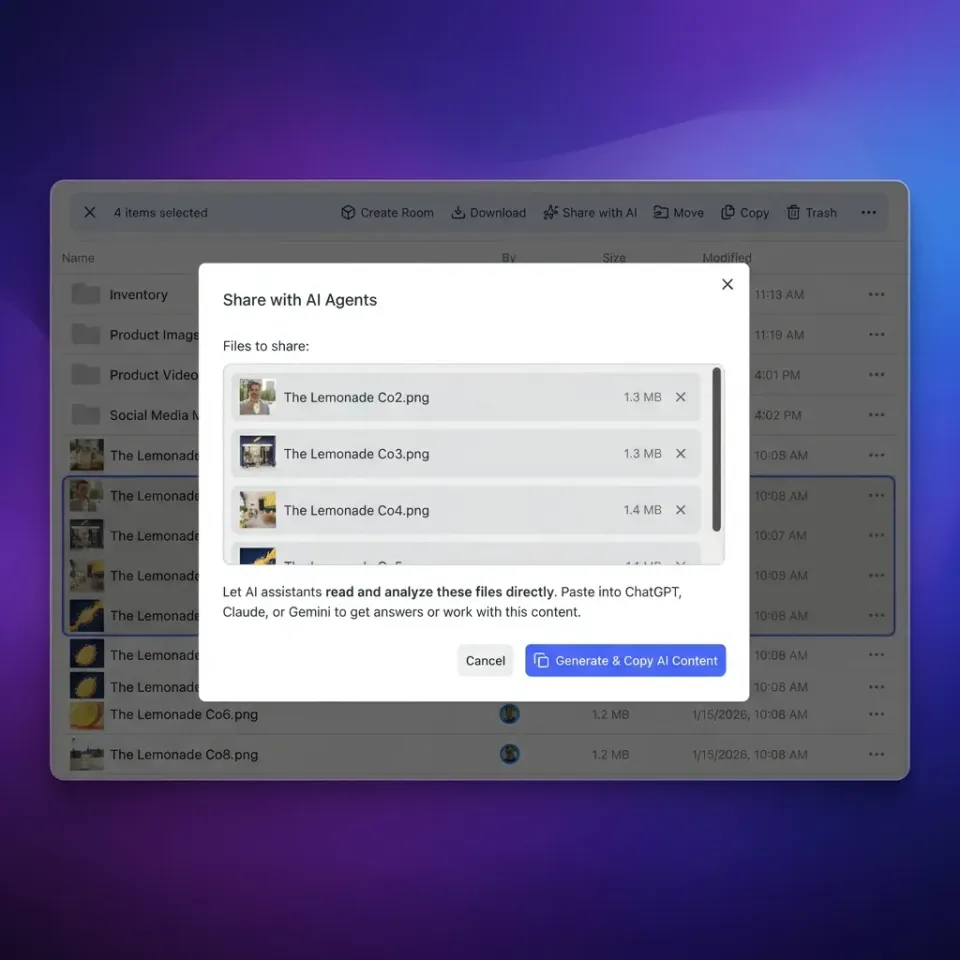
Not every message fits in a text box. When agents need to share reports, datasets, video renders, or design files, chat attachments and email limits fall short. Fastio's MCP server handles the file exchange layer of agent communication with a consolidated MCP toolset for uploading, organizing, and sharing files.
Key strengths:
- Generate secure, branded sharing links for any file type
- Upload and organize files in persistent cloud storage
- Built-in Intelligence Mode with RAG for querying shared documents
- Ownership transfer: agents build workspaces and hand them off to humans
Limitations:
- Not a real-time chat tool (file delivery, not messaging)
- 14-day Business Trial with workspace sharing
Best for: Delivering generated reports, sharing large media files, building client data rooms, and any workflow where the "message" is a file. Fastio provides a 14-day Business Trial for teams and agents to evaluate file workspaces.


Give Your AI Agents Persistent Storage
Share reports, datasets, and media files alongside your messaging workflows.
Which Server Should You Choose?
The right MCP server depends on where your audience lives and what your agent needs to deliver.
For internal team communication, start with Slack or Microsoft Teams. These cover most enterprise use cases and your team is probably already on one of them.
For email workflows, the choice splits by use case. AgentMail works best when agents need their own dedicated inboxes. Google Workspace is better for personal assistant agents managing a human's existing inbox. SendGrid and Postmark handle high-volume outbound email.
For consumer-facing interactions, Telegram and Discord serve different communities. Telegram leans toward international and mobile-first users. Discord is stronger for developer and gaming communities.
For SMS and voice, Twilio is the only real option right now. Nothing else offers the same global reach through MCP.
For file-heavy communication, Fastio fills the gap that text-based tools leave open. When your agent generates a large video render or a multi-page PDF report, a Slack message with a download link from Fastio is more useful than trying to attach files to chat messages.
Most production agent systems combine two or three of these servers. A typical setup might use Slack for status updates, AgentMail for external correspondence, and Fastio for delivering the actual work product.
Setting Up Your First Communication MCP Server
Getting started with a communication MCP server follows the same general pattern no matter which platform you pick:
Pick your MCP client. Claude Desktop, Cursor, VS Code with Copilot, and Devin Desktop (formerly Windsurf) all support MCP servers. Your choice of client determines the configuration format.
Get API credentials. Each platform requires authentication. For Slack, this means creating a Slack app and getting a bot token. For email services, you'll need API keys. For Fastio, sign in with OAuth in the browser when your client first connects; a headless agent can send an API key as an Authorization: Bearer header instead.
Add the server to your config. Most MCP clients use a JSON configuration file. Add the server's transport URL or command, along with your credentials.
Test with a simple action. Send a test message before building complex workflows. Confirm that authentication, permissions, and message formatting all work correctly.
Add guardrails. Before deploying to production, set up rate limits, human-in-the-loop approval for sensitive messages, and audit logging. Giving an agent access to communication channels means it can send messages on your behalf, so scope permissions carefully.
For Fastio specifically, connect via Streamable HTTP at https://mcp.fast.io/mcp/tools, or at https://mcp.fast.io/mcp/code from a coding agent such as Cursor or VS Code with Copilot. The server works with Claude, GPT-4, Gemini, and open-source models.
Sources
References used to verify factual claims in this guide.
-
Fastio consolidated MCP toolset Fastio handles file exchange layer for agent communication with a consolidated MCP toolset The server supports the Streamable HTTP transport and works with Claude, GPT-4, Gemini, and open-source models
-
180+ countries
-
Fastio offers a 14-day Business Trial with paid plans starting at $9.99/month
-
Slack MCP server guide
-
Twilio Alpha MCP server
-
SendGrid MCP server
-
microsoft teams mcp server organizations microsoft 365 agents participate channels send adaptive cards interact workflows
-
Teams MCP Server best for enterprise environments using Microsoft 365
Frequently Asked Questions
What MCP servers work with Slack?
Slack offers an official first-party MCP server that supports channel messaging, thread management, file uploads, emoji reactions, and user presence. You can install it by creating a Slack app in your workspace and configuring the MCP server with your bot token. Workspace admin approval is required.
How do AI agents send emails via MCP?
AI agents send emails through MCP servers like AgentMail, Google Workspace, or SendGrid. AgentMail provides dedicated agent inboxes with webhook notifications. Google Workspace connects to existing Gmail accounts. SendGrid and Postmark handle high-volume transactional and marketing email through their respective APIs.
Can MCP works alongside Discord?
Yes, several community-built MCP servers connect AI agents to Discord. These servers wrap the Discord REST API or Discord.js library and support reading messages, posting to channels, managing reactions, and handling file attachments. There is no official Discord-maintained MCP server yet, but the community options are actively maintained.
Do I need separate MCP servers for each platform?
Yes. Each communication platform requires its own MCP server because they have different APIs, authentication methods, and message formats. A typical production agent might use three or four servers: one for internal chat (Slack), one for email (AgentMail), one for SMS (Twilio), and one for file sharing (Fastio).
How do I prevent agents from sending spam through MCP?
Implement rate limiting, scope permissions to specific channels or recipients, and use human-in-the-loop approval for outbound messages. Most platforms also have their own anti-abuse protections. For file sharing through Fastio, audit logs track every file shared and accessed by agents.
What is the best MCP server for file sharing in agent communication?
Fastio was built specifically for agent file operations, with a consolidated MCP toolset covering uploads, downloads, sharing links, and workspace management. Fastio offers a 14-day Business Trial before paid plans. For text-based messaging, use a dedicated chat MCP server like Slack or AgentMail alongside Fastio for files.
Related Resources

Give Your AI Agents Persistent Storage
Share reports, datasets, and media files alongside your messaging workflows.