Best MCP Servers for Automation in 2026
MCP servers for automation let AI agents trigger workflows, schedule tasks, and coordinate actions across external systems. This guide ranks the best options, from no-code platforms like Zapier to developer tools like Temporal, so you can pick the right one for your stack.


What Are MCP Servers for Automation?
MCP servers for automation provide tools, resources, and prompts that enable AI agents to orchestrate workflows, trigger actions, and coordinate tasks across systems. Instead of hard-coding API calls for every service your agent needs, you install an MCP server and the agent discovers available tools automatically.
This matters because most AI agents are stateless by default. They can reason and write code, but they can't natively click a button in your CRM, trigger an email drip, or wait for a webhook callback. Automation MCP servers fill that gap.
According to early adopter reports, MCP-based integrations reduce automation setup time compared to building custom API connectors. Automation-focused MCP servers handle many common workflow tasks out of the box, which means less plumbing code and more time spent on the actual logic your agent should execute.
Related guides
- How to Set Up an MCP Server for n8n Workflow AutomationThe Model Context Protocol turns n8n into an AI-accessible automation platform. This guide walks through setting up n8n...
- How to Set Up an MCP Server for GitHub ActionsMost GitHub MCP guides stop at repo management. This guide covers the Actions-specific surface: connecting an MCP...
- How to Set Up an MCP Server for LinkedInAn MCP server for LinkedIn lets AI agents read profiles, search jobs, send messages, and publish posts through the...
- MCP Resources vs Tools: When to Use Each in the Model Context ProtocolUnderstanding the difference between resources and tools is essential for building efficient MCP servers. Resources...
- How to Set Up an MCP Server for CalendlyCalendly's official MCP server lets AI agents check availability, book meetings, and manage scheduling links through...
- How to Connect DocuSign to AI Agents with the MCP ServerDocuSign's official MCP server lets AI agents send envelopes, check signing status, query agreements through Navigator,...
More on this subject: MCP and Model Context Protocol (232 guides)
How We Evaluated
We tested each MCP server against five criteria:
- Tool coverage: How many automation primitives does the server expose? (triggers, schedulers, queues, file operations)
- Setup friction: How quickly can a developer get it running?
- Reliability: Does the server handle retries, failures, and long-running tasks gracefully?
- Ecosystem size: How many third-party integrations or community plugins are available?
- Cost: What does the free tier include, and where do paid plans start?
We also considered how well each server works with popular MCP clients like Claude Desktop, Cursor, and VS Code Copilot.
The Best MCP Servers for Automation
Here are the top picks, ordered by breadth of automation capabilities.
Define clear tool contracts and fallback behavior so agents fail safely when dependencies are unavailable. This improves reliability in production workflows.
Define clear tool contracts and fallback behavior so agents fail safely when dependencies are unavailable. This improves reliability in production workflows.
Define clear tool contracts and fallback behavior so agents fail safely when dependencies are unavailable. This improves reliability in production workflows.
1. Zapier MCP Server
Zapier's official MCP server connects AI agents to over 8,000 apps. It handles authentication, rate limiting, and parameter mapping so your agent can send a Slack message, create a Jira ticket, or update a Google Sheet with a single tool call.
Strengths:
- Access to 8,000+ SaaS integrations without writing API code
- Natural language action mapping (agents can describe what they want, and Zapier routes it)
- Reliable execution with built-in error handling
Limitations:
- Subscription pricing adds up quickly at scale
- Limited control over execution logic compared to code-first tools
Best for: Teams that need agents to interact with many SaaS apps without custom integrations.
Pricing: Free tier with 100 tasks/month. Paid plans start at $19.99/month.
2. n8n MCP Integration
n8n is a fair-code workflow automation tool with native MCP support. Agents can trigger existing n8n workflows, pass parameters, and receive results. Because n8n is self-hostable, your automation data never leaves your infrastructure.
Strengths:
- Self-hosted option for full data control
- Visual workflow editor with real-time execution monitoring
- 400+ community nodes for third-party integrations
- Branching, loops, and error handling built into the workflow engine
Limitations:
- Steeper learning curve than Zapier for non-developers
- Self-hosting requires infrastructure management
Best for: Developers who want full control over workflow execution while letting AI handle decision-making.
Pricing: Free self-hosted. Paid cloud plans are available; see the vendor's pricing page.
3. Fastio MCP Server
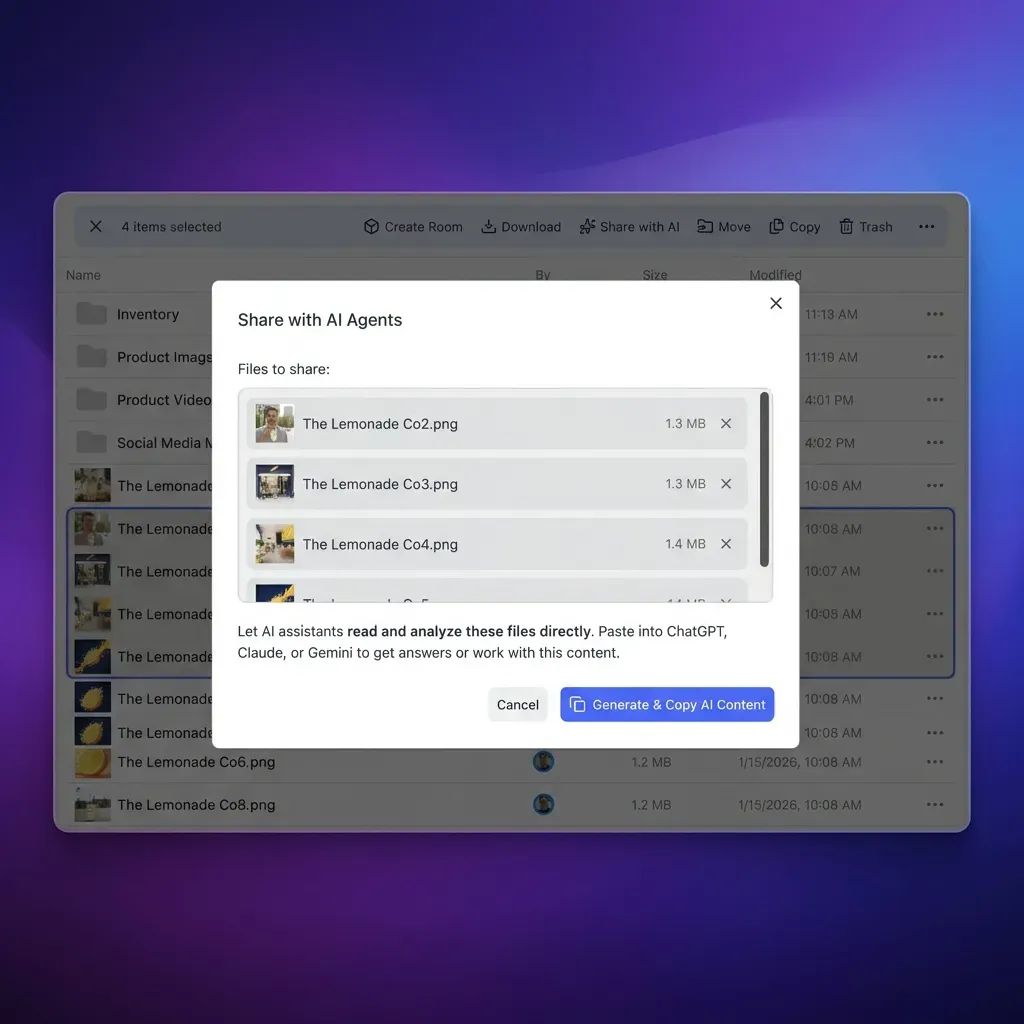
Fastio provides a full MCP server for file operations and persistent agent storage. It exposes a consolidated toolset via Streamable HTTP and SSE, covering file management, workspace organization, sharing, and RAG once Intelligence is enabled, giving agents long-term memory and a real file system.
Strengths:
- A consolidated MCP toolset for file CRUD, advisory file locks, workspace management, sharing, comments, and AI chat
- Built-in RAG: Toggle Intelligence Mode on a workspace and files are auto-indexed. Ask questions with citations, no separate vector database needed
- Ownership transfer: Agents build workspaces and shares, then hand them off to humans while keeping admin access
- Works with any LLM: Claude, GPT-4, Gemini, LLaMA, and local models
Limitations:
- 14-day Business Trial with workspace collaboration
- Focused on file and document workflows, not general SaaS integration
Best for: Agents that need persistent file storage, document processing, report generation, or RAG-powered knowledge bases.
Pricing: 14-day Business Trial with paid plans starting at $9.99/month (Starter) up to $199.99/month (Enterprise).
4. Temporal MCP Server
Temporal handles durable execution. The Temporal MCP server lets agents start, signal, and query long-running workflows that are guaranteed to complete even if the underlying server crashes mid-execution.
Strengths:
- Workflows survive hardware failures and network outages
- Built-in state management for processes spanning days or weeks
- Code-first workflow definitions in Go, Java, TypeScript, or Python
Limitations:
- Significant learning curve for Temporal's programming model
- Overkill for simple one-shot automations
Best for: Mission-critical agent tasks where failure is not acceptable, like payment processing or multi-step onboarding flows.
Pricing: Free open-source. Temporal Cloud pricing is consumption-based.


Give Your AI Agents Persistent Storage
Fastio gives teams shared workspaces, MCP tools, and searchable file context to run best mcp servers for automation workflows with reliable agent and human handoffs.
Utility MCP Servers for Specific Tasks
Beyond the major platforms, several focused MCP servers solve specific automation problems. These tend to be open-source reference implementations or community-built tools.
Define clear tool contracts and fallback behavior so agents fail safely when dependencies are unavailable. This improves reliability in production workflows.
Define clear tool contracts and fallback behavior so agents fail safely when dependencies are unavailable. This improves reliability in production workflows.
5. Playwright MCP Server
The Playwright MCP server gives agents full browser automation capabilities. Agents can navigate pages, fill forms, click buttons, and extract data using structured accessibility trees instead of expensive screenshot-based approaches.
Strengths:
- Headless browser control with accessibility-first selectors
- Supports Chrome, Firefox, and WebKit
- Can handle authentication flows and multi-page interactions
Best for: Web scraping, form filling, and browser-based testing tasks.
6. Scheduler MCP Server
A dedicated server for time-based operations. It gives agents tools to schedule tasks, set delays, and manage recurring jobs. This fills a common gap where agents need to perform actions at specific times rather than immediately.
Best for: Calendar management, delayed notifications, and cron-like behaviors.
7. Task Queue MCP Server
Implements a simple FIFO (First-In-First-Out) buffer. Agents push items to the queue and other agents or worker processes pop them off. This enables multi-agent architectures where one agent generates work items and another executes them.
Best for: Decoupling producer agents from consumer agents in multi-agent systems.
8. Pipedream MCP Server
Pipedream combines event-driven architecture with serverless code execution. Agents can trigger Node.js or Python functions, listen for webhooks, and chain together multi-step workflows. It sits between Zapier's simplicity and n8n's flexibility.
Strengths:
- Built-in HTTP triggers and webhooks
- Execute custom code (Node.js, Python) in each step
- 1,000+ pre-built integrations
Best for: Developer-friendly automation that needs both code execution and pre-built connectors.
Pricing: Free tier with 10,000 invocations/month. Paid tiers are available; see the vendor's pricing page.
Which MCP Server Should You Choose?
The right server depends on what your agent needs to automate:
- Connecting SaaS apps (Slack, Gmail, Salesforce): Start with Zapier MCP. The 8,000+ integration library means your agent can talk to almost anything without custom code.
- File storage and document workflows: Use Fastio. The consolidated MCP toolset, built-in RAG when Intelligence is enabled, and persistent workspaces cover what file-centric agents need.
- Complex, self-hosted logic: Pick n8n. The visual workflow builder and self-hosting option give you maximum control over execution.
- Reliability-critical tasks: Choose Temporal when workflows cannot fail.
- Browser automation: Add Playwright when agents need to interact with web UIs.
- Multi-agent coordination: Combine Task Queue and Scheduler servers for producer/consumer patterns.
Production agent systems often use multiple MCP servers together. For example, an agent might use Fastio for persistent storage, Zapier for email triggers, and Temporal for long-running executions. MCP was built to support this kind of mix-and-match setup.

Sources
References used to verify factual claims in this guide.
-
Zapier connects to over 8,000 apps The 8,000+ integration library means agents can talk to almost anything without custom code
-
Zapier free tier includes 100 tasks/month, paid plans start at $19.99/month
-
n8n has 400+ community nodes
-
Fastio provides a consolidated MCP toolset Fastio provides a consolidated MCP toolset via Streamable HTTP and SSE for file management and workspace operations Fastio consolidated MCP toolset with built-in RAG
-
Fastio provides a 14-day Business Trial with plans starting at $9.99/month Fastio provides a 14-day Business Trial for workspaces
-
Pipedream has 1,000+ pre-built integrations
-
Pipedream free tier includes 10,000 invocations/month
-
Zapier provides 8,000+ app integrations
Frequently Asked Questions
What MCP servers support workflow automation?
The top MCP servers for automation workflows include Zapier, n8n (self-hosted visual workflows), Fastio (persistent storage and document intelligence), Temporal (durable execution), Playwright (browser automation), and Pipedream (serverless code execution with webhooks).
How do I automate tasks with Model Context Protocol?
Install an automation MCP server into your client configuration (Claude Desktop, Cursor, or VS Code). Once connected, prompt your agent with a goal like 'Monitor this folder and email me when a new PDF arrives.' The agent will use the server's tools to execute the request without custom API code.
Can MCP trigger external actions?
Yes. MCP servers expose tools that agents call to trigger real actions in external systems. For example, the Zapier MCP server can send emails, create CRM records, and post to Slack. Fastio's MCP server supports activity polling and a WebSocket events feed when files change, enabling reactive coordination.
Can I use multiple MCP servers at the same time?
Yes, composability is a core strength of the Model Context Protocol. A single agent can connect to Fastio for file storage, Zapier for SaaS integrations, and Temporal for durable workflows simultaneously. Each server registers its own tools, and the agent picks the right one for each task.
Is n8n or Zapier better for MCP-based automation?
It depends on your priorities. Zapier is better if you need quick access to thousands of apps without managing infrastructure. n8n is the stronger choice if you need self-hosting, complex branching logic, or want to avoid per-task pricing. Many teams use both.
Does Fastio support automation triggers?
Agents can track file changes using Fastio's realtime activity feed or WebSocket events feed. Agents can also use URL Import to pull files from Google Drive, OneDrive, Box, and Dropbox without local I/O, and advisory file locks coordinate writes when multiple agents access the same files.
Related Resources

Give Your AI Agents Persistent Storage
Fastio gives teams shared workspaces, MCP tools, and searchable file context to run best mcp servers for automation workflows with reliable agent and human handoffs.