Best MCP Hosting Platforms for AI Agent Tool Servers
Discover the best MCP hosting platforms for AI agent tool servers. The top platforms host MCP servers that AI agents connect to. Serverless options get you running in minutes instead of days. We rank platforms by price, setup ease, scaling, tools, and file handling for agents. Fastio offers a consolidated toolset and persistent RAG workspaces. Table below compares key specs. Details on agent fit next.


Best MCP Hosting Platforms: What to Know
Model Context Protocol (MCP) connects AI clients like Claude Desktop, Cursor, or OpenClaw to remote tool servers via Streamable HTTP or SSE. Agents use it to access files, databases, workflows without local infrastructure.
MCP hosting keeps these servers up and running. Services handle authentication, global distribution, and concurrency. Serverless makes deployment take minutes, not days.
Agents turn to MCP for file CRUD, RAG queries, email, custom workflows. Look for persistent storage, advisory file locks, audit logging, RAG indexing, ownership transfer to humans, and activity feeds. Compute platforms often lack file integration. Fastio supplies a consolidated MCP toolset and shared workspaces.
Key agent-specific features like granular permissions, audit logs, RAG indexing once Intelligence is enabled, and ownership transfer make it production-ready for multi-agent teams.
Related guides
- Hosting Open Source MCP Servers in Multi-Agent RoomsHosting open source MCP servers within shared workspaces is essential for multi-agent coordination. This guide explains...
- Top 7 Open Source MCP Servers for AI Agents in 2026Open source MCP servers give AI agents direct access to files, databases, and APIs without black-box proprietary...
- Best MCP Servers for LLM Workflows in 2026Model Context Protocol servers give LLMs standardized access to tools, data, and services. With over 10,000 public...
- Best MCP Servers for Education and EdTech: Top 7 Tools for 2026MCP servers in education enable AI tutors and admin agents to access learning management systems securely. By...
- Best MCP Servers for Search: Connecting AI Agents to Real-Time DataSearch MCP servers connect AI agents to real-time web data, which cuts down on hallucinations and helps agents retrieve...
- 7 Best MCP Servers for Video Processing in 2026MCP servers for video processing let AI agents transcode, analyze, edit, and stream video through Model Context...
More on this subject: MCP and Model Context Protocol (232 guides)
How We Evaluated MCP Platforms
We deployed a test MCP server handling file ops and RAG queries on each. Criteria:
Deployment Speed: Git push, CLI, Docker? Time to first request?
Pricing for Agents: Free tiers, per-request costs, minimums. Cost for typical agent workloads (e.g., high-volume requests and substantial storage).
Scaling & Performance: Global edge? Cold starts? Multi-agent concurrency?
Built-in Tools: Native MCP endpoints or custom code? File tool support?
Agent-Specific Features: Persistent storage, version control, audit logs, RAG, ownership transfer, activity feeds.
Reliability: Docs, SLAs, uptime, community.
Tests used a Node.js MCP server handling heavy agent loads, file uploads, and concurrent access from multiple agents.
This evaluation highlights platforms that balance cost, performance, and agent-friendly features like persistent storage and low-latency global delivery.
Pricing and Features Comparison
Fastio stands out with a consolidated MCP toolset and persistent agent workspaces. Others need custom MCP code. Lack of native RAG or file locks means more work to integrate.



Give Your AI Agents Persistent Storage
Fastio gives teams shared workspaces, MCP tools, and searchable file context to run best mcp hosting platforms workflows with reliable agent and human handoffs.
1. Fastio
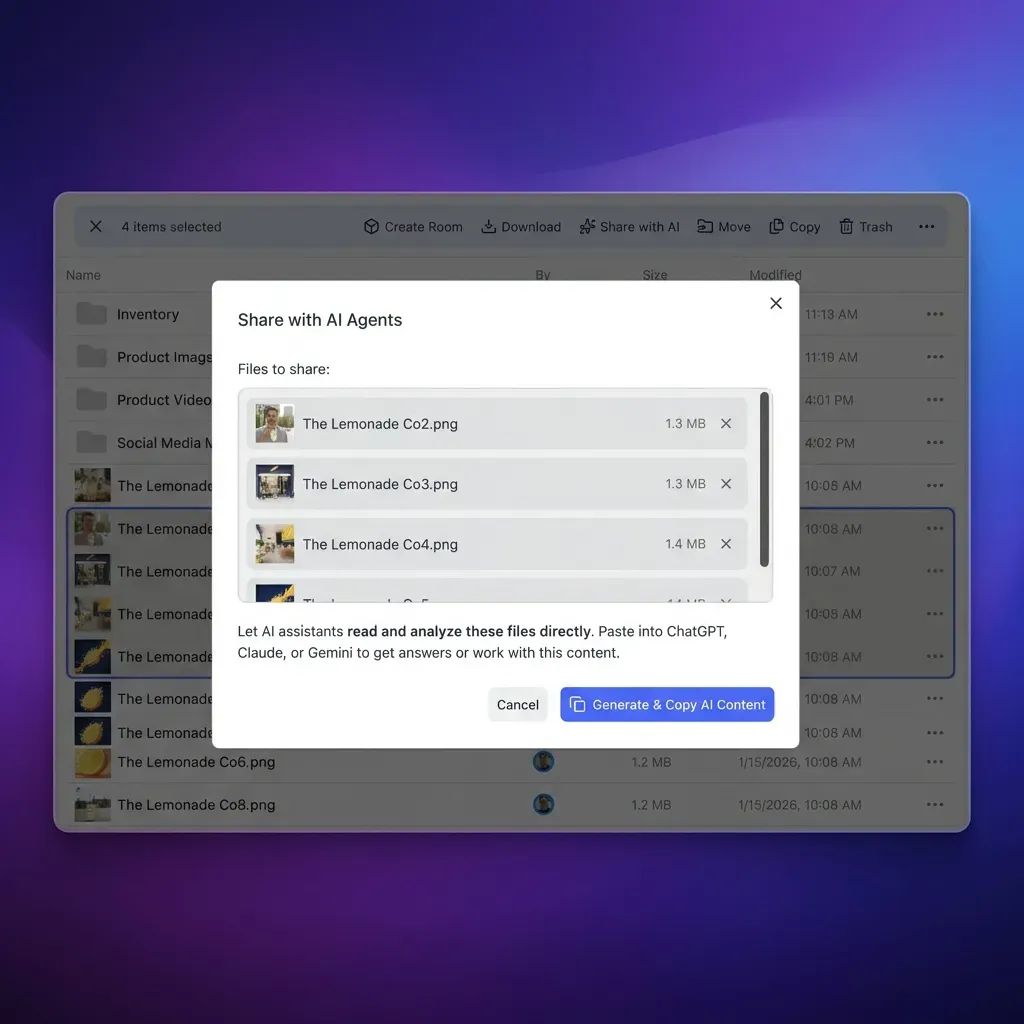
Fastio does not host your own MCP server code. It runs its own remote MCP server at https://mcp.fast.io/mcp/tools, with a consolidated toolset for files and workspaces, so agents can use it for storage next to whichever platform below hosts their custom tools. Agents create workspaces, upload, query indexed documents once Intelligence is enabled, share branded links, and transfer ownership via Streamable HTTP.
Deployment: No setup. Auth via MCP docs, call tools via remote URL. Works with Claude Desktop, Cursor, and any MCP client.
Strengths:
- Business Trial: 14-day Business Trial with workspace collaboration and Intelligence features.
- Agent-ready: Granular permissions, audit logs, RAG indexing once Intelligence is enabled, activity feeds, URL imports (Drive/Dropbox), ownership transfer.
- Strong files: Previews (video HLS 50-60% faster), comments anchored to regions/timestamps, semantic search.
Limitations:
- Usage-based credits with plans from $9.99/month.
- File-focused (not general compute).
Great for agent teams with ongoing workflows. Agent uploads report, makes branded share, and alerts human collaborators.
Pricing: 14-day Business Trial; Starter ($9.99/mo), Business ($49.99/mo), Enterprise ($199.99/mo). See pricing.
2. Vercel
Vercel handles serverless Next.js and edge functions well. Good for custom Node.js MCP servers.
Deployment Example:
vercel --prod
Connect domain, set env vars for auth/DB.
Strengths:
- Global edge (low latency everywhere).
- Minimal cold starts with Fluid Compute.
- Blob storage for files, AI SDK.
Limitations:
Teams tier requires a per-user monthly commitment.
Build custom MCP + integrations (no built-in locks/RAG).
Per-user billing adds up for agent fleets.
Blob storage integrates well for file handling, with global replication supporting agent uploads and retrievals.
Solid for web-focused agents. Pair with S3/R2 for files.
Pricing: Hobby free (1M requests/month); Pro tier scales with usage (see vendor pricing).
3. Render
Render deploys web services, workers, DBs via Git. Fits full-stack MCP setups.
Deployment Example:
git push render main
Auto-detects Node/Python/Docker.
Strengths:
- Postgres/KV for agent state.
- Zero-downtime deploys, autoscaling.
- Predictable pricing per service.
Limitations:
- Builds slow at peaks.
- Custom MCP + DB setup.
- Limited global reach.
Render's persistent disks and Postgres add-ons provide reliable storage for agent state and databases in full-stack MCP deployments.
Good for agent backends with DB needs. Files need custom handling.
Pricing: Hobby free; Pro tier billed monthly plus compute usage (see vendor pricing).
4. Railway
Railway bills by CPU/RAM usage.
Strengths:
- Pay for what you use.
- Easy Git deploys.
- Volume storage.
Limitations:
- $5 monthly credits minimum for hobby.
- Newer service.
Railway's usage-based billing and volume storage suit variable agent workloads, with quick Git deploys for MCP servers.
Fine for workloads that vary.
Pricing: $5 credits/month hobby; $20 pro minimum.
5. Cloudflare Workers
Edge compute with KV/D1 storage.
Strengths:
- Fast global delivery.
- Cheap at scale.
- Durable Objects for state.
Limitations:
- JS/Wasm only.
- Time limits per request.
Cloudflare's Durable Objects enable stateful MCP sessions, while KV and R2 offer low-latency storage for agent data at the edge.
Best for APIs.
Pricing: 100k requests/day free; paid plans scale with usage (see vendor pricing).
6. Fly.io
Global VMs in close regions.
Strengths:
- Low latency any region.
- Managed Postgres.
- Reservations cut costs 40%.
Limitations:
- Manual scaling.
Fly.io's regional VMs minimize latency for geo-sensitive agents, with persistent volumes for file persistence.
Good for latency matters.
Pricing: PAYG, ~$2 small VM/month.
7. Heroku
PaaS with dynos and add-ons.
Strengths:
- Simple deploys.
- Postgres support.
- Reliable.
Limitations:
- Dynos sleep, costs more.
Heroku's Postgres add-ons handle agent data persistence, ideal for quick prototypes without complex setup.
For prototypes.
Pricing: Eco tier available (see vendor pricing); Standard $25.
Which MCP Platform to Choose?
- Agents with files: Fastio
- Web apps: Vercel
- Budget full-stack: Railway, Render
- Edge APIs: Cloudflare
- Low latency: Fly.io
- Prototypes: Heroku
Consider agent needs: file-heavy favor Fastio's tools; compute-heavy choose Vercel or Cloudflare. Budget full-stack suits Railway/Render; latency-critical Fly.io; prototypes Heroku.
Try free tiers. Deploy a test MCP server on a couple to validate fit.
Define clear tool contracts and fallback behavior so agents fail safely when dependencies are unavailable. This improves reliability in production workflows.
Sources
References used to verify factual claims in this guide.
-
Fastio provides a 14-day Business Trial for agent workspaces Fastio stands out with a consolidated MCP toolset and persistent agent workspaces Fastio Business Trial offers consolidated MCP tools and RAG workspaces
-
Vercel Hobby 1M Edge Requests per month included Vercel Pro $20 per user per month Vercel Pro $20/user/month
-
Render Professional $19 per user per month plus compute Render Pro $19/user/month
-
Railway Hobby $5 monthly credits included Railway Pro $20 minimum usage Railway Hobby $5 credits Railway $5 credits/month hobby; $20 pro minimum
-
Cloudflare Workers 100,000 requests per day free Cloudflare Workers Paid $5 monthly minimum Cloudflare provides 100k requests/day free with usage-based paid plans
-
Fly.io reservations cut costs by 40% Fly.io small VM approximately $2 per month Fly.io PAYG small VM ~$2/mo Fly.io PAYG ~$2 small VM/month
-
Heroku Eco dyno $5 per month Heroku Standard dyno $25 per month Heroku Eco $5/mo Heroku offers an Eco tier alongside Standard at $25
-
Cloudflare Workers free 100k reqs/day
-
Fastio HLS video streaming 50-60% faster
Frequently Asked Questions
What are the best MCP hosting platforms?
Fastio for agent files. Vercel or Cloudflare for serverless. Railway/Render for apps. Pick based on files vs compute.
What serverless MCP options exist?
Vercel, Render, Railway, Cloudflare. Deploy MCP code globally, scales automatically.
Does Fastio offer a trial for MCP agents?
Fastio offers a 14-day Business Trial requiring a credit card, providing access to its consolidated MCP toolset and workspaces before paid plans.
How does MCP hosting differ from VPS?
Serverless pays per request, autoscales. VPS is fixed machines you manage.
Can I run custom MCP on these?
Yes on all except Fastio, which runs only its own MCP server. Vercel/Cloudflare simplest.
Related Resources

Give Your AI Agents Persistent Storage
Fastio gives teams shared workspaces, MCP tools, and searchable file context to run best mcp hosting platforms workflows with reliable agent and human handoffs.