Best File Storage for Multi-Agent Systems
File storage for multi-agent systems gives AI agents a shared file layer with concurrent access controls. Agents can read, write, and coordinate on documents without conflicts or data loss. Multi-agent architectures are increasingly common in production AI systems, but file coordination bugs remain a frequent cause of pipeline failures.

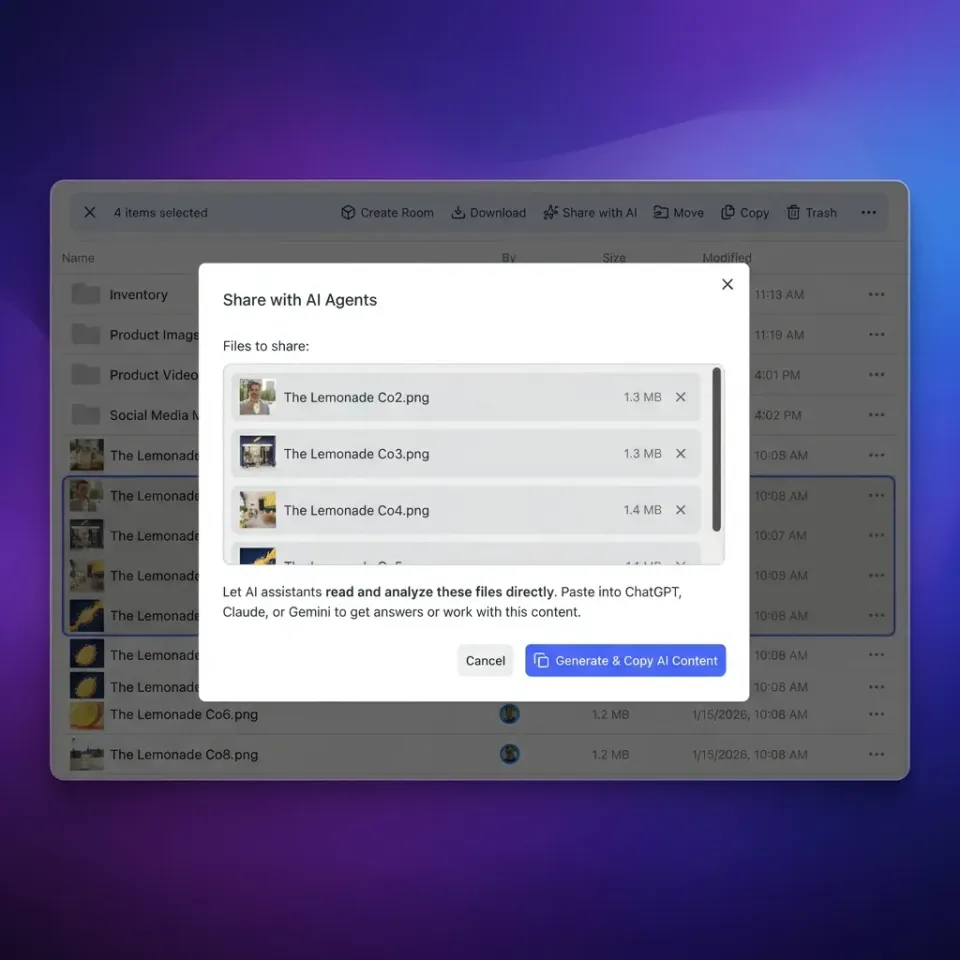
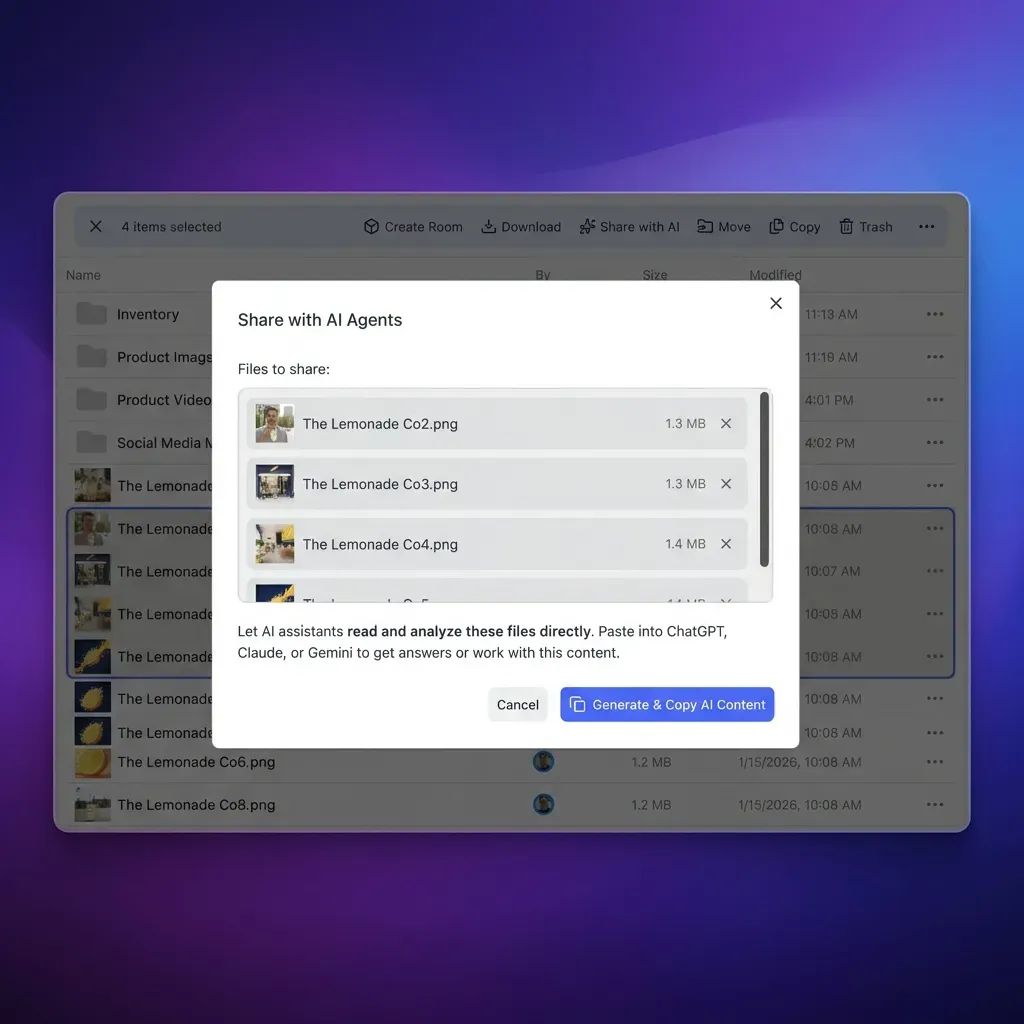
What Multi-Agent Systems Need From File Storage
Multi-agent systems break complex tasks into specialized agents that run in parallel. An AI research assistant might split work between a data-gathering agent, analysis agent, and report-writing agent. Each agent creates files, reads shared resources, and passes intermediate results to teammates. Traditional file storage fails here. Local filesystems disappear when serverless functions end. Cloud storage services designed for humans lack agent-friendly APIs. Object stores like S3 require custom integration work and provide no built-in conflict resolution.
Core requirements for multi-agent file storage:
- Concurrent access controls to prevent file conflicts when multiple agents edit simultaneously
- Persistent storage that survives container restarts and serverless cold starts
- API-first design for programmatic file operations without browser UIs
- File locking mechanisms to coordinate exclusive writes
- Shared workspaces where agents can organize files by project or client
- Ownership transfer so agents can build deliverables and hand them to humans
Helpful references: Fastio Workspaces, Fastio Collaboration, and Fastio AI.
Related guides
- How to Handle File Storage in n8n AI Agent Workflowsn8n AI agents need persistent storage to save files between workflow runs.
- How to Set Up File Storage in FlowiseFlowise is a drag-and-drop UI for building LLM-powered applications, but it doesn't include persistent file storage out...
- How to Save and Persist Code Interpreter Files Beyond the SessionCode interpreters run your Python in a sandbox, but every file vanishes when the session ends. This guide explains...
- How to Add File Storage to Vercel AI SDK ApplicationsThe Vercel AI SDK gives you React hooks and server utilities for building AI-powered applications, but file storage for...
- How to Add Persistent File Storage to Dify AI AgentsDify AI file storage connects the Dify open-source LLM platform to persistent cloud storage. This lets agents read,...
- How to Integrate Dify AI with External File StorageDify is an open-source platform for building AI applications with visual workflows. Its built-in file handling works...
More on this subject: Agent Memory and Storage (261 guides)
How We Evaluated These Solutions
We tested each file storage platform against the specific needs of multi-agent architectures.
Evaluation criteria:
- Agent-first API: Complete file operations via REST or SDK without requiring browser interaction
- Concurrent access: File locking, optimistic concurrency, or conflict-free replicated data types
- Persistence model: Files survive beyond request lifecycle, not ephemeral storage
- Workspace organization: Logical grouping of files by project, client, or workflow stage
- Human handoff: Ability to transfer agent-created files to human users
- Free tier: Development and testing support without upfront costs
- Multi-LLM support: Works with Claude, GPT-4, Gemini, LLaMA, and local models
Consider how this fits into your broader workflow and what matters most for your team. The right choice depends on your specific requirements: file types, team size, security needs, and how you collaborate with external partners. Testing with a free account is the fast way to know if a tool works for you.
1. Fastio
Fastio provides cloud storage designed for AI agents, offering 250 GB to 25 TB storage and a consolidated MCP toolset for file operations.
Why it works for multi-agent systems:
Agents sign up for their own accounts with workspaces, file management APIs, and built-in RAG. The platform treats agents as first-class citizens, not second-class API users. Granular permissions and audit logs control and track access, advisory file locks let agents coordinate before writing, and version history keeps every version. Ownership transfer lets agents build complete data rooms and hand them to human clients while keeping admin access. Intelligence adds semantic search and auto-indexing once enabled for the workspace.
Strengths:
- A consolidated MCP toolset via Streamable HTTP and SSE
- Advisory file locks and version history with restore
- Built-in RAG once Intelligence is enabled for the workspace
- Ownership transfer from agents to humans
- Realtime activity polling and WebSocket events feed
- Plans bundle storage, seats, and a monthly credit allowance
- Works with any LLM (Claude, GPT-4, Gemini, LLaMA, local models)
Limitations:
- Monthly plans start with a trial of up to 14 days, which requires a credit card, then continues on a paid plan
- Credits reset monthly, and heavy ingestion or chat can exhaust the allowance before the cycle ends
Best for: Multi-agent systems that need persistent workspaces, human collaboration, and built-in RAG without managing separate vector databases.
Pricing: Starter is $9.99/mo ($99/year) with 3 seats, 250 GB, and 100,000 credits. Business is $49.99/mo and Enterprise is $199.99/mo. Overage runs $10 per 100,000 credits.


Start with best file storage for multi-agent systems on Fastio
Fastio gives teams shared workspaces, MCP tools, and searchable file context to run best file storage multi agent systems workflows with reliable agent and human handoffs.
2. AgentFS (Turso SQLite)
AgentFS implements a complete agent filesystem on SQLite using Turso. Each agent's state lives in a single database file.
Why it works for multi-agent systems:
Everything an agent does lives in one SQLite database. Multi-agent collaboration means multiple agents work on the same filesystem. The coordination layer handles conflicts with last-push-wins by default or custom merge logic via transform hooks.
Strengths:
- Complete SQLite-based storage with full ACID guarantees
- Custom merge logic for conflict resolution
- Single database file per agent simplifies deployment
- Open source implementation
Limitations:
- Requires Turso infrastructure setup
- SQLite performance limits for large file collections
- Less mature than traditional cloud storage
Best for: Developers who want full control over the storage layer and can manage SQLite-based infrastructure.
Pricing: Based on Turso pricing (free tier available).
3. MinIO
MinIO AIStor delivers S3-compatible object storage optimized for AI workloads with sub-10ms latency.
Why it works for multi-agent systems:
MinIO provides enterprise-grade object storage that scales horizontally to support parallel reads and writes across distributed compute nodes. S3 compatibility means existing tools and libraries work immediately.
Strengths:
- Consistent sub-10ms latency
- Native S3 compatibility
- Scales to exascale for massive datasets
- Self-hosted or cloud deployment options
Limitations:
- No built-in agent authentication or workspace abstraction
- Requires custom conflict resolution implementation
- Infrastructure overhead for self-hosted deployments
- No file locking primitives (must build on top)
Best for: Teams with existing S3 workflows who need high-performance object storage and can build agent coordination layers.
Pricing: Open source (self-hosted) or enterprise cloud pricing.
4. Google Cloud Storage
Google Cloud Storage offers managed object storage for AI and ML workloads at any scale.
Why it works for multi-agent systems:
Cloud Storage handles unstructured data across all AI workflow phases. It scales horizontally and works alongside Google's AI platform tools. Object versioning provides basic conflict handling.
Strengths:
- Unlimited scale for massive datasets
- Built-in versioning for change tracking
- Integration with Vertex AI and other Google services
- Global edge locations for low latency
Limitations:
- No native file locking for concurrent writes
- Workspace abstraction requires custom implementation
- Pricing complexity with egress costs
- No agent-specific features or free tier for agents
Best for: AI teams already using Google Cloud Platform who need massive storage capacity.
Pricing: Pay-as-you-go based on storage and bandwidth.
5. Redis (for Memory and State)
Redis handles persistent storage, vector search, and caching in one platform.
Why it works for multi-agent systems:
Memory systems need persistent storage with semantic search. Redis offers fast key-value storage with optional vector search for agent state management.
Strengths:
- Sub-millisecond access times
- Native vector search for embeddings
- Pub/sub for agent communication
- Atomic operations for conflict-free updates
Limitations:
- Primarily for state and metadata, not large file storage
- Cost scales with memory size
- Not designed for multi-GB file objects
- Requires combining with object storage for complete solution
Best for: Agent state management and memory systems, combined with separate object storage for files.
Pricing: Based on memory size and throughput.
6. Amazon S3
Amazon S3 provides industry-standard object storage with extensive ecosystem support.
Why it works for multi-agent systems:
S3 offers generous storage capacity with strong consistency guarantees. Every major programming language has mature S3 libraries. Versioning and lifecycle policies provide basic conflict handling.
Strengths:
- generous storage capacity
- Strong consistency across all operations
- Mature ecosystem with extensive tooling
- Object lifecycle management
Limitations:
- No native file locking or concurrent write coordination
- Agent-specific features require custom development
- Complex IAM permissions for multi-agent access control
- Egress costs can accumulate quickly
Best for: Teams with AWS infrastructure who need proven, scalable object storage.
Pricing: Pay-as-you-go with free tier for first year.
7. OpenAI Files API
OpenAI provides ephemeral file storage tied to assistants and threads in the Assistants API.
Why it works for multi-agent systems:
Files upload directly to OpenAI and stay accessible during assistant conversations. The API handles file uploads for code interpreter and retrieval tools.
Strengths:
- Zero infrastructure setup
- Direct integration with OpenAI assistants
- Automatic file processing for supported tools
Limitations:
- Files expire after threads end (not persistent)
- Only works with OpenAI models (no multi-LLM support)
- Limited file operations compared to full storage platforms
- No workspace organization or human handoff
- Files tied to specific assistant instances
Best for: Simple OpenAI assistant workflows with ephemeral file needs.
Pricing: Included with OpenAI API usage.
Which File Storage Should You Choose?
Choose Fastio if: You want agent-native storage with built-in RAG, advisory file locks, version history, ownership transfer, and MCP integration. The entry plan supports production use for small to medium agent teams.
Choose AgentFS if: You prefer SQLite-based storage with full control over the data model and can manage Turso infrastructure.
Choose MinIO if: You need S3-compatible object storage with sub-10ms latency and already have infrastructure expertise.
Choose Google Cloud Storage if: You're deep in the Google Cloud ecosystem and need unlimited scale with Vertex AI integration.
Choose Redis if: You're building agent memory systems and need fast state management combined with separate file storage.
Choose Amazon S3 if: You're standardized on AWS and need proven, scalable object storage with extensive tooling.
Choose OpenAI Files API if: You're building simple OpenAI assistants and don't need persistent storage beyond individual conversations.
Sources
References used to verify factual claims in this guide.
-
A consolidated MCP toolset via Streamable HTTP and SSE transport
-
Fastio plans offer 250 GB to 25 TB storage for workspaces Fastio plans include a monthly credit allowance that resets each cycle Credit overage is billed at $10 per 100,000 credits
-
MinIO AIStor object storage optimized for AI workloads with sub-10ms latency
Frequently Asked Questions
How do multiple AI agents share files without conflicts?
Multi-agent file sharing requires coordination mechanisms like advisory file locks, version history, or conflict-free replicated data types. Fastio provides advisory file lock APIs (with MCP storage actions lock-acquire, lock-status, and lock-release) so agents coordinate before writing. If another agent attempts to lock the same file, it receives an HTTP 409 and can wait, while version history preserves every write as a safety net.
What storage works best for multi-agent systems?
Agent-native platforms like Fastio work best because they provide workspace organization, advisory file locks, version history, and ownership transfer out of the box. Traditional object stores like S3 or MinIO work but require building agent coordination layers. The best choice depends on whether you want to focus on agent logic or storage infrastructure.
Do I need separate vector storage for RAG in multi-agent systems?
Not necessarily. Fastio includes built-in RAG once Intelligence is enabled for the workspace, so you don't need separate vector databases like Pinecone. For custom implementations, you can combine object storage (S3, MinIO) with dedicated vector stores. Managed solutions save infrastructure complexity.
How do you coordinate file access between AI agents?
Advisory file locks and version history provide reliable coordination. In Fastio, an agent acquires a file lock before writing, renews it with a heartbeat, and releases it when finished. If a second agent tries to acquire a locked file, it receives an HTTP 409. Fastio logs actions in a detailed activity log and preserves complete version history for recovery.
Can AI agents transfer files to human users?
Yes, with platforms that support ownership transfer. In Fastio, an agent can create an organization, build workspaces and shares, then transfer ownership to a human user while retaining admin access. This enables agents to prepare complete deliverables and hand them off.
What's the difference between agent file storage and traditional cloud storage?
Agent file storage provides API-first access, version history, workspace organization, and ownership transfer features designed for programmatic use. Traditional cloud storage focuses on browser UIs and human collaboration. Agents can use traditional storage but need custom code for coordination and organization.
How much storage do multi-agent systems typically need?
This varies widely by use case. Document processing agents analyzing large numbers of documents might require significant storage. Research agents working with large datasets can require hundreds of gigabytes or more. Start on an entry plan like Fastio's, which includes 250 GB, and scale based on actual usage patterns.
Related Resources

Start with best file storage for multi-agent systems on Fastio
Fastio gives teams shared workspaces, MCP tools, and searchable file context to run best file storage multi agent systems workflows with reliable agent and human handoffs.