Best File Sharing for Fine-Tuning AI Datasets
Guide to file sharing fine tuning datasets: Fine-tuning an LLM starts long before you write a training config. You need to collect, clean, version, and distribute datasets across your team and your agents. This guide compares the most common ways to share private fine-tuning datasets and explains where each option fits in a real ML pipeline.


Why Dataset Sharing Is the Bottleneck
Fine-tuning gets the headlines, but data preparation is where most projects stall. A 2016 CrowdFlower survey of data scientists found that 60% of their time went to cleaning and organizing data, with another 19% spent collecting datasets. That roughly 80% figure has become an industry axiom, and while the exact number varies by team, the pattern holds: getting data into the right shape takes far longer than training the model.
The problem compounds when multiple people need the same data. A researcher preps a JSONL file on their laptop. An engineer needs the same file on a GPU cluster. An AI agent running a fine-tuning pipeline needs programmatic access without a human manually uploading it somewhere. Each handoff introduces friction: wrong file versions, broken paths, missing permissions, stale copies sitting in Slack threads.
Dataset sharing for fine-tuning needs three things that generic file storage often misses:
High throughput for large files. Training sets for LLM fine-tuning routinely hit tens of gigabytes. Uploading a 20 GB JSONL file through a web UI with a large limit is a non-starter.
Version tracking. When you discover a labeling error in row 47,000, you need to know which model was trained on which version of the data.
Programmatic access for agents. If an AI agent handles your fine-tuning pipeline, it needs to pull datasets through an API or MCP server, not through a browser download link.

Related guides
- 7 Best Free Online File Metadata ViewersA hands-on comparison of seven free browser-based metadata viewers. Each tool is tested for format support, file size...
- How to Automatically Organize and Sort Files Using MetadataMost file organization systems rely on manual folder structures that break down as libraries grow. Metadata-based...
- Best AI File Organizers in 2026: 8 Tools That Actually Sort Your FilesMcKinsey estimates that employees spend 1.8 hours every day just searching for and gathering information. AI file...
- How to Extract Metadata for AI Training DatasetsMetadata extraction for AI training datasets is the process of programmatically reading file properties, format...
- How to Normalize Metadata Across File FormatsDifferent file formats store metadata in incompatible standards. EXIF handles photos, ID3 covers audio, Dublin Core...
- How to Preserve Metadata During File ConversionConverting files between formats often strips embedded metadata without warning. Author names, creation dates, GPS...
More on this subject: Agent File and Document Workflows (325 guides)
What to check before scaling top file sharing for fine tuning datasets
There is no single correct answer for every team. The right choice depends on your dataset size, how many people (and agents) need access, and whether you need audit trails. Here is how the most common options stack up for private fine-tuning datasets.
S3 and Object Storage
Amazon S3 is the default choice for many ML teams because it scales to any size and every tool speaks its protocol. You can store terabytes of training data, set bucket policies for access control, and enable versioning to track changes.
The tradeoff: S3 is a bucket, not a workspace. There is no built-in way to browse files with context, no semantic search, no commenting, and no concept of "share this dataset with a contractor for review." You end up building tooling around S3 with pre-signed URLs for sharing, Lambda functions for notifications, and separate metadata stores for lineage tracking. For a small team running one fine-tuning job, that overhead is manageable. For a team running dozens of experiments with external collaborators, it compounds fast.
Best for: Teams already deep in AWS with existing IAM policies and automation.
Hugging Face Hub
Hugging Face Hub is purpose-built for ML artifacts. You can upload datasets with huggingface_hub, set repositories to private, and version data with Git LFS under the hood. The integration with the Hugging Face training ecosystem is tight: datasets.load_dataset() pulls directly from Hub repos.
The limitations show up with private, proprietary data. Free accounts have storage caps. Access control is repository-level, not file-level. If you need to share one slice of a dataset with an external annotator while keeping the rest private, you need a separate repo. Hugging Face also introduced Storage Buckets for intermediate files and checkpoints, but the access control story for enterprise-grade audit trails is still evolving.
Best for: Research teams sharing datasets within the Hugging Face training ecosystem.
DVC (Data Version Control)
DVC layers dataset versioning on top of Git. Your .dvc files track which version of the data corresponds to which commit of your training code. The actual data lives in a remote backend: S3, GCS, Azure, NFS, or SSH.
DVC solves the versioning problem well. It does not solve the sharing problem. If a new team member needs the dataset, they need Git access, DVC installed, and credentials for the remote backend. If an AI agent needs the data, it needs all three plus the ability to run dvc pull. DVC also has no built-in UI for browsing or previewing files, so reviewing a dataset before training means pulling it locally first.
Best for: Teams that want Git-native dataset versioning and already have remote storage configured.
Fastio
Fastio takes a different approach. Instead of raw object storage or a version-control layer, it provides shared workspaces where files are browsable, searchable, and accessible through both a web UI and an MCP server. When you enable Intelligence Mode on a workspace, uploaded files are automatically indexed for semantic search and RAG chat, so you can ask questions about your dataset contents without writing a custom query.
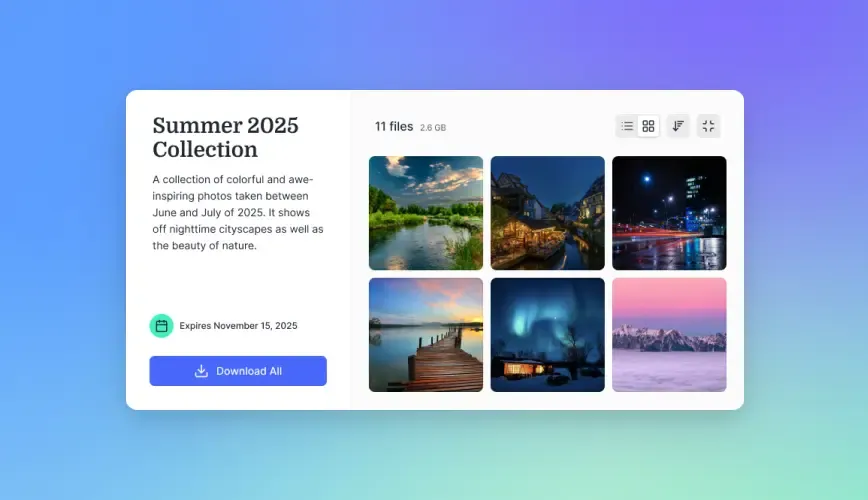
For fine-tuning workflows, Fastio fills gaps the other options leave open. Purpose-built shares let you send a dataset to an external annotator with download controls and expiration dates. Audit trails track every file operation, which matters as EU AI Act enforcement begins in August 2026 and you need documented data provenance. The MCP server means an AI agent can pull datasets, check file versions, and upload results without custom API integration code.
Fastio offers a 14-day Business Trial, card required (see pricing), which gives your team workspace access to test a small fine-tuning pipeline end to end.
Best for: Teams that need both human collaboration and agent access to the same datasets.
Setting Up a Dataset Sharing Workflow
Knowing the options is one step. Putting them together into a workflow that actually works for fine-tuning is another. Here is a practical setup that covers the full lifecycle from raw data to trained model.
Organize by Experiment, Not by Date
The most common mistake is dumping all datasets into a single flat folder. Three months later, nobody knows which file goes with which experiment. Instead, create a workspace (or bucket, or repo) per fine-tuning project with a consistent structure:
medical-qa-finetune/
├── raw/
│   ├── source-a-export-2026-03.jsonl
│   └── source-b-annotations.csv
├── processed/
│   ├── train.jsonl
│   ├── val.jsonl
│   └── test.jsonl
├── configs/
│   └── training-config.yaml
└── results/
    └── eval-metrics.json
This structure works regardless of whether you use S3, Hugging Face, or Fastio. The key is separating raw data from processed data so you can always trace back from a training run to the original source.
Version Your Processed Data
Raw data changes rarely. Processed data changes constantly as you adjust cleaning logic, fix labeling errors, or add new examples. Every time you regenerate train.jsonl, tag or version it. In DVC, that happens automatically through Git commits. In S3, enable bucket versioning. In Fastio, file versioning tracks changes, and you can use the audit trail to see exactly when a file was modified and by whom.
Control Access at the Right Granularity
Not everyone needs access to everything. Your ML engineer needs the processed JSONL files. Your annotator needs the raw data and a way to upload corrections. Your fine-tuning agent needs programmatic read access to the processed folder and write access to the results folder.
S3 handles this through IAM policies, which are powerful but verbose. Hugging Face uses repository-level privacy. Fastio provides granular permissions at the organization, workspace, folder, and file level, so you can give an agent read access to one folder without exposing the entire workspace.


Give Your Fine-Tuning Pipeline a Proper Workspace
Store, version, and share training datasets where both your team and your agents can access them. generous storage, MCP server access. Built for file sharing fine tuning datasets workflows.
Connecting Agents to Your Datasets
A fine-tuning pipeline that requires a human to manually download and upload files defeats the purpose of automation. The agent running your training job needs direct, programmatic access to the dataset.
The S3 Pattern
Most ML pipelines today pull data from S3 using boto3 or the AWS CLI. The agent needs AWS credentials (usually an IAM role or access key), the bucket name, and the object path. This works, but you are responsible for credential rotation, access logging, and building notification logic when files change.
import boto3

s3 = boto3.client("s3")
s3.download_file(
    "my-datasets",
    "medical-qa/processed/train.jsonl",
    "/tmp/train.jsonl"
)
The Hugging Face Pattern
If your data lives on the Hub, agents can pull it using the datasets library or huggingface_hub. Private repos require an access token.
from datasets import load_dataset

dataset = load_dataset(
    "my-org/medical-qa-finetune",
    split="train",
    token="hf_..."
)
This is clean for datasets that fit the Hub's format. For raw files like JSONL, CSV, or Parquet, you may need hf_hub_download instead.
The MCP Pattern
Fastio's MCP server exposes workspace operations as tools that any MCP-compatible agent can call. An agent can list files in a workspace, download a specific dataset, upload training results, and check audit history through the same protocol it uses for other tasks.
The MCP server is available via Streamable HTTP at /mcp and legacy SSE at /sse. For agents built on Claude, GPT-4, Gemini, or open-source models, dataset access works through the same tool-calling interface the agent already uses. No custom S3 integration code needed. You can read the full MCP tooling documentation at mcp.fast.io/skill.md.
Handling Large File Uploads
Fine-tuning datasets are often too large for a single HTTP request. S3 handles this with multipart uploads. Hugging Face Hub uses Git LFS. Fastio supports chunked uploads for large files, with a maximum file size of 25 GB on Starter, 50 GB on Business and 100 GB on Enterprise. If your dataset exceeds that, split it into shards, which is a common practice anyway since most training frameworks expect sharded data for parallel loading.

Data Lineage and Audit Trails
The EU AI Act requires documented provenance for high-risk AI systems, with enforcement beginning August 2026. Even if your use case is not classified as high-risk, data lineage is becoming a baseline expectation for enterprise ML teams. You need to answer questions like: which version of the training data produced this model? Who had access to the data? When was it last modified?
The data lineage market for LLM training is projected to grow from $1.78 billion in 2025 to $2.19 billion in 2026, according to market analysis from EIN Presswire. That growth reflects real demand. Teams are realizing that "we trained on some data from S3" is not a sufficient audit trail.
What Good Lineage Looks Like
A complete lineage record for a fine-tuning dataset should cover four areas:
Source tracking. Where did the raw data come from? Which API, database export, or manual collection process?
Transformation history. What cleaning, filtering, or formatting steps were applied? By whom, or by which script?
Version mapping. Which processed dataset version was used for which training run?
Access log. Who downloaded or accessed the data, and when?
S3 gives you access logs and versioning, but you need to build the rest yourself. DVC gives you version mapping through Git history. Hugging Face Hub tracks dataset commits but does not log who downloaded what.
Fastio's audit trails cover file operations, memberships, and AI activity in a single event stream. When you combine that with workspace-level Intelligence Mode, you can search and summarize activity into natural-language audit reports. That is useful when a compliance team asks "show me the history of this dataset" and does not want to parse JSON logs.
Building a Complete Fine-Tuning Pipeline
Here is how these pieces fit together in a real pipeline. This example uses Fastio for dataset storage and sharing, but the pattern adapts to any combination of tools.
Step 1: Collect and Clean Raw Data
Your data team collects training examples from internal sources, public datasets, or annotation services. Raw data goes into a raw/ folder in a dedicated workspace. If you are collecting from external annotators, create a Receive share so they can upload directly without needing a workspace account.
Step 2: Process Into Training Format
A processing script converts raw data into the format your training framework expects, typically JSONL for LLM fine-tuning. The processed files go into a processed/ folder. Version each output and keep the processing script in the same workspace or a linked Git repo so you can reproduce the transformation later.
Step 3: Agent Pulls Data for Training
Your fine-tuning agent accesses the processed dataset through the MCP server or API. It downloads train.jsonl and val.jsonl, runs the training job, and uploads evaluation metrics back to a results/ folder. Advisory file locks let agents signal when files are being updated so concurrent jobs can coordinate, while version history preserves every revision.
Step 4: Review and Iterate
After training, the team reviews metrics and examines failure cases. If the dataset needs corrections, the cycle repeats. Intelligence Mode lets you ask questions about the dataset ("show me all examples where the answer mentions pricing") without writing custom search queries. Comments anchored to specific files help the team discuss issues in context rather than in a separate Slack thread.
Step 5: Transfer and Archive
Once the fine-tuned model ships, the agent can transfer the workspace to a human owner for long-term archival. The full audit trail transfers with it, preserving the lineage chain. This ownership transfer works well when a consulting team builds a fine-tuned model for a client: the agent does the work, the client receives the workspace with all data, configs, and history intact.
Hybrid Approaches
Most teams will not use a single tool for everything. A common pattern is DVC for version control of processed datasets, S3 or GCS as the storage backend, and Fastio as the collaboration layer where humans review data and agents access it through MCP. The tools are not mutually exclusive. Fastio's URL Import feature can pull files from Google Drive, OneDrive, Box, and Dropbox via OAuth, so you can consolidate datasets from multiple sources into one workspace without downloading and re-uploading manually.

Sources
References used to verify factual claims in this guide.
-
60% of data scientists' time goes to cleaning and organizing data, with another 19% collecting datasets
-
Data lineage market for LLM training projected to grow from $1.78 billion in 2025 to $2.19 billion in 2026
-
EU AI Act requires documented provenance for high-risk AI systems, enforcement beginning August 2026
Frequently Asked Questions
Where should I store datasets for fine-tuning?
It depends on your team size and automation needs. For solo researchers, Hugging Face Hub or a local NFS share works well. For teams with multiple contributors and AI agents, a workspace platform like Fastio or a managed S3 setup with proper IAM policies gives you the access control and audit trails you need. The key requirement is that both humans and agents can access the data programmatically.
How do I share large training files with my dev team?
Avoid email and Slack for anything over a few hundred megabytes. Use a platform that supports chunked uploads: S3 multipart upload, Hugging Face Hub with Git LFS, or Fastio's chunked upload system, which handles files up to 100 GB on the Enterprise plan. For recurring shares with external collaborators, purpose-built share links with expiration dates and download controls are safer than pre-signed URLs.
Do I need dataset versioning for fine-tuning?
Yes, especially once you start iterating. After your third round of cleaning and re-training, you will want to know exactly which data version produced your best model. DVC is the most popular Git-native option. S3 bucket versioning works if you are already on AWS. Fastio tracks file versions and provides audit trails that log every modification.
How do AI agents access fine-tuning datasets?
Through APIs or tool-calling protocols. Most agents pull from S3 using boto3 or from Hugging Face using the datasets library. Fastio's MCP server lets agents access files through the same tool-calling interface they use for other tasks, available via Streamable HTTP at /mcp. This avoids writing custom integration code for each storage backend.
What is data lineage and why does it matter for fine-tuning?
Data lineage is a record of where your training data came from, how it was transformed, and who accessed it. It matters because the EU AI Act requires documented provenance for high-risk AI systems starting August 2026, and even outside regulated industries, knowing which data produced which model is essential for debugging and reproducing results.
Can I use multiple storage tools together?
Yes. A common setup is DVC for dataset versioning, S3 or GCS as the storage backend, and a collaboration platform like Fastio for team access and agent integration. Fastio can import files from Google Drive, OneDrive, Box, and Dropbox, so you can consolidate data from multiple sources without manual re-uploads.
Related Resources

Give Your Fine-Tuning Pipeline a Proper Workspace
Store, version, and share training datasets where both your team and your agents can access them. generous storage, MCP server access. Built for file sharing fine tuning datasets workflows.