Best ETL Tools for AI Agents: Parsing Unstructured Data
Extracting clean data from unstructured files is the biggest bottleneck in building effective RAG pipelines. We reviewed the top 7 ETL tools that convert PDFs, PPTs, and HTML into semantic chunks your AI agents can actually understand.

What Are AI-Native ETL Tools?
AI-native ETL (Extract, Transform, Load) tools convert unstructured data like PDFs, slide decks, and images into clean, semantic text chunks for Large Language Models (LLMs). Unlike traditional ETL, which moves database rows between systems, these tools preserve document structure, such as tables, headers, and relationships, so that Retrieval-Augmented Generation (RAG) systems can retrieve accurate context. Parsing unstructured data matters because most of enterprise knowledge lives in documents, not databases. A standard Python script might extract text from a PDF, but it will scramble multi-column layouts and ignore tables. AI-native ETL tools use computer vision and layout analysis to "read" the document as a human would, ensuring that when your agent retrieves information, it gets the complete picture.
Helpful references: Fastio Workspaces, Fastio Collaboration, and Fastio AI.
Related guides
- 5 Best Semantic Search Tools for AI AgentsSemantic search helps agents retrieve information based on meaning, not just keywords. It uses vector embeddings to...
- Best Tools for Multi-Modal AI Agents in 2026Multi-modal AI agents need more than a capable model. They need infrastructure to store, index, retrieve, and deliver...
- Best Tools for Building LlamaIndex AgentsBuilding production LlamaIndex agents requires more than just the core framework.
- Best Data Labeling Tools for AI AgentsTraining reliable AI agents requires more than just text completion. It needs precise data labeling for RLHF,...
- Best AI Data Visualization Tools in 2026Deepnote benchmarked 12 AI visualization tools in early 2026 and found that general-purpose AI assistants outscored...
- Best AI Tools for Data Analysis in 202697% of data analysts say AI tools speed up their work, but 76% still prep data in spreadsheets manually. This guide...
More on this subject: AI Tool Directories and Comparisons (231 guides)
Top ETL Tools for AI Agents Compared
We evaluated these tools based on their ability to handle complex layouts, integration with agent frameworks, and ease of use.

1. Unstructured.io
Unstructured.io has become the default choice for many developers building LLM applications. It is an open-source library (with a hosted API option) designed to ingest and process unstructured documents for RAG.
Key Strengths:
- Broad Format Support: Handles everything from PDFs and HTML to Word docs and PowerPoint slides.
- Intelligent Chunking: Automatically segments text based on semantic elements like titles and lists, not just character counts.
- Hybrid Approach: Uses a combination of rules and models to extract text, offering a good balance of speed and accuracy.
Limitations:
- Complex Setup: The open-source version requires multiple dependencies (Tesseract, Poppler) to run locally.
- Table Accuracy: While good, it can struggle with highly nested tables compared to specialized tools.
Best For: Developers who need a versatile, all-in-one ingestion engine that handles messy, real-world file varieties.
Pricing: Open source library is free; Serverless API starts with a free tier then usage-based.
2. LlamaParse
Created by LlamaIndex, LlamaParse is a proprietary parsing service built to solve the "PDF table problem." It uses a vision-language model to understand document layouts, making it great at parsing financial reports and technical manuals.
Key Strengths:
- Table Extraction: Accurately parses tables into Markdown or JSON, preserving row/column relationships that most OCR tools destroy.
- RAG Optimization: Output is formatted to maximize performance in vector databases and RAG pipelines.
- Recursive Retrieval: Works natively with LlamaIndex's advanced retrieval strategies.
Limitations:
- Proprietary: Unlike the rest of the LlamaIndex framework, the parser itself is a closed API service.
- Latency: Vision-based processing is slower than text-based extraction methods.
Best For: Financial analysis agents or any workflow involving data-heavy PDF reports.
Pricing: Generous free tier (1k pages/day), then $0.003 per page.
3. Fastio
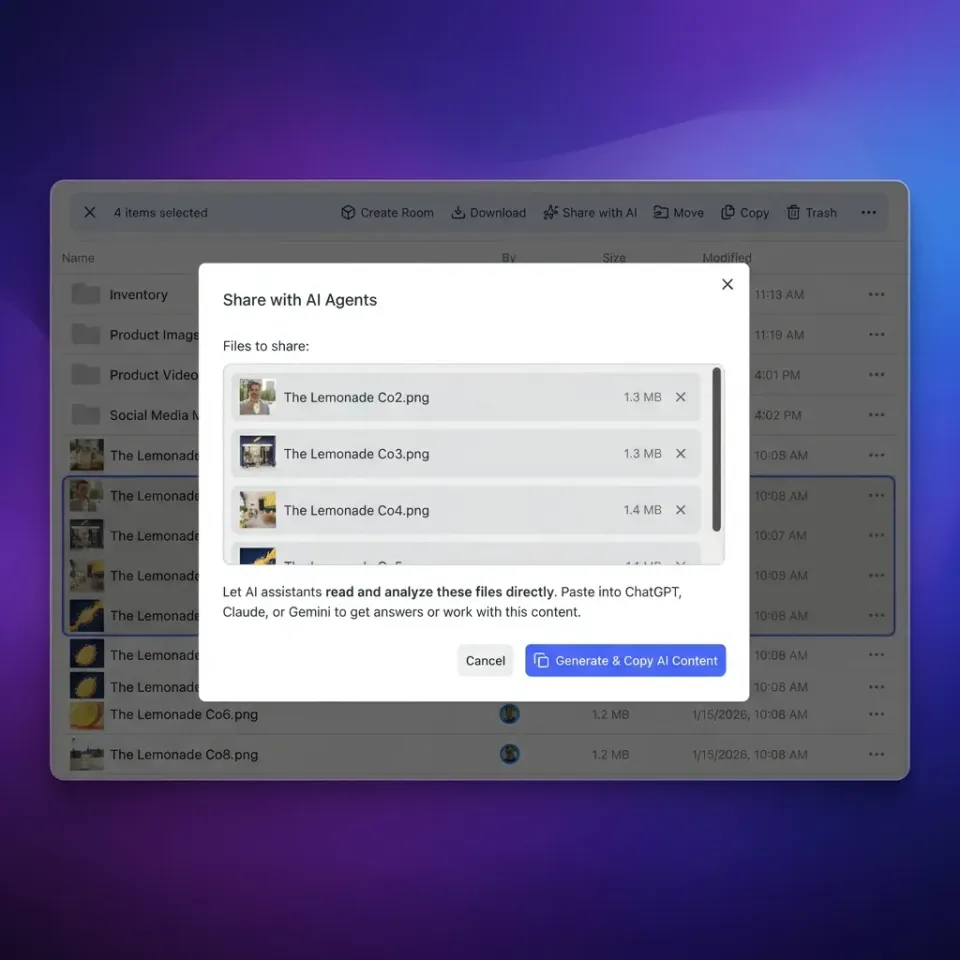
Fastio takes a different approach by integrating ETL directly into the storage layer. Instead of building a separate pipeline to extract, chunk, and embed files, you upload them to a Fastio workspace. The Intelligence Mode automatically indexes content, making it queryable by agents immediately.
Key Strengths:
- Zero-Pipeline RAG: Files are auto-indexed upon upload. Your agent can query the workspace via API without a separate vector database or parsing script.
- MCP Support: As an official Model Context Protocol server with a consolidated MCP toolset, it connects natively to Claude and other agents for file operations.
- Agent-First Storage: Storage and seats come with the plan, while credits meter the AI work such as ingestion and chat.
Limitations:
- Storage Focus: Primarily a cloud storage platform with built-in intelligence, rather than a standalone parsing API for external use.
- Customization: Less granular control over chunking strategies compared to writing your own LangChain pipeline.
Best For: Developers who want to give their agents persistent memory and RAG capabilities without managing infrastructure.
Pricing: Starter is $9.99/month ($99/year) with 3 seats, 250 GB, and 100,000 credits. Business and Enterprise plans scale seats, storage, and credits from there.



Give Your AI Agents Persistent Storage
Fastio provides persistent storage with built-in RAG for AI agents. Upload your files and start querying them instantly.
4. Azure AI Document Intelligence
Formerly known as Form Recognizer, this is Microsoft's enterprise-grade solution. It excels at extracting key-value pairs and tables from structured forms like invoices, receipts, and applications.
Key Strengths:
- Layout Analysis: Provides precise bounding boxes for every paragraph and table cell, allowing for visual grounding in RAG.
- Pre-trained Models: Includes out-of-the-box models for tax documents, IDs, and invoices.
- Security: Built on Azure's enterprise compliance and security standards.
Limitations:
- Complexity: Requires Azure subscription management and can be overkill for simple text extraction.
- Cost: Can get expensive at scale for high-volume generic document processing.
Best For: Enterprise applications requiring strict security and high-accuracy form processing.
Pricing: Pay-as-you-go per page, with tiers based on model complexity.
5. LangChain Document Loaders
LangChain isn't a single tool but a framework that wraps hundreds of loaders. It allows you to switch between different extraction backends (like PyPDF, Unstructured, or Amazon Textract) using a unified API.
Key Strengths:
- Flexibility: Swap out your parsing engine without rewriting your agent's application logic.
- Integration: Connects text directly to splitters, embedding models, and vector stores in a single workflow.
- Community: Large ecosystem of plugins and community-maintained loaders.
Limitations:
- Inconsistent Quality: The quality depends entirely on the underlying loader you choose (e.g., PyPDF is fast but inaccurate; Textract is accurate but paid).
- Abstraction Overhead: Debugging parsing errors can be harder when they are hidden behind the framework's abstractions.
Best For: Prototyping and experimenting with different extraction strategies.
Pricing: The library is free; underlying APIs (if used) may have costs.
How to Choose the Right ETL Tool
Selecting the best tool depends on your specific data types and infrastructure requirements.
Choose Unstructured.io if: You need to handle a "garbage bin" of random file formats and want a single API to clean them all.
Choose LlamaParse if: Your documents are dense with tables (financial reports, insurance policies) and you need high-precision data preservation.
Choose Fastio if: You want to skip the infrastructure headache. If your agent needs a place to store files and immediately ask questions about them, the built-in RAG and generous storage tier offer the fast path to production.
Choose Azure/Google if: You are processing thousands of standardized forms (like invoices) and need enterprise SLAs.
Sources
References used to verify factual claims in this guide.
-
reviewed the top 7 ETL tools that convert PDFs and HTML
-
Generous free tier 1k pages per day LlamaParse pricing $0.003 per page LlamaParse usage-based pricing
-
official Model Context Protocol server with a consolidated MCP toolset connects natively to Claude agents
-
Fastio plans include storage, seats, and monthly credits for agent workloads Starter is $9.99 per month with 3 seats, 250 GB of storage, and 100,000 credits Plan-included storage offers a fast path to production for agents
-
Unstructured offers open source library under Apache license
-
25+ file format types supported by Unstructured
-
Google Cloud Doc AI provides pre-trained parsers for invoices and ID cards with usage-based pricing
Frequently Asked Questions
What is the best PDF parser for AI?
For complex PDFs with tables, LlamaParse is currently the top performer due to its vision-based layout analysis. For general text extraction across many formats, Unstructured.io is the industry standard. For zero-setup RAG, Fastio offers built-in parsing and indexing.
Is Unstructured.io open source?
Yes, Unstructured offers an open-source library under the Apache license that you can run locally. They also provide a hosted Serverless API for easier deployment and scaling.
Why do I need specialized ETL for RAG?
Standard text extraction often discards layout information, merging headers with body text or scrambling table rows. This confuses the AI, leading to hallucinations. Purpose-built ETL tools preserve the document structure, ensuring the AI understands the context of the data.
Related Resources

Give Your AI Agents Persistent Storage
Fastio provides persistent storage with built-in RAG for AI agents. Upload your files and start querying them instantly.