Best Data Labeling Tools for AI Agents
Training reliable AI agents requires more than just text completion. It needs precise data labeling for RLHF, conversation trees, and tool use traces. We reviewed the top platforms to help you choose the right tooling for your agents.

What Makes Agent Labeling Different?
Labeling data for autonomous agents is harder than image or text annotation. Standard NLP tasks focus on sentiment analysis or entity extraction, but agent workflows require checking logic, multi-step reasoning, and tool execution.
Reinforcement Learning from Human Feedback (RLHF) moves the focus from static datasets to dynamic interaction logs. According to Scale AI, RLHF is the primary method for aligning agent behavior with human intent.
Key Areas of Agent Evaluation
To build a production-ready agent, you need to label data across these areas:
- Outcome Evaluation: Did the agent achieve the user's goal? (e.g., "Did it book the flight?")
- Process Supervision: Did the agent follow the right steps? This involves analyzing the "Chain of Thought" (CoT) to ensure the reasoning was sound, even if the final answer was correct.
- Tool Use Validation: Did the agent call the correct function (e.g.,
search_database) with the right arguments? An agent that invents parameters can crash production systems.
Context Matters
Unlike a single image, an agent interaction is a directed acyclic graph (DAG) of thoughts, actions, and observations. Annotators must see the full history, including what the agent tried to do and failed, to give accurate feedback. This requires interfaces that render conversation trees and code execution blocks, not just flat text.
Helpful references: Fastio Workspaces, Fastio Collaboration, and Fastio AI.

Related guides
- Best ETL Tools for AI Agents: Parsing Unstructured DataExtracting clean data from unstructured files is the biggest bottleneck in building effective RAG pipelines. We...
- Best AI Data Visualization Tools in 2026Deepnote benchmarked 12 AI visualization tools in early 2026 and found that general-purpose AI assistants outscored...
- Best AI Tools for Data Analysis in 202697% of data analysts say AI tools speed up their work, but 76% still prep data in spreadsheets manually. This guide...
- Best Headless Browsers for AI Agents: Top Tools (2026)Finding the best headless browsers for AI agents matters for reliable automation. Old scrapers break on dynamic sites....
- Best Web Browsing Tools for AI Agents (2026)Web browsing tools let AI agents navigate the live web, fill forms, and extract real-time data. Traditional scrapers...
- Best Free AI Agent Tools 2026: Top 12 Platforms ComparedBuilding autonomous agents doesn't have to be expensive. The free AI agent ecosystem now offers professional frameworks...
More on this subject: AI Tool Directories and Comparisons (231 guides)
7 Best Data Labeling Tools for AI Agents
We reviewed the top platforms based on their support for RLHF, programmatic labeling, and developer experience. Here are the best tools for your agent stack.
1. Scale AI
Best for: Enterprise RLHF & Massive Scale
Scale AI is a standard for foundation model training. Its RLHF platform aligns large language models with features like ranking, rewriting, and critique. For agents, Scale offers workflows to annotate complex reasoning traces and code generation. It has dedicated interfaces for "Silver" and "Gold" standard labeling, designed to catch logic errors in agent traces.
- Key Features:
- RLHF Platform: Full suite for ranking and rewriting model outputs.
- Generative AI Data Engine: End-to-end management of data pipelines.
- Expert Workforce: Access to PhD-level annotators for specialized domains (coding, law, medicine).
- Pros: Large workforce scale, specialized RLHF tooling, strict quality controls.
- Cons: Expensive for startups, enterprise-focused sales process.
- Pricing: Custom enterprise pricing.
2. Labelbox
Best for: Tool Use Annotation & Programmability
Labelbox focuses on "Model-Assisted Labeling." You import pre-labeled data (e.g., from your agent's logs) and humans fix the errors. Its ontology builder works well for defining structured tool calls (JSON schemas) that agents must follow. The "Catalog" feature lets you visually search through large volumes of unstructured data to find the edge cases where your agent fails.
- Key Features:
- Catalog: Visual search and data curation.
- Foundry: Pre-built labeling services for common tasks.
- Model-Assisted Labeling: Pre-label data with your own models to speed up human review.
- Pros: Strong API, search capabilities, great for visual agents.
- Cons: Learning curve for advanced features can be steep.
- Pricing: Free tier available; Pro starts at usage-based rates.
3. Label Studio
Best for: Open Source & Developer Control
With over 26,000 stars on GitHub, Label Studio is the most popular open-source data labeling tool. It's highly configurable. You can write custom XML templates to create an interface specifically for validating agent tool usage or conversation trees. It runs locally or in your private cloud, keeping sensitive agent logs secure. This makes it a great choice for teams building internal agents that handle PII or proprietary code.
- Key Features:
- Custom Tags: Build UI with HTML/XML tags.
- Multi-user Annotation: Supports collaborative labeling.
- Integration: Connects easily with MLflow, WandB, and Hugging Face.
- Pros: Free and open-source, customizable UI, works alongside MLflow/WandB.
- Cons: Requires self-hosting and maintenance.
- Pricing: Free (Community); Enterprise version available.
4. Snorkel AI
Best for: Programmatic Labeling
Snorkel uses a different approach called "weak supervision." Instead of labeling every data point by hand, you write labeling functions (code snippets) that heuristically label data. This helps with agents. You can write rules to automatically validate whether a JSON tool call matches a schema, cutting manual work.
- Key Features:
- Programmatic Labeling: Use Python functions to label data.
- Foundation Model Adapt: Fine-tune FMs using programmatically labeled data.
- Data Slicing: Identify and fix specific subsets of underperforming data.
- Pros: Fast for large datasets, data-centric approach to quality.
- Cons: Requires a different mindset (writing code to label) and engineering resources.
- Pricing: Custom enterprise pricing.
5. Prodigy
Best for: Developer-Driven Annotation
From the creators of spaCy, Prodigy is a scriptable annotation tool that runs on your local machine. It uses active learning to present only the most uncertain examples for review. Its "blocks" system lets you build custom interfaces for reviewing chat logs and agent actions with Python scripts. It's built for developers who want to label data themselves to understand their model's weaknesses.
- Key Features:
- Scriptable: Fully controlled via Python scripts.
- Active Learning: Intelligent sampling of data points.
- Local Execution: Data never leaves your machine.
- Pros: Developer-friendly, one-time purchase (no subscription), strict privacy (local only).
- Cons: Single-user focus makes it harder for large labeling teams.
- Pricing: Lifetime license per seat.
6. SuperAnnotate
Best for: Fine-Tuning Pipelines
SuperAnnotate offers a platform that integrates well with LLM fine-tuning workflows. They recently launched specialized tools for RLHF, including ranking and rewriting interfaces for teaching agents preference and style. The platform emphasizes project management and quality assurance, letting you track annotator performance in real-time.
- Key Features:
- RLHF Toolkit: specialized interfaces for chat ranking.
- Team Management: Granular roles and performance tracking.
- Multimodal Support: Handle text, image, and video in one project.
- Pros: Good analytics, RLHF support, integrated data curation.
- Cons: UI can be complex for simple tasks.
- Pricing: Custom pricing.
7. Encord
Best for: Multimodal Agents & Active Learning
Encord is a newer option gaining popularity for its strong support of multimodal data (video, DICOM, images) and active learning. If your agent interacts with the visual world, like a screen-operating agent or a robotics controller, Encord's ability to index and search visual data is excellent. Its "Index" tool helps you curate the best data for training before you even start labeling.
- Key Features:
- Encord Index: Curate and prioritize data using embeddings.
- Active Learning: Automatically select the most informative samples.
- Multimodal Native: First-class support for video and complex visual data.
- Pros: Excellent for visual/video agents, strong curation tools.
- Cons: Less focused on pure text/chat than Scale.
- Pricing: Free starter tier; Enterprise custom pricing.
Key Features to Look for in Agent Labeling Tools
Not all labeling tools handle agents well. Look for these capabilities that go beyond simple text classification.
Multi-Turn Conversation Support
Agents don't just answer questions; they hold conversations. Your tool must support nested dialogue structures. It needs to display the user's prompt, the agent's thought process (hidden or visible), the tool output, and the final response in a readable, threaded format. Flat text interfaces hide the context your annotators need.
Code & Tool Execution Sandboxes
An agent's performance relies on its ability to write code or call APIs. The best labeling tools include syntax highlighting for code blocks and structural validation for JSON outputs. Advanced setups even allow annotators to "replay" the tool call in a sandbox to verify it works as intended.
Ontology Management for Function Calls
As your agent grows, so do its tools. Your labeling tool should let you import your agent's OpenAPI spec or JSON schema. This ensures annotators validate against the current version of your tools, not an outdated list of functions.
Human-in-the-Loop (HITL) APIs
For production agents, labeling often serves as a real-time safety check. Look for tools that offer low-latency APIs to route low-confidence agent actions to a human for approval before execution. This "human-in-the-loop" pattern is key for high-stakes agents in finance or healthcare.


Give your agents a home
Store agent logs, datasets, and artifacts in an intelligent workspace built for machines and humans. Built for data labeling tools and agent workflows.
The Ideal Agent Data Ops Workflow
Building an agent data engine is a continuous cycle. Here is a workflow for effective teams.
Step 1: Capture Traces
Log every interaction your agent has, in development or production. Don't just log the text; log the full trace, including system prompts, retrieval context, tool inputs, and tool outputs. Store these as structured JSON files in a central repository like Fastio.
Step 2: Filter & Sample
You can't label everything. Use an active learning strategy or heuristic filters to select the most valuable interactions. Look for long conversations, interactions with negative user sentiment, or traces where the agent triggered a fallback mechanism.
Step 3: Human Annotation
Send the selected traces to your labeling tool (e.g., Labelbox or Scale). Have humans grade the interaction on specific criteria:
- Helpfulness: Did it solve the user's problem?
- Safety: Did it refuse harmful requests?
- Faithfulness: Did it stick to the provided context?
Step 4: Fine-Tuning & Eval
Export the improved data to fine-tune your model (e.g., creating a LoRA adapter for a Llama model) or add it to your few-shot prompt examples. Then, run your evaluation suite to measure improvement before deploying the new version.
Fastio: The Workspace for Agent Data
Best for: Managing Agent Artifacts & Storage
Fastio connects your data operations. It is not a labeling GUI itself, but the storage layer where your agent's data lives. Agents create large amounts of unstructured data, including logs, tool traces, images, and code files. Fastio offers a workspace to store, organize, and bridge this data to your labeling tools.
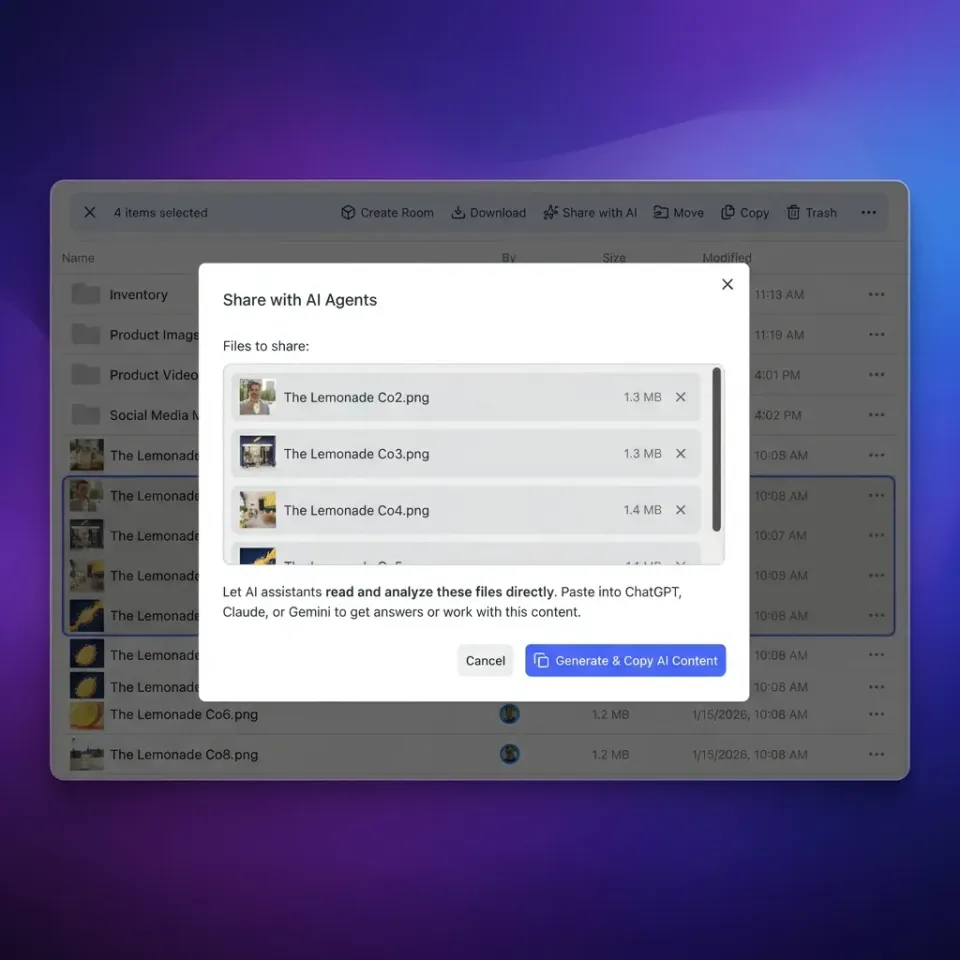
- Agent Context: Right-click any log file or dataset to generate a temporary context link for Claude, ChatGPT, or your labeling team.
- MCP Server: Connect your agents directly to Fastio via the Model Context Protocol (MCP) to read/write data programmatically.
- Search Mode: Index and search through your interaction logs using natural language to find edge cases for labeling.
Fastio makes training data accessible, secure, and ready for your labeling pipeline.
- Pros: Plans with seats included, a consolidated MCP toolset, built-in RAG/search.
- Cons: Not a pixel-level annotation interface (use Label Studio for that).
- Pricing: The Starter plan is $9.99/mo (250 GB, 100,000 credits/mo), Business $49.99/mo and Enterprise $199.99/mo; monthly plans start with a trial of up to 14 days (credit card required).
How to Choose the Right Tool
Choosing the right tool depends on your team's size and your agent's tasks.
For most developer-led teams building their first agents, starting with Fastio for storage and Label Studio or Prodigy for annotation is a cost-effective stack.
Sources
References used to verify factual claims in this guide.
-
RLHF is the primary method for aligning agent behavior with human intent.
-
Snorkel AI uses weak supervision to programmatically label data.
-
Label Studio has over 26,000 stars on GitHub.
Frequently Asked Questions
What is RLHF in the context of AI agents?
Reinforcement Learning from Human Feedback (RLHF) is a training method where human annotators rank or rate an agent's responses. This feedback is used to train a 'reward model' that guides the agent to produce more helpful, safe, and accurate outputs in future interactions.
Can I use Fastio to label data?
Fastio is a storage and collaboration workspace, not a labeling GUI. However, it is the ideal place to store the raw logs and files your agents generate. You can easily organize these files in Fastio and then pipe them into tools like Labelbox or Label Studio for the actual annotation step.
Why is labeling 'tool use' important for agents?
Agents differ from chatbots by their ability to use tools (calculators, APIs, search). Labeling 'tool use' data ensures the agent knows exactly which tool to call and how to format the arguments correctly, avoiding execution errors in production.
How much does data labeling cost?
Costs vary . Self-hosted tools like Label Studio are free but require engineering time. Platforms like Labelbox start with usage-based tiers. Fully managed services like Scale AI typically require enterprise contracts that are tailored to large-scale operations and task complexity.
Should I use automated labeling or human labeling?
Most modern pipelines use both. Automated labeling (or "weak supervision" with tools like Snorkel) is great for handling large volumes of data quickly. However, human labeling is still essential for "Gold Standard" evaluation sets and for handling complex edge cases where models struggle.
Related Resources

Give your agents a home
Store agent logs, datasets, and artifacts in an intelligent workspace built for machines and humans. Built for data labeling tools and agent workflows.