Best Communication Tools for Multi-Agent Systems
Multi-agent systems require strong communication channels to coordinate tasks, share context, and execute workflows. This guide ranks the best tools for agent interaction, from message brokers like RabbitMQ to file-based persistence layers like Fastio.


How to implement best communication tools for multi-agent systems reliably
Multi-agent communication tools enable the exchange of messages, state, and tasks between autonomous agents. When designing a multi-agent architecture, you typically need to solve for three distinct patterns:
- Transient Messaging: Sending quick signals or commands (e.g., "Start task A").
- Event Streaming: Broadcasting a history of actions for other agents to react to (e.g., "User uploaded file X").
- State Persistence: Sharing heavy context, datasets, or artifacts that are too large for message buses (e.g., "Here is the video file to analyze"). Choosing the right tool for each pillar prevents bottlenecks and ensures your agents remain stateless and scalable.
Related guides
- How to Decompose Tasks for Multi-Agent AI SystemsTask decomposition is the process of breaking a complex goal into smaller subtasks that can be assigned to specialized...
- Best Tools for CrewAI Agents: Top Picks for 2026CrewAI agents need good tools to be useful. The framework handles coordination, but external integrations let agents...
- How to Build a Multi-Agent Audio Production WorkflowMulti-agent audio workflows chain AI agents for stem generation, mixing, EQ, effects, and mastering. Fastio workspaces...
- LangGraph vs CrewAI: Which Multi-Agent Framework to Choose in 2026LangGraph and CrewAI are the two most-searched multi-agent frameworks heading into 2026. This comparison goes beyond...
- How to Master AI Agent Swarm Orchestration: Best Practices for 2026AI agent swarm orchestration manages large-scale, emergent agent behaviors in dynamic environments. While single agents...
- How to Implement AI Agent Federation: Architectures & GuideAI agent federation enables independent agents to collaborate across distributed systems via standardized protocols....
More on this subject: Multi-Agent Systems (62 guides)
What to check before scaling best communication tools for multi-agent systems
While message buses handle small JSON payloads, they fail when agents need to exchange heavy artifacts like video files, large datasets, or high-resolution images. Fastio fills this critical gap by serving as the shared file system for agent swarms. Through its Model Context Protocol (MCP) server, Fastio allows agents to read, write, and search files programmatically. A common pattern is the "Watch Folder" workflow: one agent generates an asset and saves it to a specific path, and the next agent in the pipeline picks it up from the workspace events feed.
Key Features for Agents:
- MCP Support: Connects natively to Claude, CrewAI, and other MCP-compliant clients.
- Universal Link: Agents can generate generic URLs to pass to other agents or humans.
- Intelligence Mode: Built-in RAG automatically indexes files, letting agents query document contents without downloading them.
- No Payload Limits: Unlike typical REST APIs with strict payload size limits, agents can transfer large files without restrictions.
Best For: Passing large context (PDFs, videos) between agents and human-in-the-loop workflows.
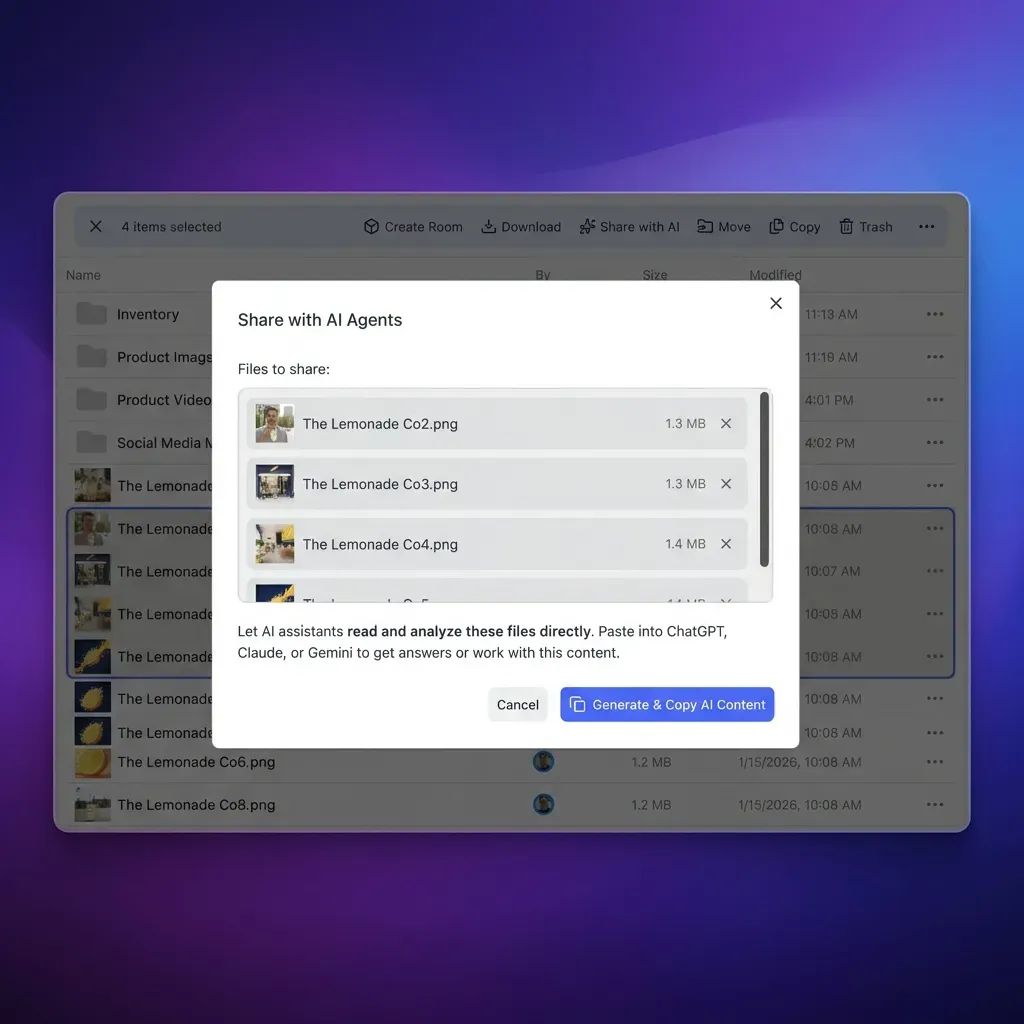


Give Your AI Agents Persistent Storage
Fastio provides a persistent file system for your multi-agent swarms. Share context, pass large files, and integrate via MCP in minutes.
2. RabbitMQ (Best for Task Routing)
RabbitMQ is the industry-standard message broker for complex routing logic. It implements the Advanced Message Queuing Protocol (AMQP), allowing for sophisticated patterns like topic exchanges, fan-out, and direct routing. In a multi-agent system, RabbitMQ excels at task distribution. A "Manager Agent" can push tasks into a queue, and a swarm of "Worker Agents" can pick them up as capacity permits. Its acknowledgment mechanism ensures that if an agent crashes while processing a task, the message is returned to the queue for another agent to handle.
Pros:
- Reliability: Guarantees message delivery with acknowledgments.
- Flexible Routing: Send messages to specific agents or broadcast to all.
- Polyglot: Client libraries for Python, Node.js, Go, and more.
Best For: Task queues and guaranteed command delivery.
3. Apache Kafka (Best for Event Streaming)
Apache Kafka is designed for high-throughput event streaming. Unlike RabbitMQ, which removes messages after consumption, Kafka retains a log of events for a set period. This "replayability" is powerful for agent learning and debugging. For example, if you deploy a new version of an "Observer Agent," it can replay recent system events from Kafka to build up its internal state before joining the active swarm. This decouples producers from consumers completely.
Pros:
- Scalability: Handles millions of events per second.
- Replay: Agents can read historical data to catch up on context.
- Persistence: Acts as a log of all system actions.
Best For: Systems with high-volume telemetry or where agents need historical context.
4. Redis Pub/Sub (Best for Speed)
When you need sub-millisecond latency and don't care about message persistence, Redis Pub/Sub is the lightweight champion. It implements a simple publish/subscribe pattern where agents listen to channels. It’s ideal for ephemeral signaling. For instance, a "Stop" signal broadcast to all agents during an emergency shutdown, or a "Heartbeat" signal where agents report they are alive. Since it keeps everything in memory, it is fast but risks data loss if the instance crashes.
Pros:
- Performance: low latency.
- Simplicity: easy to implement in most languages.
Cons:
- No Persistence: Messages are lost if no one is listening.
Best For: Real-time signaling and ephemeral coordination.
5. gRPC (Best for Direct Agent-to-Agent)
Sometimes you don't want a middleman. gRPC is a high-performance Remote Procedure Call (RPC) framework that uses Protocol Buffers (protobuf) to serialize structured data. It allows one agent to call a function on another agent as if it were a local object. gRPC is strictly typed, meaning agents define a strict contract (interface) for how they communicate. This reduces errors in large systems where agents might be written in different languages (e.g., a Python researcher agent calling a Go executor agent).
Best For: Tightly coupled agents requiring high-performance, synchronous communication. Consider how this fits into your broader workflow and what matters most for your team. The right choice depends on your specific requirements: file types, team size, security needs, and how you collaborate with external partners. Testing with a free account is the fast way to know if a tool works for you.
6. Agent Protocol (Best for Interoperability)
The Agent Protocol is an emerging open standard designed to define a universal interface for interacting with AI agents. Rather than a transport tool, it is a specification for how agents should expose their API. By adopting the Agent Protocol, your agent becomes compatible with a wide ecosystem of tools (like benchmarking suites and UI dashboards) out of the box. It standardizes concepts like "tasks," "steps," and "artifacts."
Best For: Open-source agents or systems that need to interface with external tooling. Consider how this fits into your broader workflow and what matters most for your team. The right choice depends on your specific requirements: file types, team size, security needs, and how you collaborate with external partners. Testing with a free account is the fast way to know if a tool works for you.
Sources
References used to verify factual claims in this guide.
-
Kafka can handle millions of events per second with high throughput and low latency
-
Redis Pub/Sub provides sub-millisecond latency for real-time messaging between agents
Frequently Asked Questions
How do AI agents communicate?
AI agents communicate using three main methods: message passing (sending direct data via protocols like HTTP or gRPC), shared state (writing to a database or file system like Fastio), and event broadcasting (publishing updates to a bus like Kafka or RabbitMQ).
What is the Agent Protocol?
The Agent Protocol is an open standard specification that defines a universal API for communicating with AI agents. It standardizes endpoints for creating tasks, executing steps, and retrieving artifacts, ensuring agents from different developers can work together.
When should I use a file system vs. a message bus?
Use a message bus (RabbitMQ, Kafka) for small, structured data like commands, status updates, or text messages. Use a file system (Fastio) for heavy unstructured data like images, video, PDFs, or large datasets that would clog a message queue.
Can I use REST for agent communication?
Yes, REST is the most common protocol for simple agent interactions due to its ubiquity and ease of debugging. However, for high-performance or streaming needs, gRPC or WebSockets are often preferred.
Related Resources

Give Your AI Agents Persistent Storage
Fastio provides a persistent file system for your multi-agent swarms. Share context, pass large files, and integrate via MCP in minutes.