Best AI Tools for Students in 2026
Most guides list ChatGPT and Grammarly, then stop. This one covers 13 tools across six categories: general-purpose assistants, writing helpers, note-takers, flashcard generators, math solvers, research tools, and citation managers. Each entry includes pricing, free plan details, and the specific academic task it handles best.


How We Picked These Tools
We tested each tool against four criteria: how well it handles a specific academic task, whether it has a usable free tier, how it treats citations and sourcing, and whether it fits alongside other tools in a typical student workflow.
According to a Gallup survey from early 2026, 57% of U.S. college students now use AI at least weekly for coursework, and roughly 20% use it daily. An Intelligent.com survey from 2025 found 86% of college students had used AI tools for academic work. The tools below reflect how students are actually using AI, not just the headline-grabbing chatbots.
Here is the full list with pricing at a glance:
- ChatGPT, general assistant, free or $20 per month
- Google Gemini + Gemini Notebook (formerly NotebookLM), research and study, free for students
- Claude, long reading and writing, free or $20 per month
- Perplexity AI, cited web research, free or $20 per month
- Grammarly, grammar and style, free or about $6 per month with student discount
- Notion, notes and organization, free Plus plan for students
- Otter.ai, lecture transcription, free (300 min per month) or about $7 per month for students
- Quizlet, flashcards and quizzes, free or $3 per month
- Khanmigo, guided tutoring, $4 per month
- Wolfram Alpha, math and computation, free or $5 per month
- Photomath, photo math solving, free with optional premium
- Elicit, academic paper search, free (included credits) or $12 per month
- Zotero, citation management, free and open source
Related guides
- Best AI for Learning in 2026Stanford's Tutor CoPilot study found students gained up to 9 percentage points in topic mastery when AI assisted their...
- Best Tools for LangChain Development in 2026The LangChain ecosystem has expanded beyond the core library to include specialized tools for observability,...
- Best Generative AI Tools in 2026, Ranked by Output TypeThe generative AI market hit $69.85 billion in 2026, nearly doubling year over year, yet most users still default to...
- Best AI for Game Development in 2026: 9 Tools by Dev StageHalf of game studios now use AI in production, yet most "best AI for gaming" articles lump game-playing bots in with...
- Best AI Tools for Developers in 2026Most "best AI tools" lists stop at coding assistants. This guide covers 14 tools across every phase of the software...
- 10 Best AI Tools for Teachers in 2026: Reviewed and ComparedPurpose-built AI tools for teachers now handle lesson planning, grading, reading differentiation, and student...
More on this subject: AI Tool Directories and Comparisons (231 guides)
What General-Purpose AI Assistants Actually Do Well
These four tools handle the widest range of academic tasks. Most students start here because a single chatbot can brainstorm essay topics at 11 PM, explain a confusing textbook passage before an exam, and walk through a calculus problem step by step.
The practical constraint is accuracy. General-purpose assistants predict plausible text, they do not verify facts. If you ask ChatGPT for a source, it may generate a real-sounding citation that does not exist. A good habit: treat chatbot output the way you would treat advice from a smart classmate. Useful starting point, but verify before you cite.
1. ChatGPT
OpenAI's chatbot remains the default starting point for most students. The free tier handles essay brainstorming, concept explanations, summarization, and step-by-step math walkthroughs.
Strengths:
- Handles almost any academic subject competently
- Custom GPTs let you build subject-specific study aids
Limitations:
- Does not cite sources by default, so you need to verify claims independently
Best for: brainstorming, concept explanation, and first-draft writing.
Pricing: Free (GPT-4o mini) or $20 per month for ChatGPT Plus.
2. Google Gemini + Gemini Notebook (formerly NotebookLM)
Google's student plan is the best free deal in this list. With a verified .edu email, you get Gemini 1.5 Pro, Deep Research, Gemini Notebook Plus, AI inside Google Docs and Slides, and 2TB of Google Drive storage, all at no cost.
Gemini Notebook grounds every response to your uploaded materials, which means it only answers based on your notes, slides, and readings. That makes it far less likely to hallucinate than a general chatbot. Features added in 2026 include flashcard generation, quizzes, and Audio Overviews that turn your study materials into podcast-style summaries you can listen to while commuting.
Strengths:
- Completely free for verified students
- Gemini Notebook stays grounded to your own sources, reducing hallucination
- Audio Overviews create listenable summaries of your notes
Limitations:
- Requires a .edu email for the student plan
- Gemini Notebook will not search the open web, only your uploaded sources
Best for: source-based studying, exam prep, and research projects.
Pricing: Free with verified student email.
3. Claude
Anthropic's Claude handles long-form reading and writing feedback well. Its large context window lets you paste an entire paper or textbook chapter and ask questions about it without losing track of earlier sections.
Strengths:
- Processes long documents in a single conversation
- Explains reasoning in clear, step-by-step breakdowns
Limitations:
- Free tier has usage limits during peak hours
Best for: essay feedback, reading dense academic material, and coding assignments.
Pricing: Free tier available or $20 per month for Claude Pro.
4. Perplexity AI
Perplexity answers questions by searching the web in real time and citing every claim with numbered references. You can click through to verify each source, which makes it a strong fit for research where you need traceable information.
Strengths:
- Every answer includes numbered source citations you can verify
- Searches current information, not just training data
Limitations:
- Trial limits the number of Pro searches per day
Best for: research tasks that require cited sources and fact-checking.
Pricing: Free or $20 per month for Perplexity Pro.
How to Improve Your Writing and Capture Lecture Notes
Writing and note-taking eat more student hours than almost anything else. These three tools each target a different part of that workflow: Grammarly catches errors in real time while you write, Notion organizes everything into a searchable system, and Otter.ai transcribes lectures so you can actually pay attention instead of frantically scribbling.
A practical starting point: install Grammarly's browser extension and use it for a week before deciding whether you need the paid plan. Most students find the free tier catches enough errors for weekly assignments. Save the upgrade for thesis season when tone and clarity suggestions matter more.
5. Grammarly
Grammarly checks grammar, spelling, punctuation, and tone in real time across your browser, email, and word processor. The free tier catches basic errors and provides 100 AI-powered writing prompts per month for tasks like sentence rewriting and brainstorming.
Strengths:
- Works everywhere you write (browser extension, Word, Google Docs)
- Tone detection helps you match the formality level your assignment requires
- Many universities provide free premium access through institutional licenses
Limitations:
- Style and clarity suggestions require the paid plan
Best for: polishing essays and catching grammar mistakes before submission.
Pricing: Free tier, or roughly $6 per month with a student discount through SheerID. Check if your university provides free access first.
6. Notion
Notion's free Plus plan for students (available with a .edu email) gives you unlimited pages, file uploads, and 30-day version history. It is a strong tool for organizing notes, managing study schedules, and coordinating group projects.
The AI features (summarization, writing assistance, autofill) require the Business plan at $15 per month, which makes the AI layer expensive for most students. Notion still earns a spot here because the organizational features alone replace multiple apps.
Strengths:
- Free Plus plan for students with .edu email
- Combines notes, tasks, databases, and calendars in one app
Limitations:
- AI features are not included in the free student plan
Best for: organizing study materials, managing group projects, and building a personal knowledge base.
Pricing: Free (Plus plan for students) or $15 per month for Business with AI.
7. Otter.ai
Otter records and transcribes lectures in real time, then lets you search the transcript by keyword. If you miss something during a lecture, you can find the exact moment later instead of flipping through handwritten notes.
Strengths:
- Real-time transcription with speaker identification
- AI-generated summaries highlight key points automatically
Limitations:
- Free plan caps conversations at 30 minutes, shorter than most lectures
- Accuracy drops with heavy accents or noisy environments
Best for: capturing lectures and making them searchable for review.
Pricing: Free (300 minutes per month, 30-minute cap per session) or roughly $7 per month for students with a .edu email.
Best Tools for Studying, Tutoring, and Solving Math Problems
The tools above help you read, write, and organize. These four target the other half of student life: memorizing material for exams, getting unstuck on problem sets, and building the kind of deep understanding that sticks past finals week.
Flashcard apps and computational engines work differently from chatbots. Quizlet uses spaced repetition algorithms that schedule reviews based on how well you know each card. Wolfram Alpha computes verified answers rather than predicting plausible-sounding ones. That distinction matters when you are checking a differential equation and need the actual answer, not a confident guess.
8. Quizlet
Quizlet has over 60 million user-created study sets, and its AI features now generate flashcards from your uploaded notes automatically. Students who use spaced repetition tools like Quizlet report 20 to 40% better retention compared to passive rereading, according to Quizlet's own research.
Strengths:
- Magic Notes converts uploaded notes and PDFs into flashcards, outlines, and practice tests
- Q-Chat AI tutor quizzes you in a conversational format
- Massive library of existing study sets across every subject
Limitations:
- AI features like Q-Chat and Magic Notes require the Plus subscription
Best for: memorization, practice tests, and exam prep.
Pricing: Free (basic flashcards and study modes) or $3 per month for Quizlet Plus (annual billing).
9. Khanmigo
Khan Academy's AI tutor takes a different approach from ChatGPT. Instead of giving you the answer, it asks guiding questions to help you work through problems yourself. It integrates directly with Khan Academy's curriculum, which makes it particularly strong for math from arithmetic through AP Calculus.
Strengths:
- Guides you to the answer instead of handing it over
- Integrated with Khan Academy's full math and science curriculum
Limitations:
- Strongest in math and science, less useful for humanities
Best for: math and science tutoring where you want to understand the process, not just get the answer.
Pricing: $4 per month or $44 per year. Parents can add up to 10 child accounts at no extra charge.
10. Wolfram Alpha
Wolfram Alpha is a computational engine, not a chatbot. You type in a math, physics, or chemistry problem and it returns a precise, computed answer. The Pro plan adds step-by-step solutions that show how it arrived at each result.
Strengths:
- Computed answers are mathematically verified, not predicted by a language model
- Covers algebra, calculus, statistics, physics, chemistry, and engineering
Limitations:
- Free tier omits the step-by-step breakdowns that make it most useful for learning
Best for: verifying math homework and understanding solution steps in STEM courses.
Pricing: Free (basic answers) or $5 per month for Pro with step-by-step solutions (annual billing).
11. Photomath
Point your phone camera at a math problem and Photomath shows the solution with step-by-step work. It handles printed text and handwritten equations, covering algebra, geometry, trigonometry, and basic calculus. Google acquired the app in 2023.
Strengths:
- Camera-based input is faster than typing complex equations
- Works with handwritten problems, not just printed textbooks
Limitations:
- Word problems and advanced textbook exercises require the premium subscription
Best for: quick math homework checks and understanding solution steps on your phone.
Pricing: Free for basic problems. Photomath Plus subscription adds word problems and textbook solutions.
How to Handle Research Papers and Group Project Files
Group projects and research papers share a common problem: you end up with files scattered across email attachments, Google Drive folders, and Slack threads. These two tools each solve a piece of that puzzle. Elicit finds and structures academic sources. Zotero manages your citations.
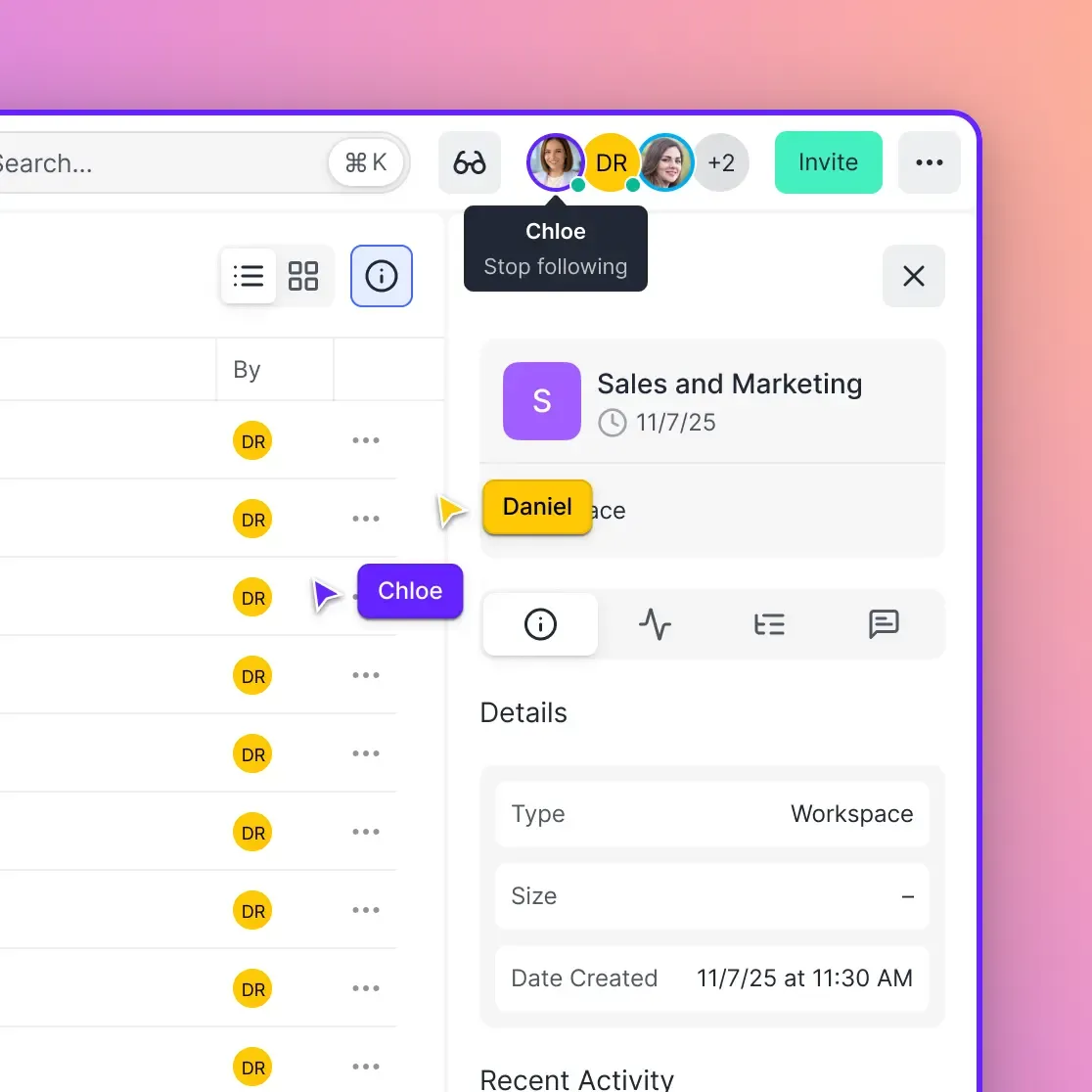
For a literature review workflow that actually scales, start with Elicit to find papers, export the citations to Zotero for bibliography management, and upload the full PDFs to a shared workspace where your whole team can search and ask questions about the collection.
12. Elicit
Elicit searches over 125 million academic papers and extracts key findings, methods, and results into structured tables. Every AI-generated claim links back to the specific sentence in the source paper, which makes verification straightforward.
Strengths:
- Semantic search finds relevant papers even when you do not know the exact keywords
- Extracts structured data from papers (sample sizes, methods, key findings)
Limitations:
- Free tier gives 5,000 one-time credits with no monthly refresh
Best for: literature reviews, thesis research, and finding academic sources.
Pricing: Free (5,000 one-time credits) or $12 per month for Plus.
13. Zotero
Zotero is a free, open-source reference manager that saves sources from the web, organizes them into collections, and generates bibliographies in over 10,000 citation styles. It does not have built-in AI, but community plugins like PapersGPT and Aria add the ability to chat with your PDFs and run AI-powered searches across your library.
Strengths:
- Completely free and open source
- Browser connector auto-captures citation metadata from library catalogs and journals
- Direct integration with Microsoft Word and Google Docs
Limitations:
- No native AI features without third-party plugins
Best for: managing references and generating properly formatted bibliographies.
Pricing: Free. Cloud storage plans start at $20 per year for 2GB.
Which Tools Should You Actually Use?
You do not need all 13 tools. Most students get by with three or four, chosen based on what they actually struggle.
If you are on a tight budget, start with the Google student plan (Gemini + Gemini Notebook + 2TB Drive), ChatGPT's free tier, Grammarly's free tier, and Zotero. That stack covers research, writing, studying, and citations at zero cost.
If you are a STEM student, add Wolfram Alpha Pro ($5 per month) and Photomath. Khanmigo ($4 per month) is worth it if you are working through math courses and want guided practice instead of answer-dumping.
If you are writing a thesis, Elicit and Zotero together handle the literature review and citation pipeline. Add Claude for feedback on your drafts.
One note on academic integrity: most schools now have published AI use policies. The general pattern is that using AI to learn, brainstorm, and check your reasoning is accepted, while submitting AI-generated text as your own is not. Check your syllabus and your school's academic integrity guidelines before relying on any AI tool for graded assignments.
Sources
References used to verify factual claims in this guide.
-
86% of college students have used AI tools for academic work
-
57% of U.S. college students use AI at least weekly for coursework, roughly 20% daily
-
Over 60 million study sets on Quizlet Students using spaced repetition tools report 20 to 40% better retention
-
Elicit searches over 125 million academic papers
Frequently Asked Questions
What AI tools are allowed in college?
Policies vary by institution and sometimes by individual professors. Most schools permit AI for brainstorming, research, and learning assistance. Submitting AI-generated work as your own typically violates academic integrity policies. Check your syllabus and student handbook for specific guidelines.
What is the best free AI tool for students?
Google's student plan offers the most value at no cost. With a verified .edu email, you get Gemini 1.5 Pro, Gemini Notebook Plus, AI in Google Docs and Slides, and 2TB of Drive storage. ChatGPT's free tier and Claude's free tier are strong general-purpose alternatives.
Can students use AI for homework?
Yes, but how you use it matters. Using AI to understand concepts, check your reasoning, or brainstorm approaches is widely accepted. Copying AI output and submitting it as your own work violates academic integrity policies at most institutions. Treat AI as a study partner, not a ghostwriter.
What AI tools help with studying?
Quizlet generates flashcards and practice tests from your notes. Gemini Notebook grounds its answers to your uploaded study materials. Khanmigo provides guided tutoring in math and science. Wolfram Alpha verifies computational answers with step-by-step solutions.
Do I need to pay for AI tools as a student?
Not necessarily. A free stack of ChatGPT, the Google student plan (Gemini + Gemini Notebook), Quizlet, Grammarly, and Zotero covers most academic needs. Paid upgrades like Quizlet Plus ($3 per month) or Khanmigo ($4 per month) add convenience but are not required.