Best AI Knowledge Management Tools for Teams in 2026
AI knowledge management tools organize and retrieve organizational knowledge using natural language, semantic search, and intelligent indexing. This guide compares 11 platforms designed for teams that need both human-accessible knowledge bases and AI-native retrieval systems.


What Makes a Knowledge Management Tool 'AI-Powered'?
AI knowledge management tools go beyond simple file storage and search. They understand context, meaning, and relationships between documents. Traditional knowledge management requires manual tagging, folder hierarchies, and exact keyword matches. AI-powered systems index content automatically, surface relevant information based on semantic meaning, and answer questions by synthesizing information from multiple sources. Knowledge workers spend 20% of their time searching for information (McKinsey). AI-powered search reduces time-to-answer by 60-80% by understanding intent rather than matching keywords. A true AI knowledge management platform includes:
- Semantic search: Find documents by meaning, not just keywords
- Automatic indexing: No manual tagging or organization required
- RAG (Retrieval Augmented Generation): Answer questions by pulling from your knowledge base with citations
- Natural language queries: Ask questions like you would ask a coworker
- Multi-format support: Index PDFs, videos, presentations, code, spreadsheets
The best tools work for both humans browsing a knowledge base and AI agents querying it programmatically.
Helpful references: Fastio Workspaces, Fastio Collaboration, and Fastio AI.
Related guides
- How to Build an AI Agent Knowledge Vault for Secure StorageAn AI agent knowledge vault is a centralized, secure storage system designed specifically for autonomous agents....
- Best Edge AI Platforms in 2026: Hardware, Software, and Fleet Management ComparedThe edge AI market reached $24.91 billion in 2025, yet most comparisons still separate hardware from software, leaving...
- Knowledge Management System Example: Building an Agent-First WikiEstablishing a modern knowledge management system example requires moving from static folders to queryable workspaces...
- AI-Native Knowledge Management Software: The Future of Workspace Shared ContextAI-native knowledge management software represents a shift from static document folders to queryable team context....
- How to Manage AI Agent Fleets: Operate and Scale Agent DeploymentsManaging a fleet of AI agents requires more than just running a few scripts. You must deploy, monitor, and scale...
- How to Build Shared Knowledge Graphs for Multi-Agent SystemsA knowledge graph for shared context gives AI agents a structured way to store facts that multiple agents can use at...
More on this subject: Agent Infrastructure and Deployment (52 guides)
How We Evaluated These Tools
We tested each platform on these criteria:
Search quality: How well does semantic search understand intent? Does it surface the right document when you ask a question in natural language?
Indexing speed: How long after uploading a document can you search it? Does it handle large PDFs, videos with transcripts, or code repositories?
AI capabilities: Does it offer RAG for question answering? Can you chat with your documents? Are answers cited with sources?
Agent access: Can AI agents (ChatGPT, Claude, custom LLMs) query the knowledge base via API or MCP? Do they get the same search quality as humans?
Team collaboration: Can multiple people contribute? Does it support comments, versioning, and shared workspaces?
Pricing model: Usage-based or per-seat? Does it have a free tier for small teams or agents? The platforms below represent the best options across different use cases: from team wikis to agent-native storage to enterprise knowledge graphs.
1. Fastio: Best for AI Agent Knowledge Storage
Fastio is cloud storage built with AI agents in mind. It includes Intelligence Mode, which turns any workspace into a RAG-enabled knowledge base with auto-indexing, semantic search, and AI chat.
Best for: Teams building AI agents that need persistent file storage with built-in RAG
Key strengths:
- Toggle Intelligence Mode on any workspace to turn on automatic indexing and semantic search
- Consolidated MCP toolset for file operations via Streamable HTTP and SSE transport
- Built-in AI chat with citations across workspace files
- Agent-first design: AI agents sign up for their own accounts, create workspaces, and manage files via API
- Ownership transfer: agents build data rooms and hand them off to humans while keeping admin access
- Works with Claude, GPT-4, Gemini, LLaMA, and local models
- 30-day Business Trial, card required; see /pricing/
Limitations:
- Focus is on file storage + RAG, not a traditional wiki with rich text editing
- Best for technical teams comfortable with APIs and agent workflows
Pricing: Starter ($9.99/mo), Business ($49.99/mo), and Enterprise ($199.99/mo) plans; monthly plans start with a Business Trial of up to 30 days (card required; see /pricing/).
RAG capabilities: Intelligence Mode auto-indexes files when toggled on. Ask questions across PDFs, videos, code, and spreadsheets with cited answers. Scope queries to specific files, folders, or full workspace.
Why choose Fastio: If you're building AI agents that need to store outputs, retrieve context, or collaborate with humans on file-based workflows, Fastio is built for this. The MCP integration gives agents native file access, and Intelligence Mode provides RAG without managing a separate vector database.
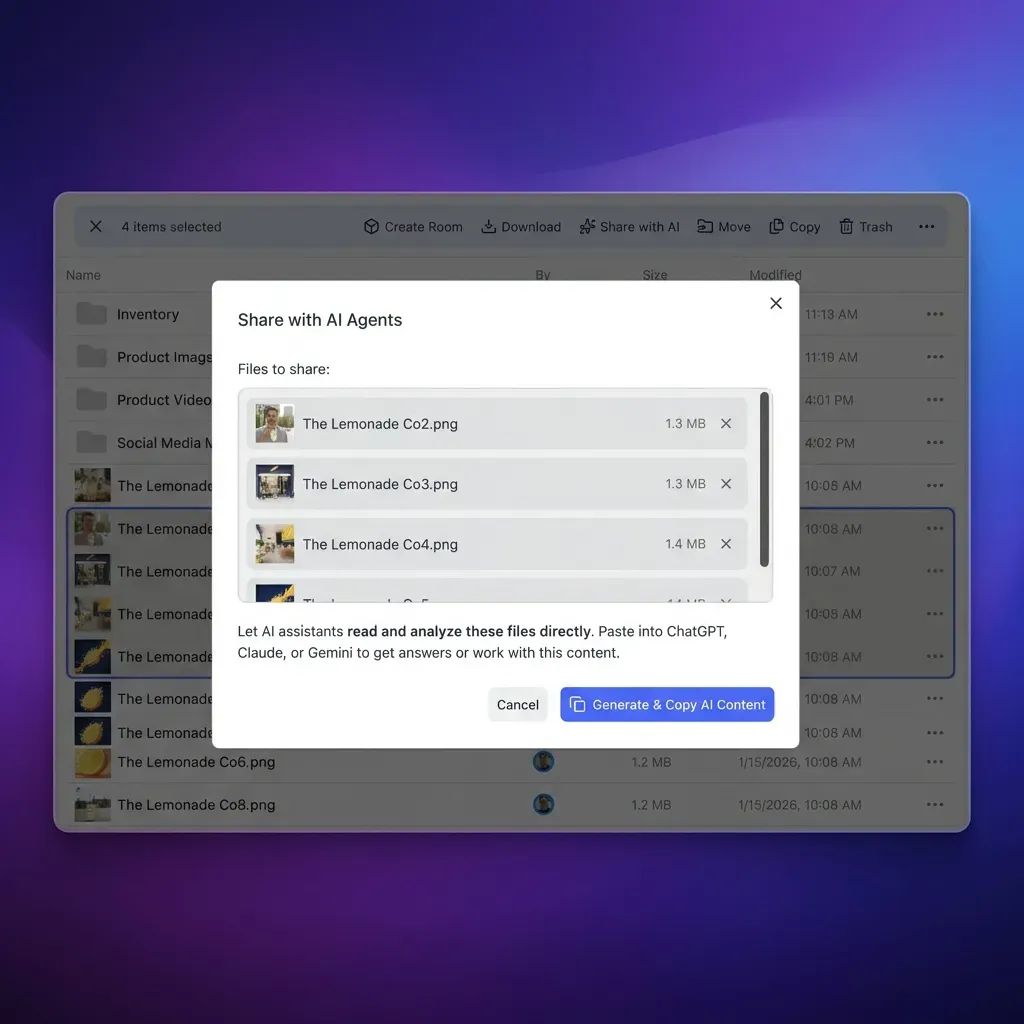


Start with best AI knowledge management tools on Fastio
Fastio gives teams shared workspaces, MCP tools, and searchable file context to run best ai knowledge management tools workflows with reliable agent and human handoffs.
2. Notion AI: Best for Team Wikis with AI Search
Notion combines a collaborative wiki, project management, and databases in one workspace. Notion AI adds semantic search, auto-summarization, and Q&A across your team's pages.
Best for: Teams that want a flexible wiki with AI-powered search and writing assistance
Key strengths:
- Rich text editor with blocks, embeds, and databases
- AI search understands context and surfaces related pages
- AI writing assistant for drafts, summaries, and translations
- Extensive templates for documentation, processes, and knowledge bases
- Strong collaboration features with comments, mentions, and permissions
Limitations:
- AI features cost extra on top of base plan pricing
- Search quality depends on how well pages are structured
- Limited API access for agent retrieval compared to agent-native platforms
- Per-seat pricing gets expensive for large teams
Pricing: Free for individuals, with Plus and Business plans priced per user per month. Notion AI is available as an add-on on any plan.
Why choose Notion: If your team already uses Notion for documentation and you want to add AI search without switching platforms, Notion AI works well.
3. Guru: Best for Enterprise Knowledge Management
Guru is an AI-powered knowledge platform that connects to Slack, Teams, Google Workspace, Salesforce, and dozens of other tools to create a unified knowledge layer.
Best for: Enterprise teams with knowledge scattered across many systems
Key strengths:
- Chrome, Slack, Teams, and Edge extensions let you search from anywhere
- AI verifies knowledge freshness and flags outdated information
- Browser extension surfaces relevant knowledge as you work
- works alongside ChatGPT and other AI tools to pull from your knowledge base
- Governance features for enterprise compliance
Limitations:
- Designed for human users, not agent-native retrieval
- Pricing scales with team size (per-seat model)
- Best value comes from extensive integrations, which require setup time
Pricing: Starter is free for up to 3 users, with Builder and Expert plans priced per user per month. Enterprise pricing available.
Why choose Guru: If your knowledge is spread across Confluence, Google Drive, Salesforce, and Slack, Guru creates a single search layer. The AI verification helps keep knowledge current in fast-moving teams.
4. Lindy: Best for Conversational Knowledge Base
Lindy is an AI agent that connects to internal documents and turns them into a conversational, searchable knowledge base. Ask questions and get answers with sources.
Best for: Teams that want to query documents in natural language without managing infrastructure
Key strengths:
- Links documents from PDFs, Google Sheets, Confluence, and other platforms
- Natural language queries with cited sources
- No manual tagging or organization required
- Fast setup with minimal configuration
- Conversational interface feels like asking a coworker
Limitations:
- Limited customization of the underlying AI model
- Best for querying existing documents, not creating new knowledge
- Smaller feature set compared to full knowledge management platforms
Pricing: Custom pricing based on usage and team size.
Why choose Lindy: If you need a quick way to make old documentation searchable without restructuring it, Lindy indexes what you have and makes it queryable right away.
5. Bloomfire: Best for Visual Knowledge Sharing
Bloomfire is a knowledge management platform with AI-powered authoring, tagging, and search. It handles video, images, PDFs, and rich text with automatic categorization.
Best for: Teams sharing multimedia knowledge (training videos, design files, presentations)
Key strengths:
- AI automatically tags, summarizes, and categorizes uploaded content
- Video transcription and searchable timestamps
- Analytics show which knowledge is most accessed
- Gamification features encourage knowledge contribution
- Mobile apps for field teams
Limitations:
- Per-user pricing model
- Focus on human knowledge sharing, not agent retrieval
- Best for companies with significant training and onboarding content
Pricing: Custom pricing based on team size and features.
Why choose Bloomfire: If your knowledge includes lots of videos, presentations, and visual content that needs to be searchable, Bloomfire's AI categorization saves manual tagging time.
6. Confluence with AI: Best for Developer Documentation
Confluence is Atlassian's wiki platform, widely used for technical documentation and team knowledge. Recent AI features add semantic search and content generation.
Best for: Engineering teams already in the Atlassian ecosystem (Jira, Bitbucket)
Key strengths:
- Deep integration with Jira for linking docs to tickets
- Version control and page history
- Strong permissions and team spaces
- AI search and page summarization (Premium/Enterprise plans)
- Markdown support and code syntax highlighting
Limitations:
- Legacy UI feels dated compared to newer tools
- AI features only available on higher-tier plans
- Per-user pricing gets expensive
- Not designed for AI agent access
Pricing: Free for up to 10 users, Standard at $6.05/user/month, Premium at $11.55/user/month.
Why choose Confluence: If your team already uses Jira and needs technical documentation connected to project tracking, Confluence AI adds semantic search to a familiar platform.
7. Pinecone + LangChain: Best for Custom RAG Systems
Pinecone is a vector database designed for AI applications. Combined with LangChain or LlamaIndex, it powers custom RAG systems for querying your knowledge base.
Best for: Developer teams building custom AI applications that need to query internal knowledge
Key strengths:
- Purpose-built for vector embeddings and semantic search
- Scales to billions of vectors
- Low-latency similarity search
- Flexible integration with any LLM or embedding model
- Metadata filtering for hybrid search
Limitations:
- Requires development work to build the RAG system
- You manage indexing, chunking, and embedding generation
- No built-in UI or collaboration features
- Separate storage needed for actual files (Pinecone stores vectors, not documents)
Pricing: Free tier with 1 index, with usage-based Starter and custom Standard plans.
Why choose Pinecone: If you're building a custom AI product and need full control over the RAG pipeline, Pinecone works well. Pair it with Fastio for file storage and you have a complete agent knowledge stack.
8. Microsoft 365 Copilot: Best for Microsoft Teams
Microsoft 365 Copilot brings AI to Word, Excel, PowerPoint, Teams, and Outlook. It searches across your organization's Microsoft content with natural language.
Best for: Enterprise teams fully committed to the Microsoft ecosystem
Key strengths:
- Deep integration across all Microsoft 365 apps
- Summarizes meetings, emails, and documents
- Generates drafts based on organizational knowledge
- Enterprise-grade security and compliance
- Works with SharePoint, OneDrive, and Teams files
Limitations:
- Requires Microsoft 365 E3 or E5 license
- Expensive add-on on top of existing licenses
- Limited to Microsoft ecosystem
- Not accessible to AI agents outside Microsoft's platform
Pricing: Priced per user per month (requires Microsoft 365 E3/E5 subscription).
Why choose Microsoft 365 Copilot: If your organization runs on Microsoft 365 and you want AI in every tool without switching platforms, Copilot is the integrated option.
9. Obsidian with AI Plugins: Best for Personal Knowledge Management
Obsidian is a markdown-based note-taking app with a rich plugin ecosystem. AI plugins add semantic search, auto-tagging, and chat-based retrieval.
Best for: Individual researchers, writers, and knowledge workers who want local-first AI
Key strengths:
- Files stored locally in markdown (no vendor lock-in)
- Graph view shows connections between notes
- AI plugins like Smart Connections, Text Generator, and Copilot add RAG
- Sync options (Obsidian Sync or self-hosted)
- Free for personal use, one-time purchase for commercial
Limitations:
- Plugin quality varies
- Not designed for team collaboration
- AI features require third-party API keys (OpenAI, Anthropic)
- Local storage means no cloud-based agent access
Pricing: Free for personal use, with paid commercial licenses and optional Sync subscriptions.
Why choose Obsidian: If you want full control over your knowledge files and prefer markdown over cloud platforms, Obsidian with AI plugins gives you local RAG.
10. Slack with Slackbot AI: Best for Chat-Based Knowledge Retrieval
Slack's AI features help teams surface knowledge from chat history, shared files, and integrations. Ask Slackbot a question and get answers from your workspace.
Best for: Teams that primarily communicate and share knowledge in Slack
Key strengths:
- Search across channels, threads, and shared files
- AI summaries of threads and channels
- Native to where teams already work
- works alongside Google Drive, Notion, Confluence, and other tools
- Automated answers to frequently asked questions
Limitations:
- AI features limited to paid plans
- Search quality depends on how well teams document in Slack
- Not a replacement for structured documentation
- Chat-based knowledge is harder to maintain than wikis
Pricing: Pro at $8.75/user/month includes AI features.
Why choose Slack AI: If your team's knowledge lives in Slack threads and you want to make that searchable without moving to a formal wiki, Slack AI helps retrieve institutional knowledge from chat history.
11. LlamaIndex: Best for Developer-Focused RAG Frameworks
LlamaIndex is an open-source framework for building RAG applications. It provides data connectors, indexing strategies, and query engines for custom knowledge systems.
Best for: Engineering teams building custom AI applications with advanced RAG requirements
Key strengths:
- 100+ data connectors (PDFs, databases, APIs, Notion, Google Drive)
- Advanced indexing strategies (vector, graph, keyword hybrid)
- Multiple query modes (semantic, SQL, graph traversal)
- Open source with commercial support available
- Works with any LLM (OpenAI, Claude, open models)
Limitations:
- Requires Python development skills
- No out-of-the-box UI or collaboration features
- You manage hosting, scaling, and infrastructure
- Best for teams with ML engineering resources
Pricing: Open source (free). Commercial support available through LlamaIndex Cloud.
Why choose LlamaIndex: If you need full control over how documents are chunked, indexed, and retrieved, LlamaIndex provides the building blocks for advanced RAG systems. Pair with Fastio for file storage and you have a complete agent knowledge platform.
Comparison Table: AI Knowledge Management Tools
Key takeaways:
- For AI agents: Fastio and Pinecone are designed for programmatic access
- For teams: Notion, Guru, and Confluence offer collaboration features
- For developers: LlamaIndex and Pinecone give you full control
- For enterprises: Guru and Microsoft 365 Copilot works alongside existing systems
What Is the Difference Between a Knowledge Base and a Knowledge Management System?
A knowledge base is a collection of documents (help articles, FAQs, internal docs) that people search and read. It's a destination. A knowledge management system actively organizes, surfaces, and distributes knowledge across your organization. It connects to where people work (Slack, Teams, email) and brings knowledge to them. AI-powered knowledge management systems go further: they understand context, answer questions by synthesizing multiple sources, and adapt to how you search. Instead of browsing folders or using exact keywords, you ask questions in natural language. Fastio bridges both: it stores files (knowledge base) and provides AI-powered retrieval through Intelligence Mode (knowledge management). AI agents can query it programmatically, and humans get semantic search and AI chat.
How AI Agents Use Knowledge Management Tools
AI agents retrieve knowledge differently than humans. They query via API, expect structured responses, and need citations to verify information.
Agent-native features to look for:
- API or MCP access: Agents need programmatic retrieval, not a web UI
- Structured responses: JSON with content, metadata, and source citations
- Semantic search: Agents benefit from embedding-based search as much as humans
- RAG with citations: Agents need to attribute information to sources
- Persistent storage: Agents create knowledge over time and need it to persist
- Ownership transfer: Agents should be able to build knowledge bases and hand them to humans
Fastio's consolidated MCP toolset lets agents perform file operations, search workspaces, and query documents via Intelligence Mode. Agents create workspaces and manage knowledge alongside human collaborators. Pinecone and LlamaIndex give developers full control to build custom agent knowledge systems. Guru and Notion offer API access but are designed primarily for human knowledge workers.
Choosing the Right AI Knowledge Management Tool
Start with your primary use case:
Building AI agents? Fastio for file storage + RAG or Pinecone + LangChain for custom vector search. Both support programmatic access.
Need a team wiki with AI search? Notion AI or Confluence AI add semantic search to familiar collaboration platforms.
Knowledge scattered across tools? Guru creates a unified search layer across Slack, Google Drive, Salesforce, and more.
Sharing multimedia knowledge? Bloomfire automatically tags videos, presentations, and images.
Want full control over RAG? LlamaIndex or Pinecone for building custom indexing and retrieval pipelines.
All-in on Microsoft 365? Microsoft 365 Copilot brings AI to Word, Excel, Teams, and SharePoint.
Chat-based knowledge? Slack AI surfaces answers from your team's conversation history.
Personal knowledge management? Obsidian with AI plugins gives you local-first RAG. Most teams work well with a hybrid approach: a wiki for structured documentation (Notion, Confluence) and an AI-native storage layer for agent workflows (Fastio, Pinecone).
Sources
References used to verify factual claims in this guide.
-
Knowledge workers spend 20% of their time searching for information AI-powered search reduces time-to-answer by 60-80% by understanding intent AI knowledge management tools reduce time spent searching by 60-80% compared to keyword systems
-
Fastio provides a 30-day Business Trial with card required Fastio offers generous storage for AI agents with included credits and included credits for humans
-
Fastio provides a consolidated MCP toolset for file operations via Streamable HTTP and SSE transport
-
Pinecone free tier includes 1 index
-
Confluence free for up to 10 users, Standard at $6.05/user/month, Premium at $11.55/user/month Confluence free access for up to 10 users with Standard and Premium tiers
-
Slack Pro at $8.75/user/month includes AI features
-
LlamaIndex provides 100+ data connectors for PDFs, databases, APIs, Notion, Google Drive
-
Guru Starter free for up to 3 users with Builder and Expert tiers
-
Microsoft 365 Copilot requires an E3 or E5 license Microsoft 365 Copilot brings AI to Word, Excel, PowerPoint, Teams, and Outlook Why choose Microsoft 365 Copilot: if your organization runs on Microsoft 365 and you want AI in every tool without switching platforms Microsoft 365 Copilot brings AI to Word, Excel, Teams, and SharePoint
-
Notion AI is available as an add-on to base plans Per-seat models cost $10-30 per user per month for Notion AI Guru Microsoft 365 Copilot
-
This guide compares 11 platforms designed for teams that need both human-accessible knowledge bases and AI-native retrieval systems
Frequently Asked Questions
What is the best AI tool for knowledge management?
Fastio is best for teams building AI agents that need persistent file storage with built-in RAG. Notion AI is best for team wikis with AI search. Guru works well for enterprises with knowledge across many systems. The right choice depends on whether you need agent access, team collaboration, or cross-platform search.
How is AI used in knowledge management?
AI powers semantic search (finding documents by meaning, not keywords), automatic indexing (no manual tagging required), RAG question answering (synthesizing answers from multiple sources with citations), and content summarization. AI knowledge management tools reduce time spent searching by 60-80% compared to keyword-based systems.
What is the difference between a knowledge base and a knowledge management system?
A knowledge base is a static collection of documents that users search and read. A knowledge management system actively organizes, distributes, and surfaces knowledge where people work. AI-powered systems add semantic understanding, question answering, and natural language queries on top of traditional knowledge bases.
Can AI agents use knowledge management tools?
Yes, but most tools are designed for human users. Fastio, Pinecone, and LlamaIndex provide API or MCP access for AI agents to query knowledge programmatically. Notion and Guru have APIs but are primarily built for human knowledge workers. Look for semantic search, structured responses, and RAG with citations when choosing a tool for agents.
Do I need a vector database for AI knowledge management?
Not always. Platforms like Fastio include built-in RAG through Intelligence Mode, so you don't manage a separate vector database. If you're building custom AI applications, Pinecone or a self-hosted vector DB gives you more control. For most teams, integrated RAG (Fastio, Notion AI, Guru) is easier than managing embeddings yourself.
How much does AI knowledge management cost?
Pricing ranges from open-source options (Obsidian personal use, LlamaIndex) to commercial workspaces like Fastio ($9.99/month with a 30-day Business Trial) and per-seat models ($10-30/user/month for Notion AI, Guru, Microsoft 365 Copilot) to usage-based models (Pinecone).
What are the best free AI knowledge management tools?
Notion has a free tier (without AI). Obsidian is free for personal use. LlamaIndex is open source. Confluence offers free access for up to 10 users. For agent-native storage, Fastio provides a 30-day Business Trial (card required). Most enterprise tools (Guru, Bloomfire, Microsoft 365 Copilot) require paid plans.
Can I use Fastio for both humans and AI agents?
Yes. Fastio is designed for human-agent collaboration. Humans use the web UI for file management, comments, and sharing. AI agents access the same workspaces via API or MCP. Intelligence Mode provides RAG for both: humans ask questions in the web chat, agents query via API. Ownership transfer lets agents build workspaces and hand them to humans.
Related Resources

Start with best AI knowledge management tools on Fastio
Fastio gives teams shared workspaces, MCP tools, and searchable file context to run best ai knowledge management tools workflows with reliable agent and human handoffs.