Best AI Data Analysis Agents in 2026
AI data analysis agents are autonomous systems that ingest raw datasets, identify patterns, run statistical tests, and surface actionable insights without manual prompting. We compared 10 of the leading platforms across NL-to-SQL accuracy, autonomous investigation, governance, and pricing to help you pick the right one for your data team.


The 10 best AI data analysis agents at a glance
The gap between "chat with your data" and genuine agentic analysis is widening. Some tools answer questions you type. Others detect anomalies in your KPIs overnight and deliver an explanation by morning. Here are the 10 platforms worth evaluating in 2026, ordered from full enterprise agents to lightweight individual tools.
- Tellius: autonomous root cause investigation with NL-to-SQL across 30+ data sources
- Databricks AI/BI Genie: warehouse-native NL-to-SQL with emerging multi-step research
- Snowflake Cortex Analyst: governed querying via YAML semantic models within Snowflake
- Power BI + Copilot: the most affordable enterprise BI at $14/user/month
- ThoughtSpot Spotter: search-bar analytics with automatic anomaly detection
- Tableau Next: deep visualization with Salesforce ecosystem integration
- Google Looker + Gemini: code-first governance with Git-versioned LookML
- Julius AI: conversational data analysis for non-technical users, starting free
- Hex: AI-assisted SQL and Python notebooks for collaborative teams
- ChatGPT Advanced Data Analysis: zero-setup Python sandbox for one-off analysis
Related guides
- Best AI Tools for Data Analysis in 202697% of data analysts say AI tools speed up their work, but 76% still prep data in spreadsheets manually. This guide...
- 7 Best Streaming Data Platforms for AI Pipelines in 2026Streaming platforms let AI systems handle data feeds in real time, from sensor telemetry to user events. Market...
- Best ETL Tools for AI Agents: Parsing Unstructured DataExtracting clean data from unstructured files is the biggest bottleneck in building effective RAG pipelines. We...
- Best Data Labeling Tools for AI AgentsTraining reliable AI agents requires more than just text completion. It needs precise data labeling for RLHF,...
- Best AI Data Visualization Tools in 2026Deepnote benchmarked 12 AI visualization tools in early 2026 and found that general-purpose AI assistants outscored...
- Top 10 Open Source AI Agents You Can Run Locally in 2026Open source AI agents are autonomous software programs that run LLMs locally, with full source code available to...
More on this subject: AI Tool Directories and Comparisons (231 guides)
How we evaluated these agents
The term "agent washing" describes vendors rebranding existing features like NL-to-SQL translation, dashboard generation, and code execution as agentic AI. The practical test is straightforward: when a KPI moves unexpectedly, does the platform detect it, investigate which factors contributed, quantify each driver's impact, and deliver an explanation without being asked?
We scored each platform across five dimensions:
- NL-to-SQL depth. Can the agent translate plain-English questions into accurate SQL across multiple data sources, or only within a single warehouse?
- Autonomous investigation. Does the platform detect anomalies, decompose contributing factors, and rank drivers without prompting?
- Governance and trust. Does it enforce semantic layers, row-level security, audit trails, and deterministic answers?
- Ecosystem integration. How well does it connect to Snowflake, Databricks, BigQuery, Redshift, and the rest of your stack?
- Pricing transparency. What does the platform cost for a team of 10 to 50 analysts, and are there hidden consumption charges?
Tellius published a detailed comparison of 12 platforms using these criteria. We drew on that analysis alongside Noimosai's evaluation of 7 agents and Zerve's 10-tool review to cross-check our findings.
Enterprise and data platform agents
These seven platforms connect to live data warehouses and are built for teams that need governed, repeatable answers. The differences come down to how much autonomy each agent has and which data ecosystem it fits into.

1. Tellius
The only platform in this comparison that combines full NL-to-SQL with autonomous root cause analysis. Tellius queries across 30+ data sources simultaneously and uses ML-driven variance decomposition to explain why metrics changed, not just that they moved. It generates executive-ready narratives from its findings. Gartner has recognized Tellius as a Magic Quadrant Visionary four years running.
Key strengths:
- Autonomous 24/7 KPI monitoring with proactive alerts
- ML-driven driver ranking and variance decomposition across sources
- No per-user pricing, which keeps costs predictable as teams grow
Limitations:
- Requires semantic layer setup with a 4 to 6 week ramp to production value
- Visualization is functional but not its primary strength
Best for: Enterprise teams that need automated root cause investigation across multiple data sources.
Pricing: Custom enterprise pricing, starting around $495/month.
2. Databricks AI/BI Genie
A NL-to-SQL agent built into the Databricks lakehouse. Genie translates natural language into queries grounded in Unity Catalog metadata, so answers stay consistent with your governance layer. Genie Research, currently in beta, adds multi-step investigation where the agent chains queries to answer follow-up questions automatically.
Key strengths:
- Native to Databricks with no data movement required
- Metadata-grounded queries reduce hallucination
- Consumption-based pricing included in existing Databricks spend
Limitations:
- Locked to the Databricks ecosystem
- Genie Research is still in beta and not production-ready
Best for: Teams already on Databricks who want NL-to-SQL without adding another vendor.
Pricing: Included in Databricks AI/BI consumption.
3. Snowflake Cortex Analyst
Cortex Analyst uses YAML semantic models to translate natural language into SQL within Snowflake. Your data never leaves the Snowflake perimeter, which simplifies compliance. Cortex Agents can orchestrate across both structured tables and unstructured documents stored in Snowflake stages.
Key strengths:
- Data stays within Snowflake's security boundary
- Lightweight YAML-based semantic models instead of heavy metadata layers
- Cortex Agents handle mixed structured and unstructured queries
Limitations:
- No automated driver attribution or root cause decomposition
- Regional availability is limited for some Cortex features
Best for: Snowflake-first organizations that want governed NL-to-SQL without external tools.
Pricing: Credit-based consumption with a 25% markup for Intelligence features.
4. Power BI + Copilot
The most widely deployed BI platform, now with Copilot for natural language DAX generation and report building. Key Influencers and Decomposition Tree visuals help identify drivers, though interpretation is still manual. The $14/user/month Pro tier is the cheapest enterprise BI option available.
Key strengths:
- $14/user/month makes it the most affordable enterprise-grade BI
- Deep Microsoft 365 integration
- Fabric integration for unified data management across the Microsoft stack
Limitations:
- Copilot outputs are non-deterministic, which limits trust for critical decisions
- Full Copilot access requires Fabric F64+ capacity at roughly $5,000/month or more
Best for: Budget-conscious teams already running Microsoft 365.
Pricing: Pro at $14/user/month. Full Copilot requires Fabric capacity starting around $5,000/month.
5. ThoughtSpot Spotter
ThoughtSpot built its reputation on search-based analytics, and Spotter extends that with an agent suite for visualization, modeling, and code generation. SpotIQ runs over 20 automated analysis types to surface anomalies in your data. The search interface remains one of the most intuitive in the category.
Key strengths:
- A decade of NL search investment produces accurate results on well-modeled data
- SpotIQ automates anomaly detection across 20+ analysis types
- Spotter Agent Suite accelerates dashboard and model building
Limitations:
- Agents help build analytics faster, but do not investigate problems autonomously
- Results depend heavily on clean, well-modeled source data
Best for: Teams that want self-service search analytics with automated anomaly flagging.
Pricing: Essentials at $25/user/month. Pro at $50/user/month. Enterprise pricing is custom.
6. Tableau Next
Salesforce's Tableau Next introduces Data Pro, Concierge, and Inspector agents. Inspector flags anomalies in dashboards. Concierge handles conversational queries. Tableau Pulse delivers personalized data digests on a schedule. The visualization engine is the strongest in this comparison for complex, publication-quality charts.
Key strengths:
- Deep visualization capabilities for complex, multi-dimensional data
- Tight Salesforce integration for CRM-driven analytics
- Tableau Pulse delivers proactive, personalized data summaries
Limitations:
- Inspector detects anomalies but does not decompose root causes
- Full value requires investment in Salesforce, Agentforce, and Data Cloud
Best for: Salesforce organizations that prioritize visualization quality and data storytelling.
Pricing: Enterprise Creator at $115/user/month, plus Agentforce and Data Cloud costs.
7. Google Looker + Gemini
Looker's LookML semantic layer is Git-versioned, giving data teams the same review and rollback workflows they use for application code. Gemini adds conversational analytics, and Code Interpreter is available in preview for exploratory analysis. Looker also supports open semantic interoperability via Model Context Protocol.
Key strengths:
- Git-versioned LookML enforces governance through code review
- Gemini conversational analytics for GCP-native organizations
- Open semantic interoperability via Model Context Protocol
Limitations:
- LookML requires dedicated developer expertise to maintain
- High average cost, roughly $150,000/year for a mid-size enterprise deployment
Best for: GCP-native organizations that want code-first governance and open semantic standards.
Pricing: Creator at $60/month. Developer at $120/month. Enterprise deployments average around $150,000/year.
Individual and developer tools
These three tools prioritize speed and accessibility over enterprise governance. They work well for ad-hoc analysis, prototyping, and individual exploration where you need answers fast and audit trails are optional.
8. Julius AI
Julius lets you upload a CSV, ask questions in plain English, and get charts, statistical tests, and written explanations back. The Pro tier at $45/month connects directly to Snowflake, PostgreSQL, and Google Ads for live database queries instead of static file uploads. Julius holds SOC 2 Type II certification, which gives it a governance edge over general-purpose LLMs for data work.
Key strengths:
- No coding required for data analysis on uploaded files
- Pro tier connects to live databases for real-time queries
- SOC 2 Type II certified
Limitations:
- No semantic layer or enterprise-grade governance features
- No continuous monitoring or autonomous investigation
Best for: Non-technical users who need quick answers from spreadsheets and databases.
Pricing: Free (15 messages/month). Essential at $20/month. Pro at $45/month.
9. Hex
Hex Magic translates natural language into SQL and Python inside collaborative notebooks. Data teams write, review, and share analyses in a single workspace with version control and commenting. Scheduled automations let you run notebooks on a recurring cadence and push results to Slack or email without manual intervention.
Key strengths:
- AI code generation inside real collaborative notebooks
- Connects to Snowflake, BigQuery, Redshift, and other major warehouses
- Scheduled automations for recurring analysis runs
Limitations:
- Requires analyst involvement, this is a code editor rather than an autonomous agent
- No semantic layer or built-in governance
Best for: Data teams that want AI-assisted notebooks with built-in collaboration.
Pricing: Free for up to 2 users. Teams at $24/user/month. Enterprise pricing is custom.
10. ChatGPT Advanced Data Analysis
Upload a file, describe what you want, and ChatGPT writes and executes Python in a sandboxed environment. It handles statistical tests, visualizations, and data cleaning with automatic error correction. For anyone with a ChatGPT subscription, this is the fastest path from a raw file to an initial insight.
Key strengths:
- Zero setup and immediate availability
- Automatic error correction reduces friction for non-coders
- Handles diverse file formats and analysis types
Limitations:
- Snapshot-based with no persistent data connections
- Non-deterministic: running the same prompt twice may produce different results
- No governance, audit trail, or access controls
Best for: Personal, one-off analysis where speed matters more than repeatability.
Pricing: Plus at $20/month. Pro at $200/month. Enterprise pricing is custom.


Store and share your analysis agent outputs in one workspace
Generous storage with MCP server access. Upload agent results, index them for semantic search once enabled, and hand off findings to teammates.
How AI data analysis agents differ from BI dashboards
Traditional BI dashboards are passive. You build the view, filter the data, and interpret what you see. AI data analysis agents flip that relationship: they ingest data, detect changes, investigate causes, and deliver explanations without waiting for someone to ask the right question.
The practical differences show up in three areas.
Initiative. A dashboard shows you what happened when you look at it. An agent monitors data continuously and alerts you when something changes, along with an explanation of why it changed.
Interaction model. Dashboards require you to know which filters to apply and which charts to read. Agents accept natural language questions and return answers, sometimes pulling from data sources you did not think to check.
Depth of analysis. Most dashboards are descriptive: they show what happened. The strongest agents go further, decomposing root causes, ranking contributing factors, and suggesting next steps. Tellius's comparison framework identifies four capability tiers that span from basic chat-with-data up to full agentic intelligence with 24/7 monitoring and proactive delivery.
That said, agents do not replace dashboards entirely. Dashboards still work well for structured reporting that teams review on a regular cadence. The strongest setup combines dashboards for routine monitoring with agents for investigation and ad-hoc questions.
Which agent should you choose?
Your decision depends on where your data lives and how much autonomy you need from the platform.
If you run on Databricks, Genie is the zero-friction starting point. Snowflake teams should evaluate Cortex Analyst first. Microsoft-heavy organizations get the strongest price-to-coverage ratio with Power BI + Copilot. If autonomous root cause investigation is the priority, Tellius is the only platform in this comparison that handles it natively.
For individual analysts and small teams, Julius AI offers the fastest path from data to insight without writing code. Hex is the better choice if your team writes SQL and Python and wants collaborative notebooks. ChatGPT works for throwaway analysis, but its lack of governance makes it a poor fit for anything that needs an audit trail.
One gap across most of these tools is what happens after the analysis is done. Reports get emailed, CSVs land on laptops, and insights get buried in Slack threads. If you run analysis agents that produce outputs for a team, you need a persistent workspace where results are stored, indexed, and shareable.
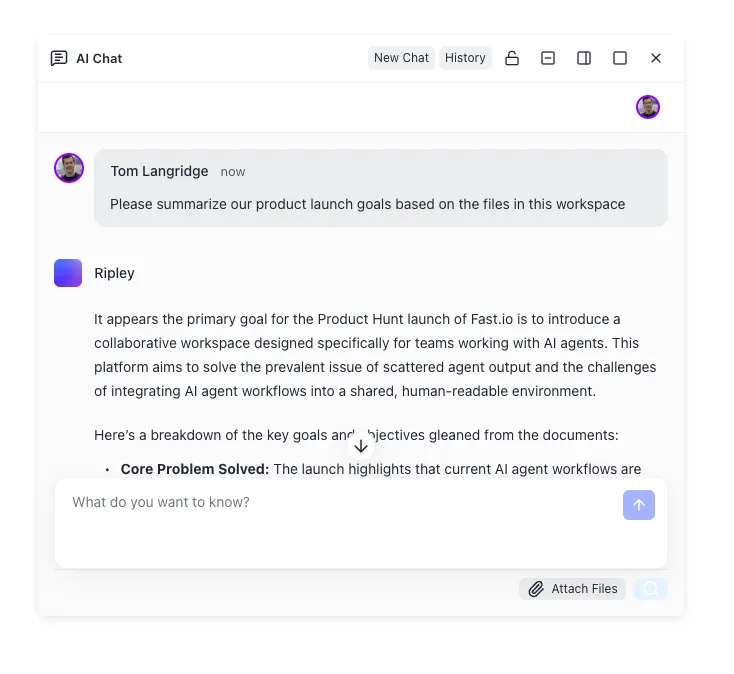
Fastio handles that handoff layer. Agents connect via the MCP server and write results to shared workspaces. Once enabled, Intelligence Mode indexes uploaded files for semantic search, so teammates can query past analyses through chat instead of digging through folders. Metadata Views can extract structured fields from uploaded reports, turning PDFs and spreadsheets into a queryable database of findings. Ownership transfer lets an agent build a workspace and hand it off to a human while keeping admin access. Plans start at $9.99 per month with 250 GB of storage, and a 14-day Business Trial is available at fast.io/pricing.
Sources
References used to verify factual claims in this guide.
-
Tellius compared 12 platforms for NL-to-SQL, autonomous investigation, and governance Power BI Pro costs $14/user/month and full Copilot requires Fabric F64+ at roughly $5,000/month ThoughtSpot Essentials starts at $25/user/month and Pro at $50/user/month Average Looker enterprise deployment costs around $150,000/year Tableau Enterprise Creator costs $115/user/month
-
Noimosai identified 7 agents for proactive insights and autonomy in 2026
-
Julius AI Pro costs $45/month or approximately $37/month billed annually
-
Tellius pricing starts around $495/month
Frequently Asked Questions
What is the best AI agent for data analysis?
It depends on your data stack and requirements. For autonomous root cause investigation across multiple sources, Tellius is the strongest option. For NL-to-SQL within a single warehouse, Databricks Genie and Snowflake Cortex Analyst offer the tightest integration with their respective platforms. For individual analysts who want quick answers from uploaded files without writing code, Julius AI has the lowest barrier to entry.
Can AI agents replace data analysts?
Not yet. Current agents handle data cleaning, anomaly detection, SQL generation, and basic statistical analysis well. They struggle with questions that require business context, judgment about data quality, or creative problem framing. The strongest teams use agents to accelerate routine analysis so human analysts can focus on interpretation, strategy, and communicating findings to stakeholders.
What AI tools do data scientists use in 2026?
Data scientists commonly use notebook-based tools like Hex, Databricks, and Jupyter alongside LLM-powered assistants such as ChatGPT and Claude for code generation and exploration. For production ML pipelines, Databricks MLflow and DataRobot remain widely used. NL-to-SQL agents are reducing time spent on ad-hoc queries, freeing data scientists for modeling and experimentation.
How do AI data analysis agents differ from BI dashboards?
BI dashboards are passive displays that show pre-built views of historical data. AI data analysis agents accept natural language questions, query live data, detect anomalies, and in some cases investigate root causes autonomously. Dashboards require you to know which question to ask and which filter to apply. Agents can surface insights proactively from data sources you did not think to check.
Related Resources

Store and share your analysis agent outputs in one workspace
Generous storage with MCP server access. Upload agent results, index them for semantic search once enabled, and hand off findings to teammates.