Best AI Automation Tools for 2026: 9 Platforms Compared
AI automation tools now span three distinct tiers: simple trigger-action platforms, multi-step AI workflow builders, and fully autonomous agent systems. This guide compares nine platforms across those tiers, covering pricing, AI capabilities, and practical trade-offs so you can pick the right tool for the work you actually need automated.


How We Evaluated These Tools
AI automation tools combine workflow automation with machine learning to handle complex, multi-step business processes that previously required human judgment at each decision point. With 590 monthly searches for "ai automation platforms" and $21+ CPC on related queries, teams are actively evaluating their options. Most listicles mix basic Zapier-style tools with agentic platforms as if they were interchangeable. They're not. We segmented this guide into three tiers based on automation complexity: simple triggers, multi-step AI workflows, and fully autonomous agents.
We tested each platform against five criteria:
- AI depth. How far beyond basic "if-then" logic does the platform go? Can it call LLMs mid-workflow, reason about outputs, and branch accordingly?
- Integration breadth. Native connectors matter, but so does the ability to hit an arbitrary API when the connector you need doesn't exist.
- Pricing transparency. We compared the cost of running 5,000 workflow executions per month on each platform and penalized hidden credit multipliers.
- Self-hosting and data control. Essential for regulated industries and teams that can't send data to a third-party cloud.
- Learning curve. How long it takes a new user to ship their first useful automation, not just complete a tutorial.
Related guides
- Best Free AI Agent Tools 2026: Top 12 Platforms ComparedBuilding autonomous agents doesn't have to be expensive. The free AI agent ecosystem now offers professional frameworks...
- Best Headless Browsers for AI Agents: Top Tools (2026)Finding the best headless browsers for AI agents matters for reliable automation. Old scrapers break on dynamic sites....
- Best Web Browsing Tools for AI Agents (2026)Web browsing tools let AI agents navigate the live web, fill forms, and extract real-time data. Traditional scrapers...
- Best Pydantic AI Tools for Building Reliable Agents (2026)Building reliable AI agents requires more than just prompts; it demands structured, type-safe data. Pydantic AI tools...
- 7 Best Streaming Data Platforms for AI Pipelines in 2026Streaming platforms let AI systems handle data feeds in real time, from sensor telemetry to user events. Market...
- 8 Best AI Agent Cost Optimization Tools in 2026AI agent costs add up fast once you move past prototyping. Tool calls, retries, multi-step reasoning, and storage...
More on this subject: AI Tool Directories and Comparisons (231 guides)
Quick Comparison
Here's how the nine platforms stack up at a glance.
Zapier: 8,000+ integrations, starts at $19.99/mo. Best for non-technical teams that need quick automations.
Make: 3,000+ integrations, starts at $9/mo. Best for visual, multi-branch workflow design on a budget.
Activepieces: 500+ integrations, free self-hosted tier. Best open-source alternative with MIT licensing.
n8n: 500+ integrations, free self-hosted or cloud from $24/mo. Best for technical teams that want full data control.
Pipedream: 3,000+ integrations, starts at $29/mo. Best for developers who want to write real code inside workflows.
Gumloop: 130+ integrations, starts at $37/mo. Best for agentic AI workflows that need multi-step reasoning.
Lindy: Pre-built AI employee templates, starts at $49.99/mo. Best for solo operators automating knowledge work.
Relevance AI: 2,000+ integrations, free tier available. Best for multi-agent orchestration at scale.
Fastio: Consolidated MCP toolset, persistent storage. Best for shared workspaces and human-agent handoff alongside your automation platform.
Best for Simple Automation
These platforms handle the "connect app A to app B" use case well. They've added AI features over the past year, but their core strength remains trigger-action workflows with broad integration support.
1. Zapier
Zapier remains the default choice for teams that want automation without touching code. Its library of 8,000+ integrations means you can connect almost anything, and most workflows take under ten minutes to set up.
The AI additions in 2026 are meaningful. Copilot turns natural language descriptions into working Zaps. Agents can plan and execute multi-step actions autonomously across connected apps. Chatbots let you build customer-facing AI support flows. All plans now include Tables, Forms, and Zapier MCP at no extra cost.
Key strengths:
- Largest integration library of any automation platform
- AI Copilot makes workflow creation accessible to anyone
- Zapier Agents add autonomous capability on top of existing Zaps
Limitations:
- Task-based pricing gets expensive at volume (2M tasks/mo costs $5,999)
- Less customizable than code-first platforms for complex logic
Best for: Non-technical teams that value speed of setup over fine-grained control.
Pricing: Free (100 tasks/mo), Professional from $19.99/mo, Team from $69/mo.
2. Make
Make (formerly Integromat) stands out for its visual canvas-based workflow builder. You drag modules onto a canvas and connect them, which makes complex branching and looping logic much easier to follow than Zapier's linear format.
Make switched from operations to credits as its billing unit in August 2025 to accommodate AI workloads. Standard app connections still cost 1 credit per operation, but AI-enhanced steps can consume 5 to 10 credits depending on model and prompt length. Teams adding AI to existing workflows should expect 3 to 5x higher credit usage than before.
Key strengths:
- Visual canvas makes multi-branch workflows readable at a glance
- Native modules for OpenAI, Claude, Gemini, and Stability AI
- Competitive pricing for small and mid-size teams
Limitations:
- AI credit multipliers can surprise teams migrating from standard workflows
- Steeper learning curve than Zapier (plan a few hours to get comfortable)
Best for: Teams that build multi-step workflows with conditional logic and need a visual way to manage complexity.
Pricing: Free (1,000 credits/mo), Core from $9/mo, Pro from $16/mo.
3. Activepieces
Activepieces is the strongest open-source option in the automation space. It's MIT-licensed, self-hostable, and includes 500+ native integrations with community contributions making up about 60% of the connector library.
The 2026 release added AI agents and 400+ MCP servers, which puts it closer to the agentic platforms further down this list. You can embed its automation builder into your own product using the JavaScript SDK, a feature no other platform here offers.
Key strengths:
- MIT license with full self-hosting support
- Embeddable automation builder via JavaScript SDK
- Unlimited tasks on self-hosted free tier
Limitations:
- Smaller integration library than Zapier or Make
- Community-driven connectors vary in quality and maintenance
Best for: Teams that need open-source licensing, data sovereignty, or want to embed automation into their own product.
Pricing: Free self-hosted (unlimited tasks), Cloud from $25/mo.
Best for Multi-Step AI Workflows
These platforms go beyond simple trigger-action patterns. They let you build workflows where AI models make decisions mid-flow, process unstructured data, and chain multiple reasoning steps together.

4. n8n
n8n is the most popular AI workflow builder for technical teams right now. It ships with nearly 70 AI-specific nodes, including deep LangChain integration, and it's the only platform on this list with full self-hosted deployment and no execution limits on the free Community Edition.
Billing is execution-based: one workflow run counts as one execution regardless of how many steps it contains. A 10-step workflow on n8n costs the same as a 1-step workflow, while Zapier would charge for each step separately. For teams running thousands of executions daily, this difference can mean 10x cost savings.
In April 2026, n8n removed all active workflow limits across every plan. You only pay based on executions now.
Key strengths:
- 70 AI nodes with native LangChain integration
- Execution-based billing (not per-step like Zapier)
- Self-hosted Community Edition is free with unlimited executions
Limitations:
- Requires technical skill to set up and maintain self-hosted instances
- Cloud plans start higher than Make ($24/mo vs $9/mo)
Best for: Developer-led teams in regulated industries or anyone who needs self-hosting with serious AI workflow capabilities.
Pricing: Free self-hosted, Cloud from $24/mo, Startup program at $400/mo with enterprise features.
5. Pipedream
Pipedream occupies a unique spot: it's a managed platform that lets you write real Node.js, Python, Go, or Bash code inside each workflow step. If you've outgrown no-code builders but don't want to build an entire automation framework from scratch, Pipedream fills that gap.
Its MCP Server is one of the most mature in production as of early 2026, exposing 10,000+ tools across 3,000+ apps with managed OAuth and encrypted credential storage. The AI Workflow Builder generates code and integration steps from natural language descriptions.
Workday signed a definitive agreement to acquire Pipedream in November 2025. The acquisition adds enterprise stability but raises questions about long-term pricing and product direction.
Key strengths:
- Write real code (Node.js, Python, Go, Bash) inside managed workflows
- Mature MCP Server with 10,000+ tools and managed OAuth
- 3,000+ native integrations with one SDK
Limitations:
- Workday acquisition may shift product direction toward enterprise use cases
- Credit-based pricing can be restrictive on lower tiers
Best for: Developers who want the flexibility of code with the convenience of managed integrations and OAuth.
Pricing: Free (100 credits/day), Basic from $29/mo, Advanced from $79/mo.
6. Gumloop
Gumloop is built for agentic workflows from the ground up. While Make and Zapier build reactive chains (event happens, actions fire), Gumloop agents reason autonomously, consider context across steps, and perform multi-step reasoning before acting.
The visual node-based editor works similarly to n8n, but the nodes are designed around AI operations: document summarization, unstructured data extraction, multi-step research, and content generation. The platform raised a $50 million Series B led by Benchmark in early 2026, which signals strong investor confidence in the agentic approach.
Key strengths:
- Built for agentic AI workflows, not retrofitted onto traditional automation
- Visual node editor with AI-first node types
- Access to GPT-4, Claude, Gemini, and other top models
Limitations:
- Smaller integration library (130+) compared to established platforms
- Newer platform with less community content and fewer templates
Best for: Teams building AI-native workflows that require reasoning and multi-step decision-making, not just data shuttling between apps.
Pricing: Free (2,000 credits), Solo from $37/mo, Pro from $97/mo.


Give your AI agents persistent storage and a workspace they can share
Generous storage, MCP-ready endpoint for agent reads, writes, and human handoff. Pair with any automation platform on this list.
Best for Autonomous Agent Platforms
These platforms move beyond workflows entirely. Instead of designing step-by-step processes, you define goals and let AI agents figure out how to accomplish them. They handle planning, tool selection, and execution loops on their own.
7. Lindy
Lindy lets you create AI "employees" (called Lindies) that automate knowledge work: email triage, meeting prep, lead research, and calendar management. Each Lindy handles a specific role and can escalate to humans when confidence is low.
The platform earned a 4.9/5 rating across 170+ reviews on G2, with ease of use mentioned 125 times in user feedback. Blackbird's case study reported 10 to 20 hours saved per week, and Ankor deployed 10 agents in their first week on the platform.
Key strengths:
- Pre-built agent templates for common knowledge work tasks
- Genuinely intuitive no-code agent builder
- Smart escalation routes tasks to humans when needed
Limitations:
- Credit-based pricing gets expensive for heavy users
- Voice calls billed separately at $0.19/minute plus $10/month per number
Best for: Solo operators and small teams automating repetitive knowledge work like email, scheduling, and lead research.
Pricing: Plus from $49.99/mo, Professional from $890/mo (annual).
8. Relevance AI
Relevance AI is built for multi-agent orchestration. You create a team of specialized agents that collaborate: one gathers information, another verifies it, a third writes the report. This architecture handles complex processes that would break as a single linear workflow.
The platform connects to 2,000+ apps and supports custom API integrations. Agents operate in chat mode, scheduled tasks, voice calls (from the Team plan), or meeting-based automation. All plans include SOC 2 and GDPR compliance, and Enterprise adds SSO, RBAC, and audit logs.
Key strengths:
- Multi-agent collaboration where specialized agents work together
- Multiple operating modes (chat, scheduled, voice, meetings)
- SOC 2 and GDPR compliance included on all plans
Limitations:
- Credit consumption scales with agent complexity
- Advanced features like voice agents locked to higher tiers
Best for: Teams that need multiple AI agents working together on complex, multi-step business processes.
Pricing: Free (200 actions/mo), Pro from $19/mo, Team from $234/mo.
9. Fastio
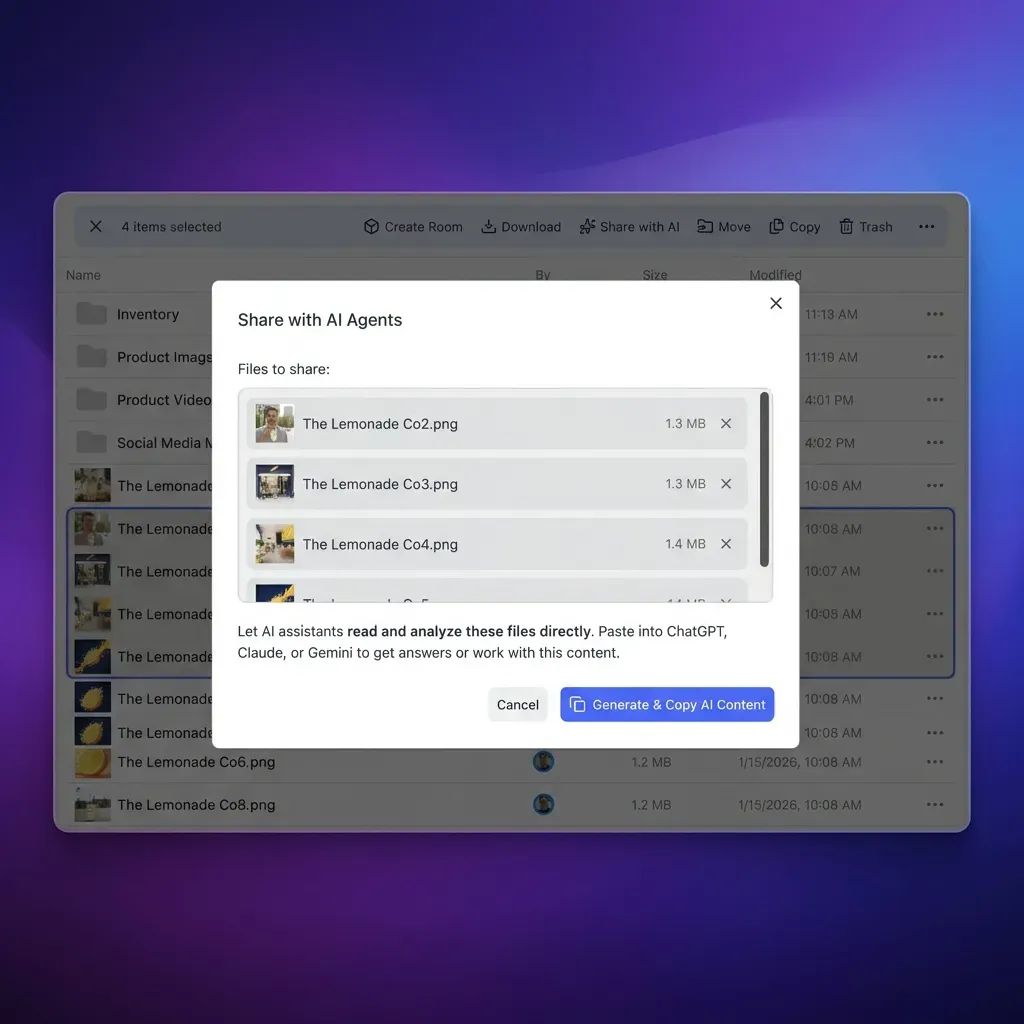
Fastio solves a problem that every other platform on this list ignores: where do your AI agents store files, share outputs, and hand work off to humans?
Automation platforms connect APIs and run AI logic, but they don't provide persistent storage, file versioning, or a collaboration layer where agents and humans work in the same space. Fastio fills that gap. Its MCP server exposes a consolidated MCP toolset for workspace, storage, and AI operations. Once Intelligence Mode is enabled for the workspace, it indexes uploaded files for semantic search and RAG, so agents can query documents without setting up a separate vector database.
The ownership transfer feature is useful for agency and consulting workflows: an agent creates a workspace, generates reports or processed files, then transfers the entire workspace to a human client while retaining admin access.
Metadata Views add structured data extraction from documents. Describe the fields you want in natural language, and AI builds a typed schema to extract contract dates, invoice totals, or policy numbers from PDFs and scanned pages.
Key strengths:
- 14-day Business Trial requiring a credit card
- MCP server works with Claude, GPT-4, Gemini, or any LLM
- Built-in RAG via Intelligence Mode, no separate vector database needed
- Ownership transfer for clean agent-to-human handoff
Limitations:
- Automation logic lives in a separate tool such as n8n or Zapier
- Newer platform with a smaller community than established storage providers
Best for: Teams running AI agents that need persistent file storage, document intelligence, and a clean handoff path between agents and humans.
Pricing: Starter $9.99/mo (3 seats, 250 GB), Business $49.99/mo (10 seats, 5 TB), Enterprise $199.99/mo (30 seats, 25 TB), with a 14-day Business Trial requiring a credit card. Details at fast.io/pricing.
Picking the Right Tool for Your Team
The right choice depends on what you're automating and who's building the workflows.
Start with Zapier if your team is non-technical and your workflows connect standard SaaS apps. The 8,000+ integration library means you'll rarely hit a dead end, and most automations ship in minutes. Switch away when task-based pricing starts eating your budget at scale.
Choose Make or Activepieces for visual workflows with more complexity. Make is the polished commercial option with strong AI model integrations. Activepieces is the MIT-licensed alternative you can self-host for free or embed into your own product.
Choose n8n or Pipedream if your team writes code. n8n's execution-based billing and self-hosting make it the cost leader for high-volume AI workflows. Pipedream gives you full programming language access inside a managed platform with mature MCP support.
Choose Gumloop, Lindy, or Relevance AI for agentic automation where AI makes decisions autonomously. Gumloop is strongest for custom agentic workflows. Lindy works best with pre-built AI employees for knowledge work. Relevance AI handles multi-agent orchestration where specialized agents collaborate.
Add Fastio as your workspace layer when agents need to read, write, and share files persistently. It pairs with any automation platform on this list and gives your agents a home for their outputs, with built-in RAG and ownership transfer when work is ready for human review.
Most platforms offer free tiers generous enough to test a real workflow before committing. Start with the tier that matches your automation complexity, test against a real use case, and scale from there.
Sources
References used to verify factual claims in this guide.
-
Zapier has 8,000+ integrations
-
n8n removed all active workflow limits across every plan in April 2026
-
Gumloop closed a $50 million Series B led by Benchmark in early 2026
-
Lindy earned a 4.9/5 rating across 170+ reviews on G2
-
Workday signed a definitive agreement to acquire Pipedream in November 2025
-
Make switched from operations to credits as billing unit in August 2025
-
Automation Anywhere AI agents resolve more than 80% of employee IT support requests
Frequently Asked Questions
What is the best AI automation tool?
It depends on your team's technical ability and how complex your workflows are. Zapier is the best starting point for non-technical teams that need broad integrations. n8n is the strongest choice for technical teams that want self-hosting and AI-native workflows. For fully autonomous agent-based automation, Gumloop and Relevance AI lead the field.
How do AI automation tools differ from traditional workflow automation?
Traditional automation follows rigid "if this, then that" logic. AI automation tools add language models that can reason about unstructured data, make judgment calls mid-workflow, and adapt their approach based on context. A traditional automation might forward an email based on a keyword match. An AI automation can read the email, understand the intent, draft a reply, and route it to the right team member based on urgency and topic.
What business processes can AI automate?
The most common use cases in 2026 are customer support triage, document processing and data extraction, lead qualification and outreach, meeting scheduling and follow-up, content generation workflows, and IT service management. Automation Anywhere reports that AI agents now resolve more than 80% of employee IT support requests across its enterprise deployments.
Is n8n better than Zapier for AI automation?
For technical teams, yes. n8n has 70 AI-specific nodes with LangChain integration, execution-based billing that's dramatically cheaper at scale, and a free self-hosted option with no execution limits. Zapier wins on ease of use and integration breadth (8,000+ apps vs 500+ for n8n), which makes it better for non-technical teams running simpler workflows.
Can I use multiple AI automation tools together?
Yes, and many teams do. A common pattern is using Zapier or Make for simple integrations, n8n for complex AI workflows, and Fastio for persistent file storage and agent-to-human handoff. Most platforms on this list expose APIs or MCP servers that let them interoperate, so you can pick the right tool for each layer of your automation stack rather than forcing one platform to do everything.
Related Resources

Give your AI agents persistent storage and a workspace they can share
Generous storage, MCP-ready endpoint for agent reads, writes, and human handoff. Pair with any automation platform on this list.