Best AI Agent Runtime Environments for Developers
Agent runtimes provide secure stateful execution for AI agents. Developers need tool support, persistent memory, safe environments. We compare the top 10 by popularity, features, ease of deployment, and cost.


How to Compare AI Agent Runtime Environments
Use this table to compare key features across the top runtimes.

Related guides
- How to Integrate Nextcloud with AI AgentsIntegrating Nextcloud with AI agents allows autonomous systems to read, write, and analyze files directly from your...
- How to Build an AI Agent Data Enrichment PipelineMost data enrichment pipelines connect to a single API and stop there. An AI agent enrichment pipeline chains multiple...
- How to Implement AI Agent Production LoggingLogging for AI agents requires capturing traces, reasoning chains, decisions, API calls, and errors for effective...
- How to Implement AI Agent Infra as Code (IaC)Deploying AI agents manually leads to "works on my machine" issues and state drift. AI Agent Infrastructure as Code...
- How to Build AI Agent Infrastructure: The Complete Stack GuideAI agent infrastructure is the comprehensive technology stack required to build, deploy, and run autonomous agents in...
- How to Connect ChatGPT to Nextcloud: Private Cloud AI Integration GuideConnecting ChatGPT to Nextcloud allows users to combine OpenAI conversational intelligence with self-hosted private...
More on this subject: Agent Infrastructure and Deployment (55 guides)
How We Evaluated AI Agent Runtimes
We selected runtimes developers rely on.
Popularity: GitHub stars, forums, adoption.
State management. Does it persist memory across sessions?
Sandbox/security: Isolation for tools/code.
Multi-agent: Team support, handoffs.
Deployment and pricing. Ease of setup, free tiers, scaling costs.
From GitHub data, developer surveys, and our tests. We evaluated runtime performance by deploying sample agents for multi-step tasks like data retrieval, file operations, and agent coordination.
Document access rules, audit trails, and retention policies before rollout so staging results are repeatable in production. This avoids late surprises and helps teams debug issues with confidence.
1. LangChain
LangChain is the most popular open-source framework for building LLM chains and agents, with 127k GitHub stars[^1].
Strengths:
- 1000+ integrations[^9] (tools, vector stores, LLMs)
- LangGraph for stateful graphs and cycles
- Built-in memory and RAG support
Limitations:
- Complex abstractions, steep learning curve
- Heavy dependencies (90+ packages)[^9]
- Local-only execution (no hosted runtime)
Best for prototyping and local development. See LangChain agents docs for integration ideas. Its vast ecosystem supports quick iteration with hundreds of pre-built tools and memory options.
from langchain.agents import create_openai_functions_agent
### Build agent...
Pricing: Free (LangSmith for production tracing: $39+/mo).
Deployment
pip install langchain; run locally or deploy to cloud (Vercel, AWS).
2. CrewAI
CrewAI focuses on role-based multi-agent teams for collaborative tasks.
Strengths:
- Simple crew/task setup
- Role-playing agents
- Sequential/hierarchical processes
Limitations:
- Smaller ecosystem
- Limited code execution
Best for team-based automation. Pricing: Free.
CrewAI enables intuitive multi-agent collaboration through role definitions and task delegation, simulating real team dynamics effectively.
3. AutoGen
AutoGen enables conversational multi-agent systems.
Strengths:
- Dynamic agent interactions
- Human-in-loop support
- Customizable
Limitations:
- Complex configuration
- Research-oriented
Best for experimental multi-agent convos. Pricing: Free.
AutoGen shines in scenarios requiring adaptive conversations, where agents negotiate and refine plans dynamically.
4. LangGraph
LangGraph builds stateful graphs for controllable agents.
Strengths:
- Cycles and branching
- Persistent state
- LangChain integration
Limitations:
- Graph complexity
- LangChain dependency
Best for structured workflows. Pricing: Free.
LangGraph offers fine-grained control over execution paths, essential for reliable complex agent behaviors.
5. Fastio MCP Server
Fastio is a hosted MCP server with a consolidated MCP toolset[^5] that gives agents persistent storage in intelligent workspaces; it does not run agent code itself. Agents create orgs, workspaces, and shares just like humans, with built-in RAG, previews, and collab.
Strengths:
- Consolidated MCP toolset: file operations, RAG search, URL import, events feed, ownership transfer
- 14-day Business Trial, card required (see /pricing/)
- Persistent state, advisory file locks for multi-agent coordination, version history, audit logs, human-agent handoff via transfer
- Built-in intelligence: indexed files once enabled, semantic search, cited answers
Limitations:
- Cloud-hosted (no self-host)
- Usage-based credits across plans
Best for production workflows needing persistence and team collab. Get started.
Fastio provides a remote MCP server at https://mcp.fast.io/mcp/tools (Streamable HTTP).
Pricing: 14-day Business Trial (card required); Starter $9.99/mo, Business $49.99/mo, Enterprise $199.99/mo (see /pricing/).
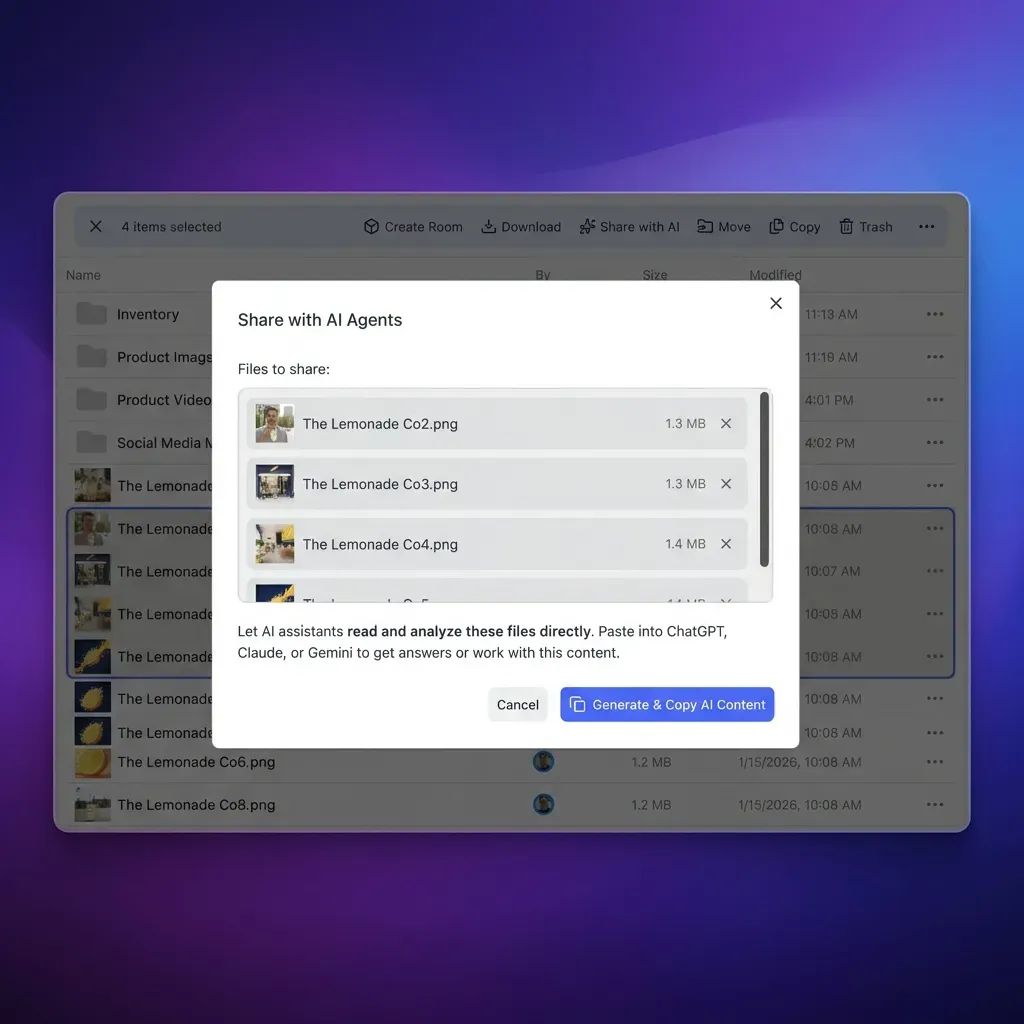


Give Your AI Agents Persistent Storage
Fastio MCP Server gives your agent runtime persistent storage and a consolidated MCP toolset. No infrastructure setup needed.
6. LlamaIndex
LlamaIndex specializes in RAG and data indexing for agents.
Strengths:
- Excellent data loaders
- Query engines
- Index management
Limitations:
- Narrower scope
- Less agentic
Best for knowledge bases. Pricing: Free.
LlamaIndex simplifies RAG pipelines, ensuring agents access relevant context from vast data sources accurately.
7. Semantic Kernel
Microsoft's framework for .NET/Python agents.
Strengths:
- Enterprise plugins
- Memory stores
- Planner support
Limitations:
- MS ecosystem focus
Best for .NET teams. Pricing: Free.
Semantic Kernel provides planners and memory abstractions tailored for enterprise Microsoft environments.
8. Dify
No-code platform for agent apps.
Strengths:
- Visual builder
- Workflow orchestration
- Marketplace
Limitations:
- Less custom code
Best for quick prototypes. Pricing: Freemium.
Dify's marketplace of components speeds up building deployable agent applications.
9. Flowise
Drag-and-drop LLM app builder.
Strengths:
- Embeddings support
- Easy sharing
- Self-hostable
Limitations:
- Basic agents
Best for non-devs. Pricing: Freemium.
Flowise allows visual construction of agentic flows, deployable via embed codes.
10. n8n
Workflow automation with agent nodes.
Strengths:
- 400+ integrations[^8]
- Visual editor
- Self-host
Limitations:
- Less AI-native
Best for hybrid workflows. Pricing: Freemium.
n8n connects AI agents to 400+ apps[^8], automating business processes end-to-end.
Open-Source MCP Runtimes
Most lists overlook MCP (Model Context Protocol) runtimes. Fastio's hosted server provides stateful tool access without self-hosting. Open-source MCP servers are in development, enabling standardized tool ecosystems for agents.
Define clear tool contracts and fallback behavior so agents fail safely when dependencies are unavailable. This improves reliability in production workflows.
Sources
References used to verify factual claims in this guide.
-
LangChain has 127k GitHub stars
-
CrewAI has 44k GitHub stars
-
90% of agents need sandboxed execution
-
Fastio provides a 14-day Business Trial, card required; see /pricing/
-
Fastio MCP Server provides a consolidated MCP toolset via Streamable HTTP, persistent workspaces, and built-in RAG
-
LangSmith production tracing starts at $39/mo
-
top 10 AI agent runtimes compared by popularity features ease of deployment and cost
-
n8n connects AI agents to 400+ apps, automating business processes end-to-end
-
LangChain offers 1000+ integrations and has heavy dependencies with 90+ packages
Frequently Asked Questions
What are the best AI agent runtime environments?
Top choices include LangChain for modularity, CrewAI for teams, and Fastio MCP for persistent storage that a runtime connects to.
What are open-source agent runtimes?
LangChain, CrewAI, AutoGen, and LangGraph are fully open-source. Fastio uses open MCP protocol.
Do AI agents need sandboxed execution?
Many do for safe tool use. Fastio uses secure workspaces instead of isolated sandboxes.
How does Fastio MCP work for agents?
Provides a consolidated MCP toolset via Streamable HTTP, persistent workspaces, and built-in RAG once Intelligence is enabled.
Does Fastio have a trial for agents?
Fastio offers a 14-day Business Trial (credit card required; see /pricing/) with persistent workspaces and usage-based credits.
Related Resources

Give Your AI Agents Persistent Storage
Fastio MCP Server gives your agent runtime persistent storage and a consolidated MCP toolset. No infrastructure setup needed.