Best AI Agent Infrastructure Stacks in 2026
Guide to agent infrastructure stacks: Choosing an AI agent stack means balancing storage, orchestration, and observability. This guide compares the top options for production agents. We look at state management, tool reliability, and how well they handle multi-agent systems. Whether you need a simple bot or a complex team of agents, here is how to find the right infrastructure for your project.

What Is an AI Agent Infrastructure Stack?
An AI agent infrastructure stack is the set of tools that handle an agent's core needs: where it stores data, how it coordinates tasks, and how you monitor its behavior. Most stacks include a mix of persistent storage, message brokers, orchestration frameworks, observability tools, and tool-calling interfaces.
These components usually break down into three layers. The storage layer handles state, file management, and vector embeddings. The orchestration layer manages agent loops, task distribution, and multi-agent communication. Finally, the observability layer provides tracing, logging, and debugging.
Research from the RAND Corporation cites estimates that more than 80% of AI projects fail. State loss and poor session handling are two of the biggest technical hurdles for agentic systems. Choosing the right stack determines how reliably your agents operate when you move beyond a demo.
Helpful references: Fastio Workspaces, Fastio Collaboration, and Fastio AI.

Why Infrastructure Choice Matters
The difference between a proof-of-concept and a production system often comes down to infrastructure. Agents that lose their place mid-task produce inconsistent results. Systems without good observability are difficult to fix when they break. The stack you choose determines whether your agents handle edge cases gracefully or fail when things get complex.
Related guides
- How to Automate AI Agent InfrastructureAI agent infrastructure automation helps you scale agent workflows from one bot to thousands. Most teams focus on...
- Top 10 AI Agent Infrastructure Platforms in 2026AI agent infrastructure platforms build backends for multi-agent systems. The market is expected to grow from $7.63...
- How to Build AI Agent Infrastructure: The Complete Stack GuideAI agent infrastructure is the comprehensive technology stack required to build, deploy, and run autonomous agents in...
- Best AI Agent Hosting Platforms in 2026AI agent hosting platforms provide compute, storage, and orchestration for deploying autonomous agents in production....
- How to Deploy AI Agents: The Complete Production GuideThis AI agent deployment guide explains how to move autonomous systems from development to production. Most AI agents...
- Top AI Agent Infrastructure Stacks for DevelopersChoosing the right infrastructure is the difference between a prototype and a production agent. We analyze the top...
More on this subject: Agent Infrastructure and Deployment (55 guides)
How We Evaluated These Stacks
We evaluated each stack across five areas that matter for production. State management covers how each solution handles session persistence and memory. Tool reliability measures how consistently agents execute external actions. Multi-agent support looks at how agents coordinate on complex workflows.
Integration flexibility assesses the SDK quality and protocol support. Finally, developer experience considers documentation and how quickly you can get a prototype running. Each solution below includes a rating in each category along with use cases where it works best.
For example, if you are building a research agent, you should prioritize state management. This ensures the agent doesn't forget its progress during long-running web searches or complex data gathering.
1. Fastio + MCP (Best for Shared Workspaces)
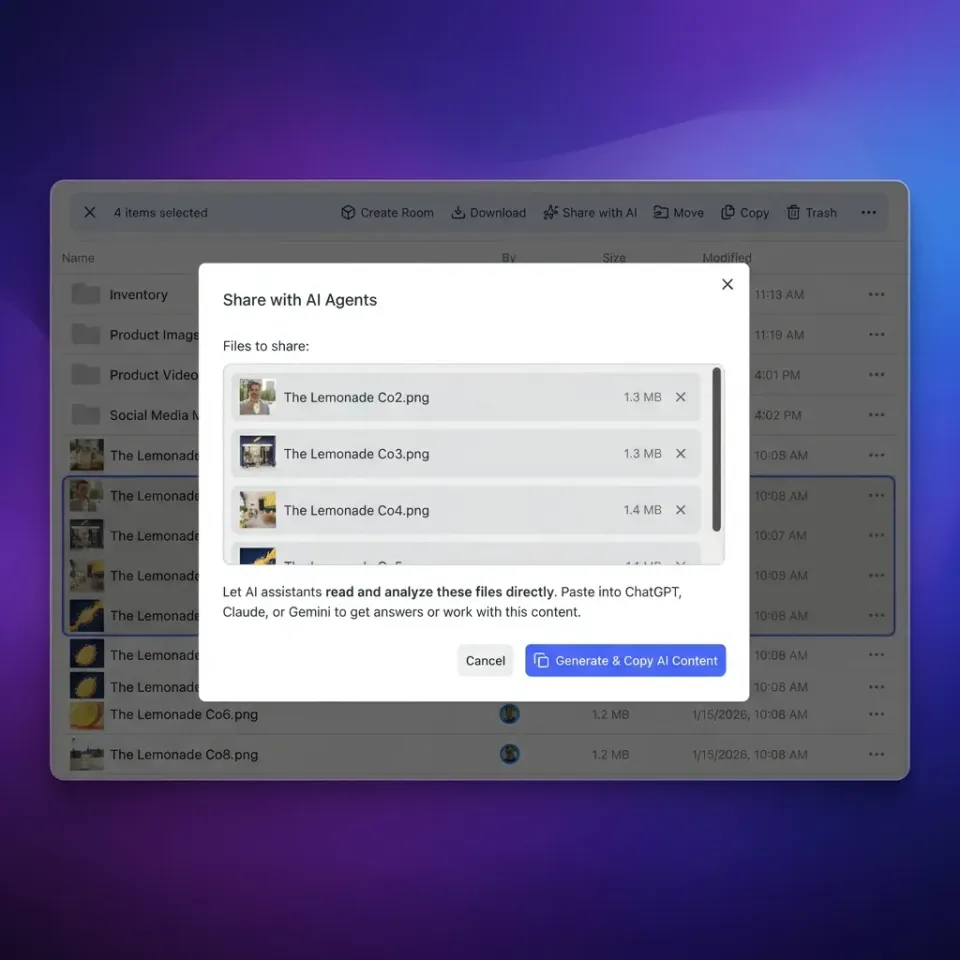
Fastio offers a workspace layer designed for agents and humans to work together. The big difference here is that agents and humans share the same workspaces instead of isolated sandboxes. Once Intelligence is enabled for a workspace, its files are indexed for search and AI chat. This means you don't have to set up or manage a separate vector database.
Using clear tool contracts helps agents fail safely when a service is down. This makes production workflows much more reliable. Start by testing this on a single workflow, then expand to other environments once you've confirmed it meets your goals.

Strengths
Persistent Storage: Workspaces for agent and human collaboration with granular permissions.
Consolidated MCP Toolset: Remote MCP server exposes tools for files, shares, and metadata extraction.
Built-in Intelligence: Once Intelligence is enabled for a workspace, files are indexed for semantic search and cited answers without a separate vector DB.
Ownership Transfer: Agents can create an organization and hand it to a human through a claim link.
Data Integrity: Advisory file locks coordinate writes between concurrent agents, while version history and audit logs protect all revisions.
Works with Any LLM: Use Claude, GPT-4o, Gemini, or local models via MCP or REST API.
Limitations
No Built-in Orchestration: Fastio focuses on storage and collaboration rather than managing the agent's logic loop.
Best For
Teams building agent-human collaboration tools, agencies delivering agent-built assets to clients, and developers who want RAG features without the extra infrastructure work.
Pricing
A 14-day Business Trial requires a credit card. Starter, Business, and Enterprise plans feature usage-based pricing. See fast.io/pricing for details.
2. LangChain + LangSmith
LangChain is the most common framework for building LLM applications. LangSmith provides the observability layer, offering tracing, evaluation, and debugging for your agents.
If you're seeing high latency, use LangSmith traces to find which step in the chain is slowing things down. This often reveals unnecessary loops or bloated prompts. Test your chains with a small set of inputs first to ensure the logic holds up before scaling to production traffic.
By monitoring performance metrics in LangSmith, teams can identify bottlenecks and optimize prompt engineering for better cost efficiency.
Strengths
Large Ecosystem: Plenty of documentation, an active community, and hundreds of integrations.
LangGraph: Good support for multi-agent workflows that need to loop back on themselves.
Observability: LangSmith gives you detailed traces and token usage tracking.
Flexibility: Works with almost any LLM and tool set.
Limitations
State Management: You'll need to handle session persistence yourself with extra setup.
Complexity: Can feel like overkill for simple tasks.
Tool Reliability: Performance depends on how well you implement your tools.
Best For
Teams already using LangChain who need deep tracking and debugging for complex agent workflows.
3. OpenAI Agents SDK
The OpenAI Agents SDK is a framework for building agents that use OpenAI's specific features, like structured outputs and built-in tool calling.
A common pattern is using one agent to plan a task and another to execute it. This handoff keeps the context window clean and improves the success rate for difficult tasks. Monitor your token usage closely, as multi-agent handoffs can increase costs if they pass large amounts of context back and forth.
Setting up fallback models or error handling for tool calls is important here. This ensures that even if one model call fails, the agent can recover and continue the task.
Strengths
Native Integration: Built to work perfectly with OpenAI models.
Structured Outputs: Guarantees JSON formatting for reliable tool calls.
Agent Handoffs: Simple ways to pass a conversation between specialized agents.
File Search: Vector search is built-in for RAG tasks.
Limitations
Provider Lock-in: Harder to use with other models.
Storage: Uses temporary file storage that doesn't last forever.
Pricing: Costs can add up quickly with many agents and long sessions.
Best For
Teams building apps exclusively on OpenAI who want to get up and running quickly.
4. AWS Bedrock Agents
AWS Bedrock Agents combines models with reasoning, tool use, and knowledge base retrieval, all within the AWS ecosystem.
It's helpful to connect Bedrock to your existing S3 buckets. This lets agents work with your internal data without moving files to a new location. Keep an eye on IAM permissions. Agents only need access to the specific Lambda functions and buckets required for their tasks.
Integrating Bedrock with CloudWatch provides centralized logging. This is helpful for enterprise teams that need to meet strict compliance and auditing standards.
Define clear tool contracts and fallback behavior so agents fail safely when dependencies are unavailable. This improves reliability in production workflows.
Strengths
AWS Integration: Connects directly to S3, Lambda, and DynamoDB.
Knowledge Bases: RAG is built into the Bedrock Knowledge Bases feature.
Security: Meets enterprise standards with VPC isolation and IAM control.
Scalability: AWS handles the infrastructure scaling for you.
Limitations
Vendor Lock-in: Deep integration makes it hard to move elsewhere later.
Complexity: Requires AWS knowledge to set up correctly.
Cost: Can get expensive, especially with high API usage.
Best For
Large companies already in AWS who need secure agent infrastructure.
5. Anthropic Computer Use (Claude)
Anthropic's computer use feature lets Claude control a computer by looking at screenshots and using the keyboard and mouse. It is useful for browser automation and desktop tasks.
One practical use case is automated UI testing. Claude can navigate through your app like a human user and report any visual bugs it finds. Ensure you are running these agents in a sandbox or virtual machine to keep your primary systems safe.
This approach works well for legacy software that lacks a modern API. Claude can interact with the interface just like a human operator would.
Strengths
Top Performance: Claude Sonnet is a strong choice for computer interaction tasks.
Browser Automation: Direct control for complex web workflows.
Tool Reliability: Often more reliable than API-based tools for tasks that don't have a public API.
Limitations
Specific Use Case: Built for computer interaction, not general agent management.
Cost: Continuous computer use uses a lot of tokens.
Security: Needs careful isolation since the agent is clicking on a real interface.
Best For
Teams building browser automation, testing tools, or workflows that need to use desktop software.
6. AutoGen (Microsoft)
Microsoft's AutoGen framework lets agents talk to each other to solve tasks through conversation or by writing code.
Try setting up a peer-review loop with a coder agent and a reviewer agent. This helps catch errors before any code is executed in production. Standardize your code execution environment so agents don't run into dependency issues when they try to run their scripts.
AutoGen is particularly strong for data science tasks where agents can write, test, and iterate on Python scripts autonomously.
Strengths
Multi-Agent Focus: Native support for agent-to-agent talk and specific roles.
Flexibility: Supports custom agents and human-in-the-loop steps.
Code Generation: Strong at writing and running code to solve problems.
Limitations
State Management: You will need a separate solution for persistent state.
Learning Curve: Can be complex for teams new to multi-agent systems.
Observability: Fewer built-in tracking tools than LangChain.
Best For
Teams building complex systems where agents need to coordinate and write their own code.
7. CrewAI
CrewAI takes a structured approach, organizing agents into teams with roles, goals, and specific processes.
A common setup is a researcher that gathers data and a writer that drafts the final report. This clear division of labor keeps the agents focused on their specific tasks. Define your processes . Sequential tasks are easier to debug, while hierarchical tasks handle more complexity.
The framework is designed for production use cases where you need consistent, repeatable results from a team of specialized agents.
Strengths
Role-Based: Clear definitions for what each agent is responsible for.
Process Framework: Built-in workflows like sequential or hierarchical task execution.
Tool Integration: Easy to connect to external APIs and tools.
Community: Fast-growing ecosystem with lots of examples.
Limitations
Newer Framework: Less mature than LangChain or AutoGen.
State Persistence: You'll need extra setup for sessions that last across restarts.
Enterprise Features: Still adding advanced security and compliance tools.
Best For
Teams that want a clear, role-based structure for their multi-agent workflows.
8. Pinecone + Custom Orchestration
Some teams build their own orchestration layer while using Pinecone for vector storage and search. This gives you full control but requires more engineering work.
If you have billions of documents, a custom setup with Pinecone often performs better than general-purpose RAG tools. Expect to spend more time on maintenance. You'll be responsible for managing the storage, the agent logic, and the monitoring yourself.
This is the preferred route for high-scale applications where every millisecond of latency and every dollar of compute cost matters.
Strengths
Vector Performance: Built specifically for storage and search at scale.
Control: You have full control over the orchestration and state.
Scalability: Handles huge amounts of data with managed infrastructure.
Limitations
Engineering Cost: You have to build the logic from scratch.
No Built-in Agents: You must write the agent loops and memory yourself.
Complexity: Managing separate systems for storage and logic is harder than using an all-in-one stack.
Best For
Teams with strong engineering resources who need a custom architecture.
Comparison Summary
These stacks range from fully managed to build-your-own. Fastio is a strong choice if you want agents and humans to work in the same space. Most competitors overlook this collaborative layer.


Give Your AI Agents Persistent Storage
Fastio provides shared workspaces, Intelligence-enabled search, and a consolidated MCP toolset for your agent infrastructure stack.
Which Stack Should You Choose?
Your choice depends on your existing infrastructure, whether you need agents and humans to work together, and how much complexity you can handle.
Choose Fastio + MCP if you want workspace search without managing databases, need advisory file locks for multi-agent coordination, or need agents to share spaces with humans. See the Business Trial for evaluation details.
Choose LangChain + LangSmith if you need a large ecosystem of integrations, want detailed debugging traces, or are building multi-step logic chains.
Choose AWS Bedrock Agents if you are already on AWS and need enterprise security features.
Choose AutoGen or CrewAI if your project is centered on multiple agents talking to each other with specific roles.
Build custom with Pinecone only if you have massive search requirements that other tools can't handle and you have the engineers to build the rest of the stack.
The right stack today might change in six months. Choose solutions that work well with others so you can swap parts as your needs grow.
Sources
References used to verify factual claims in this guide.
-
80%
-
Claude 3 top performance Claude 3.5 Sonnet top performance for computer interaction
-
billions of documents
Frequently Asked Questions
What is an AI agent infrastructure stack?
It is the mix of storage, orchestration, and observability tools used to build and run AI agents. It handles where an agent saves data, how it thinks through tasks, and how you monitor its performance.
What is the best stack for multi-agent systems?
LangGraph, AutoGen, and CrewAI are the strongest for multi-agent work. LangGraph is great for stateful workflows, AutoGen is best for code-writing agents, and CrewAI is best for role-based teams. Fastio + MCP is the best for agents and humans collaborating in one space.
How do I choose between managed and custom stacks?
Managed stacks like AWS Bedrock or OpenAI reduce work but lock you into one provider. Custom stacks offer more control but require more engineering. Most teams start with a managed solution and move to custom once they hit specific limits.
Why does state management matter for production agents?
Estimates cited by the RAND Corporation put the failure rate of AI projects above 80%. Without saving state, agents forget what they were doing if a task is interrupted. Saving progress makes agents more reliable and consistent over time.
Can Fastio work with any LLM?
Fastio's remote MCP server uses Streamable HTTP, with legacy SSE available, so MCP-compatible clients can connect to its consolidated toolset.
Related Resources

Give Your AI Agents Persistent Storage
Fastio provides shared workspaces, Intelligence-enabled search, and a consolidated MCP toolset for your agent infrastructure stack.