Best AI Agent Hosting Platforms in 2026
AI agent hosting platforms provide compute, storage, and orchestration for deploying autonomous agents in production. This guide compares 10 platforms across pricing, persistent storage, framework support, and developer experience so you can pick the right infrastructure for your agents.

What AI Agents Actually Need From a Hosting Platform
Traditional web hosting gives you a server, a database, and a deployment pipeline. AI agents need more. A production agent typically requires four layers working together: compute for running inference and business logic, persistent storage for artifacts and context, orchestration for coordinating multi-step workflows, and monitoring to understand what agents are doing and why.
Most hosting comparisons focus on the first layer, compute, because that is where model inference happens. Platforms like Replicate and Modal excel here. But production agents generate files, build reports, maintain conversation history, and hand off work to humans. The AI agents market hit $7.84 billion in 2025 and is projected to reach $10.91 billion in 2026, according to MarketsandMarkets. As organizations move agents from prototypes to production, the storage and coordination layers become just as important as raw compute.
The gap matters because most AI agents need persistent storage alongside compute for production use. An agent that processes contracts needs somewhere to store extracted data. A research agent needs to save its findings. A coding agent needs to commit artifacts. Ephemeral compute with no file persistence works for chatbots, but breaks down for anything that produces lasting output.
Related guides
- Top 10 AI Agent Infrastructure Platforms in 2026AI agent infrastructure platforms build backends for multi-agent systems. The market is expected to grow from $7.63...
- Top AI Agent Hosting Providers in 2026AI agent hosting providers offer scalable runtime with persistent storage and tools for reliable operation. This list...
- Best AI Agent Infrastructure Stacks in 2026Guide to agent infrastructure stacks: Choosing an AI agent stack means balancing storage, orchestration, and...
- How to Automate AI Agent InfrastructureAI agent infrastructure automation helps you scale agent workflows from one bot to thousands. Most teams focus on...
- How to Deploy AI Agents: The Complete Production GuideThis AI agent deployment guide explains how to move autonomous systems from development to production. Most AI agents...
- How to Build AI Agent Infrastructure: The Complete Stack GuideAI agent infrastructure is the comprehensive technology stack required to build, deploy, and run autonomous agents in...
More on this subject: Agent Infrastructure and Deployment (55 guides)
How We Evaluated These Platforms
We scored each platform across five dimensions:
Compute infrastructure: GPU availability, cold start times, auto-scaling, and whether the platform supports long-running processes or only short-lived functions.
Persistent storage: Can agents store files, organize them into projects, and access them across sessions? This is where most platforms fall short. Ephemeral volumes that reset on each deploy do not count.
Framework support: Compatibility with LangChain, LlamaIndex, CrewAI, AutoGen, and the emerging MCP (Model Context Protocol) standard for tool access.
Pricing model: Free tiers, pay-per-use vs subscription, and total cost for a typical production agent running 24/7.
Developer experience: API quality, SDK availability, local dev tooling, and how fast you can go from code to running agent.

The 10 Best AI Agent Hosting Platforms
Here are the platforms worth evaluating in 2026, organized from compute-focused to storage-focused. Most production architectures combine at least two of these, one for running code and one for persisting output.
1. Modal
Modal is a serverless compute platform built for Python ML workloads. You define functions with Python decorators, run modal deploy, and get auto-scaling infrastructure without writing Dockerfiles.
Key strengths:
- Sub-4-second cold starts, GPU containers spin up in roughly one second
- Built-in scheduling, secrets management, and shared volumes
- Excellent Python developer experience with no Docker required
Key limitations:
- Python only, no TypeScript or JavaScript support
- Production costs can exceed base rates due to regional and preemption multipliers
- Shared volumes are compute-adjacent, not a full file management system
Best for: Python teams running scheduled agent jobs, batch processing, and inference pipelines.
Pricing: Free starter plan with $30/month in credits and 3 seats. Team plan at $250/month with $100 in credits and up to 1,000 containers.
2. Railway
Railway provides instant deployment for web apps and background services, including always-on agent processes that need persistent state.
Key strengths:
- One-click deploy from GitHub with built-in CI/CD
- Persistent volumes that survive restarts and redeploys
- Integrated databases (Postgres, Redis) for agent state management
Key limitations:
- No native GPU support for model inference
- Credit-based billing makes cost forecasting harder
- Apps shut down immediately when credits run out
Best for: Always-on agents that need database integration and persistent volumes without managing Kubernetes.
Pricing: Credit-based model, typically $5-50/month for always-on services depending on resource usage.
3. Fly.io
Fly.io runs applications on a global edge network across 30+ regions using micro-VMs, giving agents low-latency access worldwide.
Key strengths:
- Global edge deployment across 30+ regions
- Persistent volumes and private networking
- GPU support with A100 and H100 availability
- Zero-downtime deploys with sub-second autoscaling
Key limitations:
- Removed free tier for new customers in 2024
- IPv4 costs an extra $2/month
- Pricing has many line items that complicate cost estimation
Best for: Agents that need global distribution with persistent state and optional GPU access.
Pricing: Usage-based. Shared 256MB instances start around $1.94/month. GPUs from $1.35/hour. Fly.io has no free tier for new accounts.


Give Your AI Agents a Persistent Storage Layer
Fastio provides shared storage, MCP integration, and workspace search once Intelligence is enabled. Pair it with any compute platform for a complete agent hosting stack.
Enterprise and Managed Agent Platforms
4. AWS Bedrock Agents
Amazon Bedrock Agents provides managed agent orchestration tightly integrated with AWS services. Agents connect to S3, Lambda, DynamoDB, and other AWS resources natively.
Key strengths:
- No separate charge for the agent orchestration layer itself
- Knowledge Bases with managed RAG and vector storage
- Access to Claude, Titan, Llama, and other foundation models
- Enterprise governance with IAM, CloudTrail, and VPC support
Key limitations:
- A single user query can trigger 5+ internal model calls, each billed separately
- Complex IAM configuration and steep learning curve
- Deep AWS ecosystem lock-in
Best for: Teams already invested in AWS who need managed agent orchestration with enterprise compliance.
Pricing: Pay per model token and per tool invocation. No charge for the agent service itself. Storage via S3 at $0.023/GB/month.
5. Google Vertex AI Agent Builder
Vertex AI Agent Builder is Google Cloud's managed platform for building enterprise agents with visual no-code tools and native RAG capabilities.
Key strengths:
- No-code drag-and-drop agent builder alongside code-first options
- Native RAG with Google Search grounding
- LangChain and LlamaIndex integration built in
- $300 in free credits for new GCP accounts
Key limitations:
- Pricing changed significantly in late 2025, adding charges for sessions, memory, and code execution
- Express Mode limited to 10 agent engines
- Requires GCP expertise for production deployments
Best for: Teams on Google Cloud who want managed infrastructure with visual agent building tools.
Pricing: Pay-as-you-go. Agent Engine Runtime at $0.0864/vCPU-hour. Stored sessions at $0.25 per 1,000 events. Code execution billing added February 2026.
6. Azure AI Foundry Agent Service
Microsoft's managed agent hosting integrates with SharePoint, Fabric, and the broader Microsoft enterprise ecosystem through Azure AI Foundry.
Key strengths:
- No additional charge for the agent orchestration layer
- 1,400+ action connectors via Azure Logic Apps
- Microsoft Entra Agent ID for identity management
- Deep SharePoint and Fabric integration for enterprise data
Key limitations:
- Underlying model tokens and tool invocations still cost money
- Heavily tied to Microsoft ecosystem
- Relatively new service with an evolving feature set
Best for: Microsoft-centric organizations that need agent identity, governance, and integration with existing Microsoft infrastructure.
Pricing: Free orchestration layer. You pay for model tokens at Azure OpenAI rates, plus tool invocations. Agent Commit Units available for volume discounts.

Agent-Native Orchestration Platforms
7. LangGraph Cloud
LangGraph Cloud is the managed deployment layer for LangGraph agents (by LangChain), with built-in persistence that saves state at every execution step.
Key strengths:
- Automatic state persistence via checkpointers, no manual save/load logic
- Human-in-the-loop workflows with approval gates
- Time-travel debugging to replay and inspect past agent decisions
- LangGraph Studio for visual prototyping and testing
Key limitations:
- Requires LangSmith Plus ($39/user/month) for the Plus tier
- Metered pricing can be unpredictable for high-throughput agents
- Tied to the LangChain ecosystem
Best for: Teams building stateful agents with LangChain who need managed persistence, debugging, and human oversight.
Pricing: $0.001 per node executed. Standby costs from $0.0007/min (dev) to $0.0036/min (production). Plus tier requires LangSmith Plus at $39/user/month.
8. CrewAI Enterprise
CrewAI is a multi-agent orchestration platform where you define teams of agents that collaborate on tasks, with an open-source core and managed cloud option.
Key strengths:
- Multi-agent collaboration is a first-class concept, not bolted on
- Visual Studio interface for building agent teams
- Open-source core for self-hosting
- Integrated observability for tracking agent interactions
Key limitations:
- No pay-as-you-go pricing, only fixed tiers starting at $99/month
- Exceeding execution limits requires a tier upgrade
- Self-hosted mode requires managing your own infrastructure
Best for: Teams building multi-agent systems where agents need to delegate, share context, and collaborate on complex tasks.
Pricing: Starts at $99/month with fixed execution limits. Enterprise tier up to $120,000/year. Self-hosted open-source core is free.
The Missing Layer, Persistent Storage for Agents
9. Fastio
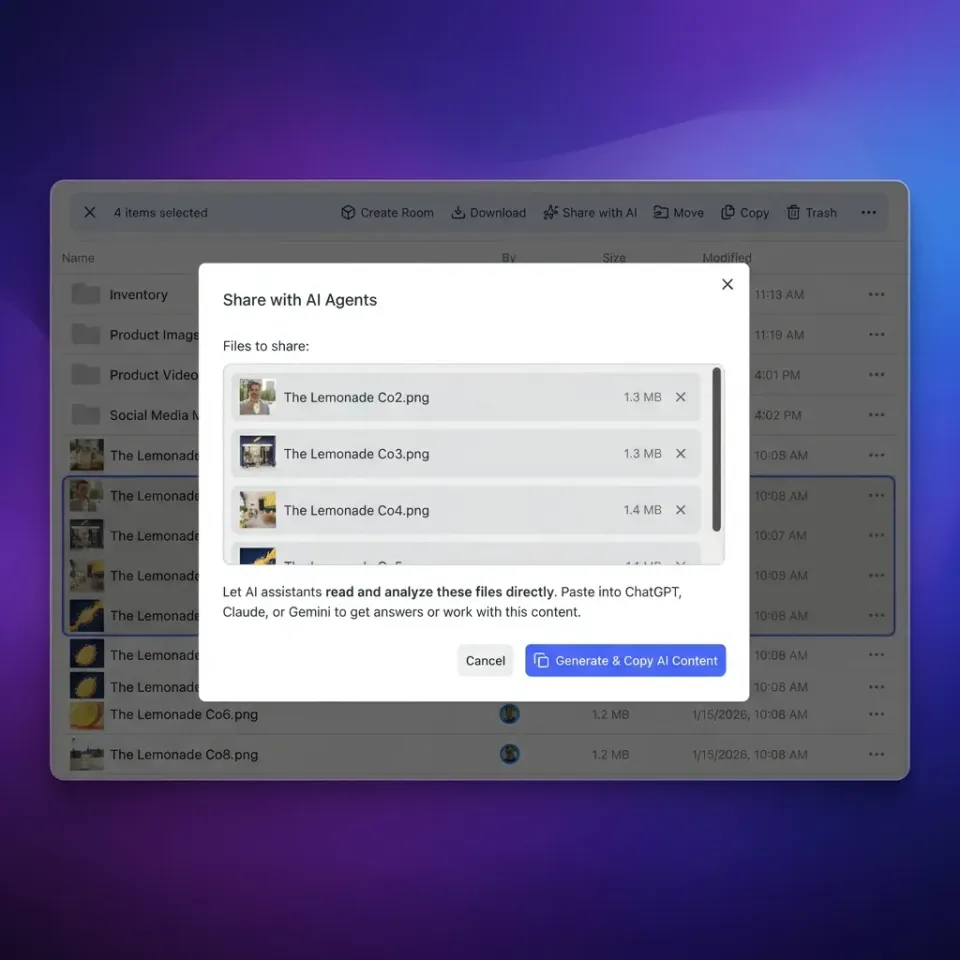
Fastio is a workspace platform built for agentic teams, providing the persistent storage and collaboration layer that compute-focused platforms leave out. Where other platforms run your agent's code, Fastio stores and organizes what agents produce.
Key strengths:
- A 14-day Business Trial (requires a credit card) to evaluate shared workspaces
- Consolidated MCP toolset via Streamable HTTP (
https://mcp.fast.io/mcp/tools) - Once Intelligence is enabled for a workspace, uploaded files are indexed for semantic search and document chat with citations
- Ownership Transfer allows an agent to create an organization and hand it to a human through a claim link
- Granular permissions, file version history, and a realtime activity feed or WebSocket events feed
- Cloud import from Google Drive, Dropbox, OneDrive, Box and public URLs
Key limitations:
- Storage and collaboration platform, not compute infrastructure. Pair with Modal, Railway, or a hyperscaler for inference
- Best suited for persistent file workflows rather than ephemeral scratch space
Best for: Agents that generate artifacts, manage documents, or need organized file handoff to humans. Works especially well as the storage layer for AI agents alongside any compute platform.
Pricing: A 14-day Business Trial requires a credit card. Starter, Business, and Enterprise plans are available at fast.io/pricing.
10. Replicate
Replicate provides a serverless API for running 50,000+ open-source ML models without managing infrastructure. It was acquired by Cloudflare in 2025, adding edge distribution to its inference capabilities.
Key strengths:
- Access to 50,000+ community models via simple REST API
- Per-second billing with no idle costs
- Cloudflare acquisition brings edge distribution
- Simple to deploy custom models with Cog
Key limitations:
- Replicate has no free tier
- Primarily stateless inference, not suited for long-running agent processes
- No persistent storage layer for agent artifacts
Best for: Teams that need fast access to a wide range of models for inference without managing GPUs.
Pricing: Per-second billing based on hardware. A100 (80GB) at approximately $0.0032/second. Some models bill per input/output instead.
Which Platform Should You Choose?
The right choice depends on what your agent does and where your team already works.
If you are prototyping: Start with Modal's free tier for compute and Fastio's Business Trial for storage. You get GPU access, persistent file storage, and workspace search once Intelligence is enabled.
If you need always-on agents: Railway or Fly.io for the process, paired with a storage solution for artifacts. Railway is simpler, Fly.io gives you global distribution.
If you are an enterprise team: Pick the hyperscaler you already use. AWS Bedrock if you are on AWS, Vertex AI for Google Cloud, Azure AI Foundry for Microsoft shops. The ecosystem integration outweighs individual feature differences.
If you are building multi-agent systems: LangGraph Cloud or CrewAI for orchestration. LangGraph if you are in the LangChain ecosystem and want built-in persistence. CrewAI if multi-agent collaboration is your primary design pattern.
If your agents produce files: Any compute platform paired with Fastio for the storage layer. Agents can organize output and use workspace search once Intelligence is enabled. The MCP server connects to MCP clients such as Claude Desktop and Cursor.
Most production architectures combine two platforms: one for running agent code and one for persisting what agents produce. Trying to force a compute platform to handle file management (or a storage platform to run inference) leads to workarounds that break at scale.
Sources
References used to verify factual claims in this guide.
-
AI agents market hit $7.84 billion in 2025, projected to reach $10.91 billion in 2026
-
Modal starter plan free with $30/month credits, Team plan $250/month
-
Fly.io removed free tier for new customers in 2024, shared instances from $1.94/month
-
Vertex AI Agent Engine Runtime at $0.0864/vCPU-hour, stored sessions at $0.25 per 1,000 events
-
LangGraph Cloud $0.001 per node executed, LangSmith Plus at $39/user/month
-
CrewAI Enterprise starts at $99/month, up to $120,000/year
-
Replicate A100 (80GB) at approximately $0.0032/second
-
Azure AI Foundry Agent Service free orchestration layer with 1,400+ Logic Apps connectors
-
AWS Bedrock Agents no separate charge for agent service, pay per model token
Frequently Asked Questions
Are there free tiers or trials for AI agent hosting and storage?
Several platforms offer free tiers for compute while Fastio provides a 14-day Business Trial that requires a credit card for workspace storage. Modal gives $30/month in compute credits on their starter plan. Google Vertex AI offers $300 in credits for new accounts. For production workloads, expect to pay for compute, storage, or both.
What platforms support AI agent deployment?
The market splits into three categories. Compute platforms (Modal, Railway, Fly.io, Replicate) run your agent code. Managed agent services (AWS Bedrock, Google Vertex AI, Azure AI Foundry) provide orchestration with enterprise integrations. Orchestration platforms (LangGraph Cloud, CrewAI) handle multi-agent coordination and state. Fastio provides the persistent storage layer that agents need for files, artifacts, and human handoff. Most production setups combine two or more of these.
How much does it cost to host an AI agent?
A typical production agent costs $50-200/month for compute (Modal or Railway), $10-500/month for LLM API calls depending on token usage, and $0-60/month for storage. Fastio offers a 14-day Business Trial for evaluating its workspace layer. Serverless platforms like Modal charge only when your agent runs, which helps control costs for intermittent workloads. Always-on platforms like Railway charge for uptime regardless of activity.
Do I need separate storage for my AI agent?
If your agent generates files, processes documents, or hands off work to humans, yes. Compute platforms like Modal and Replicate offer ephemeral storage that resets between runs. Production agents that create reports, extract data, or maintain project context need persistent storage with organization, search, and access control. Fastio provides this as a workspace layer with built-in RAG indexing and file versioning.
What is MCP and why does it matter for agent hosting?
Model Context Protocol (MCP) standardizes how AI assistants access external tools and data sources. Instead of writing custom API integrations for each client (Claude Desktop, Cursor, Devin Desktop (formerly Windsurf)), MCP-compatible platforms expose a single interface that any MCP client can use. Fastio provides a consolidated MCP toolset for workspace, storage, and AI operations via Streamable HTTP at `https://mcp.fast.io/mcp/tools` (coding agents such as Cursor use `https://mcp.fast.io/mcp/code`).
Which platform is best for multi-agent systems?
LangGraph Cloud and CrewAI are purpose-built for multi-agent orchestration. LangGraph provides automatic state persistence and human-in-the-loop workflows. CrewAI treats agent collaboration as a first-class design pattern. For the file coordination layer, Fastio provides advisory file locks for concurrent agent access, shared workspaces, activity polling, and a WebSocket events feed.
Related Resources

Give Your AI Agents a Persistent Storage Layer
Fastio provides shared storage, MCP integration, and workspace search once Intelligence is enabled. Pair it with any compute platform for a complete agent hosting stack.