AI Agent vs Chatbot: Key Differences & When to Use Each (2026)
Everyone knows chatbots, but AI agents are the new workforce. While a chatbot waits for your input to reply, an AI agent autonomously plans, executes tasks, and manages files to achieve your goals. This guide breaks down the critical differences in autonomy, memory, and tool use so you can choose the right tool for the job.


The Core Difference: Autonomy vs. Conversation
An AI agent is an autonomous system that can plan, use tools, and take actions to accomplish goals, while a chatbot is a conversational interface that responds to user messages within a predefined scope. The key difference is autonomy: agents act independently, chatbots react to prompts. Think of a chatbot as a knowledgeable librarian. You ask a question, and they find the answer in a book. They are helpful, but they stay at the desk. An AI agent is like a research assistant. You give them a goal, such as "Plan my travel itinerary," and they go out, check flight prices, book the tickets, add them to your calendar, and email you the confirmation. They don't just talk; they do. According to recent market analysis, the AI agent market is projected to grow from $5B to $47B by 2030, driven entirely by this shift from conversation to action.
Helpful references: Fastio Workspaces, Fastio Collaboration, and Fastio AI.
Related guides
- 10 Best AI Chatbot Apps in 2026, Ranked by What You Can Actually Do With ThemMobile-only AI chatbot users in the U.S. jumped from 13 million to 110 million in under two years, yet most roundups...
- Best Headless Browsers for AI Agents: Top Tools (2026)Finding the best headless browsers for AI agents matters for reliable automation. Old scrapers break on dynamic sites....
- Best Web Browsing Tools for AI Agents (2026)Web browsing tools let AI agents navigate the live web, fill forms, and extract real-time data. Traditional scrapers...
- Best Inference Providers for AI Agents: Low-Latency API SolutionsInference providers deliver managed APIs for accessing Large Language Models with high throughput and low latency. The...
- Best Free AI Agent Tools 2026: Top 12 Platforms ComparedBuilding autonomous agents doesn't have to be expensive. The free AI agent ecosystem now offers professional frameworks...
- Best Pydantic AI Tools for Building Reliable Agents (2026)Building reliable AI agents requires more than just prompts; it demands structured, type-safe data. Pydantic AI tools...
More on this subject: AI Tool Directories and Comparisons (231 guides)
Comparison at a Glance: AI Agent vs. Chatbot
To understand why 65% of enterprises plan to deploy AI agents by 2027 (up from just 5% in 2024), we need to look at the capabilities side-by-side.
Bottom Line: Use a chatbot when you need an answer. Use an agent when you need a job done.
Deep Dive: How Chatbots Work
Chatbots are designed for interaction. They excel at Natural Language Understanding (NLU), parsing what you say and mapping it to an intent. Whether it's a simple rule-based bot or an advanced LLM like ChatGPT (in its default mode), the interaction loop is always the same: User Input → Processing → Bot Output.
They are "stateless" by design in many architectures. Once you close the window, the context is often gone. This makes them excellent for:
- Customer Support: Answering FAQs like "What is your return policy?"
- Information Retrieval: Summarizing a pasted document.
- Creative Writing: Brainstorming ideas or drafting emails. However, they hit a wall when the task requires moving outside the chat window. A chatbot cannot "go check your file server for the report from last month" unless it has been upgraded into an agentic system.
Deep Dive: How AI Agents Work
AI agents wrap a Large Language Model (LLM) in a cognitive architecture that gives it "hands" and "eyes." Instead of just generating text, an agent generates actions. When you give an agent a goal, it enters a loop:
- Perceive: It looks at its environment (files, emails, active tools).
- Plan: It breaks the goal into steps. "First, I need to find the data. Then I need to analyze it. Finally, I will write the report."
- Act: It uses tools, like a Python script, a file system API, or a web browser, to execute the first step.
- Reflect: It looks at the result of its action. Did it work? If yes, proceed. If no, try a different approach. This "Loop" allows agents to solve problems that developers never explicitly programmed them.
The Critical Role of Memory and State
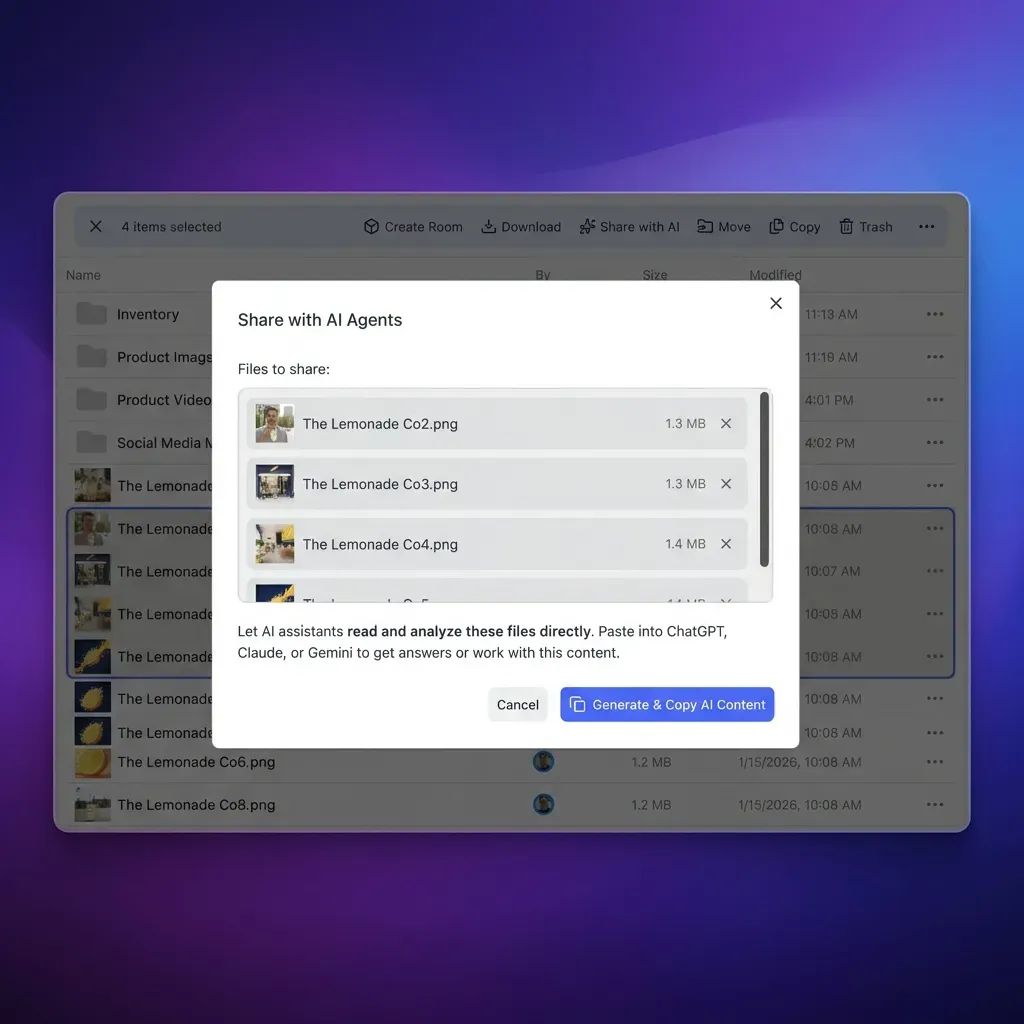
One of the most practical differences for businesses is memory. Chatbots typically rely on "context windows," which is the amount of text they can "see" in the current conversation. If you paste a lengthy document, they can read it. But if you come back next week and ask about a specific page, a standard chatbot starts blank. It has no long-term memory. AI Agents use persistent storage. They can save state, remember user preferences, and maintain an index of documents over months or years. For example, Fastio workspaces provide agents with persistent cloud storage. An agent can read a project brief in January, store its notes in a structured JSON file, and reference those notes in March when you ask for a status update. This persistence transforms the AI from a casual chat buddy into a reliable employee.


Give Your AI Agents Persistent Storage
Stop chatting and start building. Get persistent cloud storage and a consolidated MCP toolset for your agent workflows.
Tool Use: The Power of MCP
The Model Context Protocol (MCP) has standardized how AI agents connect to data and tools. While chatbots are often walled gardens, agents are open systems. A chatbot might be able to search the web if its developer allows it. An agent using MCP can connect to almost anything:
- File Systems: Reading, writing, and organizing local or cloud files.
- Databases: Querying SQL or NoSQL databases for real-time metrics.
- APIs: Sending Slack messages, creating GitHub issues, or updating CRM records. Fastio offers an MCP server for file operations with a consolidated MCP toolset. This allows an agent to not just "read" a file, but to move it, rename it, compress it, change its permissions, or generate a public share link, all without human intervention.

When to Use Which?
Choosing between an agent and a chatbot depends on your specific needs.
Choose a Chatbot If:
- Your primary goal is conversation or engagement. * The task is isolated (e.g., answering a specific question). * You need a low-latency response (agents take time to "think" and act). * Safety and predictability are top priority (chatbots have fewer ways to "break" things).
Choose an AI Agent If:
- You need to complete a multi-step workflow. * The task involves interacting with other software or files. * You need the system to remember context over long periods. * You want to automate manual labor, not just information retrieval. For instance, if you want to know "How do I edit a video?", ask a chatbot. If you want a system to "Take all raw footage from the 'Uploads' folder, organize it by date, and alert the editor," you need an AI agent.
The Future is Agentic
The industry is moving rapidly toward agentic workflows. As LLMs become cheaper and faster, the cost of the "reasoning loop" drops, making agents viable for everyday tasks. We believe that in the future, you won't just "chat" with your files; you will hire agents to manage them. You might have a "Librarian Agent" that organizes your messy downloads folder every Friday, or a "Security Agent" that audits your sharing permissions daily. Fastio is built to power this future. We treat AI agents like any other user, giving them their own accounts, persistent storage, and secure identity. Whether you are building an agent or hiring one, giving it the right environment to operate is the first step toward automation.
Sources
References used to verify factual claims in this guide.
-
AI agent market projected to grow from $5B to $47B by 2030
-
65% of enterprises plan to deploy AI agents by 2027, up from 5% in 2024
-
Fastio workspaces provide agents with persistent cloud storage Fastio offers an MCP server for file operations with a consolidated MCP toolset
Frequently Asked Questions
Can a chatbot become an AI agent?
Yes, a chatbot can evolve into an AI agent. If you connect a chatbot (like a custom GPT) to external tools via APIs and give it permission to execute actions autonomously, it crosses the line from chatbot to agent. The core requirement is the ability to plan and act, not just speak.
Are AI agents more expensive than chatbots?
Generally, yes. AI agents consume more compute resources because they perform multiple steps of reasoning and often make multiple API calls to complete a single goal. However, they provide higher value by replacing manual labor, often resulting in a better return on investment despite higher operational costs.
Do AI agents replace human jobs?
AI agents are best viewed as force multipliers rather than direct replacements. They excel at repetitive, administrative, and data-heavy tasks, freeing up humans to focus on strategy and creative work. While they will change job descriptions, they primarily automate tasks, not entire roles.
What is the best way to build an AI agent?
The modern standard for building agents is using the Model Context Protocol (MCP) to connect an LLM (like Claude or GPT) to tools. Platforms like Fastio provide the necessary infrastructure, including storage, authentication, and toolsets, so developers can focus on the agent's logic rather than the plumbing.
Related Resources

Give Your AI Agents Persistent Storage
Stop chatting and start building. Get persistent cloud storage and a consolidated MCP toolset for your agent workflows.