How to Secure Vector Stores for AI Agents
Vector stores are the memory layer for AI agents, and attackers know it. RAG poisoning, embedding manipulation, and cross-tenant data leaks can silently corrupt agent behavior. This guide covers the attack surface, practical defenses, and how to implement multi-agent access controls that most vector databases still lack.


Why Agent Vector Stores Are a Primary Attack Target
AI agents rely on vector stores to retrieve context through retrieval-augmented generation (RAG). Every query pulls embeddings from the store, feeds them to the language model, and shapes the agent's response. That retrieval step is now a primary attack target.
The most studied threat is RAG poisoning. Researchers at the University of Virginia demonstrated PoisonedRAG in 2024, showing that injecting just five malicious texts into a knowledge base containing millions of documents achieved a 90% attack success rate on targeted questions. A follow-up study, CorruptRAG, proved that a single poisoned document can be enough.
These aren't theoretical concerns. In September 2024, researchers exploited ChatGPT's memory system to inject persistent instructions that survived across chat sessions. In August 2024, attackers combined RAG poisoning with social engineering to exfiltrate sensitive data through Slack's AI features. The attack surface is real and growing.
Three categories of vector store attacks matter most for agent builders:
- Data poisoning: Injecting malicious content that gets embedded and retrieved, steering agent outputs toward attacker-chosen answers
- Embedding manipulation: Crafting adversarial embeddings that match arbitrary queries while containing hidden instructions. Research from Prompt Security showed these attacks evade human inspection because the payloads exist in vector space, not readable text
- Cross-tenant leakage: In shared vector indices, improperly scoped queries can retrieve embeddings belonging to other tenants or agent sessions
OWASP recognized the severity by adding Vector and Embedding Weaknesses as LLM08 in its 2025 Top 10 for LLM Applications. For teams running multi-agent systems, the risk compounds: one compromised agent with write access can poison the store for every agent that reads from it.

Related guides
- How to Manage LlamaIndex Storage for Production RAG ApplicationsLlamaIndex storage handles the persistence of document embeddings, index metadata, and raw document nodes required for...
- How to Choose the Best Vector Database for AI Agents (2026)Vector databases serve as the long-term semantic memory for AI agents, allowing them to recall context across sessions...
- Top 7 Vector Database Alternatives for AI Agents (2026)Vector databases serve as the long-term memory for AI agents, storing semantic embeddings that allow models to retrieve...
- How to Store Legal Contracts for AI Analysis AgentsLegal contract analysis agents need secure, version-controlled storage to review and compare documents. This guide...
- OneDrive RAG: How to Connect AI Agents and Vector Search to OneDrive FilesOneDrive RAG is a method for connecting AI agents to documents in Microsoft OneDrive by syncing folders into an indexed...
- Best Knowledge Graph Tools for RAG: Enhancing Agent MemoryRAG systems often fail when they only use vector search. Adding a knowledge graph gives AI agents the context to...
More on this subject: Agent Memory and Storage (261 guides)
How to Secure Data Ingestion Against Poisoning
Most vector store attacks happen at ingestion time. If you can control what goes into the store, you block the majority of poisoning attempts before they reach your agents.
Validate before embedding. Scan all incoming documents for prompt injection patterns before they enter the embedding pipeline. Look for suspicious instructions like "ignore previous directives," "you must respond with," or "disregard all prior context." A combination of regex filters, heuristic checks, and a small classifier model works well here. Research from the University of Washington showed that combining content filtering with embedding-based anomaly detection reduced attack success rates from 73.2% to 8.7%.
Authenticate data sources. Every document entering your vector store should come from a verified origin. Reject uploads from unauthenticated sources. Track provenance metadata (who uploaded it, when, from where) alongside the embeddings so you can trace poisoned content back to its source.
Hash and deduplicate. Compute content hashes before embedding. Reject exact duplicates, which are a common vector for replay attacks. Flag near-duplicates for manual review, since attackers often modify a few words in legitimate documents to slip past basic deduplication.
Separate ingestion from retrieval. Run your embedding pipeline as a distinct service with its own credentials and access controls. Write-path agents should never share credentials with read-path agents. This limits blast radius if one set of credentials is compromised.
Stage before promoting. Don't embed documents directly into your production index. Use a staging index where new content sits for a validation period. Run automated quality checks, compare embedding distributions against your baseline, and flag statistical outliers before promoting to production.
Platforms like Fastio simplify this with Intelligence Mode, which handles indexing automatically within workspace boundaries. Files uploaded to a workspace are indexed for semantic search and RAG queries, with all access governed by workspace-level permissions. That means your ingestion security inherits the same granular controls you set for the workspace itself, no separate pipeline to secure.



Secure your agent knowledge base without managing vector infrastructure
Fastio's Intelligence Mode gives your agents semantic search and RAG with built-in access controls, audit trails, and workspace-level permissions. Start your 14-day Business Trial.
Multi-Agent Access Controls for Vector Stores
Most vector databases offer namespaces or collections for basic isolation, but they weren't designed for multi-agent architectures. When five agents share a knowledge base, you need controls that go beyond "this collection belongs to this API key."
Define agent roles explicitly. Categorize every agent by its access needs:
- Read-only agents query specific namespaces but never write. Research bots, summarizers, and monitoring agents belong here
- Scoped writers can upsert embeddings within their designated namespace. Content ingestion agents and data pipeline agents fall into this category
- Administrators have broad access for maintenance tasks like reindexing or schema changes, but their actions should be logged and reviewed
Implement tenant isolation. Microsoft's architecture guidance for multi-tenant RAG systems recommends that every vector query must include a tenant ID filter. Never rely on application logic alone to enforce this. Use database-level enforcement: separate collections per tenant, namespace-scoped queries, or row-level security if you're using pgvector on PostgreSQL.
Combine RBAC with attribute-based controls. Role-Based Access Control (RBAC) defines what an agent can do. Attribute-Based Access Control (ABAC) adds context: which project, what sensitivity level, during which time window. Combining both gives you policies like "research-agent can read low-sensitivity embeddings in the product-docs namespace during business hours."
Pass tenant context through deterministic components. A critical pattern from MCP security research: never send tenant identifiers through the LLM. Pass them through your application's deterministic layer (middleware, API gateway, or orchestrator) so that prompt injection can't manipulate access scope.
Use file locks for concurrent writes. When multiple agents need to update the same knowledge base, race conditions corrupt data. Distributed locks or file-level locking prevent two agents from writing conflicting embeddings simultaneously.
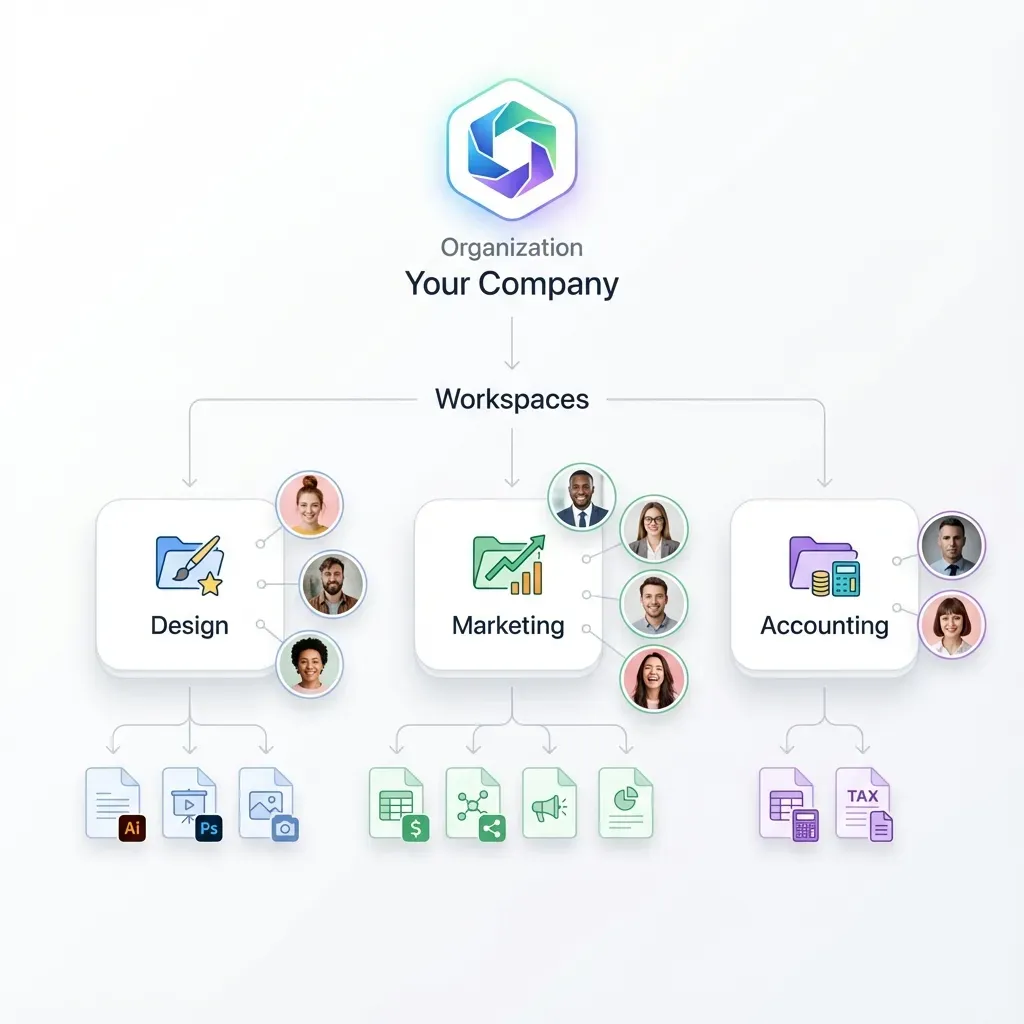
Fastio's workspace model maps naturally to these patterns. Each workspace acts as an isolated tenant with its own permissions at the organization, workspace, folder, and file level. Agents authenticate via the Fastio MCP server and inherit role-based access. Advisory file locks help agents coordinate writes, and automatic version history keeps every revision so nothing is silently lost, while audit trails capture every agent action. For teams that don't want to build multi-agent access controls on top of a standalone vector database, this eliminates a significant engineering burden.
How to Monitor and Detect Vector Store Attacks
Security monitoring for vector stores requires different signals than traditional database monitoring. Embedding-level anomalies are harder to spot than SQL injection attempts, and poisoned retrievals can look identical to legitimate queries in access logs.
Log the right signals. Capture more than just access events. Track:
- Query text and metadata filters for every retrieval
- Embedding content hashes and source metadata for every upsert
- Agent identity, IP address, and timestamp for all operations
- Permission changes, especially privilege escalation
- Retrieval result sets, so you can trace which embeddings influenced which agent outputs
Build detection rules for agent-specific patterns. Alert on:
- Query volume exceeding 2x the agent's baseline within a 5-minute window
- Upserts from agents that normally only read
- Bulk deletes or modifications outside scheduled maintenance windows
- Embeddings whose cosine similarity to existing content is suspiciously high (near-duplicate injection)
- Retrieval patterns that repeatedly pull the same small set of embeddings across different queries (a sign of targeted poisoning)
Run embedding drift analysis. Compare the statistical distribution of your embedding space over time. A sudden cluster of new embeddings far from existing distributions may indicate poisoned content. Tools like Prometheus with custom metrics can track centroid distances and flag outliers.
Test your defenses quarterly. Red-team your vector store by attempting controlled poisoning attacks in a staging environment. The PoisonedRAG and CorruptRAG papers provide reproducible attack methodologies. Prompt Security published a full proof of concept using LangChain and Chroma on GitHub that you can adapt for testing.
Integrate with your existing security stack. Export vector store logs to your SIEM (Splunk, Elastic, or similar) alongside application logs. Correlate vector store anomalies with network events, authentication failures, and agent behavior changes for a complete picture.
Fastio's audit trails cover workspace events including uploads, permission changes, and AI activity. Each entry includes actor identity, action type, timestamp, and affected resources. For teams already using Fastio workspaces for agent storage, this monitoring comes built in rather than requiring a separate observability pipeline.
Choosing a Secure Vector Store Architecture
Your architecture choice determines your security baseline. Each approach carries different tradeoffs for agent workloads.
Self-hosted vector databases like Milvus or pgvector give you full control. Milvus supports username/password authentication with bcrypt hashing, TLS for transit encryption, and RBAC with fine-grained permissions. pgvector inherits PostgreSQL's row-level security, which is mature and well-understood. The cost: you own the entire security stack, from network isolation to backup encryption to access control policies. For small teams, this operational burden often exceeds the engineering budget.
Managed vector services like Pinecone, Weaviate, and Qdrant handle infrastructure security for you. Pinecone offers SSO, RBAC, end-to-end encryption, and compliance certifications including SOC 2 Type II. Qdrant provides SSO, RBAC, TLS, and Prometheus/Grafana integration for monitoring. Weaviate supports cloud-native multi-tenancy. The tradeoff: you depend on their security posture and can't customize at the infrastructure level.
Workspace-native intelligence is a third approach that eliminates the standalone vector store entirely. Fastio's Intelligence Mode auto-indexes uploaded files for semantic search and citation-backed RAG queries. Security inherits from the workspace: granular permissions at the org, workspace, folder, and file level. Agents access everything through the MCP server or REST API, and Fastio offers a 14-day Business Trial (card required; see /pricing/). This works best when your agent workflows already center on document storage and retrieval rather than custom embedding pipelines.
Hybrid approaches combine a managed vector database for specialized embedding workloads with a workspace platform for document storage, access control, and human collaboration. This gives you optimized vector search where you need it while keeping the collaboration and handoff layer in a system designed for human-agent teams.
The right choice depends on your team's security expertise, compliance requirements, and how much infrastructure you're willing to manage. For most agent teams starting out, a managed service or workspace-native approach reduces the attack surface simply by having fewer components to secure.
Vector Store Security Checklist for AI Agents
Use this checklist to audit your vector store security posture. Run through it before deploying agents to production, and review quarterly.
Data Ingestion
- Scan all documents for prompt injection patterns before embedding
- Authenticate and verify the origin of every data source
- Hash content and reject duplicates
- Use a staging index before promoting to production
- Log provenance metadata alongside embeddings
Access Controls
- Define explicit roles for each agent (read-only, scoped writer, admin)
- Enforce tenant isolation at the database level, not just application logic
- Pass tenant context through deterministic middleware, never through the LLM
- Rotate API keys and credentials on a regular schedule
- Use file locks or distributed locks for concurrent write access
Encryption and Network
- Encrypt data at rest and in transit (TLS 1.3+)
- Deploy vector stores in private networks with no public ingress
- Use VPC peering or private endpoints for agent access
- Enable multi-factor authentication for administrative access
Monitoring and Response
- Log all queries, upserts, deletes, and permission changes with agent identity
- Set alerts for anomalous query volumes and off-hours bulk operations
- Run embedding drift analysis to detect injected content clusters
- Export logs to your SIEM for cross-correlation
- Red-team your vector store quarterly using published attack methodologies
- Document and test your incident response playbook for RAG poisoning events
Troubleshooting Common Issues
- Poisoned outputs appearing: Audit recent upserts, check content hashes against known-good baselines, and isolate the affected namespace
- Cross-tenant data in results: Verify tenant ID filters are enforced at the database level, not just in application queries
- Unexplained latency spikes: Check for rate limit exhaustion from runaway agents, review query complexity, and verify index health
Sources
References used to verify factual claims in this guide.
- 1 PoisonedRAG: Knowledge Corruption Attacks to Retrieval-Augmented Generation of Large Language Models Accessed
Injecting five malicious texts into a knowledge base achieved a 90% attack success rate on targeted questions
-
A single poisoned document can be sufficient for a practical RAG poisoning attack
- 3 Securing AI Agents Against Prompt Injection Attacks: A Comprehensive Benchmark and Defense Framework Accessed
Combined defense framework reduced attack success rates from 73.2% to 8.7%
-
OWASP added Vector and Embedding Weaknesses as LLM08 in its 2025 Top 10 for LLM Applications
-
Researchers exploited ChatGPT memory to inject persistent instructions surviving across sessions Attackers combined RAG poisoning with social engineering to exfiltrate data through Slack AI
Frequently Asked Questions
How do I secure a vector store for AI agents?
Start with four fundamentals. Encrypt data at rest and in transit. Authenticate every agent with unique credentials and enforce least-privilege roles. Validate all documents before embedding to catch prompt injection patterns. Monitor query and upsert patterns for anomalies. For multi-agent setups, enforce tenant isolation at the database level and use file locks to prevent concurrent write conflicts.
What is RAG poisoning and how do I prevent it?
RAG poisoning is when an attacker injects malicious content into a vector store so that AI agents retrieve and act on it. The PoisonedRAG study showed that just five injected documents can achieve a 90% attack success rate. Prevent it by scanning documents for injection patterns before embedding, authenticating data sources, using a staging index before production, and monitoring embedding distributions for statistical anomalies.
What are best practices for multi-agent vector access controls?
Define explicit roles (read-only, scoped writer, admin) for each agent. Enforce tenant isolation at the database level using separate namespaces or collections. Combine role-based access control with attribute-based policies for fine-grained permissions. Pass tenant context through deterministic middleware rather than through the LLM to prevent prompt injection from manipulating access scope. Use distributed locks for concurrent writes.
Do I need a separate vector database for AI agents?
Not necessarily. Workspace platforms like Fastio offer Intelligence Mode, which auto-indexes uploaded files for semantic search and RAG queries without a standalone vector database. Security inherits from workspace permissions. This works well for document-centric agent workflows. Teams with custom embedding pipelines or specialized vector search requirements may still benefit from a dedicated vector database alongside their workspace platform.
How do I detect RAG poisoning attacks?
Monitor three signals. First, track embedding drift by comparing the statistical distribution of your embedding space over time, since sudden clusters of new embeddings far from existing distributions suggest injection. Second, watch for retrieval anomalies where different queries repeatedly pull the same small set of embeddings. Third, log content hashes for all upserts and flag near-duplicates of existing documents, which is a common injection technique.
Which vector databases have the best security features?
Among managed services, Pinecone offers SSO, RBAC, end-to-end encryption, and SOC 2 Type II compliance. Qdrant provides SSO, RBAC, TLS, and monitoring integration. For self-hosted options, Milvus supports bcrypt authentication, TLS, and fine-grained RBAC. pgvector inherits PostgreSQL's mature row-level security. Each option requires different levels of operational security management from your team.
Related Resources

Secure your agent knowledge base without managing vector infrastructure
Fastio's Intelligence Mode gives your agents semantic search and RAG with built-in access controls, audit trails, and workspace-level permissions. Start your 14-day Business Trial.