How to Enable AI Agent Collaboration for Product Design
AI agent product design collaboration is transforming how creative teams build, iterate, and ship. By integrating autonomous agents into the design process, companies can shorten product design cycles and automate repetitive technical tasks. This guide explores how to set up multi-agent workflows, manage concurrent file access, and use intelligent workspaces to keep humans and agents in sync.

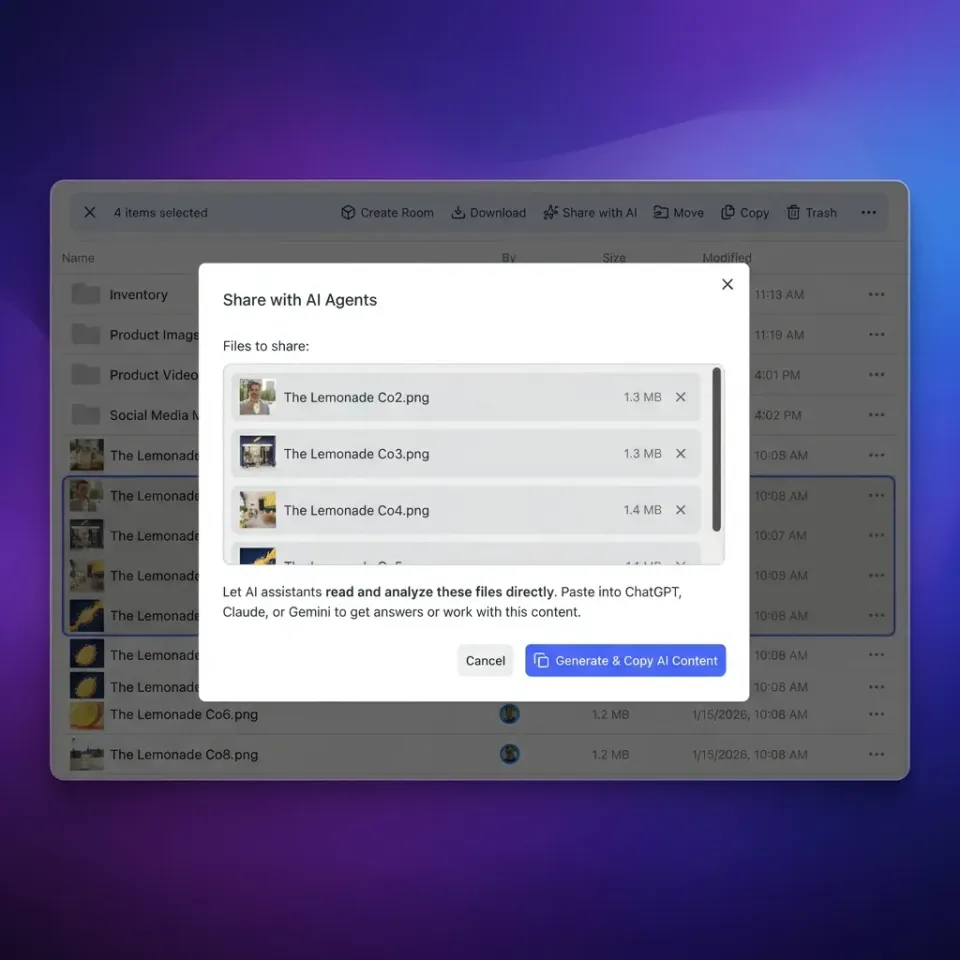
What is AI Agent Collaboration in Product Design?
AI agent product design collaboration enables smooth multi-agent/human teams to co-create complex products. Unlike simple generative AI tools that create images from prompts, autonomous agents can perform multi-step workflows, generating CAD specs, verifying compliance, running simulations, and updating documentation, without constant human oversight. In this model, the "designer" becomes an orchestrator. You define the goals and constraints, while specialized agents handle the execution. For example, one agent might generate multiple variations of a bracket design, while another immediately tests them for structural integrity, and a third estimates the manufacturing cost for the top five candidates. According to Agents for Hire, the generative AI in design market is projected to reach nearly $1 billion in 2025, driven by this shift from passive tools to active collaborators.
Helpful references: Fastio Workspaces, Fastio Collaboration, and Fastio AI.

Related guides
- How to Build AI Agent Real-Time Collaboration WorkspacesMulti-agent systems often struggle when two agents try to edit the same file simultaneously. AI agent real-time...
- How to Implement AI Agent Federation: Architectures & GuideAI agent federation enables independent agents to collaborate across distributed systems via standardized protocols....
- How to Build an AI Agent to Human Handoff WorkflowAn AI agent to human handoff workflow is the critical bridge between autonomous operation and human oversight. Learn...
- How to Enable Multi Agent Real Time CollaborationMulti agent real time collaboration is the capability for autonomous AI agents to simultaneously access, edit, and...
- How to Set Up Unreal Engine Agent CollaborationUnreal Engine agent collaboration works best when agents share one persistent workspace, follow lock-based edit rules,...
- How to Master AI Agent Swarm Orchestration: Best Practices for 2026AI agent swarm orchestration manages large-scale, emergent agent behaviors in dynamic environments. While single agents...
More on this subject: Multi-Agent Systems (62 guides)
The Role of Multi-Agent Systems in CAD and Creative Workflows
Modern product design involves dozens of specialized software tools, from SolidWorks and AutoCAD to Figma and Blender. AI agents bridge these silos by acting as universal connectors.
In a multi-agent system, agents are assigned specific roles based on their capabilities:
- The Researcher: Scours market data and competitor products to generate requirements.
- The Drafter: Converts requirements into preliminary CAD models or wireframes.
- The Auditor: Checks designs against regulatory standards (e.g., ISO, FDA) and internal brand guidelines.
- The Project Manager: Tracks file versions, updates tickets, and notifies humans when decisions are needed.
This specialization allows for massive parallelization. While a human designer focuses on the aesthetic direction, a fleet of agents can handle the technical validation in the background. Companies using these agentic workflows report gains in operational efficiency, as agents work around the clock to clear backlogs and prepare assets.
Benefits of AI Agents for Design Teams
The primary advantage of agent collaboration is speed without sacrificing quality. By offloading the "grunt work" of design, file conversion, basic modeling, data entry, teams can iterate much faster.
Key Benefits:
- Reduced Errors: Agents follow strict protocols for file naming, versioning, and compliance, eliminating common human errors.
- Continuous Iteration: Agents can explore thousands of design permutations overnight, presenting the best options to the human team in the morning.
- Unified Context: With a shared intelligent workspace like Fastio, all agents and humans work from a single source of truth, preventing version conflicts. > Pro Tip: Start small by assigning agents to "read-only" tasks like compliance checking before giving them "write" access to core design files.


Give Your AI Agents Persistent Storage
Give your agents a shared workspace with version history and searchable project context. Built for agent product design collaboration workflows.
Overcoming Challenges: Concurrency and File Locking
One of the biggest hurdles in multi-agent collaboration is concurrency. If two agents (or an agent and a human) try to edit the same CAD file simultaneously, data corruption is almost guaranteed. Most standard cloud storage solutions are not built for the speed and frequency of agent operations.
The Solution: Agent-Aware File Locking To solve this, your workspace must support explicit file locking mechanisms that agents can respect.
- Acquire Lock: Before opening a file, the agent requests a lock via API or MCP tool.
- Edit & Save: The agent performs its task (e.g., updating a render).
- Release Lock: The agent releases the lock, notifying the system that the file is safe for the next user.
Fastio's remote MCP server provides a consolidated MCP toolset for workspace operations. Use version history and application-level coordination to manage concurrent edits.
How to Set Up an AI-Human Design Workflow
Building a collaborative environment for humans and agents requires more than just installing software. You need a structured workflow that defines permissions, handoffs, and storage.
Step 1: Create a Shared Intelligent Workspace Set up a workspace that both humans and agents can access. Configure a compatible MCP client with Fastio's remote endpoint so agents can access the workspace.
Step 2: Install Agent Tools (MCP) Equip your agents with the tools they need to interact with your files. The Fastio MCP server provides a consolidated MCP toolset for workspace file operations and search.
Step 3: Define Agent Permissions
Not every agent needs admin access. Use granular permissions to restrict agents to specific folders (e.g., /output/renders/) to prevent accidental deletion of source files.
Step 4: Enable Intelligence Mode Turn on Intelligence Mode to index workspace files. This allows agents to search the workspace for files such as the latest chassis specification.
Tools and Integrations for Design Agents
To fully enable this workflow, you need a stack that supports agentic interaction.
- Fastio: The storage and coordination layer. It provides workspaces, granular permissions, advisory file locks, version history, and Intelligence for project context.
- OpenClaw (ClawHub): A zero-config agent runtime that works alongside Fastio. Configure Fastio's remote MCP endpoint in a compatible client to access workspace files.
- Blender / FreeCAD Python Scripts: Many design tools allow for scripting. Agents can write and execute these scripts to manipulate 3D models programmatically.
By combining these tools, you create a "headless" design studio where agents handle the heavy lifting, and humans provide the creative direction.
Sources
References used to verify factual claims in this guide.
-
Generative AI in design market to reach nearly $1 billion in 2025
Frequently Asked Questions
What is an AI agent in product design?
An AI agent in product design is an autonomous software program that can perform specific tasks such as generating 3D models, running simulations, or updating documentation without constant human intervention. Unlike passive tools, agents can plan and execute multi-step workflows.
How do multiple agents collaborate on one file?
Multiple agents can collaborate through shared workspaces with advisory file locks and file version history. One agent acquires a file lock before writing while others wait, and version history preserves all revisions.
Can AI agents use CAD software?
Yes, AI agents can interact with CAD software through APIs or by generating scripts (like Python for Blender or FreeCAD) that the software executes. They can also analyze exported file formats like STL or STEP to verify dimensions and geometry.
What is the best storage for AI design teams?
The best storage for AI design teams is a platform like Fastio that provides shared workspaces, granular permissions, advisory file locks, file version history, and Intelligence for searchable project context.
Is AI replacing product designers?
No, AI is not replacing product designers but rather augmenting them. AI agents take over repetitive, technical, and data-heavy tasks, allowing human designers to focus on creative strategy, user empathy, and complex problem-solving.
Related Resources

Give Your AI Agents Persistent Storage
Give your agents a shared workspace with version history and searchable project context. Built for agent product design collaboration workflows.