How to Build AI Agent GitOps Workflows
AI agent GitOps workflows use autonomous agents to manage declarative infrastructure from Git repositories. Traditional GitOps relies on tools like ArgoCD and Flux to reconcile cluster state with Git definitions. Agentic GitOps adds reasoning on top: agents validate manifests, coordinate deployments, analyze failures, and adapt without human intervention.


What Are AI Agent GitOps Workflows?
AI agent GitOps workflows combine GitOps principles with autonomous AI agents to create self-managing deployment pipelines. In standard GitOps, tools like ArgoCD or Flux watch a Git repository and continuously reconcile cluster state with whatever is declared there. The flow is mechanical: Git changes, tool detects, tool applies.
AI agents add a reasoning layer on top. Instead of blindly applying every commit, an agent can evaluate whether a change is safe, check deployment history for similar failures, validate resource dependencies, and decide whether to proceed or flag for review. The agent treats Git as the source of truth but brings judgment to the process.
A practical example: a commit adds a new model-serving deployment. The agent picks up the change, pulls the manifest from the repository, queries workspace files for past deployment outcomes with similar configurations, validates that the container image exists and resource limits are reasonable, then either proceeds with deployment or opens a pull request with its concerns.
This pattern works especially well for AI workloads where deployments involve datasets, model weights, prompt configurations, and application code that all need to stay in sync. An agent can understand these relationships and catch mismatches that static schema validation would miss.
The persistent workspace is what makes this practical. Traditional GitOps tools lose context between reconciliation cycles. An agent with access to a persistent workspace retains deployment history, learned failure patterns, and coordination state across runs. That institutional memory compounds over time, making the pipeline smarter with each deployment.
GitOps adoption reached 64% of enterprises in 2025, according to the Octopus Deploy State of GitOps report, with 81% of adopters reporting higher infrastructure reliability. Adding agents to this foundation pushes reliability further by catching issues that rule-based tools cannot.

Related guides
- How to Implement AI Agent GitOps: Declarative Agent DeploymentsAI Agent GitOps applies the principles of GitOps, version control, declarative definitions, and automated...
- How to Integrate AI Agents with Argo CDAI agent Argo CD integration enables autonomous continuous deployment management through GitOps principles. Agents can...
- How to Build an AI Agent Service Mesh: A Guide for 2026As enterprises deploy more autonomous agents, managing their communication becomes critical. An AI agent service mesh...
- How to Master AI Agent Job Scheduling for Production WorkflowsAI agent job scheduling enables autonomous agents to execute tasks on predefined schedules while maintaining context...
- How to Build an AI Agent Knowledge Vault for Secure StorageAn AI agent knowledge vault is a centralized, secure storage system designed specifically for autonomous agents....
- 7 Best Agentic GitOps Platforms for 2026Agentic GitOps platforms use Git to manage AI agents. Agents handle infrastructure deployments independently, using Git...
More on this subject: Agent Infrastructure and Deployment (55 guides)
Why Agents Need Persistent Workspaces for GitOps
The biggest gap in most AI agent GitOps setups is state. Agents spin up, do work, and disappear. Everything they learned about the deployment environment vanishes with them. The next invocation starts from zero.
This matters for GitOps because deployment pipelines accumulate context that drives better decisions. Which configurations caused rollback last month? What resource limits work for this model size? Which tests are flaky and can be safely retried? Without persistent state, agents cannot answer these questions.
Persistent workspaces solve this in three ways.
Deployment history stays accessible. Agents write status files, test results, and deployment logs to the workspace after each run. Future invocations query this history through semantic search rather than rebuilding context from raw Git logs. When an agent sees a deployment configuration similar to one that failed previously, it can flag the risk before applying changes.
Multi-agent coordination becomes reliable. When multiple agents work on the same pipeline, they need shared state for coordination. Advisory file locks let an agent lease state files before writing so others can wait on an HTTP 409, while status files signal completion between stages. Without a persistent shared workspace, agents resort to fragile message passing or external databases that add operational complexity.
Tool orchestration has a home. Agents need access to diverse capabilities: file operations, semantic search, event tracking, and permission management. A workspace platform that exposes these through a standard protocol like MCP gives agents a consistent interface instead of requiring custom integrations for each capability.
Fastio workspaces provide this persistence layer. The 14-day Business Trial lets teams evaluate persistent storage with full features. Intelligence Mode auto-indexes uploaded files for semantic search, so agents can query deployment history by meaning rather than exact filenames. The MCP server at mcp.fast.io exposes a consolidated MCP toolset over Streamable HTTP at https://mcp.fast.io/mcp/tools, covering workspace management, file operations, and AI queries.
Compare this to alternatives. Local storage disappears when the agent process ends. S3 provides durable storage but no semantic search, no advisory file locks, and no built-in agent workspace coordination primitives. Google Drive and Dropbox work for human collaboration but lack MCP integration and agent-specific features like ownership transfer.
The workspace approach means agents and humans share the same environment. An agent builds a deployment workspace, a team lead reviews the results through the same UI, and ownership transfers cleanly when the pipeline moves from automated to human-supervised stages.


Give Your Agents a Persistent Workspace
Build GitOps pipelines with shared workspaces, a consolidated MCP toolset, and built-in semantic search.
Step-by-Step: Build Your First Agent GitOps Pipeline
This walkthrough sets up a pipeline where an AI agent watches a Git repository, validates infrastructure changes, and deploys approved configurations through a persistent workspace.
1. Structure Your Git Repository
Organize the repository so agents can navigate it programmatically. Keep declarative configs, agent instructions, and status tracking in separate directories:
/manifests/for Kubernetes manifests, Terraform files, or cloud resource definitions/agents/for natural language prompts that define agent behavior at each stage/status/for JSON files tracking deployment state and coordination signals/configs/for model versions, feature flags, and environment-specific variables
A minimal manifest might look like this:
apiVersion: apps/v1
kind: Deployment
metadata:
  name: model-api
  labels:
    app: model-api
spec:
  replicas: 3
  selector:
    matchLabels:
      app: model-api
  template:
    spec:
      containers:
        - name: api
          image: registry.example.com/model:v1.2.0
          resources:
            limits:
              memory: "2Gi"
              cpu: "1000m"
2. Set Up the Agent Workspace
Create a Fastio workspace dedicated to this pipeline. Enable Intelligence Mode so that every file the agent uploads gets indexed for semantic search.
The agent authenticates via API key and connects to the MCP server. From there it can create files, query indexed content, and manage permissions, all through the same consolidated MCP toolset.
# Connect agent to Fastio MCP
# Streamable HTTP endpoint: https://mcp.fast.io/mcp/tools
# Send the API key as an Authorization: Bearer header on the connection.
# `workspace` below stands for your own wrapper around the MCP tools
# (upload_manage action=stream-upload to write, storage to read and search).

# Agent creates a deployment tracking file
workspace.write_file(
    path="/status/pipeline-state.json",
    content=json.dumps({
        "last_validated": None.
        "last_deployed": None.
        "current_stage": "idle"
    })
)
For external configurations stored in Google Drive, OneDrive, Box, or Dropbox, use URL Import to pull them into the workspace without local I/O. The agent accesses these files directly through OAuth-connected URLs.
3. Configure Webhook Triggers
Set up a GitHub webhook pointing to your agent's trigger endpoint. Configure it to fire on push events to the main branch and on pull request events. When the webhook fires, the agent reads the changed files and determines what action to take.
The Fastio activity feed and WebSocket events feed provide a second trigger layer. Monitor workspace file events to notify the agent when files change in the status directory, enabling event-driven coordination between pipeline stages.
4. Validate Before Deploying
When triggered, the agent pulls the changed manifests and validates them. Validation goes beyond schema checking. The agent queries the workspace for deployment history, looking for configurations similar to the proposed change and checking whether they succeeded or failed.
# Agent validation flow
changed_files = get_changed_manifests(webhook_payload)

for manifest in changed_files:
    content = workspace.read_file(path=f"/manifests/{manifest}")

# Semantic search against deployment history
    similar = workspace.search(
        query=f"deployment outcomes for configs similar to {manifest}"
    )

if any_past_failures(similar):
        create_pr_comment(
            f"Warning: similar config failed on {similar[0].date}. "
            f"Review before merging."
        )
    else:
        mark_validated(manifest)
5. Deploy with State Validation
Before modifying deployment state, the agent acquires an advisory file lock (or checks pipeline status files) to coordinate with other agents or concurrent pipeline runs:
# Verify pipeline state before deployment
state = workspace.read_file(path="/status/pipeline-state.json")

try:
    # Apply manifests to cluster
    result = deploy_to_kubernetes(manifests)

# Record outcome in workspace
    workspace.write_file(
        path=f"/status/deploy-{timestamp}.json",
        content=json.dumps({
            "manifests": manifests.
            "result": result.status.
            "timestamp": timestamp
        })
    )
finally:
    update_pipeline_state("/status/pipeline-state.json", "idle")
The deployment result gets written to the workspace, adding to the history that future validations will query. Each deployment builds on the knowledge of previous ones.
6. Hand Off to Humans
For production deployments, transfer workspace ownership to a team lead. The agent retains admin access for continued monitoring, but the human owns approval decisions. This pattern provides governance without blocking automation: the agent builds and validates, the human approves, and the agent continues execution after approval.
Every action in this flow gets recorded in both Git history and Fastio audit trails. Who changed what, when, and through which agent is always traceable.
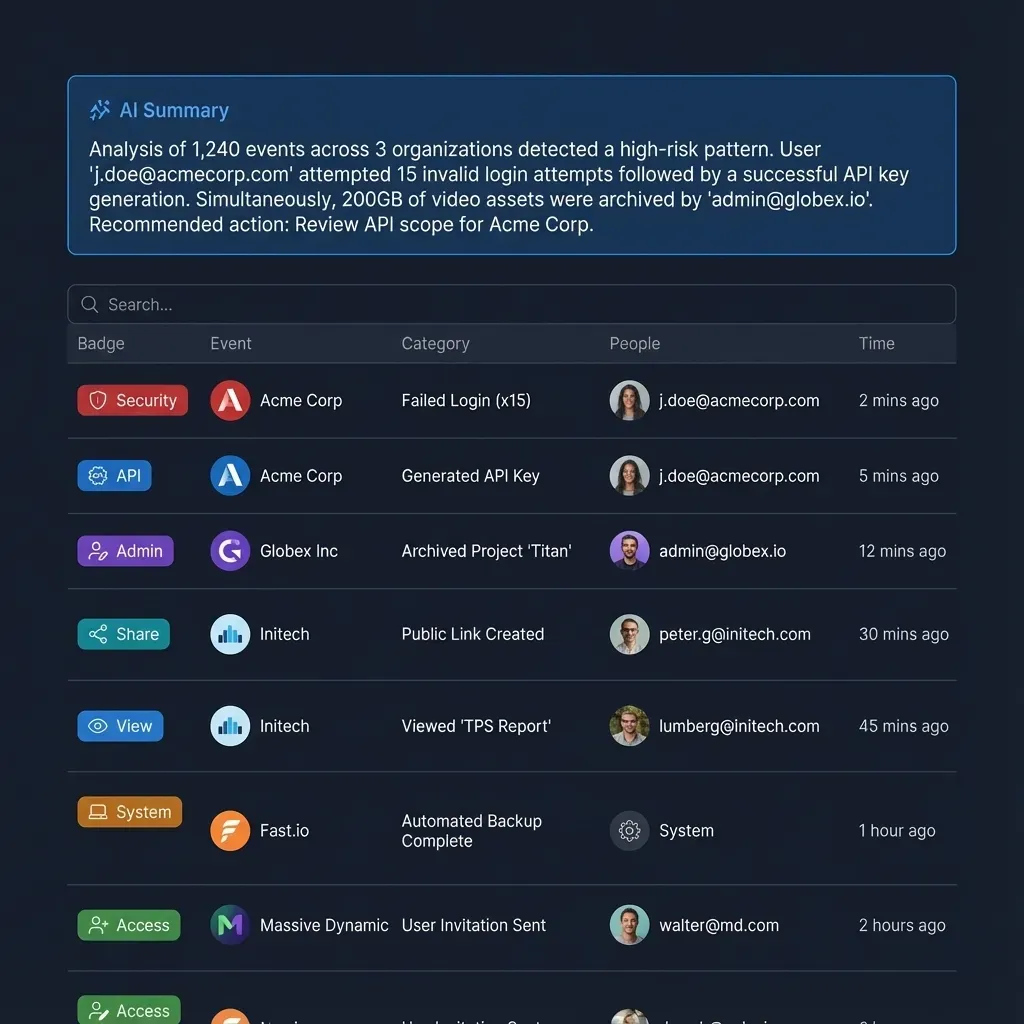
Orchestrating Multi-Agent GitOps Pipelines
Single-agent pipelines work for simple deployments, but production GitOps benefits from specialization. Splitting responsibilities across multiple agents improves reliability, enables parallel execution, and isolates failures to specific stages.
A four-agent pipeline covers most deployment scenarios:
Validator agent watches for pull requests and push events. It checks manifest syntax, validates resource references, and queries workspace history for related failures. It writes pass/fail status to /status/validated.json.
Tester agent triggers when validation passes. It runs integration tests against a staging environment, analyzes test output for regressions, and records results. Flaky test detection improves over time as the agent accumulates test history in the workspace.
Deployer agent triggers on test success. It verifies deployment state, applies changes to the target cluster, verifies rollout health, and updates deployment records. If the rollout fails health checks, it triggers automatic rollback and writes a failure report.
Monitor agent runs on a schedule after deployment. It checks application metrics, analyzes logs for anomalies, and compares current behavior against baseline patterns stored in the workspace. If something looks wrong, it can open a rollback PR or alert the team.
Each agent connects to the same Fastio workspace but operates independently. Coordination happens through status files and event feeds rather than direct communication. This loose coupling means you can swap out one agent's implementation without touching the others.
# Pipeline coordination config
pipeline:
  workspace: gitops-pipeline-prod
  agents:
    validator:
      trigger: github.pull_request
      writes: /status/validated.json
    tester:
      trigger: file_change:/status/validated.json
      writes: /status/tested.json
    deployer:
      trigger: file_change:/status/tested.json
      requires_status: ready
      writes: /status/deployed.json
    monitor:
      trigger: schedule:5m
      reads: /status/deployed.json
Each agent can use a different LLM based on task requirements. The validator might use a fast, inexpensive model for quick schema checks, while the monitor uses a stronger reasoning model for anomaly detection. Fastio MCP works with any model that supports tool calling: Claude, GPT-4, Gemini, LLaMA, or local models.
Research from Google DeepMind found that unstructured multi-agent networks can amplify errors significantly compared to single-agent baselines. The fix is structured coordination, exactly what the status-file approach provides. Each agent has a clear input, a defined output, and explicit triggers. No ambiguous handoffs.
Persistent workspaces give multi-agent systems an advantage over ephemeral setups. The validator learns which patterns cause deployment issues. The tester remembers which tests are flaky. The monitor builds a baseline of normal behavior. This accumulated knowledge makes the entire pipeline more reliable over time.
Integrating Agents with ArgoCD and Flux
Most teams already run ArgoCD or Flux for GitOps. AI agents complement these tools rather than replacing them. The agent handles the reasoning, ArgoCD or Flux handles the reconciliation.
ArgoCD holds roughly 60% market share among GitOps tools in 2026. Its API and notification system make it a natural integration point for AI agents. The typical pattern: an agent generates or modifies Kubernetes manifests, commits them to Git, and ArgoCD picks up the change during its next sync cycle.
Agent + ArgoCD workflow:
- Agent detects a new model version in the registry
- Agent updates the image tag in the deployment manifest
- Agent validates the change against workspace deployment history
- Agent commits the updated manifest to Git
- ArgoCD detects the commit and syncs the cluster
- Agent monitors the rollout through ArgoCD's health status API
- If health checks fail, agent reverts the commit and ArgoCD reconciles back
For Flux users, the pattern is similar. Flux's pull-based model means the agent only needs to commit changes to Git. Flux handles detection, reconciliation, and drift correction automatically. The agent focuses on the decision-making layer: should this change be applied, and what happens if it fails?
Handling large artifacts. Model weights, training datasets, and other large files should not live in Git. Store them in a Fastio workspace and reference them by URL in your manifests. The agent manages the artifact lifecycle, uploading new versions to the workspace, updating manifest references, and cleaning up old versions, while ArgoCD handles the deployment mechanics.
Webhook acceleration. ArgoCD's default polling interval is 3 minutes. For faster feedback loops, configure GitHub webhooks to trigger ArgoCD sync immediately on commit. Combine this with the agent's pre-commit validation to catch issues before they reach the cluster.
One practical constraint: keep agent-generated commits clean and atomic. Each commit should represent one logical change so that rollback targets a specific modification rather than a bundle of unrelated changes. ArgoCD's sync and rollback work best with granular commits.
Troubleshooting and Best Practices
After building several agent GitOps pipelines, patterns emerge around what goes wrong and what keeps things stable.
Keep Everything Declarative
Agent prompts, pipeline configurations, validation rules, and deployment parameters all belong in Git. When an agent's behavior needs to change, update the prompt file and commit. This makes agent behavior auditable and rollback-safe, the same properties that make GitOps valuable for infrastructure.
Design for Idempotency
Agents retry. Networks flake. Webhooks fire twice. Every operation your agent performs should be safe to repeat. File writes should be complete replacements, not appends. Deployments should use kubectl apply semantics. Status updates should include timestamps so duplicate writes are detectable.
State and Status Discipline
Status files prevent race conditions but create stall risks if agents crash mid-task. Set state timeouts and build in stale-status detection. If a stage has been marked active for longer than the expected operation duration, investigate rather than waiting indefinitely.
Common failure patterns
Agent applies outdated state. The agent cached a manifest version and did not pull the latest before deploying. Fix: always read from workspace immediately before applying, never rely on cached state from a previous step.
Two agents deploy simultaneously. Stage validation was skipped. Fix: check atomic status files and verify the active stage before initiating deployments.
Pipeline stalls after a stage failure. A downstream agent waits for a status file that was never written because the upstream agent crashed. Fix: add timeout-based fallback triggers. If the tester has not written results within 10 minutes, the monitor agent investigates and reports.
Drift between Git and cluster. The agent modified the cluster directly without committing to Git first. Fix: enforce the Git-first rule. Agents commit changes to Git, and the GitOps tool (ArgoCD, Flux) applies them. No direct cluster modifications.
Monitor Agent Health
Track agent invocation counts, success rates, and execution duration. Set alerts for agents that stop running or start failing consistently. Fastio audit trails capture every workspace action, providing a secondary monitoring source alongside your cluster metrics.
Sources
References used to verify factual claims in this guide.
-
GitOps adoption reached 64% of enterprises in 2025, with 81% of adopters reporting higher infrastructure reliability
-
ArgoCD holds roughly 60% market share among GitOps tools
-
Unstructured multi-agent networks can amplify errors significantly compared to single-agent baselines
Frequently Asked Questions
What are AI agent GitOps workflows?
AI agent GitOps workflows combine GitOps principles with autonomous AI agents. Instead of static tools that blindly sync Git state to clusters, agents add reasoning capabilities. They validate changes against deployment history, coordinate multi-stage pipelines, and make context-aware decisions about when to deploy, rollback, or escalate to humans. The core idea is that Git remains the source of truth for infrastructure, but agents bring intelligence to the reconciliation process.
How do agents integrate with GitOps tools like ArgoCD?
Agents complement ArgoCD and Flux rather than replacing them. The typical integration has the agent handle reasoning tasks like manifest generation, validation, and failure analysis, then commit changes to Git. ArgoCD or Flux picks up those commits and handles the actual cluster reconciliation. The agent can also monitor ArgoCD's health status API to detect rollout failures and trigger automatic rollback by reverting the Git commit.
What is agent workspace persistence and why does it matter?
Workspace persistence means the agent's files, deployment history, and operational state survive between invocations. Without it, each pipeline run starts from scratch with no memory of past deployments. With persistent workspaces, agents accumulate knowledge over time. They remember which configurations caused failures, which tests are flaky, and what normal metrics look like. This institutional memory makes each deployment safer than the last.
How do you coordinate multiple agents in a GitOps pipeline?
Structured coordination through status files, advisory file locks, and event feeds works better than direct agent communication. Each agent writes its output to a known file path. The next agent triggers when that file appears or updates. Advisory file locks and version history coordinate concurrent writes during deployment. This approach keeps agents loosely coupled so you can update or replace one stage without affecting others.
What trial and plan options exist for agent GitOps workflows?
Fastio offers a 14-day Business Trial on monthly plans, requiring a credit card, allowing teams to test persistent workspaces and agent tooling before subscribing. Current plan details are available at /pricing/. The remote MCP server at mcp.fast.io provides a consolidated toolset for workspace management, file operations, and AI queries. For open-source GitOps tools, ArgoCD and Flux are both free under Apache and CNCF governance.
Related Resources

Give Your Agents a Persistent Workspace
Build GitOps pipelines with shared workspaces, a consolidated MCP toolset, and built-in semantic search.