How to Automate File Classification with AI Agents
AI agent file classification automation uses intelligent agents to categorize incoming documents, apply tags, and route them to the right storage locations without human intervention. This guide walks through the full pipeline, from ingestion to verification, and shows how to wire it up with workspace routing and granular permissions that most classification guides skip.


Why Manual File Sorting Still Costs So Much
The average knowledge worker spends 2.5 hours per day searching for and organizing documents. That adds up to roughly 30% of a workday lost to filing, renaming, and dragging things into folders. A 2025 study by IDC estimated that document challenges cost organizations about $19,732 per worker per year in lost productivity.
The problem compounds as teams grow. A 10-person team might manage with shared drive folders and naming conventions. At 50 people, those conventions break down. Files land in the wrong folders, naming gets inconsistent, and important documents end up buried where nobody can find them.
Traditional rules-based sorting (filename contains "invoice" goes to /finance/) handles the easy cases but breaks on anything ambiguous. A file named "Q3-update-final-v2.pdf" could be a financial report, a project update, or a client deliverable. Rules can't reason about content. AI agents can.
Related guides
- How to Set Up AI Agent File Indexing (The Easy Way)Most AI agent file indexing requires complex Python pipelines and vector databases. This guide shows you how to skip...
- Top 5 File Sharing Tools for AI WorkflowsOver 60% of AI workflows involve document or file processing. Multi-agent systems can generate hundreds of artifacts...
- How to Manage Files for Resume Parsing AgentsManaging files for resume parsing agents means organizing candidate documents for AI recruitment systems. Learn to...
- How to Extract Metadata from Docker Container ImagesDocker container images carry structured metadata far beyond the filesystem layers themselves. OCI manifests, image...
- How to Automate Spreadsheets with AI AgentsManual data entry takes up nearly 30% of the work week. AI agents take over these repetitive tasks by reading,...
- How to Automate File Unzipping on macOS inside Agent WorkspacesAutomating how you unzip files on Mac workspaces allows autonomous AI agents to process compressed archives. Using...
More on this subject: Agent File and Document Workflows (325 guides)
How AI Agents Classify Documents
AI agent file classification works differently from traditional document management rules. Instead of matching filenames or metadata against patterns, agents read the actual content, understand what the document is about, and make classification decisions the same way a human assistant would.
The pipeline follows five stages:
Ingest. Files arrive through email attachments, API uploads, drag-and-drop, or webhook triggers. The agent monitors an intake workspace or folder and picks up new files automatically.
Classify. The agent reads each file's content using an LLM. It determines the document type (contract, invoice, proposal, report, creative brief) based on semantic understanding, not keyword matching. Classification accuracy for common document types exceeds 95% with modern LLMs like Claude, GPT-4, or Gemini.
Tag. Based on the classification, the agent applies metadata tags: department, project, client name, urgency level, confidentiality tier. Tags enable downstream search and filtering without rigid folder hierarchies.
Route. The classified and tagged file moves to the appropriate workspace, folder, or share. An invoice goes to the finance workspace. A signed contract goes to the legal team's active deals folder. A creative brief routes to the design team's intake queue.
Verify. Low-confidence classifications get flagged for human review instead of auto-routed. The agent logs every decision with its confidence score, creating an audit trail that lets you spot patterns and improve accuracy over time.
What separates this from a simple ML classifier is the agent's ability to take action. Classification models output a label. Agents output a label and then move the file, set permissions, notify stakeholders, and update tracking systems.

Building the Classification Pipeline
A working classification pipeline needs three components: an LLM for understanding content, an orchestration layer for managing the workflow, and persistent storage where files actually live.
Choosing Your LLM
Any capable LLM works for classification. The choice depends on your volume and accuracy requirements:
- Claude handles nuanced document understanding well, particularly for contracts and legal documents where context matters.
- GPT-4o performs strongly on structured extraction and can output clean JSON classifications.
- Gemini 1.5 Pro offers a massive context window, useful when you need to classify documents by comparing them against a large taxonomy.
- Open-source models like LLaMA or Mistral work for teams that need to run classification on-premise.
Setting Up the Orchestration Frameworks like LangChain,
LangGraph, or CrewAI handle the multi-step workflow. Your orchestration layer should:
- Queue incoming files and process them in order
- Retry failed classifications with a different prompt strategy
- Route low-confidence results to a human review queue
- Log every classification decision for auditing
Here is a simplified agent loop in pseudocode:
for file in watch_folder.new_files():
    content = extract_text(file)
    classification = llm.classify(content, taxonomy)

if classification.confidence > 0.85:
        apply_tags(file, classification.tags)
        move_to_workspace(file, classification.destination)
        log_decision(file, classification)
    else:
        flag_for_review(file, classification)
Connecting Storage
Your agent needs somewhere to read source files from and write classified files to. Local filesystems work for prototyping, but production pipelines need cloud storage with proper access controls.
Fastio works well here because it exposes workspace operations through an MCP server. Your agent can create workspaces, upload files, set permissions, and move documents between folders, all through the same tool interface it uses for classification. The MCP server provides a consolidated MCP toolset covering storage, intelligence, and workspace operations.
Other options include S3 with a custom integration layer, Google Drive API, or Box Platform. The key requirement is programmatic access to file operations, folder management, and permission controls.


Start Classifying Files Automatically
Fastio gives AI agents persistent cloud storage with workspace routing, granular permissions, and a remote MCP server for programmatic file operations.
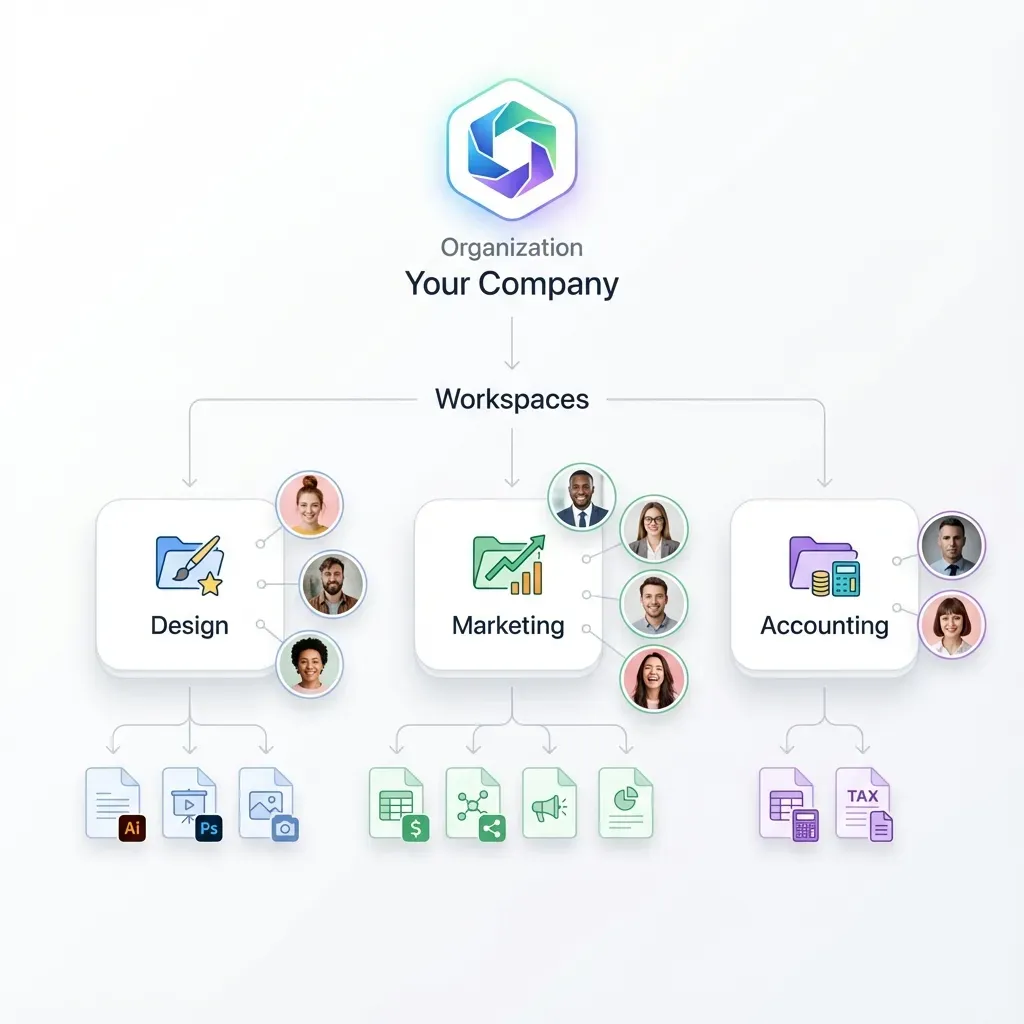
Workspace Routing and Permission Assignment
Most classification guides stop at "put the file in the right folder." That misses the harder problem: making sure the right people can access the classified file, and the wrong people cannot.
Routing by Classification
Define a routing map that connects document types to destinations:
routing_rules:
  invoice:
    workspace: finance-team
    folder: /invoices/2026/
    permissions: [finance-editors, accounts-payable]
  contract:
    workspace: legal-active
    folder: /contracts/pending-review/
    permissions: [legal-team, executive-read-only]
  creative_brief:
    workspace: design-intake
    folder: /briefs/new/
    permissions: [design-team, project-managers]
Your routing map should handle the 80% case with simple rules. For the remaining 20% (documents that span departments or don't fit a clean category), route to a triage workspace where a human decides.
Assigning Permissions Programmatically
When an agent routes a file, it should also set access controls. This prevents the common problem where classified documents are visible to everyone in a shared drive.
Fastio supports granular permissions at the org, workspace, folder, and file level. An agent can set permissions through the API or MCP server so that a classified contract is readable by the legal team but invisible to marketing. This permission granularity matters for sensitive documents like HR files, financial records, or legal correspondence.
For teams using other platforms, the same principle applies: your classification agent should have permission-setting capability built into its routing step, not bolted on afterward.
Handling Multi-Department Documents
Some files belong in more than one place. A project proposal might be relevant to both the sales team and the engineering team. Rather than duplicating files (which creates version drift), use one of these approaches:
- Primary location with shared links. Route the file to its primary workspace and create read-only shares for secondary audiences.
- Tag-based access. Keep all files in a central workspace and use tags plus permission groups to control visibility.
- Workspace intelligence. In platforms like Fastio, enabling Intelligence for the workspace auto-indexes files for semantic search. Team members can find relevant documents through natural language queries without needing the file to exist in their specific folder.
Common Pitfalls and How to Avoid Them
After building classification pipelines for production use, several failure patterns show up repeatedly.
Overconfident Classifications
LLMs can return high confidence scores for wrong classifications. A cover letter and a contract both contain formal language, names, and dates. Set your confidence threshold conservatively (0.85 or higher) and audit a random sample of auto-classified documents weekly.
Taxonomy Drift
Your classification taxonomy will need updates. New document types appear (a new client sends reports in an unfamiliar format), and old categories become irrelevant. Build your taxonomy as a configuration file, not hardcoded logic. Review it monthly and add new categories based on what lands in the "unclassified" queue.
Ignoring File Formats
Not all documents are PDFs and Word files. Classification agents need to handle spreadsheets, images, presentations, email exports, and compressed archives. For images and scanned documents, pair your LLM with an OCR step. For archives, extract contents and classify each file individually.
Missing Audit Trails
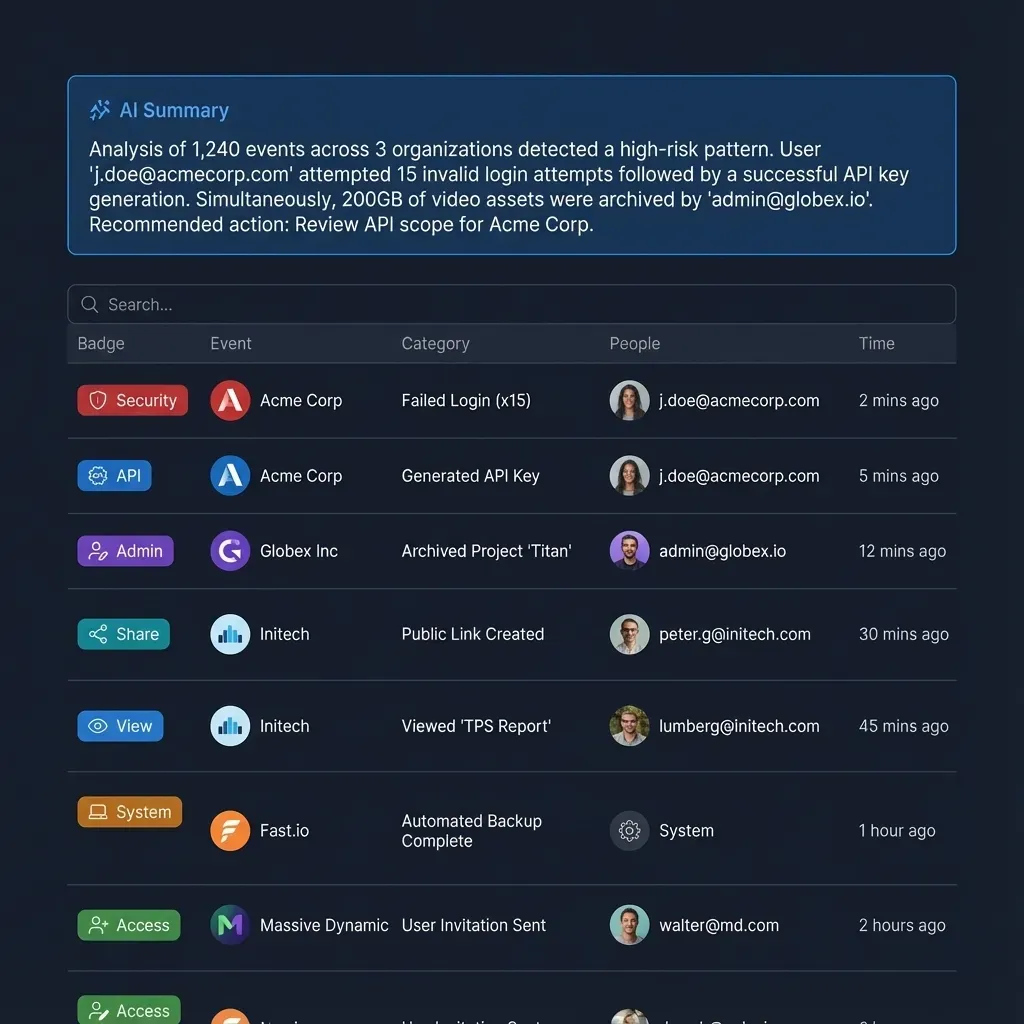
When something goes wrong (a confidential document routes to the wrong team), you need to know exactly what happened. Log every classification decision with the input file hash, the LLM's reasoning, the confidence score, the destination, and the timestamp. Fastio's built-in audit trails track file movements and permission changes automatically, which saves you from building a separate logging system.
Bottleneck at Human Review
If too many files land in the review queue, your pipeline isn't saving time. Track your auto-classification rate. If it drops below 80%, your taxonomy probably needs refinement or your confidence threshold is too strict. Analyze the review queue for patterns: if the same document type keeps appearing, add it to your taxonomy.
Scaling from Prototype to Production
A prototype classification agent running on your laptop handles a few dozen files. Production means thousands of files per day with multiple agents working concurrently.
Concurrency and Version Tracking
When multiple agents process files simultaneously, you need coordination. Two agents classifying the same file wastes compute and risks conflicting routing decisions. Fastio provides advisory file locks through MCP storage actions (lock-acquire, lock-status, lock-release) and the REST API. An agent acquires a lock before processing, heartbeats it while working, and releases it when done. A second agent attempting to acquire the lock gets an HTTP 409 and can pick up the next file instead. Even if two uncoordinated agents write at once, automatic file version history preserves every version.
Event-Driven Ingestion
Polling a folder for new files works at small scale, but reactive feeds improve throughput. Switch to event-driven processing: when a file arrives, your agent receives an event notification and starts classification immediately.
Fastio provides a real-time WebSocket events feed and activity polling, so your agent can react to uploads in real time without manual folder scanning. For teams using S3, SNS notifications serve a similar purpose.
Batch Processing for High Volume
For organizations processing thousands of documents daily, batch classification is more efficient than one-at-a-time processing. Group files by source or type, classify them in parallel, and route the results. Modern LLM APIs support batch endpoints that reduce cost per classification by 30-50% compared to real-time calls.
Agent-to-Human Handoff
The end goal of most classification pipelines is to organize information so humans can act on it. Build a clear handoff point where the agent's work becomes visible to the team. In Fastio, an agent can create an organized workspace structure, classify and route all incoming documents, and then transfer ownership to a human team lead. The agent retains admin access for ongoing maintenance while the human team works with the classified output.
This pattern (agent builds, human receives) keeps the automation transparent. The team sees a well-organized workspace, not a black box that files disappear into.
Sources
References used to verify factual claims in this guide.
-
Knowledge workers spend 2.5 hours per day searching for and organizing documents, representing roughly 30% of the workday. Document challenges cost organizations approximately $19,732 per worker per year in lost productivity.
-
AI classification accuracy exceeds 95% for common document types with modern LLMs.
Frequently Asked Questions
How do AI agents classify documents?
AI agents classify documents by reading their content with a large language model and determining the document type based on semantic understanding. Unlike keyword matching or filename rules, agents understand context. They can distinguish between a project proposal and a sales quote even if both mention prices and timelines. The agent then applies tags, routes the file to the appropriate workspace, and logs its decision with a confidence score.
Can AI automatically sort files into folders?
Yes. AI classification agents can automatically sort files into folders based on their content, not just their filename or extension. You define a routing map that connects document types to destination folders, and the agent handles the sorting. Files with low classification confidence get flagged for human review instead of being auto-sorted incorrectly.
What is an automated document classification pipeline?
An automated document classification pipeline is a system that processes incoming files through five stages. Ingest (receive the file), classify (determine what type of document it is), tag (apply metadata), route (move it to the correct location with appropriate permissions), and verify (flag uncertain classifications for review). The pipeline runs continuously without human intervention for most documents.
How accurate is AI file classification?
Modern LLMs achieve classification accuracy above 95% for common document types like invoices, contracts, reports, and correspondence. Accuracy depends on the quality of your taxonomy, the variety of document formats you handle, and whether you use a confidence threshold to catch uncertain classifications. Starting with a focused taxonomy of 10-15 document types and expanding gradually produces better results than trying to classify everything from day one.
What tools do I need to build a classification agent?
You need three components. An LLM for content understanding (Claude, GPT-4, Gemini, or an open-source model), an orchestration framework for managing the pipeline workflow (LangChain, LangGraph, or CrewAI), and persistent storage with programmatic access controls (Fastio, S3, or Google Drive with API access). The storage layer is often overlooked but critical because classification without proper routing and permissions only solves half the problem.
Related Resources

Start Classifying Files Automatically
Fastio gives AI agents persistent cloud storage with workspace routing, granular permissions, and a remote MCP server for programmatic file operations.