Real-World AI Agent Examples in Production Today
Guide to agent examples real world: AI agents have moved from demos to production at companies like Klarna, Salesforce, and Cognition. This guide covers real deployments with verified results, the architectural patterns behind them, and what separates agents that ship from those that stall.


What to check before scaling ai agent examples real world
The conversation around AI agents shifted in 2025. Instead of "what could agents do?" the question became "what are agents already doing?"
The answer: quite a lot. Klarna's AI assistant handled 2.3 million customer conversations in its first month. GitHub Copilot's coding agent now contributes to 1.2 million pull requests per month. Salesforce's Agentforce platform hit $1.4 billion in ARR with 18,500 customers.
But the picture is more nuanced than the headlines suggest. Gartner predicts that 40% of enterprise applications will feature task-specific AI agents by end of 2026, up from less than 5% in 2025. That same report warns that over 40% of agentic AI projects will be canceled by 2027. The gap between a successful agent deployment and a failed one comes down to scope, architecture, and knowing when humans still need to be in the loop.
Here are the deployments worth studying.
Related guides
- AI Agent Examples: Real-World Use Cases and ImplementationsAI agents are autonomous software that perceive their environment, make decisions, and take actions without continuous...
- Agentic AI Use Cases: 12 Real-World Applications in 2026Agentic AI has moved from experimental pilots to production deployments across financial services, healthcare, and...
- How to Build an AI Agent Supervisor Pattern for Complex WorkflowsThe AI agent supervisor pattern provides a centralized management layer for coordinating multiple specialized worker...
- How to Implement the Reflection Pattern for Self-Correcting AgentsThe Reflection pattern lets AI agents review their own work, catch errors, and fix them without human help. By...
- Top 10 Slack AI Bot Frameworks for Developers 2026Slack AI bot frameworks offer the components developers need to build chatbots that retrieve data, run actions, and...
- Agentic AI Design Patterns: Proven Patterns for Building Autonomous SystemsAgentic AI design patterns are reusable architectural templates for building autonomous AI systems that can plan, use...
More on this subject: Agent Frameworks and Patterns (52 guides)
Customer Service: Klarna's AI Assistant
Klarna's support agent is the most cited production deployment for good reason. Built on OpenAI's models, it connects directly to Klarna's billing and transaction systems via secure APIs. When a customer asks about a missing payment, the agent looks up the specific transaction, checks the status, and either provides an update or initiates a trace.
The numbers from the first month were striking:
- Handled two-thirds of all customer service chats (2.3 million conversations)
- Cut average resolution time from 11 minutes to under 2 minutes
- Customer satisfaction scores matched human agents
- Projected $60 million in annual cost savings
Then came the correction. In May 2025, Klarna shifted back to a hybrid human-AI model after discovering that complex edge cases, emotionally charged disputes, and multi-step financial issues still needed human judgment. The lesson: agents handle volume well but struggle with cases that require empathy or creative problem-solving.
Klarna's NPS score sits at 73, which suggests customers are generally satisfied with the hybrid approach. The agent handles the routine work. Humans handle the exceptions.
Software Engineering: Devin and GitHub Copilot
Coding agents have moved well past autocomplete. Two deployments stand out for their scale and measurable impact.
Cognition's Devin
Devin operates as an autonomous software engineer. Give it a feature request, and it explores the codebase, writes an implementation plan, codes the solution, runs tests, and opens a pull request. Customers include Goldman Sachs, Dell, Cisco, and Nubank.
The performance trajectory tells the story. In 2024, only 34% of Devin's pull requests were merged. By mid-2025, that number hit 67%. Nubank used Devin for a large-scale monolith refactoring project and reported an 8x efficiency improvement over their previous approach. Cognition's ARR grew from $1 million in September 2024 to $73 million by June 2025.
GitHub Copilot Agent Mode
Copilot is deployed at roughly 90% of Fortune 100 companies, with 4.7 million paid subscribers as of January 2026. The agent mode contributes to approximately 1.2 million pull requests per month. Across all users, Copilot generates an average of 46% of code written, rising to 61% for Java developers.
Both tools follow the same architectural pattern: observe the codebase, plan the implementation, execute with tool use (file reads, writes, terminal commands), and reflect on test results before submitting.



Give Your Agents a Workspace That Keeps Up
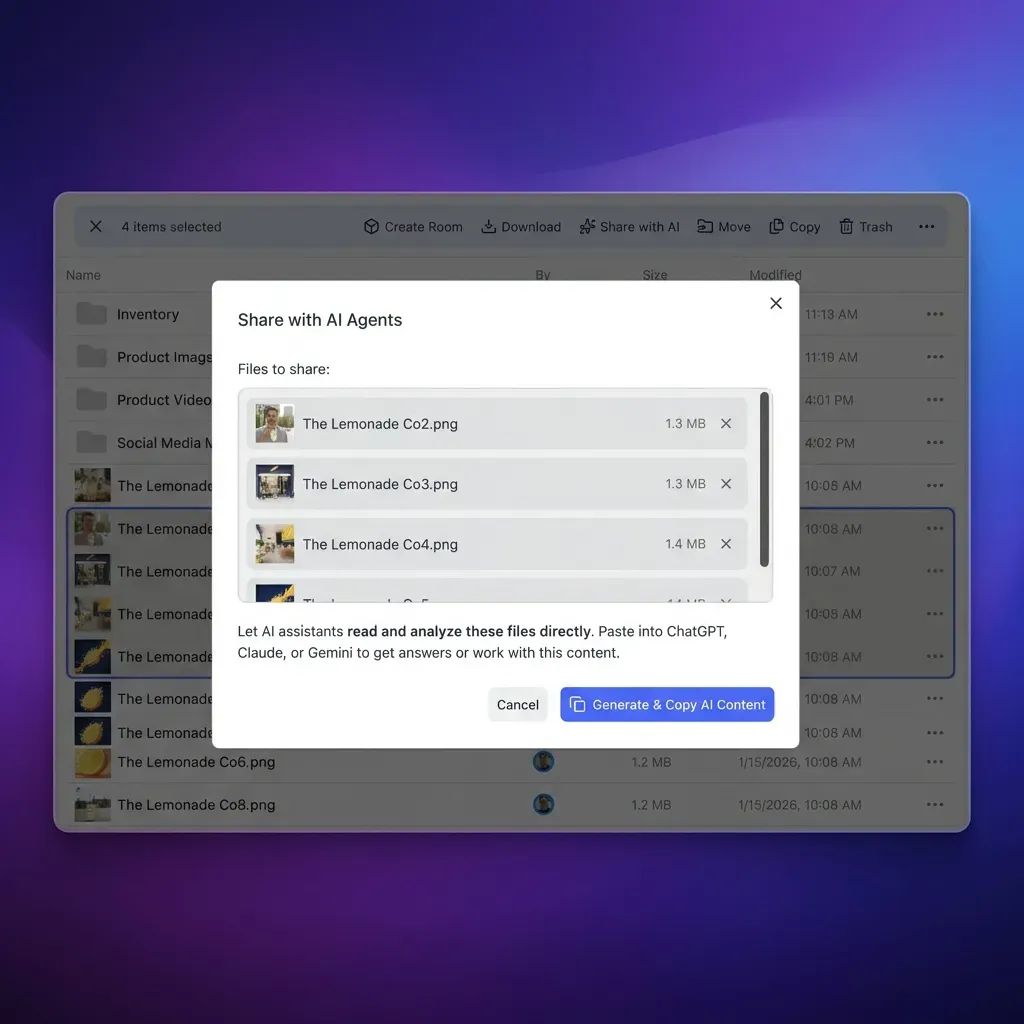
Fastio provides intelligent, persistent storage for AI agent workflows. generous storage, MCP-native access, and built-in RAG once Intelligence is enabled.
Enterprise Platforms: Salesforce Agentforce and Google Gemini
The enterprise platforms are building agent infrastructure, not just individual agents. Two approaches are worth comparing.
Salesforce Agentforce
Agentforce launched as Salesforce's fastest-growing product, reaching nearly $1.4 billion in ARR with 114% year-over-year growth. The platform has 18,500 customers and has processed over 3.2 trillion tokens.
The IRS Office of the Chief Counsel provides a concrete example. Their Agentforce deployment reduced manual activities in tax court case processing by 98%, cutting the time to open a case from 10 days to 30 minutes. That's the kind of result that justifies agent adoption: a well-scoped, repetitive, document-heavy process where the rules are clear but the volume is crushing.
Google Gemini Enterprise
Google took a different approach with Gemini Enterprise, launched in October 2025 with enterprise subscription pricing. Rather than selling individual agents, Google provides a no-code workbench for building custom agents alongside pre-built agent "taskforces" for research and data analysis. The platform unifies LLMs, agents, and enterprise data under a single interface.
The contrast matters. Salesforce targets CRM-adjacent workflows where agents act on structured data. Google targets knowledge work where agents need to reason across unstructured documents.
Multi-Agent Architecture: How Production Systems Are Built
The architectural pattern that emerged in 2025 is orchestrated teams of specialized agents rather than a single all-purpose agent. Gartner reported a 1,445% surge in multi-agent system inquiries from Q1 2024 to Q2 2025.
A typical production setup looks like this:
- Task decomposition: A coordinator agent breaks a complex request into subtasks
- Specialized execution: Each subtask routes to a purpose-built agent (one for research, one for writing, one for code review)
- Shared state: Agents read and write to a common workspace so they can build on each other's output
- Human checkpoints: Critical decision points route to humans for approval before the pipeline continues
The protocol layer is standardizing around three standards. Anthropic's Model Context Protocol (MCP) defines how agents access tools and external resources. Google's Agent-to-Agent protocol (A2A) handles peer-to-peer agent communication. IBM's Agent Communication Protocol (ACP) adds governance for enterprise deployments.
Popular frameworks for building these systems include LangGraph, CrewAI, AutoGen, Google ADK, and the OpenAI Agents SDK. Each makes different tradeoffs between flexibility and ease of use.
The shared state layer is where most teams underestimate the complexity. Agents need persistent storage that supports concurrent access, versioning, and permissions. A file lock prevents two agents from overwriting each other's work. An audit trail shows which agent made which change and when. Without this infrastructure, multi-agent systems produce inconsistent, unreproducible results.

Where Agents Fail: The 40% Cancellation Rate
Not every deployment succeeds. Gartner predicts that over 40% of agentic AI projects will be canceled by end of 2027. Understanding why helps you avoid the same mistakes.
Scope creep kills agents first. The IRS case works because it targets one specific process with clear rules. Companies that try to build a "general-purpose business agent" almost always fail. The agent that handles refunds, writes marketing copy, and manages inventory doesn't exist in production.
Cost surprises come second. Token costs for complex multi-step reasoning add up fast. An agent that makes 50 tool calls per task at enterprise scale can generate bills that dwarf the human labor it was meant to replace. McKinsey found that 23% of organizations are scaling agentic AI successfully, but another 39% are still experimenting, often stuck on cost-benefit calculations.
Governance gaps come third. When an agent autonomously processes a refund, updates a database, or sends a message to a customer, who is responsible if something goes wrong? Companies without clear accountability frameworks stall at the pilot stage.
The pattern among successful deployments is consistent: narrow scope, measurable outcomes, human oversight on edge cases, and infrastructure that provides audit trails for every agent action.
Persistent Storage as the Foundation for Agent Workflows
Every production agent deployment described above has one thing in common: the agents need somewhere to store their work. Without persistent storage, an agent starts from scratch every session. It can't build on yesterday's analysis, share context with other agents, or hand off completed work to a human reviewer.
Most teams start with local file systems or S3 buckets. These work for prototypes but break down when you need versioning, permissions, concurrent access from multiple agents, or semantic search across the files agents produce.
Fastio approaches this differently. Instead of treating storage as a dumb file system, Fastio provides intelligent workspaces where files are automatically indexed for semantic search the moment they're uploaded. Agents and humans share the same workspaces and intelligence layer. Humans use the web UI; agents use the Fastio API or MCP server.
Key capabilities for agent workflows:
- MCP-native access: Fastio exposes Streamable HTTP at
/mcpand legacy SSE at/sse, giving agents a consolidated MCP toolset for workspace, storage, and AI operations - Built-in RAG: Enable Intelligence Mode on a workspace and agents can run semantic search with citations across all indexed files, no separate vector database needed
- Ownership transfer: An agent creates workspaces, organizes deliverables, then transfers ownership to a human client. The agent retains admin access for ongoing maintenance
- Version history: Track discrete revisions and restore prior states when multiple agents write to the same workspace
- Realtime events: The WebSocket events feed and activity polling notify agents when files change
- URL Import: Pull files from Google Drive, OneDrive, Box, and Dropbox via OAuth without local I/O
The 14-day Business Trial includes usage credits and workspace collaboration features (credit card required). For teams building multi-agent systems, the shared workspace model means agent output becomes team output without manual file transfers or copy-paste workflows.
Sources
References used to verify factual claims in this guide.
-
Klarna's AI assistant handled two-thirds of all customer service chats (2.3 million conversations) in its first month, reducing resolution time from 11 minutes to under 2 minutes
-
Gartner predicts 40% of enterprise applications will feature task-specific AI agents by end of 2026, up from less than 5% in 2025
-
Over 40% of agentic AI projects will be canceled by end of 2027
-
Cognition's Devin ARR grew from $1M in September 2024 to $73M by June 2025, with 67% of PRs merged
-
GitHub Copilot has 4.7 million paid subscribers and contributes to 1.2 million pull requests per month
-
Salesforce Agentforce reached nearly $1.4 billion in ARR with 114% YoY growth and 18,500 customers
-
IRS Office of the Chief Counsel reduced manual activities by 98%, cutting tax court case opening from 10 days to 30 minutes
-
1,445% surge in multi-agent system inquiries from Q1 2024 to Q2 2025
Frequently Asked Questions
What companies use AI agents in production?
Klarna uses AI agents for customer service, handling two-thirds of support conversations. GitHub Copilot is deployed at 90% of Fortune 100 companies for code generation. Salesforce Agentforce serves 18,500 customers across CRM workflows. Cognition's Devin is used by Goldman Sachs, Dell, and Nubank for autonomous software engineering. The IRS uses Agentforce to process tax court cases.
Are AI agents better than chatbots?
Agents and chatbots solve different problems. A chatbot responds to questions with text. An agent takes action: it calls APIs, modifies files, and executes multi-step workflows autonomously. If you need something that answers FAQs, a chatbot is fine. If you need something that processes refunds, opens pull requests, or manages inventory, you need an agent.
What can AI agents actually do today?
Production AI agents handle customer support (Klarna resolves 2.3M conversations per month), write and review code (GitHub Copilot generates 46% of code for its users), process legal documents (reducing review time by thousands of hours), manage supply chains (predictive replenishment and dynamic routing), and automate enterprise workflows (Salesforce Agentforce cut IRS case opening from 10 days to 30 minutes).
How much does it cost to deploy an AI agent?
Costs depend on the complexity of the agent and the volume of tasks. Token costs for LLM calls are the primary variable expense. Infrastructure costs for storage and compute are secondary. Many teams start with free tiers to prototype. Fastio offers a 14-day Business Trial requiring a credit card, which provides workspace access and usage credits (see /pricing/). The key is to calculate cost-per-task and compare it against the human labor cost for the same work.
What is MCP and why do agents need it?
The Model Context Protocol (MCP) is an open standard created by Anthropic that defines how AI agents connect to tools and data sources. Instead of building custom integrations for every service, agents use MCP to access a standardized set of tools. Fastio's remote MCP server provides a consolidated MCP toolset for file operations, workspace management, and AI queries.
Why do most AI agent projects fail?
Gartner predicts over 40% of agentic AI projects will be canceled by 2027. The main reasons are scope creep (trying to build general-purpose agents instead of task-specific ones), unexpected costs (token usage at scale), and governance gaps (no clear accountability when agents make autonomous decisions). Successful deployments share a pattern: narrow scope, measurable outcomes, and human oversight on edge cases.
Related Resources

Give Your Agents a Workspace That Keeps Up
Fastio provides intelligent, persistent storage for AI agent workflows. generous storage, MCP-native access, and built-in RAG once Intelligence is enabled.