Agentic AI Use Cases: 12 Real-World Applications in 2026
Agentic AI has moved from experimental pilots to production deployments across financial services, healthcare, and operations. This guide breaks down twelve concrete use cases by the agent capabilities they require, with verified business outcomes and practical evaluation criteria for choosing where to start.


What Makes a Use Case Agentic
Not every AI application qualifies as agentic. A chatbot that answers questions is not agentic. A sentiment classifier is not agentic. The distinction matters because it determines what problems you can solve and what infrastructure you need to build.
Agentic AI systems share four capabilities that separate them from traditional AI and rule-based automation.
Tool use. The agent calls external APIs, queries databases, reads files, and writes outputs. It takes action in the real world rather than only generating text.
Multi-step planning. Given a goal, the agent decomposes it into subtasks, sequences them, and adjusts the plan when something fails. Traditional automation stops at unexpected states. An agentic system re-plans.
Persistent memory. The agent remembers context across interactions. It knows which documents it processed yesterday, what a customer said last week, and which workflow steps are complete.
Human handoff. The agent recognizes when it is out of its depth and escalates to a person with full context. This safety valve is what makes production deployment practical.
Gartner forecasts that 40% of enterprise applications will embed task-specific AI agents by end of 2026, up from less than 5% in 2025. The agentic AI market reached $7.55 billion in 2025 and is projected to grow at a 43.84% CAGR through 2034, according to Precedence Research. Those numbers signal broad adoption, but the real question is where these agents actually work. Here are twelve use cases that organizations are running in production today, grouped by the primary capability each one depends on.
Tool use and API orchestration:
- Document processing and data extraction. Agents ingest contracts, invoices, and reports, then extract structured fields like dates, amounts, and counterparties into queryable databases.
- Code review and CI/CD management. Agents analyze pull requests for bugs, style violations, and security issues, then trigger builds and manage deployment rollbacks.
- Financial reconciliation. Agents pull transaction data from banking APIs, match records across systems, flag discrepancies, and generate compliance reports.
- Sales prospecting and lead qualification. Agents research prospects across CRM data, public filings, and company databases, then score and route leads to the right rep.
Persistent memory and context:
- Multi-step customer onboarding. Agents guide new customers through identity verification, document collection, and account setup across multiple sessions, picking up where they left off.
- Patient intake and appointment coordination. Agents collect medical history, verify insurance, schedule appointments, and send follow-up reminders while maintaining the full patient context.
- Compliance monitoring. Agents continuously scan transactions and communications for policy violations, building audit trails and generating regulatory filings.
- Enterprise knowledge base maintenance. Agents monitor wikis, chat channels, and document repositories, flagging outdated content and routing updates to the right expert.
Multi-agent coordination:
- Supply chain disruption response. Multiple agents monitor weather, port status, and supplier health, then coordinate rerouting when disruptions hit.
- Content production pipelines. Research agents gather data, writing agents draft content, and review agents check accuracy, each handing off to the next stage.
- IT incident triage and remediation. A detection agent identifies the issue, a diagnostic agent traces root cause, and a remediation agent executes the fix or escalates.
Human handoff:
- Customer service with intelligent escalation. Agents resolve routine tickets autonomously but transfer complex or sensitive cases to human agents with full conversation history and recommended actions.
Related guides
- Agentic AI Design Patterns: Proven Patterns for Building Autonomous SystemsAgentic AI design patterns are reusable architectural templates for building autonomous AI systems that can plan, use...
- AI Agent Examples: Real-World Use Cases and ImplementationsAI agents are autonomous software that perceive their environment, make decisions, and take actions without continuous...
- Real-World AI Agent Examples in Production TodayGuide to agent examples real world: AI agents have moved from demos to production at companies like Klarna, Salesforce,...
- How to Build an Agentic AI System from ScratchMost agentic AI tutorials stop at the orchestration layer: pick a framework, define agents, connect an LLM. But...
- Agentic AI vs Generative AI: Key Differences ExplainedGenerative AI creates content from prompts. Agentic AI takes goals, breaks them into steps, uses tools, and delivers...
- How to Build an Agentic Invoice Processor using Fastio APIAn agentic invoice processor uses Fastio realtime events to detect new files, triggers an LLM to extract data, and...
More on this subject: Agent Frameworks and Patterns (52 guides)
Tool Use and API Orchestration
The most mature agentic AI use cases center on tool use: giving an agent access to APIs, databases, and file systems so it can do real work. These are also the easiest to measure, because the inputs and outputs are concrete.
The implementation pattern is consistent across all four use cases below. You define what tools the agent can call, set boundaries on what it can write or modify, and build a feedback loop where human reviewers validate the first hundred or so outputs. Once accuracy stabilizes above your threshold, you widen the autonomy and reduce the review rate. The constraint that trips up most teams is not the AI itself but the API access layer: agents need reliable, authenticated connections to every system they touch, and most enterprises underestimate how long it takes to get those credentials provisioned.

Document Processing and Data Extraction
This is where many organizations start their agentic AI journey. The workflow looks simple from the outside: feed the agent a stack of PDFs, get structured data back. The implementation demands more thought.
A production document processing agent handles format variation across scanned images, native PDFs, and Word documents. It extracts fields with confidence scores, flags ambiguous cases for human review, and maps results to a target schema. The agent goes beyond basic OCR by understanding context: distinguishing a signature date from an effective date, or a shipping address from a billing address.
Banking and insurance firms use this pattern for loan applications, insurance claims, and KYC verification. McKinsey reports that financial institutions running agentic workflows for KYC and anti-money-laundering have seen productivity gains between 200% and 2,000%, depending on the complexity of the workflow being automated.
The infrastructure requirements are straightforward: file storage, a document parsing layer, and a structured output target. Some teams build on cloud storage like S3 or Google Cloud Storage. Others use workspace platforms that bundle storage with built-in extraction. Fastio's Metadata Views take this approach: users describe the fields they want in natural language, and the system designs a typed schema, matches files, and populates a sortable database across PDFs, images, and scanned documents. Agents can trigger extraction and query results through the MCP server, which removes the need to build a custom parsing pipeline.
Code Review and CI/CD Management
Software teams adopted agentic AI early because developers already think in terms of tools and automation. A code review agent reads a pull request diff, checks it against the project's style guide and security policies, writes inline comments, and can approve or request changes.
The more interesting pattern extends beyond review into CI/CD orchestration. The agent monitors build failures, reads error logs, identifies the failing test or dependency, and either fixes the issue directly or creates a ticket with the relevant context. GitHub Copilot, CodeRabbit, and Graphite now offer agent-powered review features. What separates the agentic approach from traditional linting is judgment: the agent understands why code is problematic, not just whether it matches a pattern.
If you are evaluating this use case, start with review-only access (no write permissions to the codebase). Measure the false positive rate over two to four weeks. Only grant commit permissions once accuracy consistently hits your threshold. Most teams find that agents catch about 30% to 50% of issues that would otherwise reach human review, which frees up senior engineers for architecture decisions rather than style nitpicks.
Financial Reconciliation
Financial reconciliation is tedious, high-stakes, and full of edge cases. That combination makes it a strong fit for agentic AI.
The agent connects to banking APIs and internal accounting systems, pulls transaction records, matches them across sources, and identifies discrepancies. When it finds a mismatch, it investigates: checking for timing differences, currency conversions, duplicate entries, and partial payments. It does not flag a row in red and wait for a human. It narrows down the likely cause and presents its analysis alongside the raw data.
The persistent memory component matters here because reconciliation is ongoing. The agent needs to remember what it has already reviewed, what exceptions have been approved, and what the current matching rules are. Month-end close processes that previously took finance teams three to five days of manual matching can often run in hours once the agent has learned the organization's specific reconciliation patterns and exception rules.
Sales Prospecting and Lead Qualification
Sales teams increasingly use agents that research prospects across public data sources, enrich CRM records, score leads based on fit criteria, and draft personalized outreach. The agent handles the hours of prospect research that reps skip when pipelines get busy.
The capability pattern is tool use at scale: the agent queries company databases, reads recent press coverage, checks the CRM for existing relationships, and synthesizes everything into a one-page prospect brief. Products like Warmly and Outreach have built agent-powered SDR workflows around this pattern.
The practical impact goes beyond time savings. When every lead gets the same thorough research treatment regardless of team capacity, pipeline quality improves because reps start conversations already knowing the prospect's tech stack, recent hiring patterns, and competitive situation. The agent does not replace the human relationship. It ensures the human walks in prepared.
Persistent Memory and Context
Tool use gets an agent through a single task. Persistent memory is what makes it useful across days, weeks, and months. These use cases turn one-off automations into ongoing workflows that build on their own history.
The engineering challenge with persistent memory is deciding what the agent should remember and where it stores that state. Some teams use a database, some use a vector store, and some use file-based storage in a shared workspace that both agents and humans can access. The storage choice affects retrieval speed, searchability, and whether humans can audit what the agent "knows." For compliance-sensitive workflows, you want an approach where the agent's memory is stored in a system with audit trails and access controls, not buried in an opaque embedding database. Fastio's Intelligence Mode auto-indexes workspace files for semantic search, which means the agent's stored context is visible and queryable by both the agent and the team.

Multi-Step Customer Onboarding
Customer onboarding in financial services, insurance, and enterprise SaaS often spans multiple sessions. The customer uploads documents, waits for verification, returns to answer follow-up questions, and eventually gets provisioned. A traditional chatbot forgets everything between sessions. An agentic onboarding system remembers the full context: which documents were submitted, what verification steps are complete, what questions remain, and what the customer's specific situation requires.
AMD deployed an agentic system for internal HR onboarding and support that cut time to resolve HR inquiries by 80% and reached 70% employee satisfaction within the first 90 days. The critical factor was persistent memory: the agent tracked each employee's onboarding checklist, remembered department-specific requirements, and picked up exactly where the last conversation ended. New hires did not have to re-explain their situation every time they needed help.
This pattern works in any domain where onboarding involves multiple touchpoints over days or weeks. Insurance policy activation, SaaS workspace provisioning, contractor credentialing: the common thread is a multi-session workflow where losing context creates friction and delays.
Compliance Monitoring and Audit Trails
Compliance is an ongoing process, not a one-time check. An agentic compliance system continuously monitors transactions, communications, and system access for policy violations. It maintains a running memory of past findings, approved exceptions, and evolving regulatory requirements.
The audit trail capability matters most when regulators come asking. When an examiner wants to know how you caught a violation or why an exception was approved, the agent provides the full decision history, including what rules it applied, what data it reviewed, and what alternatives it considered. This gives agentic AI a real advantage over rule-based monitoring systems, which flag violations but cannot explain the reasoning behind their decisions.
Building this type of agent requires reliable file storage for documents and audit records, search capabilities across stored data, and clear permission boundaries. General-purpose cloud storage works for simple setups. For teams that need agents to search compliance documents by meaning rather than just filename, a platform with built-in indexing helps. Fastio's Intelligence Mode auto-indexes uploaded files for semantic search, so agents can query a workspace of compliance documents using natural language through the MCP server rather than constructing keyword searches. The audit trail tracks every agent action, which simplifies regulatory reporting.
Enterprise Knowledge Base Maintenance
Most company wikis decay. Pages go stale within months of publishing. Links break when tools get replaced. New hires spend hours searching for information that technically exists but is buried under outdated content. Knowledge base maintenance is a low-profile but high-impact agentic AI application.
The agent monitors updates across Slack, email, and document repositories. When it detects that a wiki page contradicts a recent announcement or references a deprecated tool, it flags the discrepancy. In more mature deployments, the agent drafts the update and routes it to the right subject-matter expert for approval rather than dumping a list of stale pages on a shared Jira board.
This use case depends heavily on persistent memory. The agent tracks what content it has already reviewed, what updates are pending approval, and what the current source of truth is across the organization's information systems. Teams running this pattern typically start by pointing the agent at their most-read documentation pages and expanding scope as accuracy improves. The payoff compounds over time: each month the agent runs, the knowledge base drifts less, and the time new hires spend searching goes down.


Persistent storage your agents can search by meaning
Fastio indexes files for semantic search once Intelligence is enabled, exposes a consolidated MCP toolset for agent access, and gives humans and agents the same workspace.
Multi-Agent Coordination and Human Handoff
Single agents handle single workflows. Production systems increasingly use multiple agents that coordinate with each other, with clear rules for when and how to involve humans. These architectures are more complex to build, but they handle problems that no single agent can solve alone.
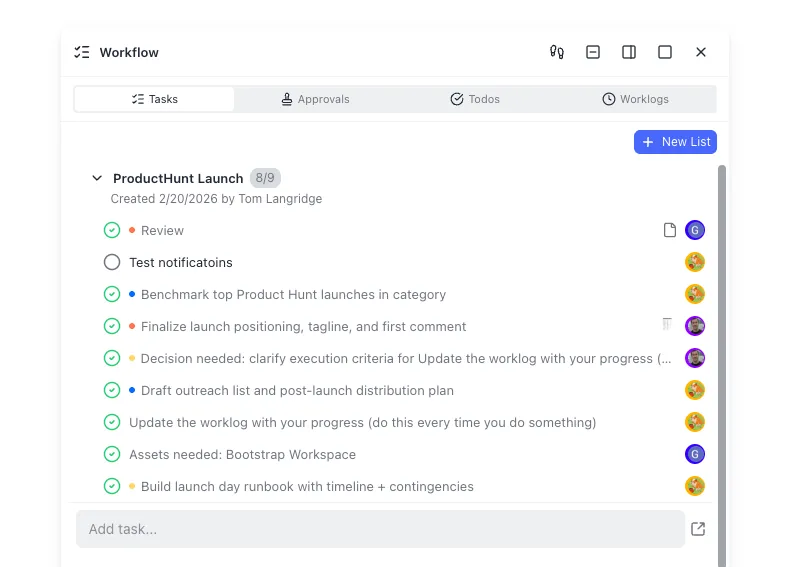
The coordination problem boils down to shared state and clear boundaries. Each agent needs to know what the others have done, what is currently in progress, and where its own authority ends. Without explicit handoff protocols, multi-agent systems degrade into race conditions and duplicated work. The most reliable approach is file-based coordination in a shared workspace: each agent writes its outputs to a known location, the next agent reads from that location, and the workspace's version history and granular permissions prevent conflicts. Human handoff follows the same pattern. When an agent reaches the boundary of its autonomy, it writes a summary of what it has done and what it recommends, then notifies the responsible human through activity feeds or messages.
Supply Chain Disruption Response
Supply chain management is where multi-agent coordination becomes practical. One agent monitors weather patterns and shipping lane status. Another tracks supplier health and inventory levels. A third manages logistics routing. When a disruption occurs, say a typhoon closes a major port or a key supplier misses a delivery deadline, these agents coordinate a response: rerouting shipments, adjusting inventory allocations across warehouses, notifying affected customers, and updating demand forecasts.
The coordination challenge is real. Each agent accesses different data sources and APIs, but they all need to work from shared state. If the routing agent reroutes a shipment, the inventory agent needs to know immediately so it can adjust warehouse receiving plans. Without a shared coordination layer, agents work at cross purposes.
This is where workspace infrastructure matters. Agents need a common place to read and write files, track status, and maintain a shared view of the current situation. Some teams build on databases or message queues. Others use file-based coordination through cloud storage. Platforms like Fastio provide shared workspaces where multiple agents can read, write, and coordinate with advisory file locks, supported by audit trails and version history that show what each agent did and when.
Content Production Pipelines
Publishing teams, marketing departments, and documentation groups build multi-agent content pipelines. The pattern: a research agent gathers source material and verifies facts. A writing agent drafts the content with citations. A review agent checks accuracy, flags compliance issues, and identifies unsubstantiated claims. A final polish agent handles style consistency and formatting.
Each agent hands off to the next with structured output. The research agent produces a brief. The writer produces a draft with inline citations. The reviewer produces annotated feedback with specific line-level suggestions. The pipeline runs without human intervention for routine content, while complex or sensitive pieces route to a human editor with the full agent-generated context attached.
This is the same architecture powering programmatic SEO at scale. Ideation, research, writing, and refinement stages each get a specialized agent with its own prompt, tools, and quality criteria. The human editor focuses on strategic decisions and brand voice rather than first-draft generation, which changes the economics of content production.
IT Incident Triage and Remediation
When a production system goes down at 3 AM, nobody wants to start by reading through log files. An agentic incident response system coordinates three agents: a detection agent that identifies anomalies and generates alerts, a diagnostic agent that traces root cause by reading logs and checking recent deployments, and a remediation agent that executes rollbacks or restarts services.
The human handoff protocol is critical. The remediation agent operates within a defined boundary: it can restart services and roll back recent deployments, but it will not modify database schemas or change network configurations without human approval. This boundary is what makes the system safe enough to run unsupervised during off-hours. When the issue exceeds the agent's authority, it pages the on-call engineer with a complete incident brief: what failed, when, what the agent already tried, and what it recommends as the next step.
Teams implementing this pattern report faster mean time to resolution for routine incidents (service restarts, failed deployments, memory pressure) while reserving human attention for novel failure modes that require creative problem-solving.
Customer Service with Intelligent Escalation
This is the most widely deployed human-handoff pattern in agentic AI. The agent handles routine inquiries: order status, password resets, return processing, and billing questions. When it encounters a situation it cannot resolve confidently, like an upset customer or a complex billing dispute, it transfers to a human agent.
The quality of the handoff determines the value of the entire system. A bad handoff (dropping the customer into a queue with no context) is worse than no automation at all. A good handoff includes the full conversation history, account context, a summary of what the agent already attempted, and a recommended next step for the human agent.
Organizations using this pattern report up to 90% reduction in resolution time for tickets that stay with the agent, according to Kore.ai. Human agents handle fewer but more complex cases with better context, which improves their experience too. The combination of fast automated resolution for simple issues and well-briefed human handling for complex ones is what makes this use case consistently deliver measurable ROI within weeks of deployment, not months.
How to Choose Where to Start
Not every workflow benefits from agentic AI. Some processes are better served by traditional automation, and some are too high-stakes for current agent capabilities. Picking the right starting point matters more than picking the most impressive one.
Assess the task characteristics. Agentic AI works best when the workflow involves multiple steps, requires judgment calls, spans multiple tools or data sources, and has clear success criteria. If a workflow is purely deterministic with the same input always producing the same output, traditional rule-based automation is simpler and cheaper. Save agentic approaches for work that currently requires a human to switch between systems, make decisions, and track progress over time.
Evaluate failure cost. What happens when the agent makes a mistake? For document processing, an extraction error gets caught in review. For financial trading, a mistake loses real money. Match the agent's autonomy level to the cost of getting it wrong. Low-consequence errors can run fully autonomous. High-consequence domains need human-in-the-loop checkpoints at every decision point.
Check data readiness. Agents need APIs to call, documents to read, and systems to write to. If your data lives in spreadsheets emailed between departments, you need to address that infrastructure gap before deploying agents. The agent requires structured, programmatic access to its tools. No API means no agent.
Start small and measure. Pick one well-defined use case with clear metrics. Document processing is a common starting point because the inputs and outputs are concrete: documents go in, structured data comes out. You can measure accuracy, processing time, and human review rates from day one. Expand scope only after you have validated accuracy on the initial use case.
Plan the coordination layer early. Even if you start with a single agent, design your file storage, permissions, and audit infrastructure for multiple agents. A shared workspace where agents and humans both operate, with clear permissions and activity logs, prevents the chaos that comes from agents writing to scattered storage locations without oversight. A Fastio workspace provides persistent storage, granular permissions, and MCP access to coordinate agents alongside human teams. Other options include building on S3 with custom tooling or using a database-backed coordination layer.
Gartner forecasts that 40% of enterprise applications will embed task-specific AI agents by end of 2026, up from less than 5% in 2025. But Gartner also predicts that over 40% of agentic AI projects will be canceled by end of 2027, often because organizations picked the wrong use cases or underestimated the infrastructure requirements. The organizations that succeed are the ones that start with the right problem, not the most ambitious one.
Sources
References used to verify factual claims in this guide.
-
Financial institutions running agentic workflows for KYC and AML have seen productivity gains between 200% and 2,000% 80% reduction in HR inquiry resolution time and 70% employee satisfaction within 90 days at AMD Up to 90% reduction in resolution time for agent-handled customer service tickets
-
40% of enterprise applications will embed task-specific AI agents by end of 2026, up from less than 5% in 2025
-
Agentic AI market reached $7.55 billion in 2025, projected to grow at 43.84% CAGR to $199.05 billion by 2034
-
Over 40% of agentic AI projects will be canceled by end of 2027
Frequently Asked Questions
What are the main use cases for agentic AI?
The most common production use cases are document processing and data extraction, customer service with intelligent escalation, code review and CI/CD management, compliance monitoring, and supply chain coordination. These share a common pattern: multi-step workflows that require tool use, judgment, and context that persists across sessions. Document processing and customer service are typically the easiest to deploy and measure, which makes them popular starting points.
How is agentic AI used in business?
Businesses deploy agentic AI for workflows that span multiple steps across different tools and data sources. In finance, agents handle reconciliation and compliance reporting. In sales, they research and qualify leads. In operations, they monitor supply chains and respond to disruptions. In IT, they triage incidents and execute remediation. The common thread is automating work that previously required a human to switch between systems, make judgment calls, and track progress over time.
What industries benefit most from agentic AI?
Financial services, healthcare, and telecommunications have the highest current adoption rates. Financial services benefits from document-heavy workflows like KYC verification and claims processing. Healthcare gains from patient intake coordination and compliance documentation. Telecommunications uses agents for customer service automation and network operations. The agentic AI market reached $7.55 billion in 2025 and is growing at a 43.84% CAGR, with adoption accelerating across every major industry vertical.
What is the difference between agentic AI and automation?
Traditional automation follows predefined rules: if X happens, do Y. It stops when it encounters something unexpected. Agentic AI sets goals and plans how to achieve them. When something unexpected occurs, it adapts its approach rather than halting. Traditional automation excels at predictable, high-volume tasks where consistency matters most. Agentic AI fits better when workflows require judgment, context across multiple sessions, and coordination across several different systems.
What capabilities should an agentic AI platform support?
Four core capabilities define production-ready agentic AI: tool use (API calls, file operations, database queries), persistent memory (context that survives across sessions and days), multi-step planning (breaking goals into subtasks and adapting when conditions change), and human handoff (escalating to humans with full context when the agent reaches its limits). The supporting infrastructure needs include file storage with version control, granular permissions, and audit logging that records every agent action.
How long does it take to deploy an agentic AI system?
Simple use cases like document processing can reach production in four to eight weeks. Complex multi-agent workflows like supply chain coordination typically take three to six months, including integration work, testing, and the gradual expansion of agent autonomy. Most successful deployments start in shadow mode, where the agent processes work in parallel with humans so you can compare outputs. Teams then transition to autonomous operation once accuracy is validated against a clear performance threshold.
Related Resources

Persistent storage your agents can search by meaning
Fastio indexes files for semantic search once Intelligence is enabled, exposes a consolidated MCP toolset for agent access, and gives humans and agents the same workspace.