Agent-to-Agent Communication Protocols: A Developer Guide
Agent-to-agent communication protocols let AI agents from different frameworks exchange messages, share files, and coordinate work without custom integration code. This guide maps the full protocol landscape, from Google A2A to Anthropic MCP to shared workspace patterns, and explains when to use each one.

What Are Agent-to-Agent Communication Protocols?
Agent-to-agent communication protocols are standardized methods that allow AI agents from different frameworks or vendors to exchange messages, share context, negotiate tasks, and collaborate without requiring direct integration between their underlying systems.
The problem they solve is straightforward. Without a shared protocol, connecting two agents requires custom glue code. Connect ten agents with custom integrations, and you're maintaining forty-five unique bridges. That doesn't scale.
Communication protocols standardize the handshake. They define how agents discover each other's capabilities, format requests, track progress, and exchange results. Think of them as the HTTP of the agent world: a shared contract that lets any client talk to any server.
Most protocols handle five core functions:
- Capability discovery: Finding which agents can perform which tasks
- Message routing: Directing requests to the right agent
- Task delegation: Assigning work and tracking its lifecycle
- Status updates: Reporting progress on delegated work
- Artifact exchange: Sharing files, data, and generated outputs
That last point, artifact exchange, gets surprisingly little attention in protocol discussions. Agents don't just pass JSON messages back and forth. They generate PDFs, process images, build datasets, and produce code. How those files move between agents matters as much as how the coordination messages flow.
Related guides
- How to Use Google's A2A Protocol for Agent-to-Agent CommunicationGoogle's Agent2Agent (A2A) protocol gives AI agents a standard way to find each other, exchange tasks, and collaborate...
- Connecting CrewAI Multi-Agent Teams to Box StorageA CrewAI Box connector enables autonomous multi-agent teams to query enterprise records without loading entire...
- How to Connect CrewAI to Dropbox: Multi-Agent Cloud Storage ArchitectureConnecting CrewAI to Dropbox provides autonomous multi-agent systems with direct, indexed access to cloud files,...
- How to Use Google's A2A Protocol for Agent CommunicationGoogle's A2A (Agent-to-Agent) protocol is an open standard that lets AI agents from different frameworks discover each...
- Agent-to-Agent Communication: Protocols for Collaborative AI TeamsAgent-to-agent communication protocols enable collaborative AI teams to coordinate work without active context...
- Best APIs for AI Agent Communication: Top 9 Solutions for 2026Building effective multi-agent systems requires structured message passing and reliable state synchronization. This...
More on this subject: Multi-Agent Systems (62 guides)
Five Approaches to Agent Communication
Developers building multi-agent systems can pick from five main approaches. Each makes different tradeoffs between simplicity, flexibility, and standardization.
1. Direct API Calls
The simplest option. Agent A calls Agent B's REST endpoint. This works when you control both agents and the integration is stable. It breaks down quickly when you add a third agent, change an API, or need to coordinate across teams.
POST /agent-b/tasks
{
  "type": "summarize",
  "input": { "document_url": "https://..." }
}
Best for: Two-agent systems under a single team's control.
2. Message Queues
Systems like RabbitMQ, Apache Kafka, or AWS SQS act as intermediaries. Agents publish tasks to topics. Other agents subscribe and respond. This decouples agents in time and space, but you still need to agree on message schemas.
Best for: Event-driven architectures with high throughput requirements.
3. Google A2A Protocol
Launched in April 2025 with over fifty technology partners, A2A provides a standardized JSON-RPC 2.0 protocol specifically for agent-to-agent collaboration. It defines capability discovery (Agent Cards), task lifecycle management, and streaming updates.
Best for: Cross-vendor agent collaboration in enterprise environments.
4. MCP (Model Context Protocol)
Released by Anthropic in November 2024, MCP connects agents to tools and data sources rather than other agents directly. It standardizes how agents access databases, file systems, APIs, and any external resource.
Best for: Giving agents consistent access to tools and shared resources.
5. Shared Storage and Workspaces
Agents read and write to a common workspace. Files, state, and context persist between interactions. Agents don't need to be online simultaneously. A research agent uploads findings overnight; a writing agent picks them up the next morning.
Best for: Asynchronous workflows, human-agent collaboration, and artifact-heavy pipelines.
Most production systems combine two or three of these approaches. A2A handles the coordination layer. MCP provides tool access. Shared workspaces store the actual files.
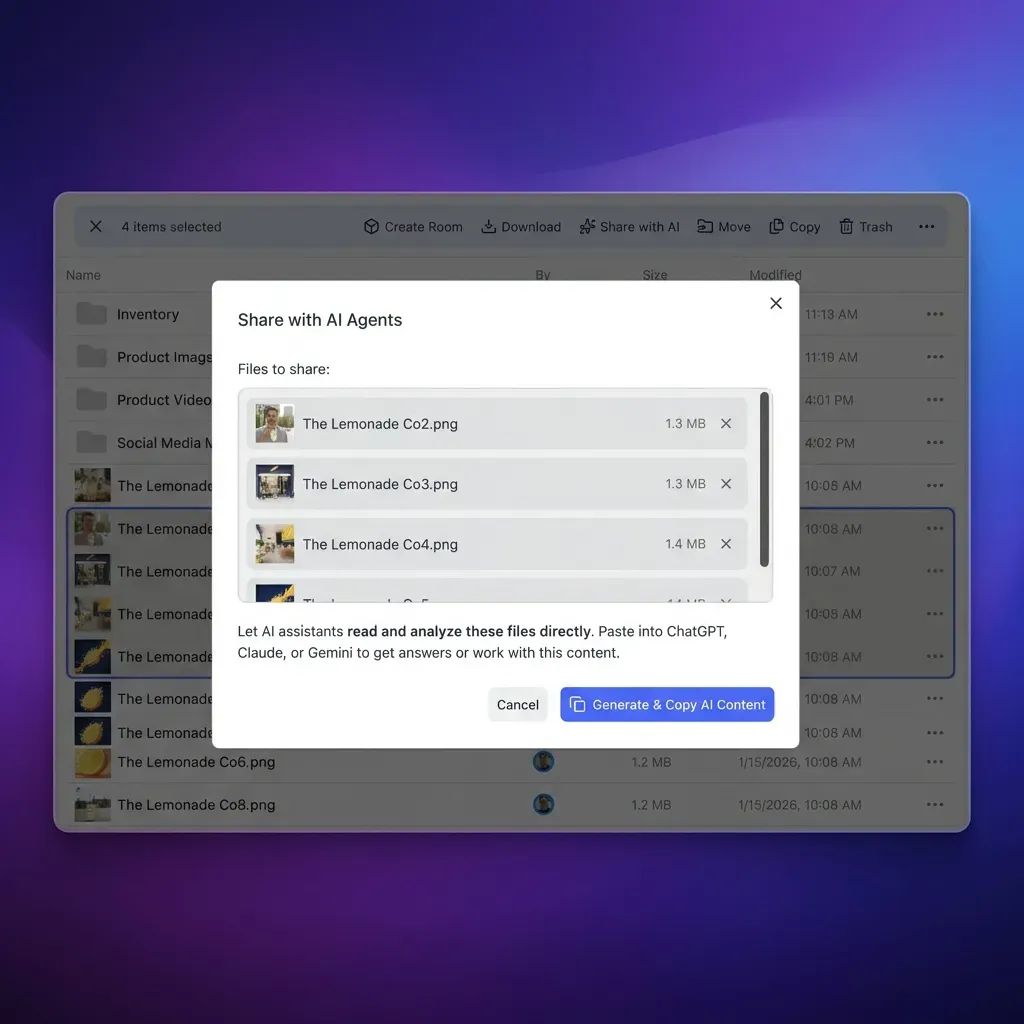
Google A2A Protocol: How It Works
Google's Agent-to-Agent protocol defines a concrete specification for how agents discover and collaborate with each other. According to Google's developer blog, A2A launched with backing from Salesforce, SAP, ServiceNow, and dozens of other enterprise vendors.
Agent Cards
Every A2A agent publishes an Agent
Card: a JSON document describing what it can do, how to authenticate, and where to send requests. Think of it as a machine-readable resume.
{
  "name": "document-processor",
  "description": "Extracts and summarizes documents",
  "url": "https://agent.example.com",
  "capabilities": ["summarize", "extract-entities", "translate"],
  "authentication": { "type": "oauth2" }
}
Client agents fetch these cards to decide who can handle a given task. No hardcoded integrations required.
Task Lifecycle
Tasks are the fundamental unit of work in A2A. A client agent creates a task, sends it to a server agent, and tracks its status through defined states: submitted, working, input-required, completed, failed, or canceled.
Tasks can contain multiple "parts" that carry different data types. A TextPart holds text content. A FilePart represents file data (inline or by reference). A DataPart carries structured JSON. This multi-part design is critical for real-world workflows where agents need to pass documents, images, and structured data alongside instructions.
Streaming and Push Notifications
For long-running tasks, A2A supports Server-Sent Events (SSE) for real-time progress updates. If a client disconnects, push notifications via webhooks keep it informed. This matters for tasks that take minutes or hours, like processing a large document corpus or generating a complex report.
Transport
A2A runs over HTTP(S) using JSON-RPC 2.0. This means any language or framework with an HTTP client can implement the protocol. Google provides reference implementations in Python and JavaScript, with community ports for Go, Rust, and Java appearing on GitHub.
MCP: The Tool and Resource Layer
The Model Context Protocol solves a different problem than A2A. Where A2A connects agents to agents, MCP connects agents to everything else: databases, file systems, search engines, APIs, and external services.
Anthropic released MCP in November 2024, and adoption moved fast. Major frameworks including LangChain, Semantic Kernel, and CrewAI added MCP client support within months. The protocol now supports thousands of tool servers covering everything from GitHub access to database queries to file management.
Architecture
MCP uses a client-server model. The AI application (host) connects to one or more MCP servers. Each server exposes three types of capabilities:
- Tools: Functions the agent can call (e.g.,
search_files,create_document,run_query) - Resources: Data sources the agent can read (e.g., file contents, database records)
- Prompts: Reusable templates for common operations
Transport Options
MCP supports two transport modes. Standard I/O (stdio) runs MCP servers as local subprocesses, useful during development. Streamable HTTP with Server-Sent Events enables remote MCP servers, which is what you want in production.
Fastio's MCP server exposes a consolidated MCP toolset via Streamable HTTP. Agents can create workspaces, upload files, manage permissions, and query documents, all through the standard MCP interface. The full tool documentation covers every operation.
How MCP and A2A Work Together
These protocols aren't competitors. They're layers in a stack.
An agent uses MCP to access tools and read from shared resources. It uses A2A to delegate tasks to other agents. A practical example: a research agent uses MCP tools to search a document database, then uses A2A to delegate the writing of a summary to a specialized content agent.
A survey of agent interoperability protocols published on arXiv in May 2025 confirms this complementary relationship, recommending that developers implement both protocols for complete coverage of tool access and agent collaboration.


Give Your AI Agents Persistent Storage
Fastio gives your agents a consolidated MCP toolset, persistent file storage, and built-in RAG.
The Missing Piece: File and Artifact Exchange
Most protocol guides focus on message passing and ignore a practical question: how do agents actually share files?
This matters more than it might seem. Agents generate PDFs, spreadsheets, images, code repositories, and processed datasets. A2A's FilePart can carry small files inline or reference external URLs, but it's not designed as a storage layer. MCP provides file access through tool calls, but individual MCP servers may not persist data between sessions.
The gap shows up in real workflows. An agent generates a long report. Another agent needs to read it, annotate sections, and produce a summary. A third agent delivers the final package to a human reviewer. Where do those files live between steps?
Shared Workspaces as the Artifact Layer
Shared workspaces fill this gap. Agents write files to persistent storage that every participant, both agents and humans, can access. Instead of passing file contents through protocol messages, agents pass references (URLs or file IDs) and let recipients fetch what they need.
This pattern has several advantages:
- No message size limits: Large datasets don't need to fit in a JSON payload
- Temporal decoupling: Agent B can process Agent A's output hours later
- Human visibility: Team members can browse, preview, and approve agent outputs in the same workspace
- Version history: Changes to files are tracked automatically
- Concurrent access: Advisory file locks signal when an agent is writing so others can wait, while version history protects every revision
Fastio workspaces are built for this pattern. With Intelligence Mode enabled, uploaded files are automatically indexed for search and AI chat. An agent can upload research documents, and any other agent (or human) can query those documents using natural language without re-processing them.
Combining Protocols with Shared Storage
A production multi-agent system might work like this:
- An orchestrator agent uses A2A to assign a research task
- The research agent uses MCP tools to search external sources
- The research agent writes findings to a shared workspace via MCP
- The orchestrator detects the upload (via the realtime activity feed) and assigns a writing task
- The writing agent reads the research from the workspace, produces a draft, and saves it
- A human reviewer opens the workspace, reads the draft, and leaves comments
- The writing agent reads the comments and produces a final version
Every step uses the right protocol for the job. A2A for coordination. MCP for tool access and file operations. Shared storage for the actual artifacts.

Security and Production Considerations
Multi-agent communication introduces attack surface that single-agent systems don't have. Every connection is a potential entry point, and the autonomous nature of agents means a compromised agent can do real damage before anyone notices.
Authentication
A2A agents should authenticate using OAuth 2.0 or mutual TLS. Every agent needs verifiable credentials. If Agent A asks Agent B to process a confidential document, Agent B needs to confirm Agent A is who it claims to be.
MCP servers must verify client identity before exposing tools. Fastio's MCP server uses the workspace permission system, so agents only access files and workspaces they've been explicitly granted.
Least-Privilege Access
Give each agent the minimum permissions it needs. A summarization agent doesn't need write access. A data collection agent doesn't need delete permissions. Role-based access at the workspace and folder level prevents accidental or malicious data loss.
Audit Logging
Log every inter-agent interaction. Who called whom, what was requested, what artifacts were exchanged. When something goes wrong in the middle of the night, logs are how you reconstruct what happened. Fastio provides full audit trails tracking workspace access, file operations, and permission changes across all agent and human activity.
Evidence and Benchmarks
According to IBM's research on the A2A protocol, organizations using standardized protocols for agent communication reduce integration time by 60-70% compared to custom development. The same research found that standardized discovery mechanisms (like A2A Agent Cards) cut onboarding time for new agent integrations from weeks to days.
Production deployments should also consider:
- Idempotency: Task submissions should be safe to retry without creating duplicate work
- Circuit breakers: Stop sending requests to a repeatedly failing agent
- Timeouts: Set reasonable limits on task completion, especially for A2A streaming connections
- State persistence: Store intermediate results so interrupted tasks can be resumed by another agent
Getting Started: A Practical Checklist
If you're building a multi-agent system and need to choose communication patterns, here's a decision framework.
Start with MCP if:
- You have a single agent that needs access to tools and data sources
- You want to connect an agent to existing services (databases, file storage, APIs)
- You're building with a framework that already supports MCP (LangChain, Semantic Kernel, CrewAI)
Add A2A when:
- You have multiple specialized agents that need to delegate work to each other
- Agents come from different vendors or teams
- You need standardized capability discovery across a fleet of agents
Use shared workspaces when:
- Agents produce files, reports, or datasets that other agents or humans need
- Workflows are asynchronous (agents don't all run at the same time)
- Humans need to review, approve, or modify agent outputs
- You need version history and audit trails on artifacts
Fastio as the workspace layer:
- A consolidated MCP toolset for programmatic file operations
- Intelligence Mode auto-indexes files for RAG, no separate vector database needed
- Ownership transfer lets agents build workspaces and hand them to humans
- Advisory file locks let agents signal active writes so other agents can wait or read
- Works with Claude, GPT-4, Gemini, LLaMA, and local models
- Business Trial: 14-day trial, credit card required; see /pricing/
The landscape is maturing fast. A2A and MCP are becoming the default building blocks. Shared workspaces fill the artifact gap that pure messaging protocols leave open. The developers who combine all three will have the most capable multi-agent systems.
Sources
References used to verify factual claims in this guide.
-
A2A protocol launched in April 2025 with over fifty technology partners A2A backed by Salesforce, SAP, ServiceNow and dozens of other enterprise vendors
-
Anthropic released MCP in November 2024
-
MCP now supports thousands of tool servers
-
Survey of agent interoperability protocols published on arXiv in May 2025
-
Organizations using standardized protocols reduce integration time by 60-70% compared to custom development Standardized discovery mechanisms cut onboarding time from weeks to days
-
Connecting ten agents with custom integrations requires forty-five unique bridges
-
Fastio MCP server exposes a consolidated toolset Fastio exposes a consolidated MCP toolset via Streamable HTTP
-
Fastio offers a 14-day Business Trial
-
A2A protocol specifically uses JSON-RPC 2.0 for agent-to-agent collaboration A2A runs over HTTP using JSON-RPC transport protocol A2A agents should authenticate using OAuth for mutual trust
-
Fastio provides a consolidated MCP toolset and persistent workspaces for multi-agent artifact exchange
Frequently Asked Questions
How do AI agents communicate with each other?
AI agents communicate through standardized protocols that define message formats, routing, and capability discovery. The most common approaches are direct API calls for simple integrations, message queues for event-driven systems, Google A2A protocol for standardized agent-to-agent collaboration, MCP for tool and resource access, and shared workspaces where agents read and write common files. Most production systems combine two or three of these approaches.
What is the difference between A2A and MCP?
Google A2A handles communication between autonomous AI agents, covering task delegation, status updates, and capability discovery. Anthropic MCP connects agents to tools and resources like databases, file systems, and APIs. They solve different problems and work well together: MCP provides shared resource access while A2A enables agents to discover and delegate work to each other.
What protocols do multi-agent systems use?
Multi-agent systems typically use a combination of protocols. Google A2A (Agent-to-Agent) handles agent coordination and task delegation. Anthropic MCP (Model Context Protocol) provides access to tools and data sources. Shared workspace platforms handle file and artifact exchange. Emerging standards like OASF and ANP are also gaining attention. The choice depends on whether agents need to delegate tasks, access tools, or share files.
How do agents from different frameworks talk to each other?
Agents built with different frameworks communicate by implementing common protocol interfaces. Google A2A is framework-agnostic, so agents built with LangChain, CrewAI, AutoGen, or custom code can all implement the A2A specification. Similarly, MCP has been adopted across major frameworks for tool access. The key is implementing the protocol layer rather than building framework-specific integrations.
What is the best way to implement agent communication?
Start with MCP for tool access if you have a single agent. Add A2A when you need multiple agents to delegate work to each other. Use shared workspaces for file and artifact exchange. For enterprise deployments, implement all three: A2A for coordination, MCP for tools, and shared storage for the actual files. Fastio provides a consolidated MCP toolset and persistent workspaces designed for multi-agent artifact exchange.
How do you handle file sharing between agents?
File sharing between agents works best through shared workspaces rather than passing files directly in protocol messages. Agents write files to persistent storage and pass references via A2A messages or MCP resources. This keeps message sizes manageable, enables offline processing, and lets humans access the same files. Advisory file locks let agents signal active writes while version history ensures all updates are preserved.
Related Resources

Give Your AI Agents Persistent Storage
Fastio gives your agents a consolidated MCP toolset, persistent file storage, and built-in RAG.