Top OpenClaw Skills for Operations Managers
Operations managers can now automate a significant portion of routine tasks using OpenClaw agents. This guide covers the skills your agents need, including file management with Fastio, browser automation, and project tracking. You'll learn to build a self-driving operations stack that reduces costs and removes busywork.

The Coordination Tax That Kills Operations Efficiency
Operations managers often struggle with the "coordination tax." This is the hidden cost of moving info between systems. Managers spend hours copying data from invoices to spreadsheets, updating project statuses from emails, and chasing teams for files. This admin work steals time from strategy and improving processes.
Agentic Operations changes this. The shift moves from "managing people who use tools" to "managing agents that use skills." In this model, AI agents don't just chat. They do the work.
According to McKinsey, current generative AI and other technologies have the potential to automate work activities that absorb 60 to 70 percent of employees' time today. This is a huge chance for operations leaders. By using agents with the right skills, you can save hundreds of hours a year. But an OpenClaw agent without skills is just a chatbot. Your agents need specific skills to work with your files, tools, and team.
Helpful references: Fastio Workspaces, Fastio Collaboration, and Fastio AI.
Related guides
- How to Use Claude Code Skills in ClineAccording to GitHub's Octoverse 2024 report, the number of developers building with generative AI on the platform...
- How to Install and Manage Cline Agent SkillsAI coding agents boost code volume by 180%, but shipped code rises by only 30%, showing a critical gap in development...
- Best OpenClaw Skills for Web ResearchWeb research skills let OpenClaw agents find and read information on the live web. Without them, your AI is stuck with...
- How to Use OpenClaw for Education: Top 7 Skills for EducatorsThe top OpenClaw skills for educators help create personalized lessons and handle admin tasks. By using these...
- Top OpenClaw Skills for Interior DesignersInterior design is half creativity and half administration. OpenClaw skills help designers automate sourcing, organize...
- Top OpenClaw Skills for Real Estate AgentsOpenClaw skills help real estate agents automate routine tasks and focus on closing deals. From instant lead...
More on this subject: OpenClaw Skills (109 guides)
What Are OpenClaw Skills?
OpenClaw skills connect your AI agents to the real world. They are blocks of code that let agents do specific things, like reading a file, sending an email, or updating a database.
How Skills Differ from APIs Traditional API integrations are rigid (e.g., "If X happens, do Y"). OpenClaw skills are flexible. An agent uses reasoning to decide when and how to use a skill to reach a goal.
For operations managers, this matters. You don't have to map out every step. Instead, you give the agent a goal ("Update the inventory report") and the skills (Fastio for files, SQL Toolkit for data). The agent figures out how to do it.
The Core Ops Stack To build a strong operations agent, you need a mix of skills that cover the three pillars of operations:
- Storage & Memory: A place to keep files and records (Fastio).
- Execution: Tools to use the web and apps (Playwright, API Gateway).
- Communication: Channels to talk to humans (AgentMail, Slack).

1. Fastio: File Management and Workflow Handoffs
The most important skill for an operations agent is handling files. In ops, "work" is usually a file - invoices, contracts, reports, or videos. Without a workspace, your agents are stuck in a text-only world. They can't make or organize the actual work.
MCP Endpoint: https://mcp.fast.io/mcp/tools
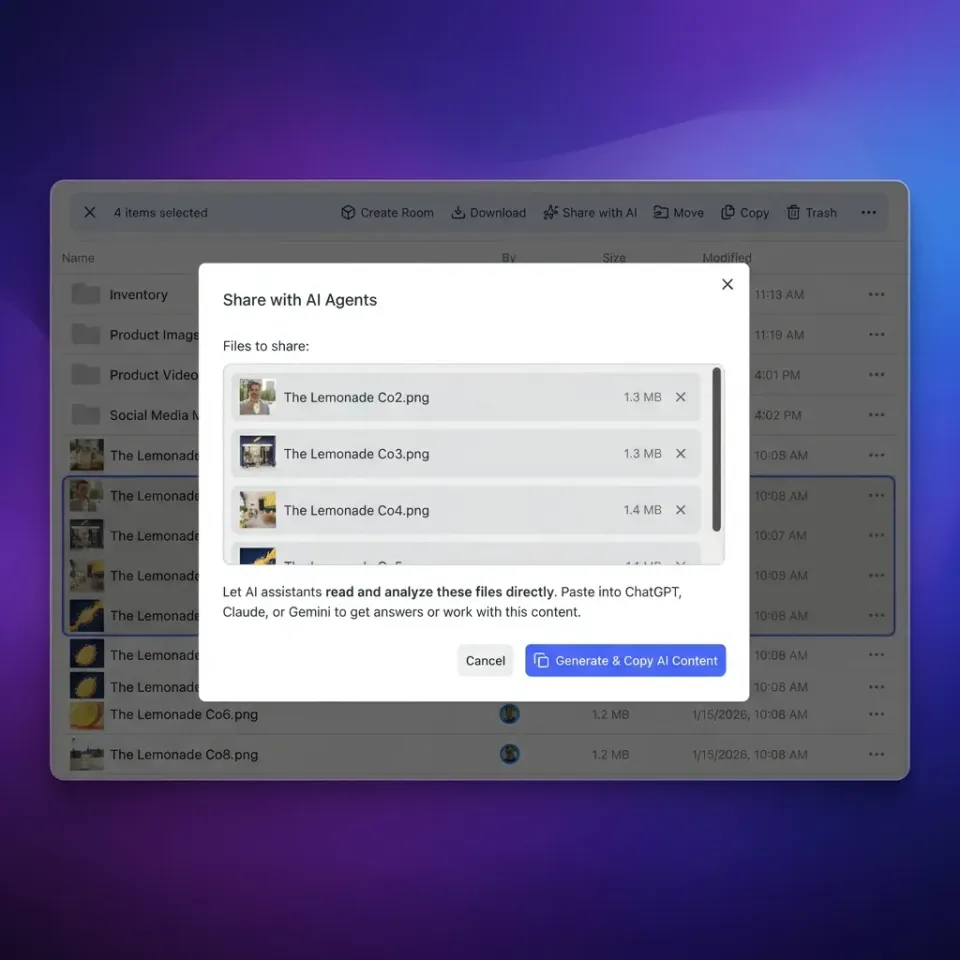
Fastio gives your OpenClaw agents a "desk" in your office. It provides a secure cloud workspace where they can read, write, and organize data, backed by a consolidated MCP toolset covering file operations, AI chat, anchored comments, and sharing.
Core Capabilities for Ops:
- Read/Write Files: Agents can read data from CSVs, logs, and PDFs, and create new reports in shared folders.
- Semantic Search: Using Fastio's Intelligence Mode, agents can search thousands of docs by meaning (e.g., "Find the vendor agreement for Acme Corp from last year").
- Ownership Transfer: An agent can build a client portal, organize the files, and then transfer ownership to a manager for review.
- Audit Trails and Activity: A detailed activity log, realtime activity feed, and WebSocket events feed create a complete record of human and agent actions without extra tooling.
Example: The "Ready for Review" Workflow
- Watch a "Drafts" folder for new uploads.
- Check files against a checklist.
- Move approved files to a "Ready for Review" folder.
- Acquire an advisory file lock or restrict edit access using granular workspace permissions during review.
Documentation: Fast.io for Agents

2. Playwright: Browser Automation for Legacy Systems and Web Forms
Not every tool has a clean API. Ops managers often deal with legacy systems, government portals, or vendor sites that only have a web interface. For these, agents need eyes and hands. The Playwright skill (ivangdavila/playwright) enables browser automation using Playwright and MCP for tasks requiring real browser interaction.
Install:
clawhub install playwright
Skill Capabilities:
- Scrape Data: Check competitor pricing, track inventory, or retrieve news from sites that block simple HTTP requests.
- Fill Forms: Automate data entry for legacy ERP systems. The agent reads a spreadsheet row and types it into a web form, handling dropdowns and errors.
- Capture Evidence: Take screenshots of confirmation pages or errors for an audit trail.
- Trace Capture: Records full browser sessions for debugging and compliance documentation.
Safety and Rate Limits When using agents on the web, be a good citizen.
- Rate Limits: The Playwright skill supports throttling between actions so you don't overwhelm servers.
- Human-in-the-Loop: For sensitive actions (like clicking "Purchase"), have the agent draft the action and leave a comment anchored to the draft file for human review.
ClawHub Page: clawhub.ai/ivangdavila/playwright


Run Operations Workflows on Fastio
Give your OpenClaw agents a secure place to read, write, and share files with your team. Built for automated operations. Built for openclaw skills operations managers workflows.
3. AgentMail: Vendor Communication and Invoice Processing
Email is still the nervous system of business. It's where invoices arrive, approvals are requested, and fires start. The AgentMail skill (adboio/agentmail) is an API-first email platform purpose-built for AI agents. It gives your agent its own programmatic inbox (e.g., ops-bot@agentmail.to), letting it act as a first line of support without a human watching the inbox.
Use Cases:
- Vendor Comms: The agent replies to "where is my payment?" questions by checking the ledger and giving an update without bothering a human.
- Invoice Processing: Receives invoices via email, pulls PDF data, saves the file to a Fastio folder, and sends a summary to finance.
- Webhook-Driven Alerts: Triggers immediately when a new message arrives, so urgent issues get processed in seconds.
Drafting vs. Sending For external comms, it's safer to have the agent draft responses. The agent saves the draft as a text file in a "Drafts" folder in Fastio. A human reviews and approves it, ensuring the tone and details are right.
ClawHub Page: clawhub.ai/adboio/agentmail

4. API Gateway: Connecting to 100+ Business Tools
Operations managers work across many platforms - Salesforce, HubSpot, Notion, Airtable, Stripe, and more. The API Gateway skill (byungkyu/api-gateway) connects OpenClaw to 100+ third-party APIs through managed OAuth authentication, acting as a passthrough proxy so agents can call any integrated service without managing individual API keys.
Key Functions:
- 100+ Integrations: Google Workspace, Microsoft 365, Slack, Notion, HubSpot, Salesforce, Stripe, Airtable, and more.
- Managed OAuth 2.0: Handles token injection automatically - no credential management per service.
- All HTTP Methods: GET, POST, PUT, PATCH, DELETE - supports the full API surface of each integrated tool.
- Native API Passthrough: Use official API documentation directly; no proprietary query language to learn.
Operations Use Case: The agent receives an invoice via AgentMail, extracts the vendor and amount, queries the Airtable vendor database via API Gateway to verify the vendor is approved, then posts a Slack notification to the finance channel with a summary and the Fastio file link for payment processing. All four tools work together in one workflow.
ClawHub Page: clawhub.ai/byungkyu/api-gateway
5. SQL Toolkit: Reporting and Operational Analytics
Agents need to read data, not just move files. The SQL Toolkit skill (gitgoodordietrying/sql-toolkit) provides comprehensive guidance for querying, designing, and optimizing relational databases across SQLite, PostgreSQL, and MySQL - with patterns for complex queries, aggregations, window functions, and migrations, all without an ORM.
Why it matters for ops: Operations data lives in structured tables - inventory levels, order histories, SLA tracking, vendor performance. Connecting OpenClaw to your database with the SQL Toolkit turns the agent into an on-demand analyst.
Key Workflows:
- Daily Reporting: Agent queries the ops database each morning and saves a summary report to Fastio.
- Anomaly Detection: Window functions flag unusual spikes in costs or delays compared to historical averages.
- SLA Tracking: CTEs calculate resolution times across support tickets and surface breaches automatically.
ClawHub Page: clawhub.ai/gitgoodordietrying/sql-toolkit
Building Your Ops Stack: A Case Study
To start, don't build a "general manager" agent that does everything. Start with a specific, high-volume workflow and add skills.
Case Study: The "Self-Driving" Invoice Processor Here is how these skills automate an accounts payable workflow.
- Receive (AgentMail): The agent gets an email with a PDF at
invoices@agentmail.to. - Sort (Fastio): The agent saves the PDF to the "Invoices/Processing" folder in Fastio.
- Read (Fastio Intelligence): The agent uses Fastio RAG to extract vendor name, date, items, and total from the PDF.
- Verify (API Gateway): The agent queries the Airtable vendor registry to confirm the vendor is approved.
- Check (SQL Toolkit): The agent queries the ops database to compare this invoice against the vendor's historical averages for anomaly detection.
- Notify (AgentMail + Slack via API Gateway): The agent posts a summary to the finance Slack channel and comments on the Fastio file: "Processed and queued for payment."
The Result According to McKinsey, businesses using AI have reported cost reductions of at least 10% in affected units. More importantly, your team stops doing data entry. They can focus on vendor relationships and strategy.
Sources
References used to verify factual claims in this guide.
-
current generative AI and other technologies have the potential to automate work activities that absorb 60 to 70 percent of employees' time today
-
businesses implementing AI have reported cost reductions of at least 10% in the affected business units
Frequently Asked Questions
How do I connect OpenClaw to Fastio?
Connect OpenClaw to Fastio's remote MCP server at https://mcp.fast.io/mcp/tools; your config can send an API key as a Bearer header. This gives your agent file management, semantic search once Intelligence is enabled, and sharing with a consolidated MCP toolset.
Can OpenClaw agents work with my existing files?
Yes. With Fastio, agents can access any files in your workspaces. Fastio also imports from Google Drive, Dropbox, Box, and OneDrive. Your agent can pull files from those sources into a workspace without downloading them.
Is it safe to give agents access to operations data?
Security is key in ops. Fastio lets you grant agents access to specific workspaces only, keeping HR or legal files private. Agents can also acquire advisory file locks before editing to signal active work, backed by version history and a detailed activity log of all actions.
Do I need to know how to code to use these skills?
No. Most OpenClaw skills, including Fastio, are low-code or no-code. You use natural language instructions (e.g., 'Save this report to the Monthly folder' or 'Find the invoice from Acme'). It is easy for ops managers without engineering skills.
Related Resources

Run Operations Workflows on Fastio
Give your OpenClaw agents a secure place to read, write, and share files with your team. Built for automated operations. Built for openclaw skills operations managers workflows.