Top OpenClaw Skills for Content Strategy
Content strategy is more than just writing. It requires research, planning, and data analysis. With the right skills, [OpenClaw](/storage-for-openclaw/) agents handle these tasks for you. This guide shows you the best skills to turn your agent into a content strategist, covering everything from research to your editorial calendar.


Why Use OpenClaw for Content Strategy?
Content strategy skills help OpenClaw agents analyze trends and build calendars. Simple chatbots just generate text. OpenClaw agents with the right skills handle complex workflows, access real-time data, and manage local files. This is important for strategy, which relies on accurate, current information.
Giving your agent specific skills moves you from content creation to strategy. Agents can track competitor blogs, group topics, and manage your editorial database without needing constant human help.
Related guides
- How to Use Claude Code Skills in ClineAccording to GitHub's Octoverse 2024 report, the number of developers building with generative AI on the platform...
- How to Install and Manage Cline Agent SkillsAI coding agents boost code volume by 180%, but shipped code rises by only 30%, showing a critical gap in development...
- Top 10 OpenClaw Skills for Content CreatorsContent creators use OpenClaw skills to handle repetitive tasks and scale production. For content creators, OpenClaw...
- Best OpenClaw Skills for AI Affiliate Marketing Content AutomationNearly 80% of affiliate marketers now use AI for content creation, but most tools handle only one step of the pipeline....
- Best OpenClaw Skills for AI SEO Keyword Research and Content PlanningOpenClaw SEO skills automate keyword discovery, search volume analysis, and content brief generation using your local...
- Best OpenClaw Skills for LinkedIn Content and Professional Brand BuildingOnly 1% of LinkedIn users post content weekly, yet that group generates 9 billion impressions. OpenClaw skills close...
More on this subject: OpenClaw Skills (109 guides)
1. Fastio (Storage & RAG)
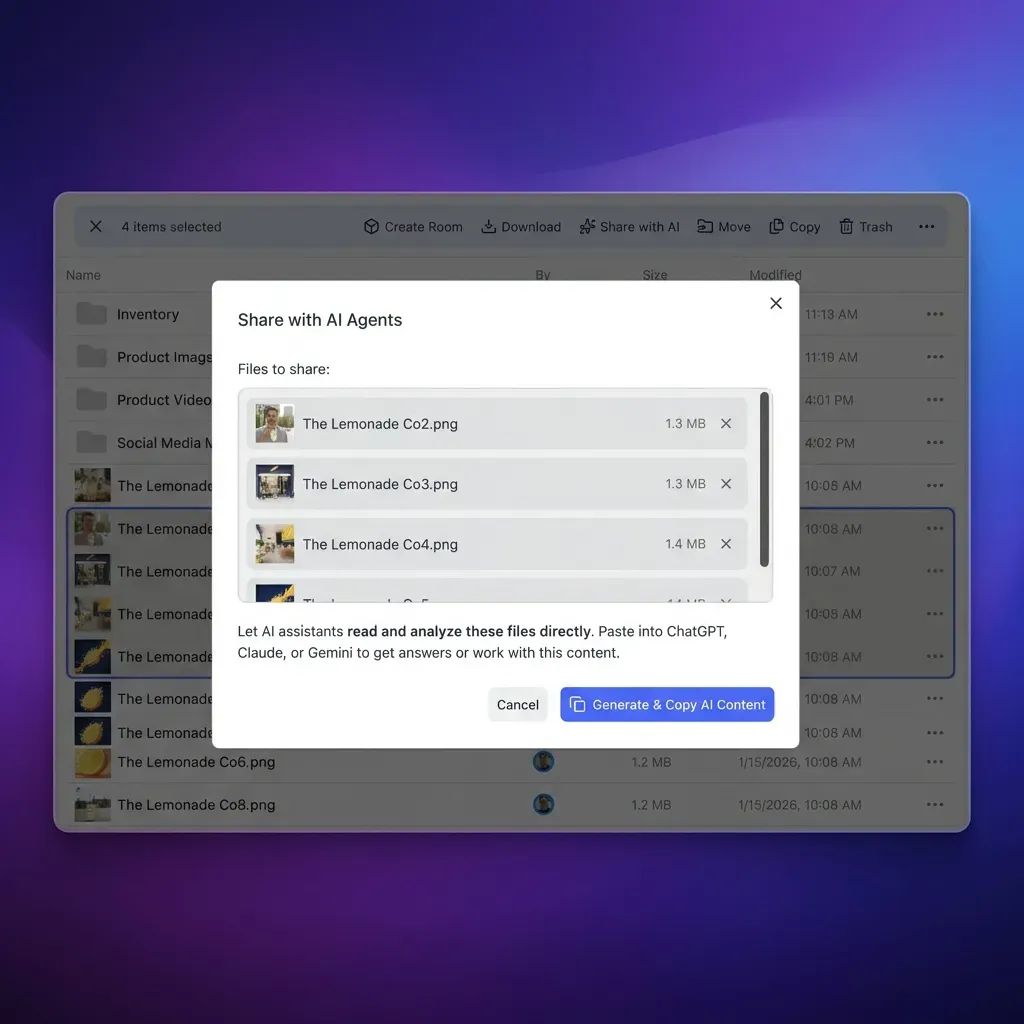
Connecting your OpenClaw agent to Fastio gives it persistent cloud storage and native Retrieval-Augmented Generation (RAG) once Intelligence is enabled. Content strategy creates piles of documentation, from briefs to persona research and keyword data. You need a way to organize and find this later.
Fastio provides a consolidated MCP toolset covering file operations, AI-powered semantic search once Intelligence is enabled, shared workspaces, a detailed activity log, and activity feeds, giving a content agent everything needed to manage a living strategy document.
Key Strengths:
- Persistent Memory: Stores strategy documents that agents can reference weeks later.
- Native RAG: Automatically indexes uploaded files (PDFs, CSVs, Docx) for semantic search.
- Shared Workspace: Allows agents to hand off drafts to humans in a shared folder.
- Collaboration: Anchored comments, mentions, and threaded discussions on any file.
Limitations:
- Requires an internet connection for cloud synchronization.
- Files are indexed for semantic search and document chat once Intelligence is enabled for the workspace.
Best For: Managing long-term strategy assets and knowledge bases.
Pricing: Plans start at $9.99/mo (Starter) with a 14-day Business Trial (card required; see /pricing/).
MCP Server: mcp.fast.io


Give Your Agents Long-Term Memory
Stop your OpenClaw agents from forgetting their strategy. Use Fastio to store briefs, research, and calendars that persist across sessions.
2. Agent Browser (Web Research)
Real-time research is the backbone of good content strategy. The Agent Browser skill lets your OpenClaw agent navigate the web, read competitor articles, and gather current search data. Built on a fast Rust-based headless browser with a Node.js fallback, it handles JavaScript-rendered pages that simpler tools miss.
Without a browser skill, your agent is limited to its training data, which is often outdated. Agent Browser gives it live access to the web.
Key Strengths:
- Real-Time Research: Accesses live websites to verify facts and gather current statistics.
- Competitor Analysis: Reads headers, meta tags, and body content from ranking pages.
- Screenshots: Captures visual evidence for competitive audits and trend reports.
- Session Persistence: Handles multi-step workflows like login-gated content.
Limitations:
- ClawHub Security flagged broad data-access capabilities - review the skill before installation.
- Some websites block automated browsers (requires proxy configuration).
Best For: SERP analysis, competitor research, and fact-checking.
Pricing: Free (MIT-0 license).
ClawHub Page: clawhub.ai/TheSethRose/agent-browser
3. SQL Toolkit (Keyword & Data Analysis)
Good content planning means understanding raw data. The SQL Toolkit skill gives OpenClaw a command-line reference for SQLite, PostgreSQL, and MySQL - covering schema design, query patterns, aggregations, window functions, and CSV import/export.
This is the right tool for processing CSV exports from Semrush or Ahrefs, clustering keywords into topic groups, and running gap analyses against your content inventory.
Key Strengths:
- Pattern Recognition: Query raw search volume data to identify high-value topic clusters.
- Gap Analysis: Compare your existing content inventory against competitor data with SQL joins.
- Automated Reporting: Generate weekly performance summaries from analytics exports.
- JSON Support: JSONB in PostgreSQL and JSON functions in MySQL for API response data.
Limitations:
- Requires sqlite3, psql, or mysql binaries on your system.
- Instruction-only skill - guides the agent's SQL work rather than executing autonomously.
Best For: Turning keyword lists and analytics exports into an editorial plan.
Pricing: Free (MIT-0 license).
ClawHub Page: clawhub.ai/gitgoodordietrying/sql-toolkit
4. Gog (Google Workspace Calendar & Sheets)
A strategy only works if you use it. The Gog skill is a Google Workspace CLI that gives OpenClaw access to Gmail, Calendar, Drive, Contacts, Sheets, and Docs - all from one install. This makes sure planned topics get scheduled and assigned without leaving your agent's workflow.
For content strategists, Gog's Sheets and Calendar integrations are the most valuable: agents can populate editorial calendars in Sheets, create Calendar events for draft deadlines, and send Gmail invites to editors and writers.
Key Strengths:
- Editorial Calendar: Read, write, and append to Google Sheets to maintain the content schedule.
- Team Coordination: Creates Calendar events for deadlines and sends Gmail notifications to contributors.
- Drive Search: Finds existing documents before creating duplicates.
- Full Suite: One skill covers the entire Google Workspace rather than requiring separate integrations.
Limitations:
- Requires installing the
gogbinary via Homebrew and completing OAuth authentication. - Initial OAuth setup takes a few minutes per Google account.
Best For: Managing the editorial calendar and coordinating production timelines.
Pricing: Free (MIT-0 license).
ClawHub Page: clawhub.ai/steipete/gog
5. Clawdbot Docs (Agent Configuration & Setup)
Content strategy agents need reliable configuration to run across sessions. The Clawdbot Docs skill (formally "Clawdbot Documentation Expert") is a decision-tree-based helper that covers setup, troubleshooting, configuration, automation, and deployment for the Clawdbot runtime.
With 256 stars and over 400 active installs, it is one of the most-used reference skills on ClawHub. It provides ready-to-use config snippets for providers, gateway settings, and automation - exactly what you need when wiring up a content agent with multiple skills.
Key Strengths:
- Decision Trees: Navigates common setup and troubleshooting scenarios step by step.
- Config Snippets: Provider configs, gateway settings, and automation patterns ready to copy.
- Version Tracking: Tracks documentation changes so your setup stays current.
- Search: Keyword and full-text search across all Clawdbot documentation.
Limitations:
- Focused on Clawdbot configuration - not a general content or marketing tool.
- Documentation fetches from docs.clawd.bot, so an internet connection is required.
Best For: Configuring and maintaining a reliable multi-skill content agent.
Pricing: Free (MIT-0 license).
ClawHub Page: clawhub.ai/NicholasSpisak/clawddocs
How We Evaluated These Skills
We tested these OpenClaw skills on three main things:
- Reliability: Does the skill work consistently without crashing?
- Integration: Does it fit with other tools in the modern marketing stack?
- Impact: Does it actually save time or improve the strategy?
According to Straits Research, nearly 90% of content marketers are projected to use AI in 2025. The value comes from how these tools work together. We looked for skills that let agents connect data sources with planning documents.
Which Skills Should You Install First?
For a complete content strategy agent, connect Fastio via remote MCP for memory and storage. Pair it with Agent Browser for research and Brave Search for quick fact-checking. This mix lets your agent learn from the web and remember what it finds. Once you have that base, add Gog to turn findings into a scheduled editorial calendar in Google Sheets, and SQL Toolkit for data-heavy keyword analysis.
Sources
References used to verify factual claims in this guide.
-
Nearly 90% of content marketers are projected to use AI in 2025.
-
AI utilization in content creation has led to a reported 4x increase in content output.
-
Fastio offers tiered plans with usage-based credits and a 14-day Business Trial requiring a credit card
Frequently Asked Questions
Can OpenClaw plan a complete blog strategy?
Yes, by using research and data analysis skills. An OpenClaw agent can research a niche, find high-traffic keywords, group them, and propose a 6-month editorial calendar. A human strategist should always review the final plan to make sure it fits the brand voice and business goals.
How do I install skills on OpenClaw?
You can install skills using the ClawHub CLI or by adding the skill files to your agent's directory. For cloud storage with Fastio, you connect OpenClaw directly to Fastio's remote MCP server at https://mcp.fast.io/mcp/tools using an API key, without installing a local package.
Is OpenClaw safe for proprietary content data?
OpenClaw runs locally on your machine, giving you better privacy than cloud-only chatbots. Be careful when installing third-party skills. Always audit the code of community skills to make sure they don't send your data to unauthorized external servers.
Do I need coding knowledge to use these skills?
Knowing the command line helps for setting up OpenClaw and installing skills. Once installed, you talk to the skills using natural language. For instance, you can simply tell the agent to 'Research this topic and save a brief to Fastio'.
Can OpenClaw agents post directly to WordPress?
Yes, if you install a WordPress integration skill. There are skills that allow agents to draft content and push it to your CMS. We recommend keeping the status as 'Draft' so a human can do a final quality check before publishing.
Related Resources

Give Your Agents Long-Term Memory
Stop your OpenClaw agents from forgetting their strategy. Use Fastio to store briefs, research, and calendars that persist across sessions.