Top MCP Servers for Data Analysis and SQL (2026 Guide)
MCP servers for data analysis let LLMs safely query databases and visualize data without exposing credentials. They provide a standard connection between AI agents and data sources, enabling "text-to-SQL" workflows and automated reporting.


Why Use MCP for Data Analysis?
The Model Context Protocol (MCP) solves a key problem in AI engineering: connecting LLMs to private data securely. Instead of pasting CSVs into a chat window or hard-coding database credentials into a prompt, MCP servers provide a standardized interface. This abstraction layer ensures that the agent never "sees" the raw credentials; it only sees the tools available to interact with the data. MCP adoption grew over 300% in Q4 of 2024, driven by data engineering and business intelligence use cases. When you add an MCP server to an agent's environment, the agent gains specific capabilities like running SQL queries, inspecting table schemas, and generating Python visualization code. The database connection itself stays isolated and secure within the server environment.
The Rise of Text-to-SQL Workflows One of the powerful applications of MCP is the "text-to-SQL" workflow. A user asks a question in plain English (e.g., "What was our highest-grossing region last quarter?"). The agent uses an MCP tool to inspect the database schema, understands which tables contain revenue and region data, constructs a valid SQL query, and executes it. This process reduces hallucinations because the agent is working with the actual database structure rather than guessing from memory.
Benefits for Data Teams:
- Credential Security: LLMs interact with a server, not the database directly, preventing credential leakage in chat logs.
- Schema Awareness: Agents can inspect metadata before attempting to write queries.
- Standardized Tools: Whether you are using SQLite, Postgres, or Snowflake, the agent uses the same protocol to communicate.
- Precision and Verification: Agents can run
EXPLAINplans or count rows to verify their assumptions before delivering an answer.
Related guides
- How to Choose the Best MCP Servers for Data AnalysisData analysis MCP servers allow LLMs to directly query databases and execute analysis scripts securely. By connecting...
- Best MCP Servers for Search: Connecting AI Agents to Real-Time DataSearch MCP servers connect AI agents to real-time web data, which cuts down on hallucinations and helps agents retrieve...
- Top 7 MCP Servers for Databases: Connecting Agents to Data (2026)MCP servers for databases connect AI agents to structured data storage. This guide ranks the top 7 servers for...
- Best MCP Servers for Real-Time Data in 2026Real-time MCP servers let AI agents consume live data feeds, from stock tickers and Kafka topics to infrastructure...
- Top 7 Open Source MCP Servers for AI Agents in 2026Open source MCP servers give AI agents direct access to files, databases, and APIs without black-box proprietary...
- Best MCP Servers for LLM Workflows in 2026Model Context Protocol servers give LLMs standardized access to tools, data, and services. With over 10,000 public...
More on this subject: MCP and Model Context Protocol (238 guides)
The Modern Data Analysis Workflow with MCP
To understand why MCP is becoming the industry standard, it helps to look at the lifecycle of a single data request. When a human asks an agent for a report, the MCP-enabled workflow follows four distinct stages:
1. Exploration and Schema Mapping
The agent doesn't start by guessing. It calls a list_tables or get_schema tool provided by the MCP server. This allows the LLM to understand the primary keys, foreign keys, and column types. It builds a map of your data architecture before writing a single line of code.
2. Query Construction and Validation
Once the agent knows where the data lives, it writes the SQL. In high-trust environments, agents can also call a validate_sql tool to check for syntax errors or potential performance bottlenecks before execution. This prevents "expensive" queries that might crash a local database.
3. Execution and Data Transformation The MCP server executes the query and returns the results as a structured JSON object. The agent then analyzes these results. If the data is too large to fit in the conversation context, the agent might use a storage tool like Fastio to save the results as a CSV for later reference or deeper analysis.
4. Visualization and Reporting The agent can use a Python-based MCP server (like Pandas) to generate a chart. It takes the query results, writes a Matplotlib script, executes it, and saves the resulting image to a shared workspace. The user receives a human-readable answer along with a professional visualization.
Leading MCP Servers for Data Teams
We evaluated the most popular community and official MCP servers based on reliability, feature set, and ease of deployment.
Effective team collaboration starts with shared context. When everyone works from the same organized workspace, you eliminate the confusion of scattered files and version conflicts. Real-time presence indicators and threaded comments keep discussions focused and productive.
1. SQLite MCP Server
The SQLite MCP server is the standard for local, lightweight data analysis. Since SQLite is a file-based, serverless database, agents can spin up a new instance instantly, import external data, and run complex queries without any IT provisioning. This works well for "scratchpad" analysis. For example, if you have a large CSV file that's too large to paste into a prompt, an agent can use the SQLite MCP server to create a temporary table, import the CSV, and perform aggregations like GROUP BY or JOIN that would be impossible with text alone.
Common Use Cases:
- Ad-hoc Log Analysis: Import server logs and query for error frequencies.
- Personal Knowledge Bases: Query local markdown files or bookmarks stored in a database.
- Prototyping: Build the logic for a data agent before moving to a production Postgres instance.
Pros:
- Zero Infrastructure: No server to maintain; everything happens within the agent's runtime.
- Read/Write Versatility: Agents can create tables to store intermediate calculations or "memory."
- Security: The database is often isolated to the agent's local filesystem or a sandbox.
Cons:
- Limited to single-user access; not ideal for large collaborative datasets. * Lacks the advanced window functions and JSON optimization of larger databases.
2. PostgreSQL MCP Server
For production applications, the PostgreSQL MCP server is the primary bridge between AI agents and enterprise data. Community implementations like mcp-postgres provide tools that expose the full power of the Postgres engine to your LLM. The value here is schema introspection. A Postgres MCP server allows an agent to call describe_table, which returns not just column names, but types, constraints, and index information. This metadata enables the agent to construct syntactically correct queries for complex relational schemas.
Best Practices for Postgres Agents:
- Read-Only Users: Always connect your MCP server to the database using a restricted user account with
SELECTpermissions only. - Row Limits: Configure the MCP server to automatically append a
LIMITclause to queries to prevent large data dumps from overwhelming the agent's context window. - Audit Logging: Use the server's logs to track which queries the agent is running and why.
Best For:
- Enterprise data warehouses and live production reporting. * Complex relational queries involving multiple joins and window functions. * Building "Chat with your Data" interfaces for internal business teams.
3. Pandas MCP Server
SQL is the best tool for data retrieval, but Python's Pandas library is the standard for data transformation, cleaning, and visualization. The Pandas MCP server allows an LLM to write and execute Python code against CSV files or DataFrames in a secure, isolated environment. This server gives your agent a "Code Interpreter." When an agent retrieves data from a SQL database, it can pass that data to the Pandas server to calculate rolling averages, perform pivot table operations, or run linear regressions.
Capabilities:
- Automated Data Cleaning: The agent can detect missing values, outliers, or inconsistent formatting and fix them using Python scripts automatically.
- Advanced Visualization: Beyond just numbers, the agent can generate Matplotlib, Seaborn, or Plotly charts. These are saved as PNG or SVG files which the agent can then provide to the user.
- Statistical Analysis: Run hypothesis tests or calculate correlations that are difficult to express in standard SQL queries.
Security Note: Because this server executes code, it should be run in a sandboxed environment with limited access to the host filesystem to prevent unauthorized execution.


Give Your AI Agents Persistent Storage
Stop losing analysis when the chat window closes. Fastio lets agents save reports, share charts, and index files with generous storage.
4. Fastio MCP Server (Storage & RAG)
Data analysis agents have a problem: amnesia. Once a session ends, the temporary CSVs, generated charts, and SQL query results are often lost. Fastio provides the persistent storage layer that makes data agents useful for long-term project work. The Fastio MCP server gives agents a consolidated MCP toolset for managing files and data. It includes Intelligence Mode, a built-in RAG system where files are indexed and searchable once Intelligence is enabled for the workspace. An agent can upload a lengthy PDF annual report or a large dataset, and query it directly. The agent can then ask semantic questions about the data without exhausting its context window with raw text.
How it complements data tools:
- Persistent Memory: While SQLite handles the "now," Fastio handles the "later." Agents can save their work to a generous storage cloud drive that persists across sessions.
- Multi-Agent Collaboration: Different agents can use Fastio as a shared "disk" to pass data back and forth. One agent might query the database and save a CSV, while a second agent reads that CSV to generate a report.
- Human-in-the-Loop: An agent can build a data portal and transfer ownership to a human colleague, ensuring that the insights live on after the agent's task is done.
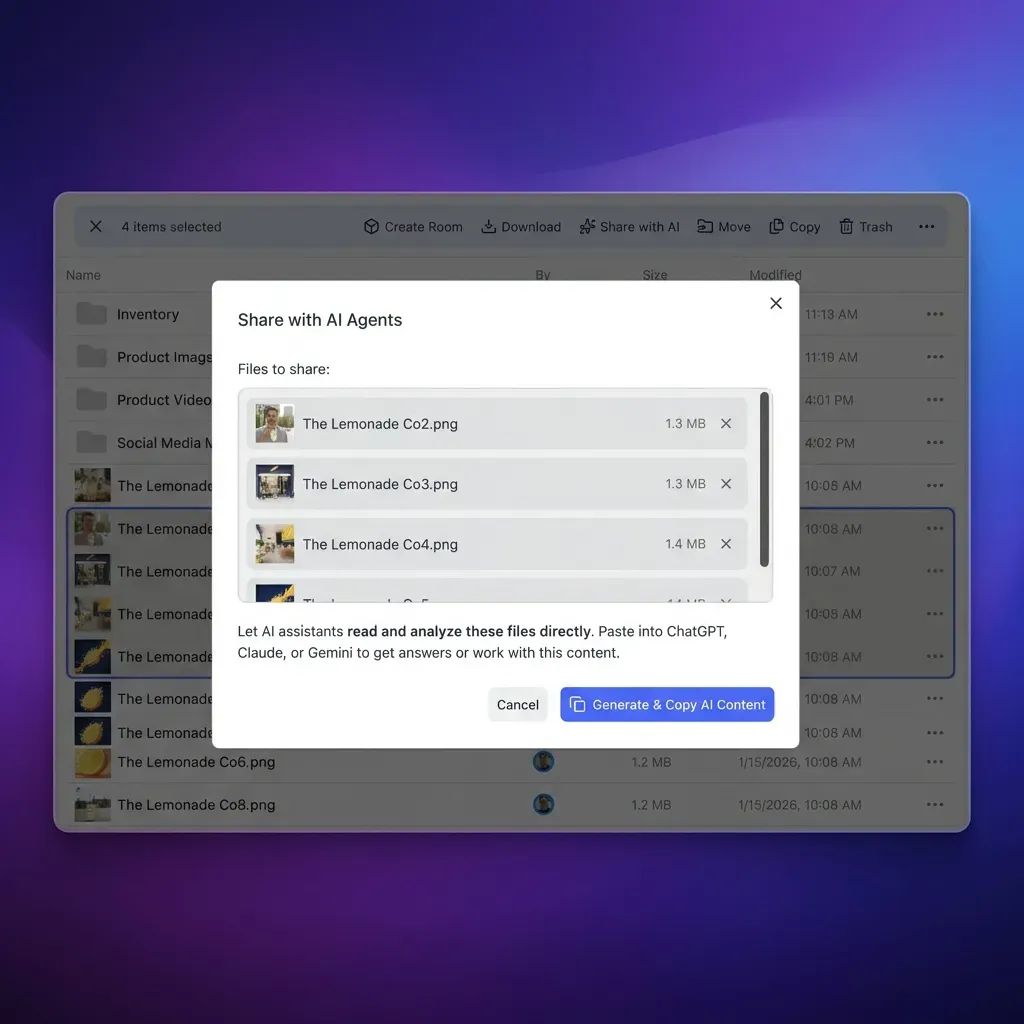
5. SQL Server MCP (MCPQL)
For organizations standardized on the Microsoft stack, MCPQL provides a dedicated bridge to MS SQL Server. It handles the specific T-SQL syntax nuances that generic SQL agents might miss. This server works well for internal corporate agents that need to access legacy data or works alongside .NET based business applications. It supports safe, read-only modes to ensure agents can analyze data without risking accidental deletions. Consider how this fits into your broader workflow and what matters most for your team. The right choice depends on your specific requirements: file types, team size, security needs, and how you collaborate with external partners. Testing with a free account is the fast way to know if a tool works for you.
Security Best Practices for Data MCP
Granting an AI agent access to your database is a significant security responsibility. To protect your sensitive data while still enabling the benefits of automation, follow these core security principles:
Implement the Principle of Least Privilege
Never connect an MCP server to your database using a 'superuser' or 'admin' account. Create a dedicated database user for the AI agent and grant it only the minimum permissions required. For most analysis tasks, SELECT permissions on specific tables are all the agent needs. If the agent needs to store results, give it its own schema or database where it has CREATE and INSERT rights, isolated from production tables.
Enable Query Guardrails LLMs can sometimes generate inefficient SQL that could potentially lock tables or consume excessive CPU. Most production MCP servers allow you to set guardrails, such as:
- Row Limits: Automatically append a limit to every query.
- Timeout Settings: Kill any query that takes longer than a few seconds.
- Forbidden Keywords: Block dangerous commands like
DROP,TRUNCATE, orGRANT.
Use Human-in-the-Loop for Write Operations If your workflow requires the agent to modify data (e.g., updating a customer record based on an email), always require a human to review the proposed change before the MCP server executes the write command. This prevents unintended data corruption or unauthorized changes driven by prompt injection or logic errors.
Monitor and Audit Everything Every tool call made by an agent should be logged. By reviewing these logs, you can verify that the agent is staying within its intended scope and identify any "probing" behavior that might indicate a security risk.
How to Choose the Right Server
Picking the right MCP server depends on your data volume, your existing tech stack, and your specific security requirements. * Start with SQLite if you are in the experimentation phase or working with single files like CSVs or small Excel sheets. It is fast, requires zero server infrastructure, and is safe in a local environment. * Graduate to PostgreSQL if you need to query live production data or work with a multi-user enterprise data warehouse. Remember to always use a read-only user and implement row limits to protect your database performance. * Use Pandas when your task moves beyond simple retrieval and into data science. If you need to "clean" messy data or generate professional charts, the Pandas MCP server is necessary. * Add Fastio to every stack. Regardless of which database you use, your agents need a place to save their work, share reports with humans, and maintain long-term context. Fastio acts as the "connective tissue" that turns a one-off query into a persistent asset.
Sources
References used to verify factual claims in this guide.
-
MCP adoption grew over 300% in Q4 of 2024, driven by data engineering and business intelligence use cases.
-
Large CSV file too large paste into prompt agent SQLite MCP server create temporary table import CSV aggregations GROUP BY JOIN impossible text alone.
-
Row Limits configure MCP server automatically append LIMIT 100 queries prevent large data dumps agent context window.
-
Fastio MCP server gives agents a consolidated MCP toolset for managing files and data.
-
Agent upload 100-page PDF annual report large dataset Fastio indexes once Intelligence is enabled.
-
Timeout Settings kill query longer than 5 or 10 seconds.
-
Fastio MCP server compatible any model supports Model Context Protocol Claude 3.5 GPT-4o Gemini 1.5.
-
Fastio Business Trial provides workspaces and access to a consolidated MCP toolset.
Frequently Asked Questions
What is an MCP server for data analysis?
An MCP server for data analysis is a secure bridge that allows AI agents to connect to databases (like SQL or Postgres) or data processing tools (like Pandas). It translates the agent's natural language intent into executable queries or code, enabling safe, structured, and reproducible data interaction.
Can I use the SQLite MCP server for production?
SQLite is excellent for local analysis, prototyping, and handling moderate datasets. However, for high-concurrency production environments or massive data warehousing where multiple agents or users are querying the same data simultaneously, a PostgreSQL or dedicated data warehouse MCP server is recommended.
How does Fastio works alongside data MCP servers?
Fastio acts as the persistent file system for your agents. While a Postgres MCP server runs the query, the agent uses Fastio to save the resulting CSV report or generated chart. Fastio also provides built-in RAG via Intelligence Mode for searching through unstructured documents related to your structured data.
Is it safe to let an AI agent write SQL?
It is safe if you implement the right guardrails. Use a read-only database user, set strict timeouts on query execution, and never allow the agent to run destructive commands like DROP or DELETE without human approval. MCP servers provide the abstraction layer needed to enforce these rules.
Does the Fastio MCP server work with any LLM?
Yes. The Fastio MCP server is compatible with any model that supports the Model Context Protocol, including Claude 3.5, GPT-4o, and Gemini 1.5. You can also use it with local models via tools like Ollama or LM Studio.
How does the Fastio Business Trial work?
Fastio offers a 14-day Business Trial requiring a credit card, providing agents with persistent workspaces, usage-based credits, and a consolidated MCP toolset.
Related Resources

Give Your AI Agents Persistent Storage
Stop losing analysis when the chat window closes. Fastio lets agents save reports, share charts, and index files with generous storage.