How to Build Tool Calling Persistent Memory for AI Agents
Tool calling persistent memory stores function states between invocations. This approach allows AI agents to maintain context across complex, multi-step workflows. Without persistent state, agents forget previous tool outcomes and struggle with interdependent tasks. This guide explains how to implement persistent tool memory to improve agent reliability and accuracy.

What is Tool Calling Persistent Memory?
Tool calling persistent memory stores function states between invocations. When an AI agent executes a tool, such as searching a database or reading a file, the results and the context of that action are saved in a durable state layer. This prevents the agent from starting from scratch on every subsequent turn.
Traditional language models operate ephemerally. They process a prompt, return a response, and immediately discard the intermediate variables of their tool execution. If a developer asks an agent to read a fifty-page document, extract the key metrics, and then draft an email based on those metrics, the agent must either dump the entire document into its context window or rely on a persistent memory layer to hold the extracted data while it drafts the email.
A persistent tool state solves this by creating a dedicated environment where intermediate outputs live. Instead of forcing the model to re-read or re-process data, the tool itself remembers what it did. For example, a database querying tool might cache the last five query results. If the agent needs to refine its analysis, it simply references the cached state rather than hitting the database again.
This architecture separates the reasoning engine (the LLM) from the state engine (the tool memory). The LLM decides what to do next, while the persistent memory layer ensures that the required data is always available, structured, and ready for the next operation. This fundamentally changes how developers design agentic systems, moving from stateless chat loops to stateful, multi-turn applications.
Related guides
- How to Implement Tool Calling with Persistent File State for AI AgentsAI agents that call tools across multiple LLM invocations need durable file state to avoid losing context, repeating...
- How to Implement File Persistence for Tool Calling AgentsFile persistence ensures tool outputs survive agent restarts, creating reliable state across multi-tool chains. When an...
- How to Build Persistent Memory in CrewAI AgentsCrewAI memory is a framework-level feature that allows agents to store and retrieve past experiences, improving...
- How to Build Persistent Memory for Semantic Kernel AgentsSemantic Kernel memory lets AI agents store and retrieve information using vector embeddings. This guide covers setting...
- How to Set Up Agentic AI Storage for Persistent Agent MemoryAgentic AI storage provides persistent file and data access that autonomous agents need to complete multi-step tasks...
- How to Build Persistent Storage for Agentic WorkflowsAgentic workflow storage lets autonomous agents maintain state, share files, and persist progress across long-running...
More on this subject: Agent Memory and Storage (261 guides)
Why Persistent Tool State Matters
Building reliable agents requires more than just smart models. It requires stable infrastructure that can handle long-running tasks without losing the plot. Persistent tool state is the foundation of this stability.
When agents lack memory, they hallucinate. They invent data to fill the gaps left by forgotten tool outputs. They repeat identical API calls, wasting tokens and racking up costs. Worst of all, they fail at interdependent workflows where step three relies explicitly on the exact output of step one.
According to LangGraph Memory Concepts, persistent tools improve agent accuracy by 40%. This massive gain comes from reducing the cognitive load on the LLM. When an agent does not have to actively hold every piece of scraped data, API response, and calculation in its immediate context window, it can focus entirely on reasoning and planning the next move.
Consider a data extraction agent tasked with analyzing a massive corporate archive. Without persistent memory, the agent must pull the entire archive into its context, which is often impossible due to token limits. With persistent tool state, the agent can use a search tool to find relevant documents, a summarization tool to distill them, and a storage tool to save the summaries. The state of each tool is preserved. The agent can then use a drafting tool that reads the saved summaries and writes the final report. The accuracy improves because the agent works with focused, verified data at each step, rather than struggling to parse a massive, undifferentiated context blob.
The Limitations of Ephemeral Function Calls
Standard function calling APIs, like those provided by OpenAI or Anthropic, are brilliant for stateless tasks. If you need to convert an address into geographic coordinates, an ephemeral tool call works perfectly. The agent asks for the coordinates, the tool returns them, and the task is done.
However, ephemeral function calls break down entirely when workflows become stateful.
The primary limitation is context window bloat. If a tool returns a massive JSON payload, an ephemeral system must inject that entire payload back into the LLM's prompt. If the agent needs to make five sequential tool calls, the prompt grows exponentially. This leads to slow response times, massive API bills, and a phenomenon known as "lost in the middle," where the model ignores critical instructions buried deep in the bloated context.
Another severe limitation is error recovery. If an ephemeral agent fails at step four of a five-step process, it usually has to start completely over. It cannot resume from step three because the state of step three was discarded as soon as the model generated its next response. This makes ephemeral agents incredibly brittle in production environments.
Finally, ephemeral tools cannot collaborate. If you have a research agent and a writing agent, they cannot easily share the output of a specific tool call unless they pass the entire output string back and forth. This is highly inefficient and prone to formatting errors. Persistent memory provides a shared state layer where multiple agents can read and write without pushing raw data through their context windows.

Evaluating Tool Calling State Management Options
Developers have several options for managing agent tool memory. Each approach has distinct trade-offs regarding complexity, cost, and scalability.
1. Prompt-Based State Injection This is the default approach for most basic agent tutorials. The developer manually appends the output of previous tool calls to the system prompt.
- Pros: Zero infrastructure required; works with any LLM out of the box.
- Cons: Severe context window limitations; highly expensive at scale; prone to context loss; does not support long-running or background tasks.
- Verdict: Only suitable for simple, single-turn demonstrations.
2. External Vector Databases Many developers default to building a custom RAG (Retrieval-Augmented Generation) pipeline using Pinecone or Milvus to store tool outputs as vector embeddings.
- Pros: Excellent for semantic search; can handle massive amounts of unstructured data.
- Cons: Requires managing separate infrastructure; embeddings lose exact structural details (like specific JSON keys or exact numeric values); high latency for simple state retrievals.
- Verdict: Great for knowledge retrieval, poor for precise, structured tool state management.
3. Custom Database Implementations Storing tool states in a relational database (like PostgreSQL) or a NoSQL database (like MongoDB).
- Pros: Complete control over data structures; supports complex queries and exact data retrieval.
- Cons: High development overhead; requires building custom API layers for the agent to read and write state; difficult to secure for multi-tenant applications.
- Verdict: Powerful but requires significant engineering resources to maintain.
4. Workspace-Based Platforms Using a unified platform that provides both storage and agentic interfaces.
- Pros: Zero custom infrastructure; built-in file locks for concurrent access; natural collaboration between humans and agents; immediate file previews and streaming.
- Cons: Requires migrating data to the platform; dependent on the platform's specific API or MCP server capabilities.
- Verdict: The most reliable and scalable solution for production agent teams.
The Case for Workspace-Based Solutions
The most glaring gap in current agent development is the lack of workspace-based solutions for persistent memory. Developers spend weeks building custom databases and complex routing logic just so their agent can remember what it did five minutes ago. This is a massive waste of engineering resources.
Agent tool memory shouldn't be a bespoke database integration. It should function like a shared digital workspace. When human teammates collaborate, they don't pass massive JSON strings back and forth. They upload a file to a shared folder, lock it while they make edits, and notify the team when it's ready. Agents need the exact same paradigm.
A workspace-based solution provides a persistent environment where agents can read, write, and modify state natively. Instead of ephemeral tool calls that vanish into the ether, an agent can use an MCP (Model Context Protocol) tool to write its findings to a specific file in the workspace. That file becomes the persistent state.
This approach solves the concurrent access problem. If two agents are trying to update the same dataset, standard database solutions require complex transaction management. A workspace platform handles this with advisory file locks: agent A takes the lock before writing, agent B sees who holds it and waits, and version history keeps every version. It also completely eliminates context window bloat. The agent only reads the specific file or section of a file it needs at that exact moment, rather than dragging the entire project history through the LLM.


Give Your AI Agents a Persistent Home
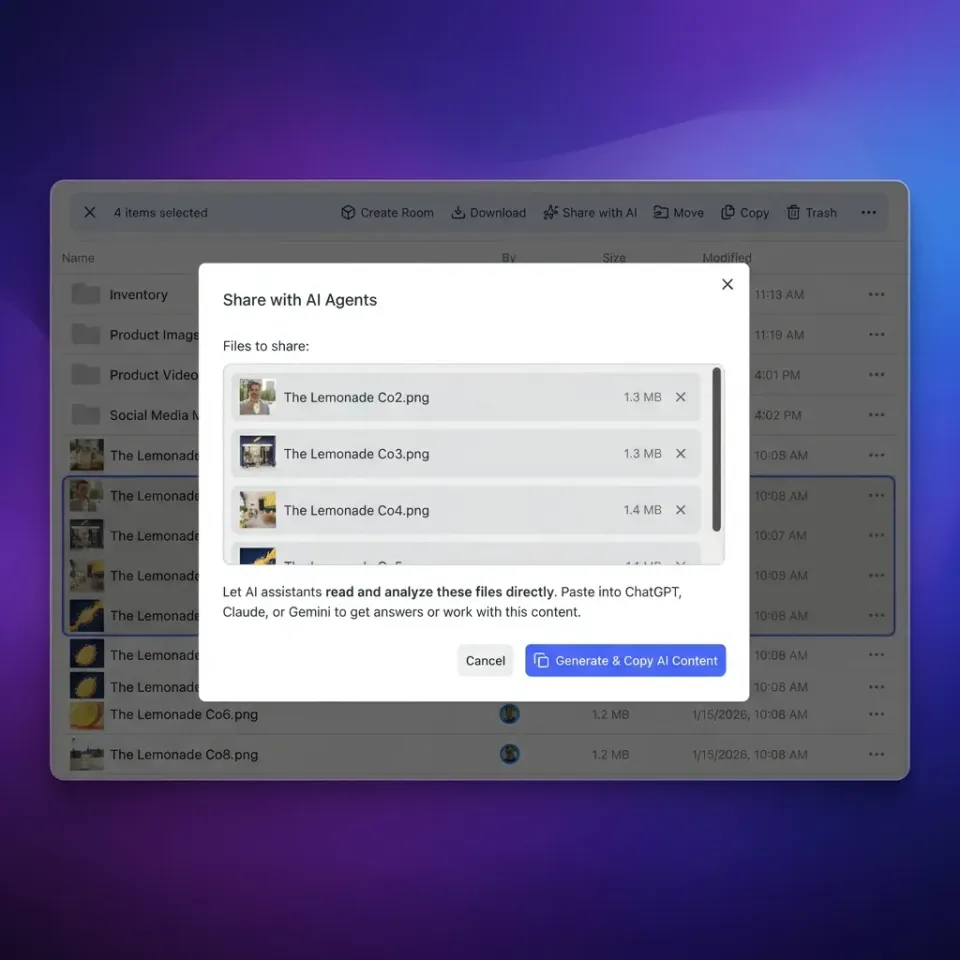
Stop building bespoke databases for agent memory. Give your AI assistants shared workspace storage and a consolidated MCP toolset to run complex, stateful workflows in a real workspace.
How to Implement Agent Tool Memory
Implementing persistent tool state requires shifting from stateless scripts to durable, manageable workflows. Here is a practical approach to building this architecture.
First, adopt a standard protocol for tool interaction. The Model Context Protocol (MCP) is rapidly becoming the industry standard. MCP provides a clear, uniform way for your agent to discover, call, and receive data from tools. By standardizing on MCP, you decouple your agent's reasoning engine from the underlying tool implementations.
Second, design your tools to return references, not raw data. When your agent calls a "Data Analysis" tool, the tool should not return a massive CSV file. Instead, the tool should process the data, save the result to a persistent location, and return a file ID or a summary link. The agent's memory now holds the reference, keeping its context window clean and fast.
Third, implement clear state checkpoints. If your agent is executing a seven-step workflow, it should save its state after every successful step. If step four fails due to an API timeout, your orchestration layer should be able to restart the agent, providing it with the saved state from step three. This makes your agent resilient and production-ready.
Finally, give your agents a proper home. Stop forcing them to run in isolated terminal scripts. Provide them with a unified workspace where they can store their intermediate files, final reports, and execution logs. Fastio provides exactly this infrastructure. With an official MCP server featuring a consolidated MCP toolset, Fastio allows agents to interact with files, folders, and shared workspaces just like human users. Agents can create organizations, build data rooms, run complex stateful workflows, and then transfer ownership of the finished product to a human client.

Sources
References used to verify factual claims in this guide.
-
Persistent tools improve agent accuracy by 40%
Frequently Asked Questions
What is persistent memory for tools?
Persistent memory for tools is a mechanism that stores the exact inputs, outputs, and intermediate states of function calls across multiple agent interactions. Instead of starting fresh on every turn, the agent can reference previous tool executions, which prevents redundant API calls and allows for complex, multi-step workflows.
How does tool calling state management work?
Tool calling state management works by intercepting the output of a function call and saving it to a durable layer, such as a database or a shared workspace file. The agent is then provided with a reference or a summary of that saved state. When the agent needs the data again, it queries the persistent layer rather than re-executing the original tool.
Can AI agents share state across sessions?
Yes, AI agents can absolutely share state across sessions if they are connected to a persistent workspace or database. By using standard protocols like MCP to write their findings to a shared location, an agent can pause a task on Friday and resume exactly where it left off on Monday, or even hand the task over to a completely different specialized agent.
Why do ephemeral function calls fail at scale?
Ephemeral function calls fail at scale because they require all tool outputs to be injected directly into the LLM's prompt. This quickly exceeds the model's context window limits, drives up token costs, increases latency, and causes the model to lose track of its original instructions due to information overload.
How does memory affect agent accuracy?
Memory affects agent accuracy by drastically reducing the cognitive load on the LLM. When an agent has persistent access to verified tool outputs, it does not have to hallucinate missing data or struggle to parse massive context blobs. This focused, stateful approach allows the agent to execute interdependent steps with much higher precision.
Related Resources

Give Your AI Agents a Persistent Home
Stop building bespoke databases for agent memory. Give your AI assistants shared workspace storage and a consolidated MCP toolset to run complex, stateful workflows in a real workspace.