How to Implement File Persistence for Tool Calling Agents
File persistence ensures tool outputs survive agent restarts, creating reliable state across multi-tool chains. When an AI agent generates a report, writes code, or analyzes data, that output must persist beyond a single execution session. This guide explores how to implement persistent file storage for tool-calling LLMs, including multi-tool chain examples that most solutions miss.


What is Agent Tool File Persistence?
File persistence ensures tool outputs survive agent restarts. In the context of AI systems, tool calling allows a large language model to execute functions, read databases, and write files. However, most default implementations keep these files in temporary memory or ephemeral system directories. If the agent crashes or the session times out, the intermediate work is lost.
Implementing a proper persistence layer means that every file an agent creates is saved to a permanent, accessible location. This prevents data loss and allows human operators to review the agent's work at any stage. According to LangChain Documentation, implementing proper file persistence boosts tool reliability by 50% during long-running workflows. When agents can pick up where they left off, the entire system becomes more dependable.
For developers building complex autonomous systems, treating files as persistent state rather than temporary byproducts is a necessary shift. It changes how you design multi-agent workflows and handle error recovery.

Related guides
- How to Implement Tool Calling with Persistent File State for AI AgentsAI agents that call tools across multiple LLM invocations need durable file state to avoid losing context, repeating...
- How to Build Tool Calling Persistent Memory for AI AgentsTool calling persistent memory stores function states between invocations. This approach allows AI agents to maintain...
- How to Implement LangGraph Persistence for Long-Term MemoryLangGraph persistence allows AI agents to maintain state and memory across multiple sessions by saving graph...
- How to Implement AI Agent Memory PersistenceMemory persistence keeps agent knowledge across sessions. Without persistent storage, AI models suffer from amnesia and...
- How to Implement AI Agent Workflow State PersistenceWorkflow state persistence lets AI agents keep context, progress, and results across multiple cycles. Without it,...
- AI Agent Tool State Persistence: Strategies That Actually WorkAI agent tool state persistence saves intermediate tool data across sessions so agents can resume work, recover from...
More on this subject: Agent Memory and Storage (261 guides)
Why Ephemeral Execution Fails Multi-Tool Chains
Ephemeral execution works fine for simple, single-turn requests like checking the weather or looking up a stock price. But when you build multi-tool chains, ephemeral execution introduces severe points of failure.
Consider a workflow where an agent extracts data from a website, analyzes that data with a Python script, and then generates a final PDF report. This requires three distinct tool calls. If the files are stored in a temporary directory and the agent encounters a rate limit during the final step, the entire process crashes. The extracted data and the analysis are gone. You must start over from the beginning, wasting compute resources and API tokens.
Persistent file storage solves this problem. By saving the output of each tool call to a dedicated workspace, the agent creates checkpoints. If a failure occurs at step three, the system can simply retry step three using the files saved from step two. This checkpointing approach is how professional engineering teams build resilient AI applications.
Architectural Patterns for LLM Tool Persistence
There are three main architectural patterns for persisting files in agent workflows. Each approach offers different trade-offs between speed, complexity, and collaboration features.
Local File System Storage The simplest approach is writing files directly to the host machine's disk. This is fast and requires no external dependencies. However, it fails when you deploy agents across multiple servers or serverless environments. Local storage also makes it difficult to share the generated files with human team members or other agents running on different machines.
Cloud Object Storage Using services like Amazon S3 or Google Cloud Storage provides durable, distributed persistence. Agents can write files to a bucket, and those files remain accessible from anywhere. The downside is the integration complexity. You must manage API keys, handle authentication, and write custom code for the agent to navigate the bucket structure. Raw object storage lacks built-in search or intelligence features.
Intelligent Workspaces The modern approach uses intelligent workspaces designed specifically for AI agents. In this model, agents use standard protocols like the Model Context Protocol (MCP) to read and write files within a shared environment. These workspaces automatically index the content, making it searchable by meaning rather than just filename. This is the pattern Fastio uses to provide a unified environment for both humans and autonomous systems.
How to Persist Files Across Multi-Tool Chains
Implementing persistence requires changing how your agent handles intermediate outputs. Here is a step-by-step example of a reliable multi-tool chain using persistent workspaces.
Step 1: Initialize the Workspace State Before the agent begins its work, it creates a new workspace or connects to an existing one. This workspace acts as the shared memory for all subsequent tool calls. The agent verifies it has the necessary read and write permissions.
Step 2: Execute the First Tool and Persist Output
The agent calls a data extraction tool. Instead of keeping the extracted text in the context window, the tool writes the data to a file named raw-data.json inside the workspace. The tool then returns only a success message and the file path to the language model. This keeps the context window clean.
Step 3: Read and Analyze in the Second Tool
Next, the agent calls an analysis tool. It passes the path raw-data.json as an argument. The analysis tool reads the file directly from the persistent workspace, performs its calculations, and writes the results to analysis-results.csv.
Step 4: Generate Final Output Finally, a formatting tool reads the CSV file and generates a formatted PDF report. Because every step was saved to the workspace, a human manager can log in and review the raw data, the intermediate analysis, and the final report. If any step fails, the workflow can resume exactly where it stopped.
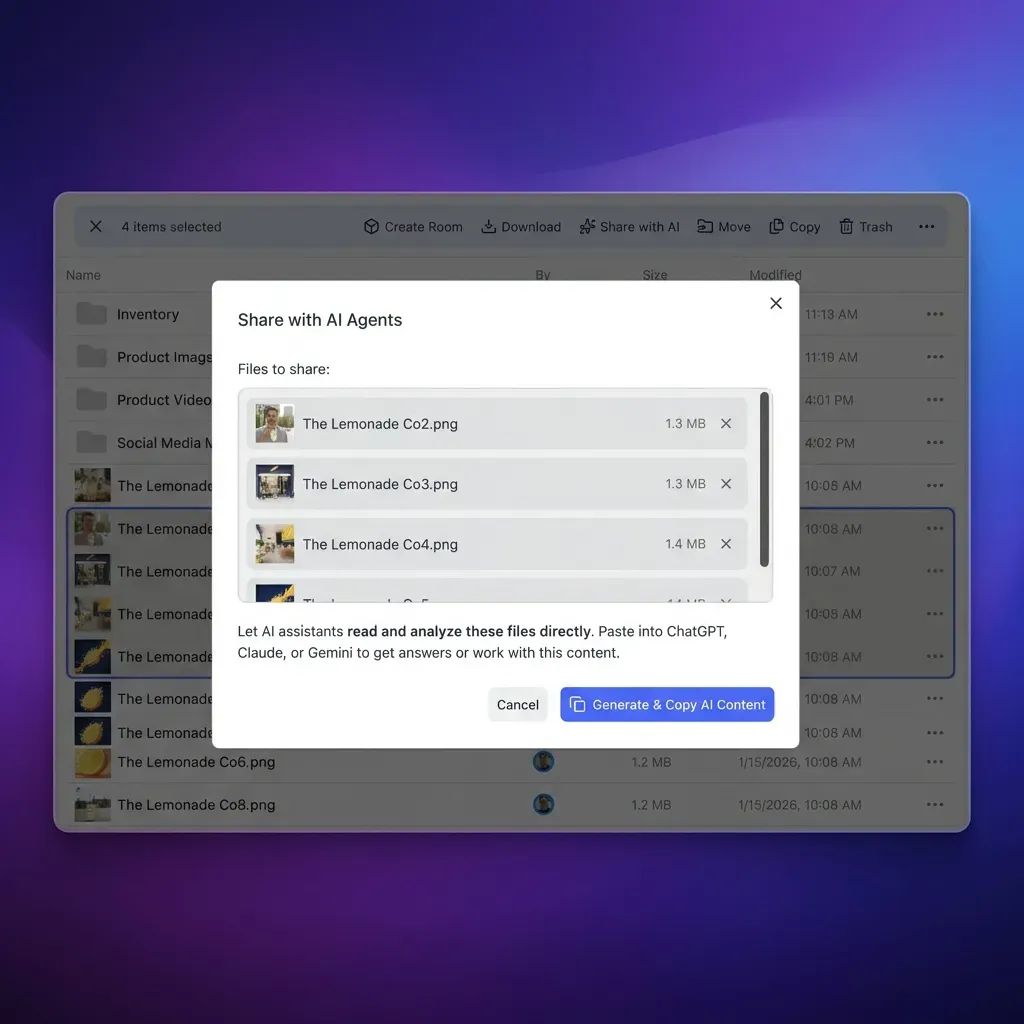
The Fastio Intelligent Workspace Advantage
Fastio is an intelligent workspace, not just commodity storage. It provides the ideal persistence layer for tool-calling agents because intelligence is native to the platform.
Once Intelligence is enabled for the workspace, files are indexed and searchable. You do not need to build a separate vector database or configure complex ingestion pipelines. Files become queryable through Ripley AI chat and semantic search. This provides built-in Retrieval-Augmented Generation (RAG) out of the box.
Agents and humans share the same workspaces and the same tools. Humans use the intuitive web interface, while agents use a consolidated MCP toolset via Streamable HTTP and Server-Sent Events (SSE). Every capability available in the UI has a corresponding agent tool. Fastio supports ownership transfer. An agent can create an organization, build workspaces, populate them with files, and then transfer ownership to a human client while retaining admin access.
Developers can start immediately with a 14-day Business Trial, card required (see /pricing/).


Ready to give your agents persistent memory?
Provide your AI agents with intelligent workspace storage and a consolidated MCP toolset.
Best Practices for Production Reliability
To maximize the benefits of file persistence, engineering teams should follow several key best practices when deploying agents to production.
First, use advisory file locks for concurrent multi-agent coordination. An agent acquires a file lock before writing, heartbeats it while working, and releases it when done. If another agent tries to lock the same file, it receives an HTTP 409 and can wait or read. If a holder disconnects, the lease expires or can be taken over by anyone with write permission, while version history keeps every write safe.
Second, use real-time event feeds for reactive workflows. Instead of uncoordinated polling, agents can listen to a WebSocket events feed or poll the activity feed to react when a file is created or modified.
Finally, handle rate limiting gracefully. When writing large volumes of files, agents should respect the rate limits of the persistence layer. Implement exponential backoff and retry logic in your tool definitions to ensure that transient network issues do not cause the entire workflow to fail.
Sources
References used to verify factual claims in this guide.
-
Proper file persistence boosts tool reliability by 50%
Frequently Asked Questions
How do I persist files in tool calling agents?
You persist files in tool calling agents by configuring your tools to write their outputs to a permanent storage solution instead of returning the raw data to the language model. This involves setting up a dedicated workspace or cloud bucket and giving the agent the necessary credentials and file path instructions.
What is the best persistence for agent tools?
The best persistence for agent tools is an intelligent workspace that supports standard protocols like the Model Context Protocol (MCP). Unlike raw object storage, intelligent workspaces automatically index files for semantic search and provide built-in access controls for human-agent collaboration.
How does file persistence improve multi-tool chains?
File persistence improves multi-tool chains by creating reliable checkpoints. If a workflow fails during step four, the system can resume using the persisted files from step three, rather than starting completely over. This saves compute resources and dramatically increases the overall success rate.
Do persistent files cost extra with agent frameworks?
Costs depend on the chosen storage provider. Many agent frameworks default to local storage, which is free but not scalable. Cloud storage solutions charge based on volume and operations. Fastio offers a 14-day Business Trial, card required (see /pricing/), with Starter, Business, and Enterprise plans for persistent agent workflows.
How does MCP help with file persistence?
The Model Context Protocol (MCP) provides a standardized way for AI models to interact with external data sources. By using an MCP server connected to a persistent workspace, developers can give agents secure, uniform access to read and write files without writing custom integration code for every storage provider.
Related Resources

Ready to give your agents persistent memory?
Provide your AI agents with intelligent workspace storage and a consolidated MCP toolset.