How to Secure MCP File Access for AI Agents
Secure MCP file access enforces role-based permissions on tool calls and file reads so AI agents only touch what they should. This guide covers the real security risks of unrestricted MCP access, how to lock down agent permissions at every level, and practical patterns for concurrency control, audit trails, and scoped authentication in production agent workflows.


Why MCP File Access Needs Its Own Security Model
The Model Context Protocol gives AI agents direct access to tools that read, write, and manage files. That access is powerful, but it creates risks that traditional file-sharing permissions weren't designed to handle.
A human user clicks through a UI, reads confirmation dialogs, and makes deliberate choices about which files to open. An agent operating through MCP tools can issue dozens of file operations per second, traverse directory structures automatically, and chain tool calls without human review. When something goes wrong, the blast radius is larger and faster than a misclick.
The core problem is scope. Most MCP server deployments start with broad access because it's easier to get an agent working when it can reach everything. Security researchers at the Coalition for Secure AI have identified this pattern as the primary attack surface: agents with overly permissive tool access that expose data they were never meant to touch. Prompt injection attacks can exploit this gap. A malicious prompt embedded in a document could instruct an agent to read sensitive files and exfiltrate data through a legitimately authorized tool call.
The fix isn't to restrict agents so heavily they can't function. It's to apply the same principle that works in human IAM systems: least privilege, scoped credentials, and audit trails. The difference is that agent workflows need these controls enforced at the MCP tool level, not just the filesystem level.
Related guides
- How to Give Agents Direct File Access with MCP FilesystemThe MCP Filesystem server provides a standardized way for AI agents to read, write, and list files within allowed...
- How to Implement MCP Server Rate LimitingMCP server rate limiting controls how often AI agents can invoke tools through a Model Context Protocol server. Without...
- How to Set Up an MCP Server Proxy for Production AI AgentsMCP servers work fine over localhost during development, but production deployments need TLS termination,...
- How to Validate MCP Tool Inputs: Best Practices for Reliable AgentsGuide to validating mcp tool inputs: Input validation prevents AI agents from crashing or performing unsafe actions....
- How to Add OAuth Authentication to Your MCP ServerIf you're running a remote MCP server over HTTP, OAuth authentication isn't optional. The MCP specification (revised...
- How to Set Up MCP Server AuthenticationMCP server authentication is the process of verifying the identity of AI agents and applications connecting to a Model...
More on this subject: MCP and Model Context Protocol (244 guides)
What to check before scaling secure mcp file access
Effective MCP security operates at four distinct layers. Skip any one of them and you leave a gap that agents (or attackers exploiting agents) can walk through.
Authentication: proving identity
Every agent connecting to an MCP server needs a verified identity. The MCP specification recommends OAuth 2.1 with PKCE for remote servers. This means agents authenticate through a browser-based flow where a human approves access, and the agent receives a scoped token rather than a password or static key.
For programmatic access, API keys work but carry more risk. A leaked API key grants access until someone revokes it. Short-lived OAuth tokens expire automatically.
Authorization: limiting what the identity can do
Authentication tells the server who is connecting. Authorization controls what that identity can access. This is where role-based access control (RBAC) comes in.
Assign agents the narrowest role that lets them complete their task. A reporting agent that only reads data should never have write access. An agent that processes files in one workspace shouldn't see files in another.
Scope: restricting the boundary
Even within an authorized role, scope limits which resources are visible. An agent scoped to a single workspace can't access files in other workspaces, even if its role would normally allow it. Scoping is the defense against lateral movement: if an agent is compromised, the damage stays contained.
Audit: recording what happened
Every tool call, file read, upload, and permission change should generate a log entry. Audit trails serve two purposes: real-time detection of anomalous behavior and post-incident forensics. Without them, you can't tell what an agent actually did.
Setting Up Scoped Agent Access on Fastio
Fastio's MCP server provides a consolidated MCP toolset covering storage, sharing, and the AI layer. Each tool call respects the agent's authenticated scope and role, so permissions are enforced at the platform level rather than relying on the agent to police itself. See the Fastio MCP server integration guide for developers for the full client setup across PKCE and API-key auth.
Granular permission levels
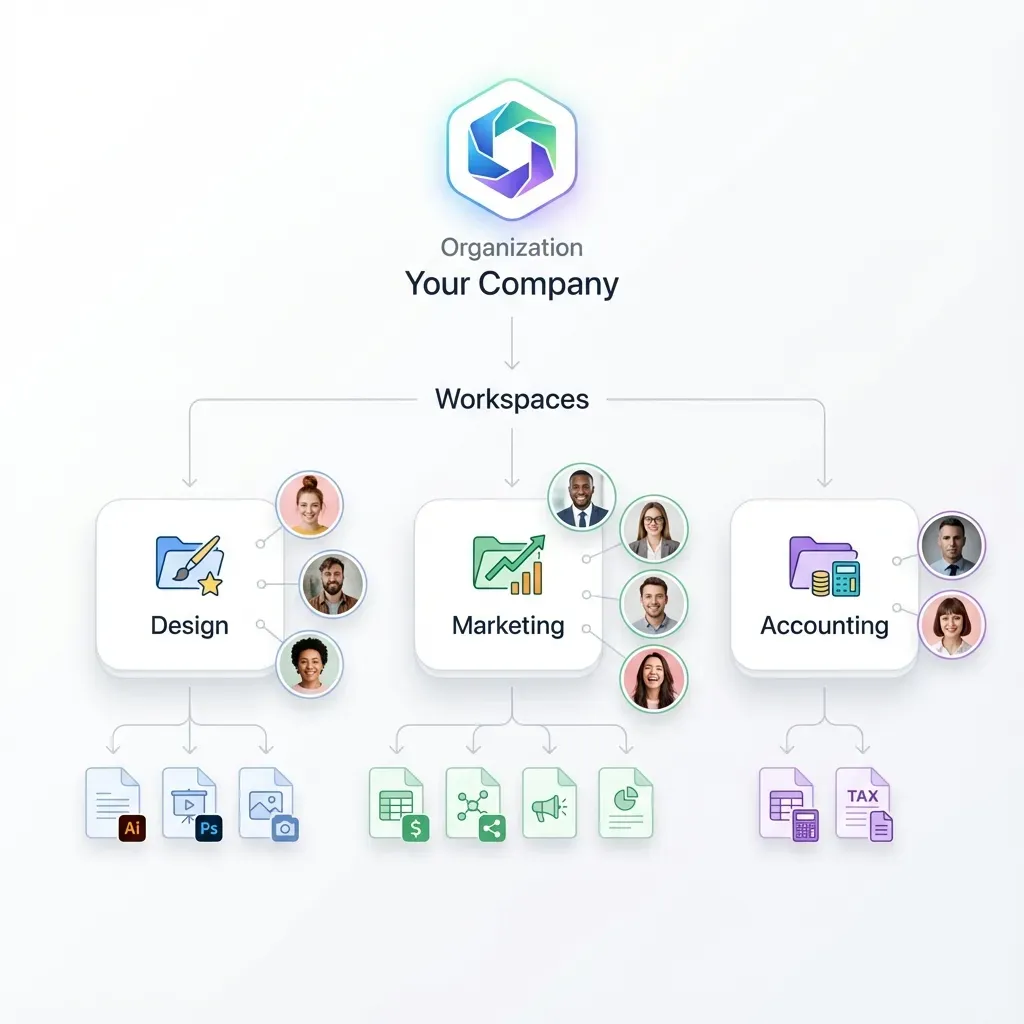
Fastio enforces permissions at four levels: organization, workspace, folder, and file. An agent invited to a workspace as a member can read and write files within it but can't change workspace settings, manage billing, or access other workspaces in the organization. Folder-level and file-level permissions let you restrict access further when agents only need specific assets.
PKCE authentication for agents
The recommended authentication path for interactive agents is PKCE login. The agent initiates an OAuth flow, a human approves access to a specific workspace or organization in their browser, and the agent receives a session scoped to that boundary. The agent never sees the human's password, and the session scope prevents the agent from accessing resources outside what was approved.
API keys for automated workflows
For agents running without human interaction, Fastio supports scoped API keys. A human creates the key in the Fastio UI, sets its scope (which organizations or workspaces the key can access), and provides it to the agent. Best practice: create one key per agent, set an expiration, and rotate regularly.
Workspace sandboxing
When an agent creates or joins a workspace, it operates within that sandbox. The agent can see files, shares, and members within the workspace but has no visibility into other workspaces or organizational resources it hasn't been explicitly granted access to. This is a natural containment boundary that limits the impact of prompt injection or misconfiguration.
For a deeper look at RBAC patterns, see the AI agent RBAC file permissions guide.



Lock Down Your Agent File Access
Fastio gives every agent generous storage with granular permissions, audit trails, and an MCP server built for secure multi-agent workflows. Built for secure mcp file access workflows.
Coordinating Concurrent Writes in Multi-Agent Systems
When two or more agents work on the same files, you need a coordination mechanism beyond permissions. Permissions control who can access a file. Version history and activity visibility control what happens when two agents touch the same file at once.
The concurrency problem
Consider a workflow where Agent A analyzes a dataset and writes results to a shared report, while Agent B reads that report to generate summaries. Without coordination, Agent B might read a partially written file. Worse, both agents might try to update the same file simultaneously, and one agent's changes overwrite the other's.
Scope writes with granular permissions
Fastio enforces permissions at the organization, workspace, share, folder, and file level. Scope write access narrowly, so only the agent responsible for a given file or folder can modify it. An agent with read-only access cannot trigger a conflicting write in the first place, which prevents most concurrency problems before they start.
Full file version history as a safety net
Every file on Fastio keeps its version history. If two agents do write to the same file in a tight window, nothing is silently lost: prior versions remain available and any of them can be restored. This turns a race condition into a recoverable event instead of a corrupted file.
Activity feed and audit log
Fastio's realtime activity feed and audit log let agents and humans review recorded writes, so an agent can check recent activity on a file before writing to it instead of writing blind. Audit entries include timestamps and identity details that help investigate a conflict if one occurs.

Audit Trails and Real-Time Monitoring
Security controls are only useful if you can verify they're working. Audit trails provide the evidence layer for MCP file access, and real-time monitoring lets you catch problems before they escalate.
What gets logged
Fastio's audit trails cover file operations (uploads, downloads, reads, deletions), membership changes, comment activity, AI operations (chat queries, search requests, indexing), and billing events. Every action is tied to the identity that performed it, whether that's a human user or an agent.
Querying audit data
Through MCP tools, agents can search event logs filtered by workspace, action type, or time range. The event tools also support natural-language summaries, so you can ask "what happened in this workspace today?" and get a readable overview instead of raw log entries.
Event-driven monitoring
For real-time alerting, subscribe to the WebSocket events feed or poll the activity feed for specific events. A security-focused event filter might notify your monitoring system when:
- A file is deleted or moved outside the workspace
- A new member is added to a workspace
- An agent accesses files it hasn't touched before
- Bulk download patterns appear
The WebSocket events feed pushes event payloads to your listener as they happen, so you don't need to poll the API for changes.
Integration with existing security tools
Event payloads can feed into SIEM platforms, chat channels, or custom alerting pipelines. This lets you centralize agent activity monitoring alongside your existing infrastructure monitoring, rather than treating agent security as a separate concern.
Practical Security Patterns for Production Agents
Theory is useful, but production agent deployments need concrete patterns. Here are the approaches that hold up in real workflows.
One workspace per project, one key per agent
Don't share workspaces across unrelated projects or reuse API keys across agents. Each agent should have its own credentials scoped to the specific workspaces it needs. When you decommission an agent, revoke its key. When a project ends, archive the workspace.
Read-only agents by default
Most agent tasks only require read access. A RAG agent querying documents, a summarization agent processing reports, an analysis agent extracting metrics: none of these need write permissions. Start with read-only access and only grant write access to agents that genuinely modify files.
Ownership transfer for client deliverables
Fastio's ownership transfer feature lets an agent build a workspace, populate it with files, enable Intelligence Mode for semantic search, and then transfer the entire organization to a human. The agent retains admin access for maintenance, but the human becomes the owner. This pattern works well for client delivery workflows where agents prepare assets that humans review and distribute.
Credential rotation schedule
API keys should be rotated on a regular cadence. Monthly rotation is a reasonable starting point for most workflows. For high-security environments, weekly rotation or OAuth tokens with short expiration windows reduce the risk window if a credential is compromised.
Test in a sandbox first
Before giving an agent access to production workspaces, test its behavior in an isolated workspace with sample data. Verify that it respects permission boundaries, handles concurrent writes safely, and doesn't attempt to access resources outside its scope. Review the audit logs from the test run to confirm the agent's actual behavior matches your expectations.
Intelligence Mode with access boundaries
When Intelligence Mode is enabled on a workspace, files are indexed once Intelligence is enabled for the workspace for semantic search and AI chat. This is valuable for agents that need to query documents, but it means the agent's RAG queries can surface content from any indexed file in the workspace. Scope the workspace contents carefully: only include files the agent should be able to reference.
For more on building agent workflows with persistent storage, see the storage for agents guide or the Fastio MCP documentation.
Sources
References used to verify factual claims in this guide.
-
Primary attack surface is agents with overly permissive tool access
-
MCP specification recommends OAuth 2.1 with PKCE for remote servers
Frequently Asked Questions
How do I secure MCP file access for AI agents?
Apply the principle of least privilege at every layer. Authenticate agents with PKCE or scoped API keys, assign the narrowest role needed (read-only when possible), scope access to specific workspaces rather than entire organizations, enable audit logging, and rely on version history and the audit log to keep concurrent write operations recoverable in multi-agent workflows.
What are MCP permissions best practices?
Use scoped OAuth tokens instead of static API keys when possible. Create one credential per agent rather than sharing keys across agents. Default to read-only access and only grant write permissions to agents that modify files. Set token and key expiration dates, rotate credentials regularly, and review audit logs for unexpected access patterns.
How does Fastio prevent data corruption in multi-agent MCP workflows?
Fastio coordinates concurrent access through granular permissions, full file version history, and a detailed activity log. Scoping write access narrowly limits who can modify a given file, version history means no write is ever silently lost, and the audit log and realtime activity feed let agents check recent activity before writing. Combined, this protects against both race conditions and accidental overwrites.
Can I monitor what my AI agents are doing through MCP?
Yes. Every MCP tool call generates an audit log entry tied to the agent's identity. You can search logs by workspace, action type, or time range. For real-time monitoring, subscribe to the WebSocket events feed or poll the activity feed for specific events like file deletions, membership changes, or bulk downloads. Event payloads can feed into SIEM platforms or alerting systems.
What is the difference between PKCE and API key authentication for MCP agents?
PKCE authentication involves a browser-based OAuth flow where a human approves agent access and the agent receives a scoped, time-limited token. API keys are long-lived credentials created by a human and provided to the agent. PKCE is more secure because tokens expire automatically, but API keys are easier for fully automated agents that run without human interaction. Use PKCE when possible, API keys when automation requires it.
How does workspace sandboxing protect against prompt injection?
Workspace sandboxing limits what an agent can access regardless of what it's instructed to do. If a malicious prompt embedded in a document tells the agent to read sensitive files, the agent can only access files within its scoped workspace. The MCP server enforces this boundary at the platform level, so the agent physically cannot reach resources outside its sandbox even if it tries.
Related Resources

Lock Down Your Agent File Access
Fastio gives every agent generous storage with granular permissions, audit trails, and an MCP server built for secure multi-agent workflows. Built for secure mcp file access workflows.