How to Set Up a Secure Data Room for Confidential Transactions
A secure data room protects confidential documents during M&A deals, fundraising rounds, and legal proceedings. This guide walks through the practical steps of setting one up: choosing encryption standards, configuring permission hierarchies, enabling audit trails, and locking down access with IP restrictions and session timeouts. You will learn what separates a secure data room from a shared folder and how to avoid the access control mistakes that lead to breaches.


What Makes a Data Room Secure
A secure data room is an online repository with enterprise-grade encryption, granular access controls, and audit logging designed to protect confidential documents during sensitive business transactions. That definition separates it from generic cloud storage, where security is an afterthought bolted onto a consumer file-sharing tool.
The distinction matters because the stakes are real. When Verizon acquired Yahoo in 2017, two previously undisclosed data breaches knocked $350 million off the purchase price. According to DealRoom, 60% of companies discover cybersecurity issues only after closing an M&A deal, when the damage is already done.
Seven features separate a genuine secure data room from a shared Google Drive folder:
- AES-256 encryption at rest and TLS 1.2+ in transit
- Granular role-based access controls at the folder and file level
- Multi-factor authentication for every user
- Detailed audit trails with timestamps, IP addresses, and page-level activity
- Dynamic watermarking that stamps each viewer's identity on documents
- IP and domain allowlisting to restrict access by location
- Session timeout policies that force re-authentication after inactivity
If your current setup is missing any of these, you have a shared folder, not a data room. The rest of this guide covers how to implement each one.
Helpful references: Fastio Workspaces, Fastio Collaboration, and Fastio AI.
Related guides
- How to Set Up a Private Placement Data RoomA private placement data room is a secure virtual workspace where issuers share private placement memorandums,...
- Open Source Data Room Options for Secure Document SharingThere is no single open source tool that replicates every feature of a commercial virtual data room. But several...
- Best Data Room Software for Secure Document SharingData room software provides secure, permission-controlled workspaces for sharing confidential documents during M&A,...
- How to Set Up a Data Room for InvestorsAn investor data room is a secure online workspace where founders organize financial statements, cap tables, legal...
- How to Set Up a Debt Financing Data Room for Lender Due DiligenceA debt financing data room is a secure virtual workspace where borrowers share financial statements, credit agreements,...
- Best Virtual Data Room Providers for Every Deal TypeChoosing a virtual data room provider depends on what kind of deal you are running. This guide breaks down the top VDR...
More on this subject: Data Rooms and Due Diligence (53 guides)
What to check before scaling secure data room
AES-256 is the encryption standard you want. Established by the U.S. National Institute of Standards and Technology (NIST) under FIPS 197, it is the same algorithm used by the U.S. government for classified information. AWS, Azure, and Google Cloud all default to AES-256 for data at rest. No practical attack exists against a correctly implemented AES-256 key, even accounting for theoretical quantum computing advances.
When evaluating a data room platform, check two things:
Encryption at rest means your files are encrypted on the server's storage disks. If someone physically stole the hard drive, they would see random noise instead of your cap table.
Encryption in transit means data traveling between your browser and the server is protected by TLS 1.2 or higher. This prevents network eavesdropping during upload, download, and preview.
Some platforms advertise "military-grade encryption" without specifying the algorithm or key length. That phrase means nothing. Ask for the specific standard. If the answer is not AES-256 (or its equivalent for transit, TLS 1.2+), look elsewhere.
Traditional virtual data room (VDR) vendors like Datasite, Intralinks, and iDeals all use AES-256. Modern workspace platforms like Fastio also encrypt data at rest and in transit, giving you the same encryption foundation without the per-page pricing model that traditional VDRs charge.
Building Your Permission Hierarchy
Encryption keeps outsiders from reading your data. Permissions keep insiders from seeing what they should not. According to IBM, the average cost of a data breach reached $4.88 million in 2024, and improper access controls are among the most common root causes.
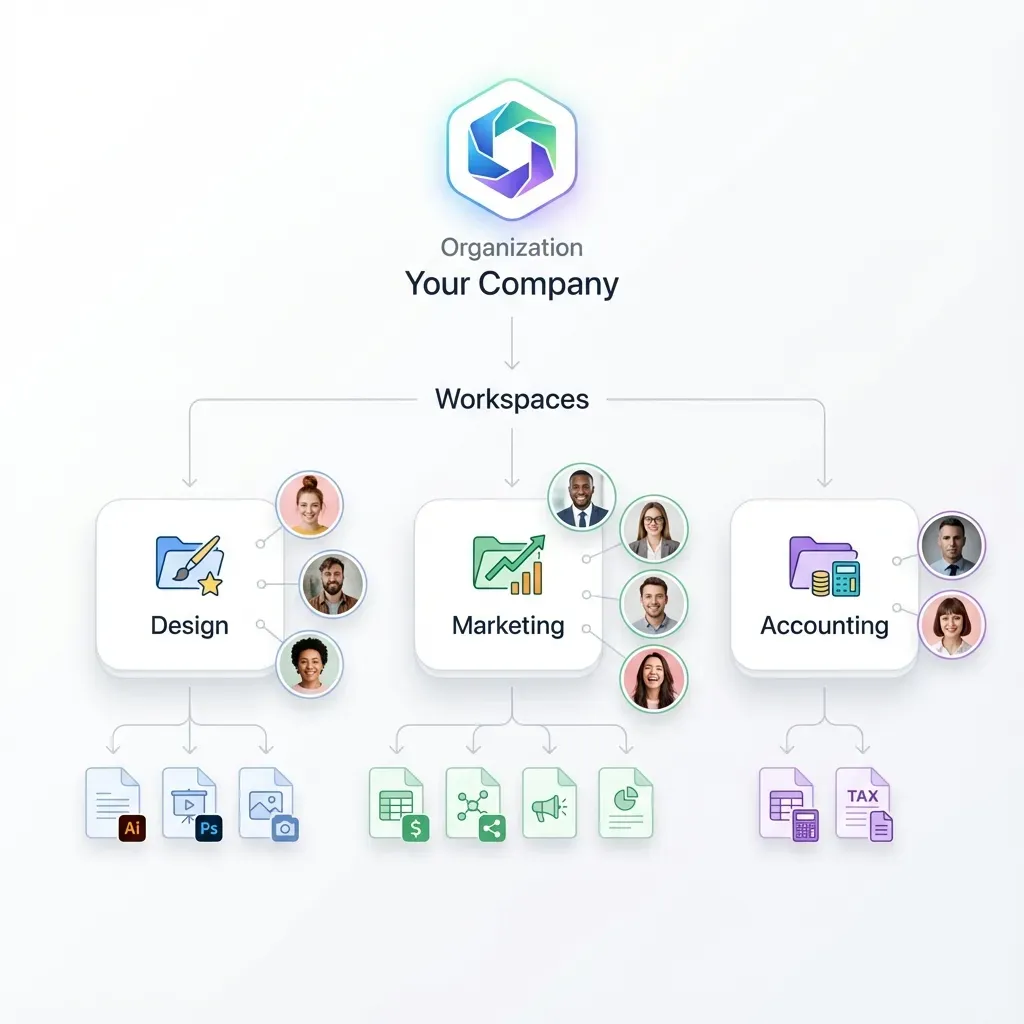
A well-designed permission hierarchy has three layers:
Organization Level
Start with roles that define what each person can do across the entire data room. Typical roles include:
- Admin: Full control over settings, users, and content
- Manager: Can upload, organize, and invite users but cannot change security settings
- Contributor: Can upload files to designated folders
- Viewer: Read-only access with no download rights
Folder Level
Within the data room, different folders hold different sensitivity levels. Your financial projections folder should have tighter access than your marketing materials folder. Set permissions per folder so that legal counsel sees the contracts directory while the technical team sees the product documentation.
File Level
For the most sensitive documents, apply permissions to individual files. A term sheet or board resolution might need access limited to three specific people, regardless of their folder-level permissions.
Fastio supports this three-tier model with granular permissions at the organization, workspace, folder, and file level. Each layer can override the one above it, so you can grant broad workspace access while restricting specific folders or files. Traditional VDR platforms like Firmex and Ansarada offer similar hierarchies, though they typically charge per-seat fees that scale with the number of external parties you invite.


Set up your secure data room in minutes
Fastio gives you encrypted workspaces with granular permissions, audit trails, and branded shares. Start with a 14-day Business Trial.
Configuring Access Controls and Session Policies
Permissions define who can see what. Access controls define where, when, and how they can see it. These are the practical settings that most setup guides skip over.
Multi-Factor Authentication
Enable MFA for every user, not just admins. A stolen password is useless without the second factor. Most platforms support authenticator apps (TOTP), and some offer hardware key support. Fastio supports two-factor authentication for sign-in and sensitive operations like API key management.
IP and Domain Allowlisting
If your deal team works from known office locations, restrict data room access to those IP ranges. This prevents a compromised account from being used at a coffee shop in another country. Set up a list of approved IP addresses or CIDR ranges, and block everything else.
For external parties like law firms or investors, you can allowlist their corporate domain or IP range rather than individual addresses. This gives them flexibility while maintaining a security boundary.
Session Timeout Policies
Set idle session timeouts between 15 and 30 minutes. When a user walks away from their laptop without logging out, the session expires automatically. For particularly sensitive rooms, consider shorter timeouts of 10 minutes.
Also configure maximum session duration. Even active sessions should require re-authentication after 8 to 12 hours. This limits the window of exposure if a session token is compromised.
Download and Print Restrictions
Not every user needs to download files. For viewers who only need to review documents, disable downloads entirely and let them use in-browser previews. Fastio's inline preview supports PDFs, images, video, audio, spreadsheets, and code files, so most document types can be reviewed without a local copy.
For users who do need downloads, consider enabling dynamic watermarking so each downloaded copy is traceable back to the specific user who downloaded it.
Setting Up Audit Trails and Monitoring
An audit trail answers the question that every deal team eventually asks: "Who looked at what, and when?"
A useful audit log captures more than just login timestamps. It should record:
- File-level activity: Who opened, downloaded, printed, or forwarded each document
- Page-level tracking: Which pages of a PDF were viewed and for how long
- Permission changes: When access was granted, modified, or revoked
- Failed access attempts: Login failures, blocked IP addresses, denied permission requests
- Search queries: What users searched for inside the data room
This level of detail serves two purposes. During an active deal, it tells you which investors or buyers are most engaged based on their document review patterns. After a deal closes (or falls apart), it provides a defensible record of who had access to what information and when.
Fastio logs events across file operations, membership changes, comments, AI activity, and billing updates. You can search and filter these events, and the platform can generate natural-language activity summaries from the raw event data. Traditional VDRs like Datasite offer similar audit granularity, with some adding heat-map style analytics that show which pages received the most attention.
Set up a weekly review cadence where someone on your team checks the audit log for anomalies: unusual access times, bulk downloads, or access from unexpected locations. Catching unusual patterns early is cheaper than discovering a leak after the deal closes.

Choosing Between a Traditional VDR and a Modern Workspace
Traditional VDR vendors like Datasite, Intralinks, iDeals, and Firmex have served the M&A market for decades. They offer purpose-built deal management features: Q&A workflows, redaction tools, and compliance certifications like enterprise security standards and security requirements.
They also come with significant costs. Per-page pricing can run $0.40 to $0.85 per page for large document sets. Per-user pricing adds up quickly when you invite dozens of external parties. Setup fees and minimum commitments are common.
Modern workspace platforms offer an alternative path. You lose some deal-specific features (structured Q&A workflows, built-in redaction) but gain flexibility and lower costs.
Here is how the two approaches compare for security:
Where traditional VDRs win:
- Compliance certifications (enterprise security standards, security requirements, strict security requirements)
- Built-in NDA click-through gates
- Structured Q&A workflows with tracked responses
- Dedicated deal management features
Where modern workspaces win:
- Flat or usage-based pricing instead of per-page fees
- Broader utility beyond a single deal
- Built-in AI features like semantic search and document chat
- Simpler setup without enterprise sales cycles
Fastio sits in the workspace category. It offers granular permissions, audit trails, branded shares with guest access, and two-factor authentication. Its Intelligence feature indexes uploaded files once Intelligence is enabled for the workspace for semantic search and RAG chat, which means your deal team can ask questions about uploaded documents and get answers with citations to specific files and pages. Fastio offers a 14-day Business Trial (credit card required; see pricing).
For a $500 million acquisition with thousands of pages of due diligence documents, a traditional VDR with compliance certifications is likely the right choice. For a Series A fundraise, a partnership agreement, or an internal restructuring, a secure workspace gives you the security features you need without the overhead you do not.
Sources
References used to verify factual claims in this guide.
-
Verizon reduced Yahoo acquisition price by $350 million due to data breaches
-
60% of companies discover cybersecurity issues only after closing an M&A deal
-
Average cost of a data breach reached $4.88 million in 2024
-
AES-256 established by NIST under FIPS 197 as the federal encryption standard
Frequently Asked Questions
What makes a data room secure?
A secure data room combines AES-256 encryption (at rest and in transit), granular role-based permissions at the folder and file level, multi-factor authentication, detailed audit trails that track page-level activity, dynamic watermarking, IP allowlisting, and configurable session timeouts. These features work together to control who accesses documents, from where, and to create a defensible record of all activity.
Is a virtual data room more secure than Google Drive?
Yes, for confidential transactions. Google Drive encrypts files and offers basic sharing controls, but it lacks page-level audit trails, dynamic watermarking, IP restrictions, NDA gates, and the granular permission hierarchies that data rooms provide. Google Drive tells you a file was opened. A data room tells you who viewed page 8 of your cap table at 11pm on a Tuesday, from which IP address, and whether they attempted to download it.
What encryption do data rooms use?
The industry standard is AES-256 encryption for data at rest, established by NIST under FIPS 197. For data in transit, data rooms use TLS 1.2 or higher. This combination protects files both on the server and during upload or download. Any provider that cannot specify their encryption standard should be avoided.
How do I restrict access in a data room?
Use a layered approach. Start with role-based permissions at the organization level (admin, manager, viewer). Then set folder-level permissions so each party sees only relevant documents. Apply file-level restrictions for the most sensitive items. Add IP allowlisting to limit access to approved networks, enable multi-factor authentication for all users, and set session timeouts between 15 and 30 minutes for idle sessions.
How much does a secure data room cost?
Traditional VDR vendors charge per page ($0.40 to $0.85), per user, or through flat monthly fees for basic plans. Modern workspace platforms like Fastio offer paid plans starting at $9.99/month with a 14-day Business Trial (credit card required; see /pricing/). The right choice depends on your deal complexity. High-stakes M&A may justify traditional VDR costs, while fundraising rounds and partnership agreements can use secure workspaces at a fraction of the price.
Do I need compliance certifications for my data room?
It depends on your industry and the type of transaction. Healthcare deals may require strict security requirements. Government contracts may need government security requirements authorization. For most private M&A and fundraising, strong encryption, access controls, and audit trails matter more than specific certifications. Check with your legal counsel to determine which certifications, if any, your transaction requires.
Related Resources

Set up your secure data room in minutes
Fastio gives you encrypted workspaces with granular permissions, audit trails, and branded shares. Start with a 14-day Business Trial.