How to Implement Semantic Search in OpenClaw
OpenClaw semantic search uses vector embeddings for intelligent file retrieval in Fastio workspaces. Combine OpenClaw agents with Fastio Intelligence Mode to auto-index documents and query by meaning, such as \"find contracts mentioning indemnity clauses.\" This how-to guide covers setup, code examples, and tips for developers building agent workflows.


What Is Semantic Search in OpenClaw?
Semantic search in OpenClaw finds files by meaning, powered by Fastio's built-in vector embeddings. When Intelligence Mode is enabled on a Fastio workspace, uploaded documents get automatically indexed. OpenClaw agents access this through the remote Fastio MCP server at https://mcp.fast.io/mcp/tools for semantic search and RAG queries.
Traditional keyword search matches exact terms. Semantic search matches on context. Query "show recent quarter sales reports with high revenue" and it retrieves relevant docs even without those exact words.
Fastio handles indexing, so OpenClaw focuses on querying. Supports PDFs, code, and text files, with uploads up to 100 GB on the Enterprise plan (25 GB on Starter, 50 GB on Business). Results include citations to pages or sections.
Fastio generates embeddings using transformer models, converting document chunks into numerical vectors that capture semantic meaning. Queries are embedded similarly, and cosine similarity measures the angle between vectors to rank results on a scale from -1 to 1, where 1 indicates identical meaning.
This setup lets OpenClaw agents handle complex tasks like legal document review or codebase search.
Advantages for agents:
- Cited RAG reduces hallucinations
- Handles synonyms ("payment terms" matches "billing")
- Real-time updates as files change
- Scoped to folders or metadata

Related guides
- How to Build Claude Cowork Semantic SearchClaude Cowork Semantic Search helps agents and humans find files based on meaning instead of exact keyword matches....
- How to Implement Data Governance in Claude CoworkData governance in Claude Cowork establishes the rules, audit trails, and access controls needed to deploy AI agents...
- How to Connect Tavily Search to Your OpenClaw AgentTavily is an AI-native search API that returns structured results instead of raw HTML, and it ships as one of nine...
- How to Set Up Web Search in OpenClawOpenClaw's web_search tool supports 13 different search providers, from API-backed services like Brave and Tavily to...
- How to Set Up OpenClaw with Google Gemini ModelsOpenClaw's Gemini integration connects your agent to Google's full model family, including Gemini 3.1 Pro for chat,...
- How to Set Up ClawHub for OpenClawClawHub is the public skill registry for OpenClaw, with over 13,000 community skills available. This guide walks...
More on this subject: OpenClaw Setup and Guides (199 guides)
Prerequisites
Before setup, prepare these:
- OpenClaw installed (https://openclaw.ai)
- Fastio account (14-day Business Trial)
- Basic knowledge of OpenClaw and MCP connections
Create an account at https://fast.io/pricing/.
Plans and pricing
Fastio plans include Starter ($9.99/mo), Business ($49.99/mo), and Enterprise ($199.99/mo) with usage-based credits, along with a 14-day Business Trial to evaluate features.
First Step: Connect to Fastio MCP Server
Configure your OpenClaw agent to connect to the remote Fastio MCP server at https://mcp.fast.io/mcp/tools (Streamable HTTP).
Authentication uses a scoped API key or PKCE browser login. The remote MCP server provides a consolidated toolset mirroring Fastio capabilities, from storage and uploads to AI chat and metadata extraction.
Test the connection by asking OpenClaw to verify access to Fastio workspaces and list available capabilities.
Step 2: Create Workspace and Enable Intelligence
Use OpenClaw agent to run:
Authenticate:
auth signinor signup for agent account.Create org:
org create.Create workspace:
org create-workspace name="project-docs" intelligence=true.
intelligence=true enables automatic indexing of uploads for semantic search.
Verify: workspace details workspace_id={id} check intelligence: true. Intelligence Mode auto-processes uploads: text extraction, chunking (typically 512 tokens), embedding generation.
Processing time varies by document size and complexity; monitor via storage details.
Pro Tip: Name workspaces descriptively and organize folders early for better scoping.
Code example (OpenClaw prompt):
Create a Fastio workspace called "docs-search" with intelligence enabled for semantic search.
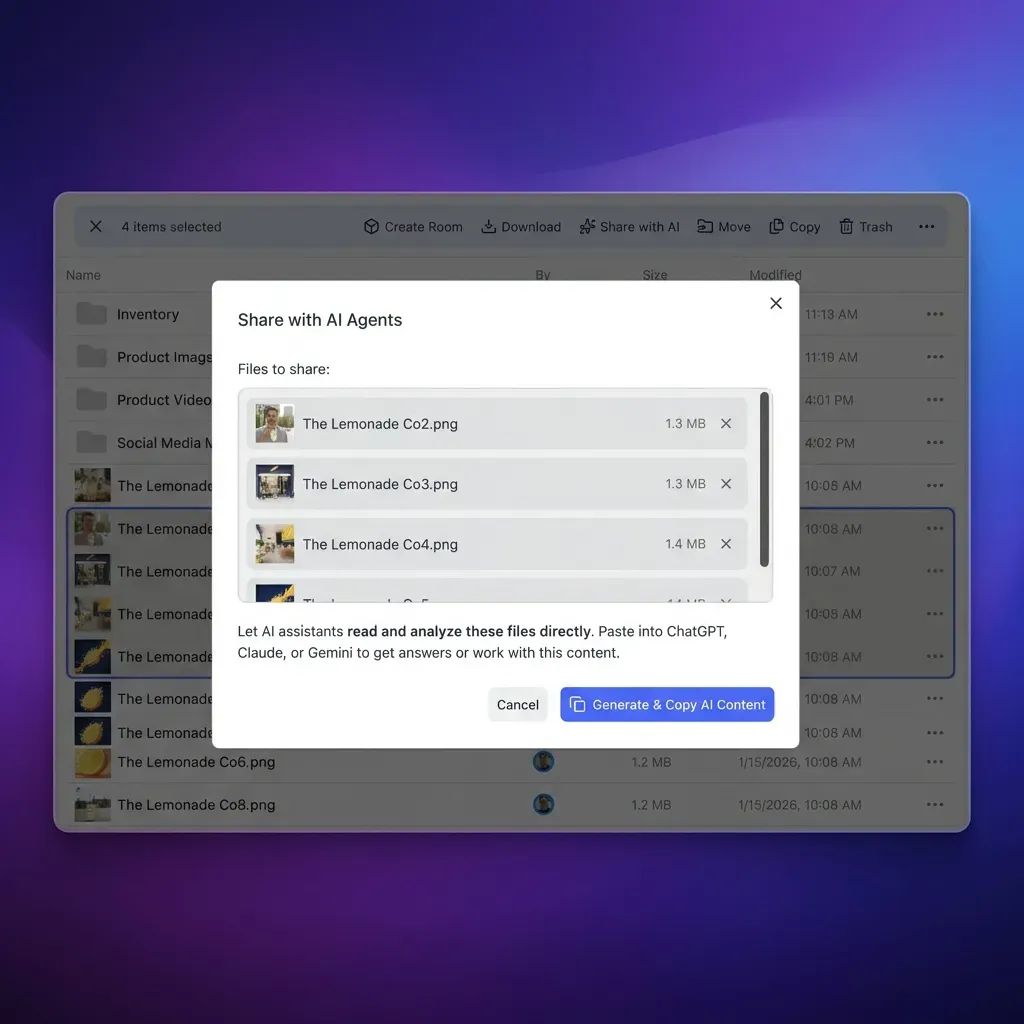
Step 3: Upload Documents
Upload files:
Direct upload: stage the file with
POST /blob, then callupload_manage action=stream-upload profile_type=workspace profile_id={id} parent_node_id={folder_id} filename="report.pdf" blob_id={blob_id}.URL import:
upload_manage action=web-importwith the file's URL,profile_type=workspace,profile_id={id}and the targetparent_node_id.
Wait for ai_state: "indexed" via storage details node_id={id}. For large files, use chunked upload: create-session, then chunk calls, then finalize. Uploads go up to 25 GB on Starter, 50 GB on Business and 100 GB on the Enterprise plan.
URL import pulls from Drive/Box via OAuth, no agent local I/O needed. Great for cloud-native workflows.
Example prompt: "Upload these PDFs to /contracts/ in docs-search workspace."


Add Semantic Search to OpenClaw Today
Connect your OpenClaw agent to Fastio cloud workspaces and query your docs with built-in semantic search once Intelligence is enabled.
Step 4: Run Semantic Searches
Query with workspace-search:
workspace-search workspace={id} query="contracts with indemnity clauses"
Returns JSON: files, similarity scores, preview snippets. Use higher thresholds for more precise results.
ai-chat-create streams SSE for long responses. folders_scope limits context size/cost, e.g. "root:top" for top levels.
RAG chat: ai_manage chat-create context_type=workspace type=chat_with_files folders_scope=root:top query_text="Summarize indemnity terms across contracts".
Citations include page numbers.
Prompt example: "Search my docs for recent quarter revenue reports with high numbers and summarize findings."
Best Practices and Tips
Scope queries: Use folders or metadata views to limit search scope.
Batch uploads: Chunk large sets.
Multi-agent: Use advisory file locks (
storagelock-acquire/release) and version history to coordinate concurrent writes.Human handoff: Generate a claim link for seamless ownership transfer.
Advanced: Multi-Agent Coordination
In multi-agent setups, coordinate access with advisory file locks using the storage actions lock-acquire and lock-release. An agent acquires a lock before writing, heartbeats it while working, and releases it when finished. If another agent attempts to acquire the lock, it receives HTTP 409 and can wait or read, while version history preserves every write and an activity log records all operations.
Use the WebSocket events feed or activity polling for event-driven workflows to notify agents when new files arrive for indexing.
Combine with ownership transfer: agents build shared knowledge bases and transfer the organization to human teams through a claim link.
Define clear tool contracts and fallback behavior so agents fail safely when dependencies are unavailable. This improves reliability in production workflows.
Troubleshooting Common Issues
Indexing not starting: Verify intelligence=true on workspace. Re-upload files to trigger.
No search results: Check indexing status with storage details. Start with broad queries.
Slow responses: Scope queries with folders or metadata views.
Auth errors: Verify your API key or re-authenticate via browser PKCE.
Tool unavailable: Verify your remote MCP server URL at https://mcp.fast.io/mcp/tools.
Real-World Use Cases
Legal Document Review: Query "contracts with termination clauses". Agent summarizes risks across numerous files.
Codebase Search: "functions for user authentication in src/". Retrieves relevant modules with snippets.
Financial Analysis: "quarterly reports showing growth". Chains to chart generation.
Multi-Agent Workflow: Index agent uploads, search agent queries, summary agent reports, human reviews via share.
Sources
References used to verify factual claims in this guide.
-
Fastio plans include storage and usage-based credits
-
Remote MCP server connects via Streamable HTTP at mcp.fast.io/mcp/tools Fastio supports large file storage and streaming
-
Queries are embedded similarly, and cosine similarity measures the angle between vectors to rank results on a scale from -1 to 1
-
Intelligence Mode auto-processes uploads: text extraction, chunking (typically 512 tokens), embedding generation
Frequently Asked Questions
What is semantic search in OpenClaw?
Semantic search lets OpenClaw agents find Fastio workspace files by meaning using vector embeddings. Enable Intelligence Mode, index docs, query naturally.
How to set up OpenClaw semantic search?
Connect OpenClaw to the Fastio MCP server, create a workspace with Intelligence enabled, upload files, and query by meaning. Full steps above.
Does OpenClaw semantic search support RAG?
Yes, via Fastio document chat and Ripley AI chat for scoped RAG queries across indexed documents.
What file types work with semantic search?
PDFs, text, code files. In-browser previews and streaming are supported for video, audio, CAD, and RAW photos.
Is there a free trial for OpenClaw integration?
Fastio offers a 14-day Business Trial on monthly plans, with paid plans starting at $9.99/mo for Starter.
Related Resources

Add Semantic Search to OpenClaw Today
Connect your OpenClaw agent to Fastio cloud workspaces and query your docs with built-in semantic search once Intelligence is enabled.