How to Set Up OpenClaw RAG Storage
Guide to openclaw rag storage: Use Fastio workspaces to index documents for OpenClaw agents. Enable Intelligence Mode for automatic indexing, semantic search, and chat. No external vector DB needed. Connect via the remote MCP server.


What Is OpenClaw RAG Storage?
OpenClaw RAG storage indexes documents so agents can pull relevant sections for responses. Fastio workspaces handle indexing when you enable Intelligence Mode. Just upload files. They process and become searchable.
No need for a separate vector database. Connect via the remote MCP server at https://mcp.fast.io/mcp/tools to get started. Queries include citations to pages or sections.
Set up RAG pipelines that fetch context from workspaces. Good for knowledge bases, report analysis, and code reviews.
Practical example: Summarize key risks from multiple compliance docs with page citations. Constraint: Enable intelligence mode first. Outcome: Audit time drops .
Practical example: Query sales reports across multiple PDFs; gets cited summaries in seconds. Constraint: Limit to one workspace per query. Outcome: Cuts research from hours to minutes.
Related guides
- How to Set Up Hermes Agent File StorageOnly 57% of organizations report having AI agents in production environments, largely due to challenges with state...
- How to Configure Claude Coworking RAG StorageClaude coworking RAG storage connects vector databases and indexing systems to give agents and humans shared context. A...
- How to Set Up an RAG Knowledge Base in OpenClawConnect your agents to your proprietary data with automated indexing and semantic retrieval. Enable Intelligence Mode...
- How to Build RAG Pipelines with OpenClawOpenClaw RAG pipelines index documents into embeddings for semantic retrieval. This helps agents be more accurate with...
- How to Build OpenClaw Cloud WorkspacesOpenClaw cloud workspaces give multi-agent teams shared storage with built-in RAG. Agents save files that last,...
- How to Set Up File Storage in OpenClaw WorkspacesOpenClaw agents need files that stick around between sessions in shared workspaces. Developers set up persistent...
More on this subject: OpenClaw Setup and Guides (199 guides)
Why Fastio for OpenClaw RAG Pipelines?
Fastio workspaces support semantic search across files. Upload PDFs, docs, or code. Files index automatically.
Key benefits:
- No vector DB: Indexing runs automatically, no DevOps work needed. Agents storage.
- Citations: Links to pages, sections, or timestamps.
- Plans: Starter at $9.99/mo, Business at $49.99/mo, Enterprise at $199.99/mo. Pricing.
- Consolidated toolset: Orgs, workspaces, uploads, AI chat, shares. Docs.
- URL import: Drive/Dropbox without local files.
- Version history & audit log: Safe for multiple agents.
Other storage services handle basic files. Fastio adds RAG too.
Practical example: Summarize key risks from multiple compliance docs with page citations. Constraint: Enable intelligence mode first. Outcome: Audit time drops .
Practical example: Query sales reports across multiple PDFs; gets cited summaries in seconds. Constraint: Limit to one workspace per query. Outcome: Cuts research from hours to minutes.
Fastio Plans and Trial
Fastio offers Starter ($9.99/mo, 250 GB), Business ($49.99/mo, 5 TB), and Enterprise ($199.99/mo, 25 TB) plans, plus a 14-day Business Trial requiring a credit card. See pricing details.
Connect Fastio Remote MCP Server
Connect OpenClaw directly to Fastio's remote MCP server at https://mcp.fast.io/mcp/tools, sending a scoped API key as a Bearer header.
Clients connect over a streamable HTTP URL, so nobody needs to install, run, deploy, or containerize an MCP server locally.
The consolidated MCP toolset enables agents to manage organizations, workspaces, file uploads, document chat, and shares.
Connection configuration:
{
  "mcpServers": {
    "fastio": {
      "url": "https://mcp.fast.io/mcp/tools",
      "headers": {
        "Authorization": "Bearer YOUR_FASTIO_API_KEY"
      }
    }
  }
}
Generate an API key or use PKCE browser login for agents. Start with a 14-day Business Trial.
Practical example: Connect MCP server; agents manage files via natural language. Constraint: Requires valid API key or PKCE login. Outcome: Eliminates manual file handling.



Add RAG Storage to OpenClaw
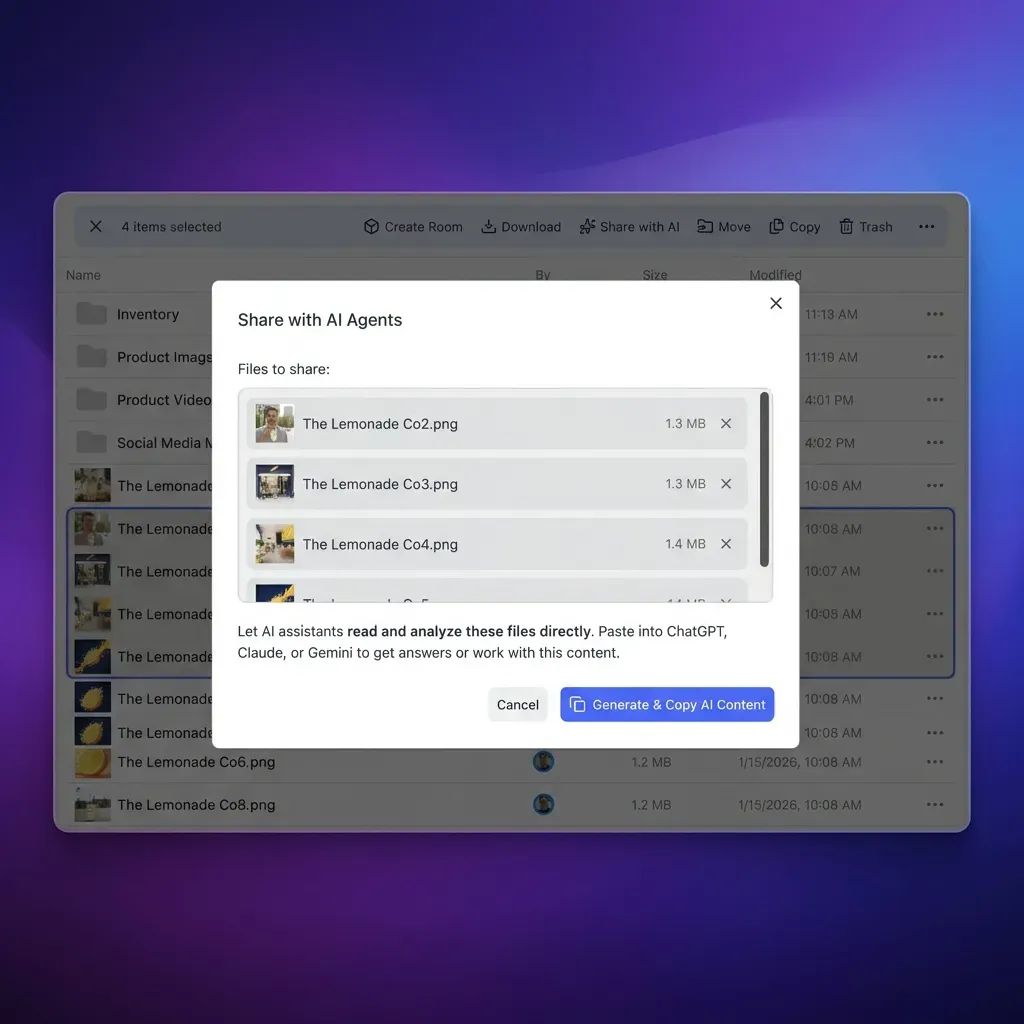
Persistent workspaces with built-in indexing once Intelligence is enabled. Connect via MCP, query docs with citations. Built for openclaw rag storage workflows.
Create RAG-Enabled Workspace
Have agents create an organization, then create a workspace within it.
Enable intelligence mode on the workspace. Upload files using one-time cloud import or direct uploads.
Files are indexed and searchable once Intelligence is enabled for the workspace.
Example workflow:
- Create workspace "ProjectRAG"
- Enable intelligence
- Import docs from Drive/Dropbox
- Query: "Summarize contracts"
Practical example: Summarize key risks from multiple compliance docs with page citations. Constraint: Enable intelligence mode first. Outcome: Audit time drops .
Log workspace IDs and tool calls for easy replication and debugging.
Practical example: Query sales reports across multiple PDFs; gets cited summaries in seconds. Constraint: Limit to one workspace per query. Outcome: Cuts research from hours to minutes.
Query Documents in OpenClaw
Use document chat with citations and scoped queries for RAG.
Scope to a workspace or folder. Answers cite sources.
Add follow-up questions and inspect responses with source citations.
Example: Scope root, ask "Key risks in reports?"
Practical example: Summarize key risks from multiple compliance docs with page citations. Constraint: Enable intelligence mode first. Outcome: Audit time drops .
Log workspace IDs and tool calls for easy replication and debugging.
Validate with test documents before scaling to production data.
Practical example: Query sales reports across multiple PDFs; gets cited summaries in seconds. Constraint: Limit to one workspace per query. Outcome: Cuts research from hours to minutes.
Advanced RAG Pipelines
Chain queries: summarize a folder, extract entities, generate a report.
Multi-agent setups: one indexes, another queries.
Activity polling or the WebSocket events feed handles change notifications. Version history and audit logs avoid conflicts.
Ownership transfer hands workspaces to humans.
Practical example: Summarize key risks from multiple compliance docs with page citations. Constraint: Enable intelligence mode first. Outcome: Audit time drops .
Log workspace IDs and tool calls for easy replication and debugging.
Validate with test documents before scaling to production data.
Practical example: Query sales reports across multiple PDFs; gets cited summaries in seconds. Constraint: Limit to one workspace per query. Outcome: Cuts research from hours to minutes.
Best Practices
- Limit scopes for faster results
- Track credit usage
- Use notes to ground responses
- Version files to track history
Practical example: Summarize key risks from multiple compliance docs with page citations. Constraint: Enable intelligence mode first. Outcome: Audit time drops .
Log workspace IDs and tool calls for easy replication and debugging.
Validate with test documents before scaling to production data.
Log workspace IDs and tool calls for easy replication and debugging.
Practical example: Query sales reports across multiple PDFs; gets cited summaries in seconds. Constraint: Limit to one workspace per query. Outcome: Cuts research from hours to minutes.
Sources
References used to verify factual claims in this guide.
-
Fastio MCP server connects with a URL without local server installation Fastio enables agents to manage workspaces, uploads, AI chat, and shares Fastio MCP server exposes a consolidated toolset for agent operations
-
Fastio workspaces support built-in search once Intelligence is enabled Fastio remote MCP server supports agent workflows with streamable HTTP Fastio supports organization and workspace creation via API and MCP
-
Fastio plans provide scalable cloud storage starting at 250 GB Fastio provides upload support for large files across workspaces Fastio offers Starter, Business, and Enterprise plans with a 14-day Business Trial Fastio plans include monthly usage credits for AI work
Frequently Asked Questions
Can OpenClaw use Fastio for RAG storage?
Yes. Connect via the remote MCP server. Once Intelligence is enabled for the workspace, files are indexed and searchable. Query with AI chat tools.
How to set up RAG in OpenClaw?
Create a Fastio workspace, enable intelligence, upload files. Use chat_with_files and folders_scope. Get citations in responses.
Does Fastio need external vector DB for OpenClaw?
No. Built-in indexing provides semantic search across workspaces.
What plans and limits apply to Fastio RAG storage?
Fastio offers Starter ($9.99/mo, 250 GB), Business ($49.99/mo, 5 TB), and Enterprise ($199.99/mo, 25 TB) plans, with a 14-day Business Trial. Check the [pricing page](/pricing/) for details.
How does OpenClaw share RAG outputs?
Create branded shares (send/receive). Links with previews, no logins required.
Related Resources

Add RAG Storage to OpenClaw
Persistent workspaces with built-in indexing once Intelligence is enabled. Connect via MCP, query docs with citations. Built for openclaw rag storage workflows.