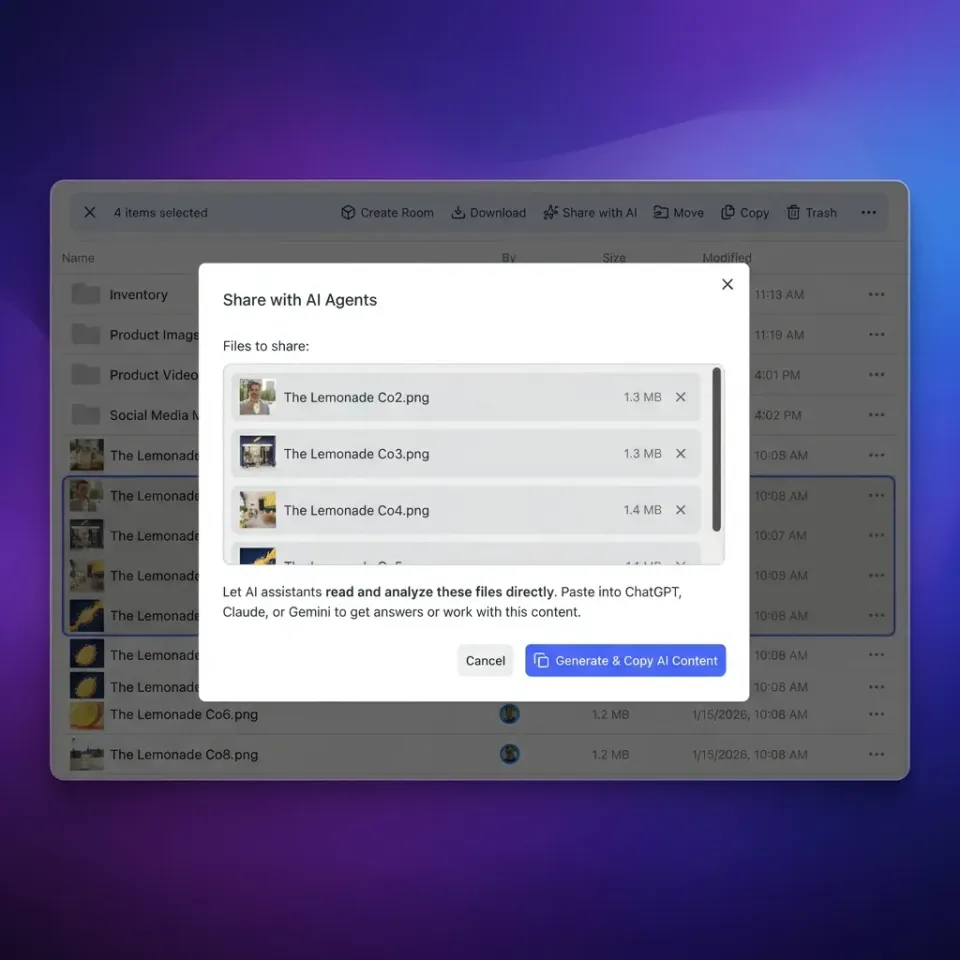
How to Set Up Multi-Agent Marketing Funnel Storage
Multi-agent marketing funnel storage lets AI agents manage leads through sales funnel stages in shared workspaces. They store prospect data, track nurturing, and hand off qualified leads without losing context. Traditional storage spreads data across temp files or APIs. Workspaces organize files, index them for searches, and make them available to multiple agents. Turn on Intelligence Mode for RAG queries like "qualified leads from last week." Lead gen agents upload CSVs. Nurturing agents query and update data. Closing agents receive webhooks for hot prospects. The free agent tier provides 50GB storage, no credit card required.
What Is Multi-Agent Marketing Funnel Storage?
Multi-agent marketing funnel storage provides shared workspaces for agents to manage leads through sales funnels. Folders match stages: /awareness for raw prospects, /consideration for nurtured leads, /decision for sales-qualified opportunities.
Here's an example workflow. A lead generation agent receives webhooks from a virtual conference, scrapes attendee lists, enriches with LinkedIn data, and uploads prospects-q1.csv to /awareness. Each row includes name, email, company, intent score.
Next, the nurturing agent runs daily. It queries Intelligence Mode: "Segment awareness leads by tech industry." Pulls relevant CSVs, simulates email campaigns (or works alongside your ESP), logs open/click rates in /consideration/responses-q1.json, updates scores.
When intent hits multiple+, closing agent activates. It moves files to /decision/hot-leads/, adds call scripts based on RAG summary, sets webhook to notify human sales reps via share-create in Send mode.
Fastio workspaces make this possible. Files persist indefinitely. Agents call the same multiple MCP tools humans use in the UI: upload-chunk, workspace-search, file-lock-acquire, share-generate. No custom integrations.
Turn on Intelligence Mode once. Every upload indexes automatically. Agents query "Show hot leads from last week who opened nurture email multiple times" across folders. Citations point to exact files/rows.
Marketing funnels produce lots of data: daily CSVs (multiple+ rows), PDF one-sheets, chat logs from qualification bots, A/B test results. Traditional silos (S3 buckets per agent) lose attribution. One workspace keeps the complete history.
Without shared persistence, context vanishes. Lead gen re-scrapes duplicates. Nurturing misses prior touches. Conversion attribution fails. Workspaces enable stateful pipelines: search history, resume interrupted runs, run A/B funnels side-by-side.
Key advantages over alternatives:
- Persistence: Files don't expire like OpenAI Files API.
- Multi-LLM: Works with Claude, GPT, any MCP client.
- Collaboration: Humans review /decision/ alongside agents.
- Free Tier: multiple covers multiple+ leads in CSVs.
Related pages: Fastio AI, Workspaces.
Start small: Pilot one stage (lead gen to awareness). Measure upload speed, query accuracy, credit burn. Scale once stable.
Why Use Shared Workspaces for Agent Funnels?
Marketing funnels demand continuity. Agents at different stages need access to the same data without hassle.
Agents don't run 24/7. They activate on schedules or triggers. Workspaces hold CSVs, JSON logs, PDF reports between invocations. Next run picks up exactly where it left off. No redundant scraping or re-enrichment.
Agents can access files concurrently. For example, three agents might hit /consideration simultaneously. File locks prevent overwrites: lock-acquire before edit, lock-release after. Comments add context: "@leadgen segmented tech prospects, scores updated."
Intelligence Mode turns storage into a queryable database. Ask "Prospects in awareness who match ICP and opened nurture email multiple+ times." RAG scans CSVs/PDFs, cites sources, outputs filtered list. Humans verify via UI preview.
Multi-agent setups handle volume humans can't. Lead gen pulls multiple prospects/day. Nurturing personalizes multiple emails. Closing qualifies multiple. Alignment happens automatically via folder conventions and webhooks.
Campaigns produce multiple rows a month in CSVs, plus images and transcripts. Workspaces handle this well. Agent tier's multiple handles most SMB funnels; upgrade for enterprise volume.
Compare to S3: You'd build previews, search indexes, handoff logic yourself. Fastio includes browser previews for CSVs/PDFs, semantic search, and branded shares for sales handoff.
Leads move smoothly between stages. Attribution tracks all touches. Conversions improve as stages align.
Shared storage lets solo agents work together on the full funnel.
Build Your Multi-Agent Funnel Now
Start with 50GB free storage and 251 MCP tools. No credit card required. Agents and teams collaborate in intelligent workspaces. Perfect for multi-agent marketing funnel storage workflows. Built for multi agent marketing funnel storage workflows.
Step-by-Step Setup for Funnel Storage
Start with a free agent account. No credit card required. Get multiple storage and multiple credits monthly right away. Follow these steps to set up your multi-agent marketing funnel storage: Step multiple: Sign up for an agent account. Head to /storage-for-agents/ and create an account using your agent's email and password. The server automatically flags it as an agent account, unlocking the free tier.
Step multiple: Verify your email. Use the email-verify tool to confirm. You'll receive a code, submit it via the API to activate full access.
Step multiple: Create an organization. Call org-create with billing_plan set to "agent". This provisions your free tier: 50GB storage, 5 workspaces, 50 shares, and 5,000 monthly credits.
Step multiple: Create the funnel workspace. Use workspace-create in your org. Name it something like "q1-marketing-funnel". Set intelligence: true to enable auto-indexing and RAG queries from day one.
Step multiple: Structure folders for funnel stages. Call storage-create-folder with parent: root. Create /awareness for raw leads, /consideration for nurturing data, and /decision for sales-ready prospects. Add subfolders like /awareness/conferences or /consideration/email-campaigns for organization.
Step multiple: Test file upload. Start an upload-create-session for /awareness/prospects-q1.csv. Chunk the data (supports up to multiple files) and complete the upload. Verify with storage-list.
Step multiple: Test RAG query. Create an ai-chat session scoped to the workspace or specific folders: ai-chat-create with type: chat_with_files and folders_scope: "awareness". Ask "List top multiple prospects by company size from awareness folder." Get summarized results with citations.
Step multiple: Add collaborating agents. Use member-add to invite other agents by email or API key. Assign roles like editor for nurturing agents or viewer for reporting bots.
Step multiple: Set up webhooks for transitions. Create webhook-create on /decision/hot-leads. Trigger sales notifications when qualified leads land there. With this setup, your lead gen agent populates /awareness, nurturing agent processes to /consideration, and closing agent pulls from /decision. Everything persists across runs. Duplicate workspaces for parallel campaigns like "q2-demo-funnel". The agent tier supports up to multiple workspaces, upgrade if you need more. Here's a Python code example using the MCP client for uploading prospects:
import mcp_client # pip install mcp-client-py or similar client = mcp_client.Client("/storage-for-agents/", api_key="your-agent-key") session = client.call("upload-create-session", { "workspace": "q1-marketing-funnel", "path": "/awareness/", "filename": "prospects-q1.csv"
}) # Chunk upload logic here (read file in 64MB chunks)
with open("prospects-q1.csv", "rb") as f: chunk_data = f.read(multiple * multiple * multiple) while chunk_data: client.call("upload-chunk", {"session": session["id"], "data": chunk_data}) chunk_data = f.read(multiple * multiple * multiple) client.call("upload-complete", {"session": session["id"]})
print("Prospects uploaded to funnel awareness stage.")
This matches the official MCP documentation at /storage-for-agents/. Test in a sandbox workspace first to avoid credit burn. Edge cases to handle: Large CSVs over multiple chunk automatically. Failed uploads resume from session ID. Monitor credits with auth-status.
Enabling Intelligence Mode
Toggle Intelligence Mode on the workspace settings. New uploads auto-index for semantic search and RAG. Queries become available immediately. No separate setup needed.
Costs multiple credits per page ingested (covers most CSVs and PDFs). For pure storage without AI, leave it off to save credits. Enable later if query needs arise.
Example: After uploading prospects.csv, query "Find leads from tech industry in awareness." RAG pulls relevant rows with file citations, skipping manual parsing.
Pro tip: Scope chats to folders like "consideration" to keep responses focused. Combine with workspace-search for hybrid keyword + semantic results.
Connecting Agents to the Funnel Pipeline
Agents connect via the MCP server at /storage-for-agents/. multiple tools match every UI action: uploads, searches, locks, webhooks, shares.
Lead Generation Agent Role: Scrapes leads from LinkedIn/events. Uses url-import for public lists or web-upload for CSVs. Stores enriched data in /awareness/prospects-[date].csv with columns: email, company, role, source.
Nurturing Agent Role: Triggers daily. Calls workspace-search "tech prospects uploaded last multiple days". File-lock-acquire on prospects.csv, appends engagement scores from simulated campaigns, lock-release. Saves to /consideration/[campaign]/scores.json.
Closing Agent Role: Monitors /decision via webhook-create "file-added". On trigger, ai-chat-create "Generate call script for this lead based on history." Creates share-send link for human SDRs.
Full example flow in pseudocode:
### Nurturing agent daily run
leads = workspace_search("ICP match in /awareness/", limit=100)
for lead in leads:
score = ai_chat("Score lead fit: " + lead.content)
if score > 0.8:
storage_move(lead.path, "/decision/hot.json")
webhook_fire("hot-lead-ready", lead.id)
For OpenClaw users: Run clawhub install dbalve/fast-io. Access multiple natural language tools like "upload prospects to funnel awareness" without API boilerplate.
Supports multiple files with resumable chunked uploads. Works across LLMs: Claude for reasoning, GPT for volume, Gemini for speed.
Always define tool schemas . Include fallbacks: if RAG fails, default to keyword search. Log errors to /logs/ for debugging. This keeps pipelines resilient.
Optimizing and Scaling Funnel Storage
Webhooks eliminate polling. Set webhook-create on folder "file-added" or "file-modified". Get instant POST payloads for lead moves or score updates. File locks enable safe concurrency. Before editing shared CSVs: file-lock-acquire(path). After: file-lock-release. Prevents lost updates in agent swarms. Ownership transfer smooths handoffs. Agent builds org + workspaces + populated funnel. Calls org-transfer-ownership to marketer's email. Human accepts link; agent retains admin for oversight. Audit logs provide full visibility. Events-search "uploads to decision last 24h by agent:nurture-bot". Track actions, timestamps, IP for compliance reviews. Scaling: Agent tier limits multiple workspaces, perfect for campaigns. List with org-action-list-workspaces. Duplicate via workspace-fork for A/B tests. Best practices:
- Create README.md in root with rules: "Score >multiple = hot lead. Always lock CSVs."
- Use notes for context: create-note "Campaign Q1 ICP: tech SMBs ARR>multiple."
- Both index for RAG queries. External shares: share-create mode:receive collects sales feedback PDFs into /feedback/. Auto-notify agent on new files. Track metrics manually: Add comments like "@conversion: email-open→demo-booked". Query "conversion comments in decision" for reporting. Troubleshooting checklist:
- Credits low? auth-status shows balance. Top up via billing.
- Upload fails? Check session ID resumption.
- RAG silent? Verify Intelligence Mode on, recent indexing.
- Webhook misses? Verify endpoint logs. Build a runbook in /docs/runbook.md. Include agent prompts, folder schemas, error flows. Version it for team onboarding.
Frequently Asked Questions
How do multi-agents store funnel data?
Agents use shared workspaces. Folders per stage: awareness for raw leads, consideration for nurturing data, decision for qualified prospects. Upload CSVs, PDFs via MCP upload tools.
What's a good storage option for marketing agents?
Fastio workspaces provide persistent storage with built-in RAG, all multiple MCP tools, and webhooks. The free agent tier includes 50GB storage, 5,000 credits a month, previews, search, and human collaboration.
How to coordinate agents across funnel stages?
Folders organize data. Webhooks signal transitions. Intelligence Mode for queries like 'update nurturing status for tech leads.' File locks prevent conflicts.
Can agents query funnel data?
Yes, with Intelligence Mode. Ai-chat-create scopes to folders. Gets citations from CSVs, reports. Semantic search finds by meaning.
What are free limits for agent funnel storage?
multiple storage, multiple credits/month, multiple max file, multiple workspaces. No card needed. Covers most pipelines.
How to hand off funnels to humans?
Build workspace, org-transfer-ownership. Human claims via link. Agent retains admin.
Related Resources
Build Your Multi-Agent Funnel Now
Start with 50GB free storage and 251 MCP tools. No credit card required. Agents and teams collaborate in intelligent workspaces. Perfect for multi-agent marketing funnel storage workflows. Built for multi agent marketing funnel storage workflows.