How to Use Multimodal AI Vision Models for Metadata Extraction
Vision-language models can look at an image or document and return structured metadata that traditional parsers miss entirely: scene descriptions, object labels, text transcription, and sentiment. This guide covers how multimodal extraction works, when it outperforms rule-based tools like ExifTool, and how to build a pipeline that combines both approaches for complete metadata coverage.


What Multimodal AI Metadata Extraction Does Differently
Traditional metadata extractors read file headers. ExifTool pulls EXIF tags from a JPEG: camera model, shutter speed, GPS coordinates, capture date. Apache Tika reads embedded properties from PDFs and Office documents. FFprobe reports codec, bitrate, and duration for video files. These tools are fast, deterministic, and free. They also ignore what the file actually shows.
A photo of a construction site contains EXIF data about the camera that took it. It says nothing about the crane in the frame, the safety signage on the fence, or the fact that it was taken during golden hour. A scanned invoice has PDF metadata listing the scanner model and page count. It says nothing about the vendor name, line items, or total amount printed on the page.
Multimodal AI metadata extraction closes this gap. Vision-language models like GPT-4o, Gemini 2.5, and Claude process the visual content of a file and return structured data about what they see. Feed the model an image along with a JSON schema, and it returns fields like scene description, detected objects, visible text, dominant colors, and estimated sentiment. Feed it a scanned document, and it reads the printed text, understands the layout, and extracts named fields like dates, amounts, and counterparties.
The practical difference: traditional tools give you metadata about the file. Vision models give you metadata about the content. A complete metadata pipeline needs both.
Related guides
- How to Extract Document Metadata with Large Language ModelsLarge language models can read unstructured documents and return structured metadata fields like author, date, topic,...
- How to Extract GPS, Altitude, and Flight Data from Drone PhotosDrone photos contain far more metadata than standard camera images. Beyond GPS coordinates, they embed relative and...
- How to Extract and Verify C2PA Content CredentialsC2PA Content Credentials are cryptographically signed manifests that record an asset's origin, edits, and provenance...
- How to Extract Metadata from Web Pages (Open Graph, Schema.org, and Twitter Cards)Web pages carry structured metadata in Open Graph tags, Schema.org JSON-LD, and Twitter Card elements. This guide walks...
- How to Extract Metadata for AI Training DatasetsMetadata extraction for AI training datasets is the process of programmatically reading file properties, format...
- How to Extract Metadata for Content Migration ProjectsContent migration metadata extraction is the process of pulling structured properties like titles, tags, categories,...
More on this subject: Agent File and Document Workflows (325 guides)
Traditional Parsers vs. Vision Models: What Each Captures
The choice between ExifTool and GPT-4o is not either/or. They extract fundamentally different categories of information, and a production pipeline typically runs both.
Traditional format parsers (ExifTool, Tika, FFprobe, Hachoir) read embedded metadata headers. For images, that includes EXIF, IPTC, and XMP fields: camera make and model, lens focal length, ISO speed, GPS coordinates, creation timestamp, color space, and copyright notices. For documents, it includes author, title, page count, creation date, and application version. For video, it includes codec, frame rate, resolution, bitrate, and duration.
These tools are deterministic. The same file always produces the same output. They run locally with zero API cost and process thousands of files per minute. The trade-off is that they only read what the file's creator or device embedded in the header. If a photographer stripped EXIF tags before uploading, there's nothing to extract. If a scanned PDF has no OCR layer, Tika returns an empty text field.
Vision-language models analyze the actual pixels or rendered content. They return semantic metadata that no header contains: what objects appear in the scene, what text is visible, what the document is about, what mood the image conveys. GPT-4o can process images up to 20 MB and return structured JSON metadata in a single API call, covering scene classification, object detection, OCR, and contextual description simultaneously.
Here's what each approach captures for a photo of a warehouse:
- ExifTool: Canon EOS R5, 24mm f/2.8, ISO 800, 2026-03-15 14:23:07, GPS 34.0522 N 118.2437 W
- GPT-4o: Indoor warehouse, metal shelving units with cardboard boxes, forklift in background, fluorescent lighting, safety signage reading "Hard Hat Area", approximately 50% shelf occupancy
Neither output replaces the other. The EXIF data tells you when and where the photo was taken. The vision model tells you what's in it.
For documents, the gap is even wider. A rule-based parser needs a template for every document layout. When a vendor changes their invoice format, the parser breaks. A vision model reads the document the way a person would: it finds the total at the bottom of the page regardless of whether it appears in the same pixel coordinates as the last invoice.

How Vision-Language Models Process Files for Metadata
The API workflow for multimodal metadata extraction follows a consistent pattern across providers. You send an image (or a rendered document page) alongside a text prompt that specifies your desired output schema. The model returns structured data matching that schema.
With OpenAI's API, a basic extraction call looks like this:
from openai import OpenAI

client = OpenAI()

response = client.chat.completions.create(
    model="gpt-4o-2024-08-06",
    response_format={
        "type": "json_schema",
        "json_schema": {
            "name": "image_metadata",
            "schema": {
                "type": "object",
                "properties": {
                    "scene_type": {"type": "string"},
                    "objects": {
                        "type": "array",
                        "items": {"type": "string"}
                    },
                    "visible_text": {"type": "string"},
                    "dominant_colors": {
                        "type": "array",
                        "items": {"type": "string"}
                    },
                    "sentiment": {"type": "string"}
                },
                "required": [
                    "scene_type",
                    "objects",
                    "visible_text",
                    "dominant_colors",
                    "sentiment"
                ],
                "additionalProperties": False
            },
            "strict": True
        }
    },
    messages=[
        {
            "role": "user",
            "content": [
                {
                    "type": "text",
                    "text": "Extract metadata from this image."
                },
                {
                    "type": "image_url",
                    "image_url": {
                        "url": "https://example.com/warehouse-photo.jpg"
                    }
                }
            ]
        }
    ]
)
The json_schema response format forces the model to return valid JSON matching your schema. Use a model snapshot that supports Structured Outputs, such as gpt-4o-2024-08-06 or later. Without schema enforcement, the model might return markdown-formatted text or skip fields.
For document pages, the workflow adds a rendering step. Convert each PDF page to an image (using a library like pdf2image or PyMuPDF), then pass the rendered page to the vision model. This handles scanned documents, handwritten notes, and complex layouts that text-only extraction misses.
Schema design matters more than prompt engineering. A schema with five specific fields ("invoice_number", "vendor_name", "line_items", "subtotal", "tax") produces more accurate results than a generic prompt asking the model to "extract all metadata." The model performs better when it knows exactly what to look for.
The Instructor library (for Python) and Zod (for TypeScript) add type validation on top of this pattern. Define your schema as a Pydantic model or Zod object, pass it to the API wrapper, and get back a typed object with validated fields instead of raw JSON. This catches extraction errors at parse time rather than downstream.


Extract Structured Metadata from Your Files Today
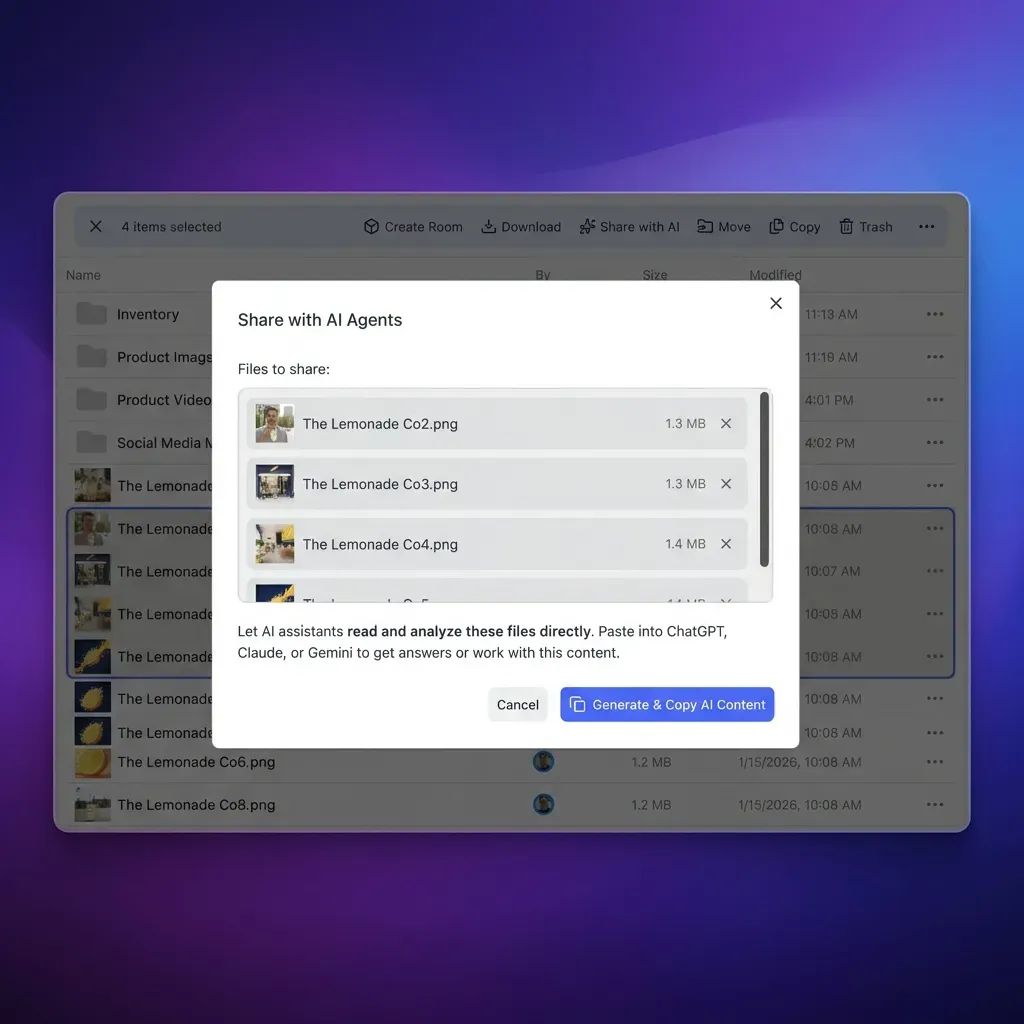
Fastio Metadata Views turn documents, images, and scanned pages into queryable data. Describe the fields you need in plain English, then review extracted values in a sortable workspace view.
Building a Combined Metadata Pipeline
A production metadata pipeline runs traditional parsers and vision models in sequence, merging their outputs into a single record per file. The general architecture has four stages.
Stage 1: File intake and format detection. When a file arrives, identify its MIME type and route it to the appropriate parser chain. Images go through EXIF extraction plus vision analysis. PDFs go through text extraction (if they have a text layer) or page rendering plus vision analysis. Video files get FFprobe technical metadata plus keyframe extraction for vision analysis.
Stage 2: Technical metadata extraction. Run ExifTool, Tika, or FFprobe to pull embedded headers. This step is fast (milliseconds per file), deterministic, and free. Store the output as the base metadata record.
Stage 3: Semantic metadata extraction. Send the file (or rendered pages, or extracted keyframes) to a vision-language model with your target schema. This step is slower than local parsing and costs API tokens. Batch where possible: GPT-4o handles multiple images in a single request, which reduces round-trip latency.
Stage 4: Merge and validate. Combine the technical and semantic records. Where both sources provide the same field (like creation date from EXIF vs. a date visible in the document), flag conflicts for review rather than silently overwriting. Write the merged record to your metadata store.
A practical priority rule: trust EXIF data for technical fields (timestamps, GPS, camera settings) and trust the vision model for semantic fields (scene description, object labels, document content). When the vision model extracts text that contradicts EXIF data (for example, a date printed on a document that differs from the file's creation timestamp), keep both values and flag the discrepancy.
Handling scale. Vision API calls are the bottleneck. OpenAI meters image inputs in tokens: for example, a 1024 x 1024 image in high-detail mode costs 765 input tokens before any output tokens. Multiply that token count by your current model price and expected output size before committing to full-archive processing. For large archives, prioritize files that lack embedded metadata or need semantic tagging for search. Skip files where EXIF data alone meets your requirements.
The ROI calculation depends on your volume and review requirements. If you process fewer than 100 files per month, manual tagging might still be faster than building a pipeline. At higher volumes, automation usually pays off once the schema is stable and review queues are limited to exceptions.

Accuracy, Cost, and Practical Limitations
Vision model extraction is not infallible. Understanding where it breaks helps you design guardrails instead of discovering errors in production.
Accuracy varies by task type. Object detection and scene classification are strongest for common subjects and clear images. OCR on printed text can work well on clean documents, but drops on handwritten text, low-resolution scans, and text at extreme angles. Extracting specific structured fields like invoice numbers, contract dates, or policy limits needs validation because document quality and field complexity change the error rate.
Hallucination is the primary risk. A vision model might report text that isn't actually in the image, or invent a date format that looks plausible but doesn't match the source document. Mitigation strategies include:
- Using structured output schemas that constrain the model's response format
- Running extraction twice with different temperature settings and flagging disagreements
- Cross-referencing vision-extracted text against dedicated OCR output
- Setting confidence thresholds and routing low-confidence extractions to human review
Cost scales with volume and resolution. Higher-resolution images use more tokens. A 1024 x 1024 image in high-detail mode costs 765 input tokens with GPT-4o. OpenAI's documentation gives 1,105 input tokens as the high-detail example for a 2048 x 4096 image. For documents, each page rendered as an image adds to the token count; multi-page PDFs can consume tens of thousands of image tokens before output tokens.
Latency matters for real-time workflows. A single vision API call takes 1-5 seconds depending on image size and output complexity. For real-time extraction on file upload, this is acceptable for individual files but creates a queue at scale. Batch processing with async workers handles the throughput problem, but adds minutes of delay before metadata appears.
Model updates change behavior. When OpenAI or Google updates their vision model, extraction results can shift. A field that extracted reliably last month might produce different formatting or miss edge cases after an update. Pin model versions in production (use gpt-4o-2024-08-06 instead of gpt-4o) and run regression tests when upgrading.
Privacy and data residency. Every file you send to a vision API leaves your infrastructure. For sensitive documents (medical records, legal contracts, financial statements), evaluate whether the API provider's data handling policies meet your requirements. Local models like LLaVA eliminate the data-residency concern but trade accuracy for privacy: current open-source vision models lag behind GPT-4o and Gemini on structured extraction tasks.
Getting Started Without Building a Pipeline
Building a custom extraction pipeline makes sense when you need fine-grained control over schemas, model selection, and post-processing logic. But if your goal is extracting structured metadata from files that are already in a workspace, you can skip the infrastructure.
Fastio's Metadata Views handles this without code. Describe the fields you want extracted in natural language. The AI designs a typed schema with field types like Text, Integer, Decimal, Boolean, URL, JSON, and Date & Time. It then scans files in your workspace, classifies which documents match, and populates a sortable, filterable spreadsheet with the extracted values.
This works across PDFs, images, Word documents, spreadsheets, presentations, scanned pages, and handwritten notes. Add new columns without reprocessing existing files. Click through from any extracted value to the source document to verify accuracy.
For teams managing visual assets, Metadata Views can tag photos with subjects, settings, brand mentions, and dominant colors, the same semantic metadata that a custom GPT-4o pipeline would produce. For document-heavy workflows, it extracts contract dates, counterparties, invoice totals, and policy numbers with the same structured output approach described in this guide.
The difference from building your own pipeline: no API key management, no schema code, no merge logic, no infrastructure to maintain. The trade-off is less control over model selection and post-processing. For most teams that need structured metadata from their existing files, the hosted approach gets results in minutes instead of weeks.
If you need programmatic access, Fastio's MCP server exposes Metadata Views to AI agents. Agents can create schemas, trigger extraction, and query results through the same tooling they use for file management and search. This makes it possible to build automated workflows where an agent uploads files, triggers metadata extraction, and acts on the results without human intervention.
For teams that want to start with a custom pipeline and migrate later, the architecture described in this guide (technical extraction plus semantic extraction, merged into a single record) maps directly onto how Metadata Views works under the hood. The concepts transfer even if the implementation changes.
Sources
References used to verify factual claims in this guide.
-
GPT-4o accepts image inputs and supports Structured Outputs
-
Structured Outputs with json_schema response format supported from gpt-4o-2024-08-06
-
A 1024 x 1024 image in high-detail mode costs 765 input tokens with GPT-4o
Frequently Asked Questions
Can AI extract metadata from images?
Yes. Vision-language models like GPT-4o, Gemini, and Claude can analyze images and return structured metadata including scene descriptions, detected objects, visible text (via OCR), dominant colors, and estimated sentiment. This semantic metadata complements the technical metadata (camera settings, GPS, timestamps) that traditional tools like ExifTool extract from file headers.
How do you use GPT-4o for image metadata extraction?
Send the image to the GPT-4o API along with a JSON schema defining the fields you want extracted. Use the structured output response format to guarantee valid JSON. The model analyzes the image content and returns populated fields matching your schema. Libraries like Instructor (Python) and Zod (TypeScript) add type validation on top of the raw API response.
What is multimodal metadata extraction?
Multimodal metadata extraction uses AI models that process both visual and textual content to generate structured metadata from files. Unlike traditional parsers that only read embedded file headers, multimodal models analyze the actual content, identifying objects, reading text, classifying scenes, and extracting named fields from documents regardless of their layout or format.
How accurate is AI-generated metadata?
Accuracy depends on the task and source quality. Common-object detection and scene classification are usually stronger than extracting small printed fields from messy documents. Handwritten text, low-resolution scans, rotated pages, and unusual layouts reduce accuracy. Production pipelines add validation steps like duplicate extraction, confidence thresholds, and human review queues to catch errors.
What is the difference between EXIF metadata and AI-generated metadata?
EXIF metadata is technical data embedded by the camera or device: shutter speed, aperture, GPS coordinates, timestamp. AI-generated metadata describes the content itself: what objects appear, what text is visible, what the scene depicts. EXIF tells you when and where a photo was taken. AI metadata tells you what the photo shows. A complete pipeline uses both.
How much does vision model metadata extraction cost?
Costs depend on image resolution, detail level, output size, and the model used. With GPT-4o, a 1024x1024 image in high-detail mode uses 765 input tokens before output. Costs increase with higher resolutions and multi-page documents. For large archives, prioritize files that lack embedded metadata or need semantic tagging rather than processing everything.
Can multimodal models extract metadata from documents and PDFs?
Yes. Convert PDF pages to images and pass them to the vision model with a schema defining the fields to extract. This handles scanned documents, complex layouts, and handwritten notes that text-only parsers miss. The model reads visible content regardless of whether the PDF has an embedded text layer, making it effective for legacy scanned archives.
Related Resources

Extract Structured Metadata from Your Files Today
Fastio Metadata Views turn documents, images, and scanned pages into queryable data. Describe the fields you need in plain English, then review extracted values in a sortable workspace view.