How to Orchestrate MCP Agents in a Workspace
MCP workspace agent orchestration is the architectural pattern of coordinating multiple AI agents within a shared Fastio workspace using the Model Context Protocol (MCP). By connecting agents to a centralized environment with persistent storage and intelligence, teams can build complex, stateful workflows that far exceed the capabilities of isolated scripts. In this model, agents act as autonomous workers that share the same files, folders, and search indexes as their human counterparts.


What Is MCP Workspace Agent Orchestration?
MCP workspace agent orchestration is a methodology for managing multi-agent systems where the "workspace" serves as the central nervous system. Instead of agents passing data directly to each other via fragile API payloads, they operate on a shared state maintained in a persistent cloud file system.
At its core, this approach relies on the Model Context Protocol (MCP), an open standard that enables Large Language Models (LLMs) to connect safely to external data and tools. Fastio implements this protocol as a hosted MCP server (mcp.fast.io), exposing a consolidated MCP toolset that maps to the platform's UI capabilities.
The Role of the Shared Workspace
In traditional multi-agent architectures, state is often ephemeral or siloed. Agent A performs a task and must explicitly transmit the result to Agent B. If Agent A crashes or the transmission fails, context is lost.
In an orchestrated workspace, the file system is the state. Agent A writes a file to project/data/processed_v1.json. Agent B, watching that directory via the WebSocket events feed, sees the new file and begins its work. If Agent B fails, Agent C can pick up exactly where it left off because the data persists in the workspace.
Bridging Agents and Humans
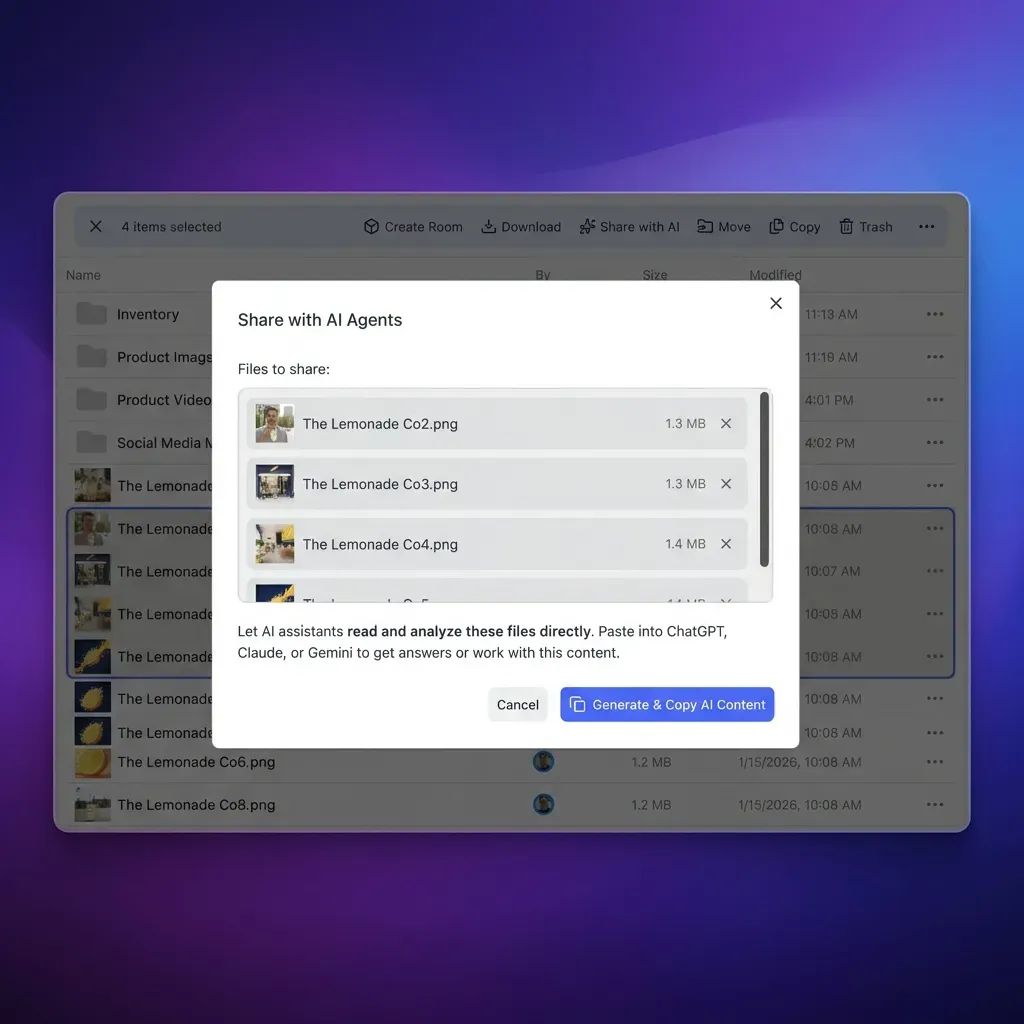
A unique advantage of this orchestration model is the unification of agent and human environments. The workspace isn't a hidden database; it's a user-friendly interface.
- Agents interact via MCP tools (Streamable HTTP/SSE).
- Humans interact via the Fastio web dashboard or mobile app.
When an agent generates a report, a human manager can open it immediately in the browser. When a human uploads a raw video file, an agent can instantly detect it and start transcoding. This "multiplayer" dynamic bridges the gap between automated backend processes and frontend human collaboration.
Helpful references: Fastio Workspaces, Fastio Collaboration, and Fastio AI.
Related guides
- Best MCP Servers for Automation in 2026MCP servers for automation let AI agents trigger workflows, schedule tasks, and coordinate actions across external...
- How to Set Up an MCP Server for GitHub ActionsMost GitHub MCP guides stop at repo management. This guide covers the Actions-specific surface: connecting an MCP...
- How to Set Up an MCP Server for LinkedInAn MCP server for LinkedIn lets AI agents read profiles, search jobs, send messages, and publish posts through the...
- MCP Resources vs Tools: When to Use Each in the Model Context ProtocolUnderstanding the difference between resources and tools is essential for building efficient MCP servers. Resources...
- How to Set Up an MCP Server for CalendlyCalendly's official MCP server lets AI agents check availability, book meetings, and manage scheduling links through...
- How to Connect DocuSign to AI Agents with the MCP ServerDocuSign's official MCP server lets AI agents send envelopes, check signing status, query agreements through Navigator,...
More on this subject: MCP and Model Context Protocol (238 guides)
Why Orchestrate Agents in a Shared Workspace?
Building reliable multi-agent systems requires solving problems of consistency, memory, and coordination. Shared workspaces address these challenges natively.
Solving the Data Silo Problem
Isolated agents often create fragmented data pools. One agent might store logs in S3, another keeps temporary files in local memory, and a third relies on a vector database. Reconciling these sources for a holistic view is difficult. By orchestrating agents in a Fastio workspace, you consolidate all assets, documents, media, logs, and indexes, into a single, organized hierarchy. Every agent sees the same "truth," reducing hallucination risks caused by stale or partial context.
Persistent State and "Infinite" Memory
LLM context windows are limited and expensive. Workspaces provide effectively infinite long-term memory. Agents don't need to keep entire history in their context window; they read the relevant files or use semantic search to retrieve specific memories when needed. Because Fastio files are persistent, an agent workflow can span days or weeks. An agent can "sleep" (terminate its process) and wake up later, checking the workspace state to resume its tasks without losing progress.
Built-in Intelligence (RAG)
Orchestrating agents requires more than just file storage; it requires intelligence. Fastio's Intelligence Mode automatically indexes every file uploaded to the workspace. This provides built-in Retrieval-Augmented Generation (RAG). Instead of managing a separate Pinecone or Milvus instance, agents use the storage tool's search action to query the workspace's knowledge base. This lowers the engineering barrier for deploying intelligent agent teams.
Human-in-the-Loop Governance
Autonomy is powerful, but oversight is critical. Shared workspaces provide a natural governance layer.
- Visibility: Humans can see every file an agent creates.
- Control: Permissions can be revoked instantly if an agent misbehaves.
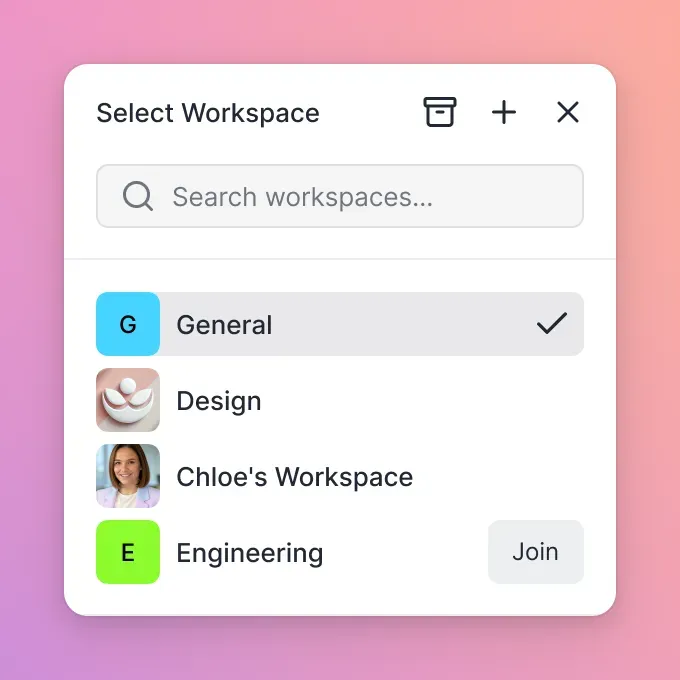
- Handoffs: Agents can transfer ownership of entire project workspaces to human users for final delivery.


Give Your AI Agents Persistent Storage
Start with generous storage, team workspaces, and a consolidated MCP toolset for agents. Built for MCP workspace agent orchestration workflows.
Performance Benefits of Workspace Orchestration
Beyond convenience, workspace orchestration offers tangible performance advantages for production systems.
Latency and Throughput
In distributed agent systems, moving data between nodes incurs network latency and egress costs. In a shared workspace, data "movement" is virtual. Agent A writes to the storage layer, and Agent B reads from it. While exact benchmarks depend on workload, this architecture eliminates the need to serialize and transmit large context payloads between agents. For media workflows, this is especially critical. Fastio's HLS streaming technology delivers media 50-60% faster than standard progressive downloads, allowing video-processing agents to access frames with minimal buffering.
Token Efficiency
Redundant processing is a major cost driver. If three agents need to analyze the same multiple-page PDF, a naive setup might have each agent read and embed the document separately. In a workspace with Intelligence Mode, the document is embedded once upon upload. All agents query the same shared index. This "embed once, query everywhere" model drastically reduces token consumption for embedding models and ensures all agents are aligned on the same semantic understanding of the data.
Atomic Operations
Concurrency bugs are the bane of distributed systems. Fastio workspaces support advisory file locks via the storage tool (lock-acquire, lock-status, lock-release). An agent acquires a lease on a file before writing, heartbeats while working, and releases when finished. Other agents see who holds the lock or get a 409 error and wait. If unreleased, the lock expires automatically or can be taken over by anyone with write permission, while per-file version history ensures every write lands safely.

Setting Up a Workspace for MCP Agent Orchestration
Getting started with agent orchestration is straightforward. Fastio offers structured plans (Starter, Business, and Enterprise) along with a 14-day Business Trial on monthly plans, requiring a credit card, at /pricing/.
Step 1: Create an Agent Account
Visit the agent signup page to start a 14-day Business Trial (card required). You'll receive an API key that grants access to the platform and the MCP server.
Step 2: Configure the Workspace
Create a new workspace for your agent team.
- Name: Give it a descriptive name (e.g., "Research-Agents-Alpha").
- Intelligence Mode: Toggle this ON. This ensures all files are auto-indexed for RAG.
- Permissions: If you plan to invite other agents or humans, set the default permissions (e.g., "Editor" for agents, "Viewer" for clients).
Step 3: Initialize the MCP Client
Your agents connect to mcp.fast.io using your API key. Here is a conceptual example of how to initialize a session in a Python-based agent environment:
### Python setup with the official MCP Python SDK
import asyncio
import os
import httpx2
from mcp import ClientSession
from mcp.client.streamable_http import streamable_http_client

async def main():
    api_key = os.environ.get("FASTIO_API_KEY")
    headers = {"Authorization": f"Bearer {api_key}"}

### Initialize connection to Fastio MCP server
    async with httpx2.AsyncClient(headers=headers) as http_client:
        async with streamable_http_client("https://mcp.fast.io/mcp/tools", http_client=http_client) as (read, write):
            async with ClientSession(read, write) as session:
                await session.initialize()

### Verify connection
                tools = await session.list_tools()
                print(f"Connected! Available tools: {len(tools.tools)}")

asyncio.run(main())
Step 4: Verify Tool Access
Once connected, your agent should have access to the named-mode toolset. Key tools to verify immediately include:
storage(actionlist): To explore the directory structure.upload_manage: To write data.storage(actionsearch): To test Intelligence Mode.storage(actionsdetailsandversion-list): To inspect file metadata and versions.
With the workspace ready, you can now deploy your agent logic.
Connecting Multiple Agents
To add more agents, share the workspace with their unique email addresses (or handle IDs). Fastio supports granular workspace permissions for agents and humans. Each agent can use its own API key to authenticate while interacting within the shared directory structure. This separation of identity is crucial for audit logging, you'll see exactly which agent performed which action.
Key MCP Tools for Agent Coordination
Fastio provides a consolidated toolset for orchestration. Mastering these capabilities enables strong multi-agent patterns.
File Locking and Version Concurrency
Fastio provides advisory file locking alongside complete per-file version history.
- Usage: Agents call
lock-acquirebefore writing, heartbeat during long tasks, andlock-releasewhen done. - Behavior: Another agent attempting to lock the same file receives an HTTP 409 response and can wait or inspect lock status.
- Safety: If an agent crashes, the lock expires automatically. All writes create distinct file versions regardless.
Activity Feeds and WebSocket Events
Fastio provides an activity feed and WebSocket events feed so agents can react to workspace changes.
- Usage: Agents poll the activity feed or subscribe to WebSocket events for real-time notifications on file updates.
- Behavior: When a file is uploaded or modified, agents receive event notifications without manually listing folders.
- Benefit: This keeps multi-agent pipelines responsive while optimizing credit consumption.
Semantic Search and Document Q&A
Once Intelligence is enabled for the workspace, files are indexed for semantic search and AI chat with citations.
- Usage: Agents query workspace contents using natural language.
- Behavior: The system returns relevant excerpts from documents complete with citations.
- Strategy: Use semantic search to route tasks to specialist agents based on document contents.
Cloud and URL Import
This capability enables data ingestion without local bandwidth.
- Usage: Agents import files directly from external URLs or cloud providers.
- Behavior: The server pulls the file directly into the workspace.
- Application: Perfect for fetcher agents that aggregate content from external sources for processing.

Example Multi-Agent Workflow Pipelines
To illustrate the power of this architecture, let's examine two concrete workflow patterns.
1. The Market Research Pipeline
This workflow automates the gathering, analysis, and synthesis of market data.
Agent A (The Hunter):
- Monitors news feeds and RSS sources.
- Uses the
uploadtool'sweb-importaction to save relevant PDFs and articles to the/raw-datafolder. - Renames files with standard conventions (e.g.,
YYYY-MM-DD-Topic.pdf).
Agent B (The Analyst):
- Monitors
/raw-datavia WebSocket events or activity polling. - On new file: Uses semantic search to extract key entities and sentiment.
- Writes a structured JSON summary to
/processed-data. - Appends findings to
daily_report.md, with Fastio preserving version history for each update.
- Monitors
Agent C (The Editor):
- Runs on a schedule (cron job).
- Reads
daily_report.md. - Synthesizes the entries into a polished executive summary.
- Uses the
sharetool to create a share with downloads disabled for view-only access. - Emails the link to human stakeholders.
2. The Video Production Pipeline
This workflow uses Fastio's media capabilities for automated content processing.
Agent A (Ingest):
- Uploads raw footage from field cameras using the
uploadtool's chunked session (handling files up to 100 GB on the Enterprise plan). - Moves files to
/ingest.
- Uploads raw footage from field cameras using the
Agent B (Transcode & Tag):
- Detects new video files.
- Fastio automatically generates HLS streams and previews.
- Agent B analyzes the transcript (generated by Intelligence Mode) to tag the video with keywords (e.g., "interview", "outdoor", "product-demo").
- Moves the file to
/library/tagged.
Human Editor:
- Receives a notification.
- Opens the file in the Fastio video player.
- Uses the timeline to add frame-specific comments.
- Because of HLS streaming, playback is 50-60% faster than downloading the raw file, enabling immediate review.
Handling Errors and Retries
In both pipelines, error handling is managed via file status. If Agent B fails to process a file, it moves it to /error instead of /processed. A specific "Janitor Agent" can monitor the /error folder to retry operations or alert a human admin. This "dead letter queue" pattern is easily implemented using standard folder structures.
Security and Governance for Agent Teams
As you scale from one agent to many, security becomes paramount. Shared workspaces provide strong tools to maintain control.
Managing Agent Identities
Never share API keys between agents. Generate a unique key for each agent identity (e.g., "ResearchBot-multiple", "VideoBot-multiple"). This ensures that the Audit Logs correctly attribute every action. If "ResearchBot-multiple" accidentally deletes a critical folder, the logs will identify the culprit immediately, allowing you to revoke that specific key without taking down the entire system.
Permission Scopes
Adhere to the principle of least privilege.
- Read-Only: Agents that only need to ingest data (like a backup verification bot) should have
Viewerpermission. - Write-Access: Agents that generate content need
Editorpermission. - Admin: Only the primary orchestrator or human admin should have
Adminprivileges to manage workspace settings and invites.
Monitoring and Limits
Keep an eye on the Usage Dashboard. While plans include generous credit allowances, an unthrottled loop in a script could drain credits quickly.
- Monitor credit usage daily during development.
- Set up alerts for unusual spikes in activity.
- Call the credit usage endpoint (
/current/org/{org_id}/billing/usage/limits/credits/) programmatically to let agents check their own remaining budget and throttle themselves if necessary.
By treating agents as distinct team members with defined roles and boundaries, you create a secure, observable environment that is ready for enterprise deployment.
Troubleshooting Common Orchestration Issues
Even with a strong architecture, issues can arise. Here are solutions to common problems.
Concurrent Edit Conflicts
Symptom: Multiple agents overwrite each other's changes in the same file. Solution: Acquire an advisory file lock before writing and release it when complete. If conflicting writes occur without locking, use Fastio's per-file version history to inspect and restore earlier revisions.
Rate Limiting
Symptom: Agents receive multiple Too Many Requests errors. Solution: Implement exponential backoff in your API client. If multiple agents wake up simultaneously (e.g., triggered by the same batch of events), add a random jitter delay before they start processing to spread the load.
Context Window Overflow
Symptom: Agent fails to process a large file.
Solution: Don't read the whole file. Use the storage tool's search action to find only the relevant chunks, or its content action to read just the passages you need. This is the primary advantage of RAG, you don't need to load everything into context.
Sync Delays
Symptom: Agent B tries to read a file immediately after Agent A writes it but cannot find it.
Solution: While Fastio is strongly consistent, network propagation can take milliseconds. Ensure Agent A waits until the upload is stored (the upload details call returns session.new_file_id) before notifying Agent B. Using the WebSocket events feed or activity polling allows agents to react promptly to new uploads.
Sources
References used to verify factual claims in this guide.
-
Fastio MCP server provides a consolidated toolset
-
Fastio offers Starter, Business, and Enterprise plans with a 14-day Business Trial Fastio offers a 14-day Business Trial with generous file size limits Fastio provides granular workspace permissions and multi-seat plans
-
HLS streaming delivers media 50-60% faster than progressive download
Frequently Asked Questions
What is MCP agent orchestration?
MCP workspace agent orchestration is a design pattern where multiple AI agents coordinate their work within a shared Fastio workspace using the Model Context Protocol. They use shared files for state, advisory file locks for concurrency, and activity feeds for reactive workflows.
What plans does Fastio offer for agent orchestration?
Fastio offers Starter ($9.99/mo), Business ($49.99/mo), and Enterprise ($199.99/mo) plans with usage credits, along with a 14-day Business Trial on monthly plans requiring a credit card. Details are at /pricing/.
How does Fastio handle concurrent agent edits?
Fastio coordinates multi-agent edits through advisory file locks (lock-acquire, lock-status, lock-release), complete per-file version history with restore capabilities, granular permissions, and a detailed activity log.
Can agents and humans work in the same workspace?
Yes. Workspaces are unified environments. Humans access files via the Fastio web or mobile UI, while agents access the exact same files via MCP tools. This allows for smooth handoffs and collaboration.
How does Intelligence Mode help orchestration?
Intelligence Mode automatically indexes all files uploaded to a workspace. This gives agents built-in RAG capabilities, allowing them to perform semantic searches and ask questions about the data without needing an external vector database.
How many members can collaborate in a workspace?
Fastio plans include bundled team seats (3 seats on Starter, 10 on Business, 30 on Enterprise) with guests on shares not taking a seat, plus granular access controls.
Related Resources

Give Your AI Agents Persistent Storage
Start with generous storage, team workspaces, and a consolidated MCP toolset for agents. Built for MCP workspace agent orchestration workflows.