How to Build TypeScript Agents with Mastra AI Framework
Mastra is an open-source TypeScript framework for building AI agents and workflows, offering built-in tool integration, RAG pipelines, and workflow orchestration for JavaScript/TypeScript developers. While Python has long dominated AI development, Mastra brings strong agent capabilities to the 65% of developers who work in the JavaScript ecosystem. This guide explores Mastra's core features, how it compares to other frameworks, and how to give your Mastra agents persistent file storage.


What is the Mastra AI Framework?
Mastra is a battery-included, open-source TypeScript framework designed specifically for building AI applications and agents. Created by the team behind Gatsby, it addresses the fragmentation in the JavaScript AI ecosystem by providing a unified set of primitives for agents, workflows, RAG (Retrieval Augmented Generation), and evaluations. Unlike general-purpose libraries that require you to stitch together separate tools, Mastra offers a cohesive architecture. It treats "agents" not just as prompts, but as stateful entities capable of planning, executing tools, and maintaining memory. For TypeScript developers, this means you can build complex agentic systems using familiar patterns, strong typing, and the existing Node.js ecosystem without switching to Python. Mastra's architecture focuses on four main pillars:
- Agents: Autonomous entities with instructions, models, and tools.
- Workflows: Graph-based orchestration for deterministic and cyclic processes.
- RAG: Built-in pipelines for ingesting, chunking, and retrieving knowledge.
- Evals: Integrated evaluation frameworks to test agent performance.
Helpful references: Fastio Workspaces, Fastio Collaboration, and Fastio AI.

Related guides
- Best AI Agent Frameworks for TypeScript in 2026TypeScript has become the default language for production AI agents that run on the web, and the framework options have...
- How to Build an Agentic AI System from ScratchMost agentic AI tutorials stop at the orchestration layer: pick a framework, define agents, connect an LLM. But...
- How to Use AG2 Framework Tools and IntegrationsAG2 (formerly AutoGen) is an open-source multi-agent framework that enables developers to build applications with...
- Best AI Agent Frameworks for Java in 2026Java developers building AI agents no longer need to switch to Python. Eight production-viable frameworks now offer...
- 7 AI Agent Templates That Actually Save You Time in 2026AI agent templates give you a working foundation instead of an empty file. This guide covers seven proven starter kits...
- Best AI Agent Frameworks for Golang in 2026Go developers building AI agents have real options now. Seven frameworks offer tool calling, multi-agent orchestration,...
More on this subject: Agent Frameworks and Patterns (52 guides)
Core Components of a Mastra Application
Building with Mastra involves assembling several key components that work together to create intelligent behaviors. Understanding these primitives is essential for effective agent development.
1. Agents and Tools
In Mastra, an agent is defined by its model (supporting OpenAI, Anthropic, Gemini, etc.), its system instructions, and the tools it can access. Tools are TypeScript functions that you expose to the agent. Mastra handles the schema generation and parameter validation automatically, allowing the LLM to "call" your code safely. This makes integrating external APIs or internal business logic straightforward.
2. Workflow Graphs
While agents are autonomous, many business processes require structure. Mastra's Workflow system allows you to define directed graphs (DAGs) where steps can be agents, simple functions, or control flow logic. This is ideal for processes like "Research → Draft → Review," where you want to constrain the agent's path while allowing for intelligent decisions at each node.
3. Memory and RAG
Agents need context. Mastra provides a built-in memory system that persists conversation history and allows for semantic retrieval. Its RAG capabilities let you ingest documents (PDFs, Markdown, etc.), chunk them, store embeddings, and retrieve relevant context at query time, all within the same framework.

Mastra vs. LangChain.js vs. Vercel AI SDK
Choosing the right framework matters. Here is how Mastra compares to the other major players in the TypeScript AI space.
Mastra stands out when you need to build backend-heavy agents that perform complex tasks, rather than just simple conversational interfaces. Its opinionated structure reduces decision fatigue compared to LangChain's flexibility.
Adding Persistent Storage to Mastra Agents
One common challenge in agent development is file management. Agents often need to generate reports, analyze datasets, or process images. Storing these files on the local filesystem of a containerized agent (like in Docker or serverless) is risky because the data vanishes when the instance spins down. Fastio provides a practical storage option for Mastra agents. By connecting Fastio, your agents get a persistent, cloud-native file system that allows them to:
- Store Outputs: Save generated PDFs, code files, or images permanently.
- Share State: Pass large files between agents in a workflow without bloating memory.
- Handoff to Humans: Save a file to a workspace that a human can instantly view and approve. Because Mastra runs in Node.js, you can easily use the Fastio MCP server or standard API to give your agents these capabilities.
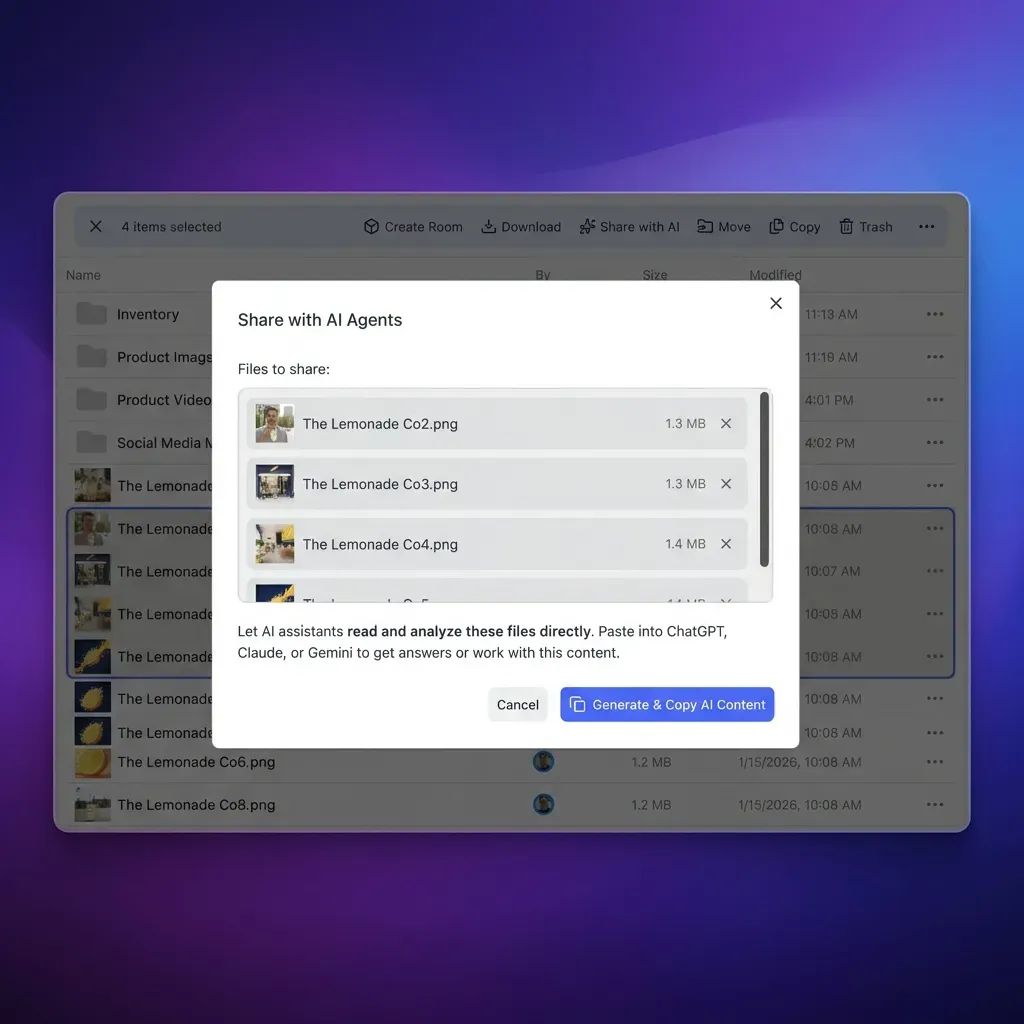


Give Your AI Agents Persistent Storage
Stop relying on ephemeral local storage. Connect persistent, cloud-native storage for your AI agents with Fastio's 14-day Business Trial.
Step-by-Step: Connecting Mastra to Fastio
Here is how to give your Mastra agent cloud storage capabilities using the Model Context Protocol (MCP).
First: Set up the Fastio MCP Server Fastio offers a 14-day Business Trial, card required; see Fastio pricing. First, sign up to get credentials. Then, configure the Fastio remote MCP server in your environment. This server exposes a consolidated MCP toolset for file operations, uploads, and search to your agent.
Next: Define the tool in Mastra In your Mastra agent configuration, you can import and register these tools. Since Mastra supports typed tool definitions, you can map the MCP tools directly to agent capabilities.
// Example pseudo-code for tool integration
import { Agent } from '@mastra/core';
import { fastIoTools } from './mcp-config';

const researchAgent = new Agent({
  name: 'Researcher',
  model: 'gpt-4',
  tools: {
    saveReport: fastIoTools.uploadFile.
    readDataset: fastIoTools.readFile
  },
  instructions: 'You are a researcher. Read data from the dataset, analyze it, and save your final report to the "Reports" folder.'
});
Then: Execute the workflow When the agent runs, it can now decide to read a CSV file from your Fastio workspace, perform analysis, and write a Markdown report back to storage. This file is immediately accessible to you via the Fastio dashboard, making human-in-the-loop workflows easy.
Best Practices for TypeScript Agents
To get the most out of Mastra and your AI agents, follow these development best practices:
- Type Everything: Use TypeScript's features. Define interfaces for your tool inputs and outputs. This prevents the LLM from hallucinating invalid parameters and ensures runtime safety.
- Use Evaluators: Don't guess if your agent is working. Implement Mastra's evaluation capabilities to run test cases against your prompts and logic whenever you make changes.
- Externalize State: Keep your agents stateless by offloading memory to a database and file storage to a service like Fastio. This allows your agents to scale horizontally.
- Human Handoff: Design points in your workflow where the agent can pause and request human review. Using a shared storage workspace is an excellent way to manage this. The agent uploads a draft to a shared workspace and waits for human review.
Sources
References used to verify factual claims in this guide.
-
65% of developers have done extensive development work in JavaScript
-
Fastio offers a 14-day Business Trial with paid plans starting at $9.99/mo.
Frequently Asked Questions
What is the Mastra AI framework?
Mastra is an open-source TypeScript framework for building AI agents and workflows. It provides tools for LLM integration, memory management, RAG pipelines, and automated evaluations, catering specifically to JavaScript and TypeScript developers.
How does Mastra compare to LangChain?
While LangChain offers a vast ecosystem for both Python and JavaScript, Mastra provides a more opinionated, cohesive architecture specifically for TypeScript. Mastra focuses heavily on production-grade workflows and built-in components like RAG and evals, whereas LangChain is often used for broader experimentation.
Can Mastra agents use MCP tools?
Yes, Mastra agents can be configured to use tools compatible with the Model Context Protocol (MCP). This allows them to connect to external services like Fastio for file storage, database access, and other capabilities without writing custom integration code.
How do I add file storage to Mastra agents?
The best way to add storage is to integrate a cloud-native solution like Fastio. By connecting your Mastra agent to Fastio (via API or MCP), the agent can read, write, and organize files in the cloud, ensuring data persists across execution sessions and is accessible to human collaborators.
Related Resources

Give Your AI Agents Persistent Storage
Stop relying on ephemeral local storage. Connect persistent, cloud-native storage for your AI agents with Fastio's 14-day Business Trial.