How to Set Up a Litigation Data Room for Case Document Management
A litigation data room gives legal teams a secure workspace to organize discovery materials, manage privilege logs, and share case documents under protective orders. This guide covers the practical setup, folder structure, access controls, and review workflows that keep litigation documents organized from filing through resolution.


What a Litigation Data Room Actually Does
A litigation data room is a secure virtual workspace where legal teams organize, review, and share case documents throughout litigation proceedings. It holds discovery materials, privilege logs, expert reports, deposition transcripts, and correspondence, all in one controlled environment with tracked access.
Most data room content on the web targets deal-making. M&A data rooms manage buyer due diligence, with workflows built around document indexing, Q&A between parties, and deal timelines. Litigation data rooms solve different problems. The documents are adversarial. Access is governed by court orders, not business relationships. And the stakes around privilege and confidentiality are higher, since a single misproduced document can waive privilege for an entire subject matter.
The core requirements break down into five areas:
- Document organization with consistent numbering (Bates stamps), folder hierarchies that mirror case structure, and version tracking across drafts
- Privilege management so attorneys can tag, review, and log privileged documents before any production
- Access controls that enforce protective order terms, restricting who can view confidential, attorneys-eyes-only, or highly confidential materials
- Audit trails recording every view, download, and share for defensible discovery compliance
- Controlled sharing that lets you produce documents to opposing counsel without losing control over access
E-discovery spending remains significant. Processing costs run $25 to $100 per gigabyte depending on the platform and service tier, and document review still accounts for over 80% of total litigation spend according to the American Bar Association. A well-organized data room reduces both by cutting down on redundant review cycles and making documents findable the first time.
Helpful references: Fastio Workspaces, Fastio Collaboration, and Fastio AI.
Related guides
- How to Set Up a Bankruptcy Data Room for Creditors and BiddersA bankruptcy data room is a secure virtual workspace used to share financial records, asset inventories, and legal...
- How to Set Up a Private Placement Data RoomA private placement data room is a secure virtual workspace where issuers share private placement memorandums,...
- How to Set Up a Data Room for Renewable Energy ProjectsRenewable energy transactions involve dozens of specialized documents that generic file-sharing tools weren't built to...
- How to Set Up a Multi-Agent Data Room for Secure CollaborationA multi-agent data room gives AI agents a secure place to work together on files. Version history and permissions...
- Open Source Data Room Options for Secure Document SharingThere is no single open source tool that replicates every feature of a commercial virtual data room. But several...
- How to Set Up AI Agent Due Diligence Data RoomsDue diligence data rooms with AI agents automate document reviews in secure VDRs. Manual DD takes weeks. AI agents...
More on this subject: Data Rooms and Due Diligence (53 guides)
What to check before scaling litigation data room
The folder structure in a litigation data room should mirror how attorneys actually work a case, not how a file server organizes documents alphabetically. Start with top-level folders that match litigation phases, then nest by document type within each phase.
A practical structure looks like this:
- 01 - Pleadings: complaints, answers, motions, court orders
- 02 - Discovery: interrogatories, requests for production, responses, meet-and-confer correspondence
- 03 - Document Productions: outgoing productions organized by Bates range, incoming productions by producing party
- 04 - Depositions: transcripts, exhibits, errata sheets, video files
- 05 - Expert Materials: reports, rebuttal reports, underlying data, correspondence with experts
- 06 - Privilege Log: the running log, supporting documentation, and clawback correspondence
- 07 - Trial Preparation: exhibit lists, witness outlines, motions in limine, jury instructions
- 08 - Correspondence: letters between counsel, court correspondence, client communications
- 09 - Internal Work Product: case strategy memos, research, timelines, damage models
Number your top-level folders so they sort in workflow order, not alphabetically. When a paralegal needs the latest production, they go straight to folder 03 instead of hunting through an alphabetical list.
Bates Numbering Conventions
Bates numbering remains the standard for tracking produced documents in litigation. Each page gets a unique sequential identifier, typically formatted as a party prefix followed by a zero-padded number: SMITH-000001 through SMITH-099999.
Agree on numbering conventions with opposing counsel early. Key decisions include prefix format, number of digits (six or eight are common), whether native files get Bates stamps or use the number as a filename, and how to handle families of documents (email plus attachments). Many ESI protocols now explicitly require parties to document these decisions in a joint Bates numbering agreement.
Within your data room, create a subfolder per production batch under the Document Productions folder. Name each subfolder with the Bates range: Production 001 (SMITH-000001 to SMITH-004523). This makes it simple to locate any document by its Bates number without searching.
Access Controls and Protective Order Compliance
Protective orders in litigation create tiered confidentiality levels. A typical stipulated protective order defines at least three tiers:
- Confidential: viewable by outside counsel and their staff, in-house counsel, and designated experts
- Attorneys' Eyes Only (AEO): restricted to outside counsel and specific support staff, excluding in-house counsel and business employees
- Highly Confidential: further restricted, sometimes limited to lead counsel and a single designated paralegal
Your data room's permission system needs to enforce these tiers. That means assigning users to groups that correspond to confidentiality levels, then restricting folder and file access based on those groups. If a document is designated AEO, the in-house legal team should not be able to see it, period. No workarounds, no exceptions.
Granular permissions at the file and folder level are essential here. Platforms that only offer workspace-wide access roles will not work for protective order compliance. You need the ability to set view, download, and print permissions independently for each confidentiality tier.
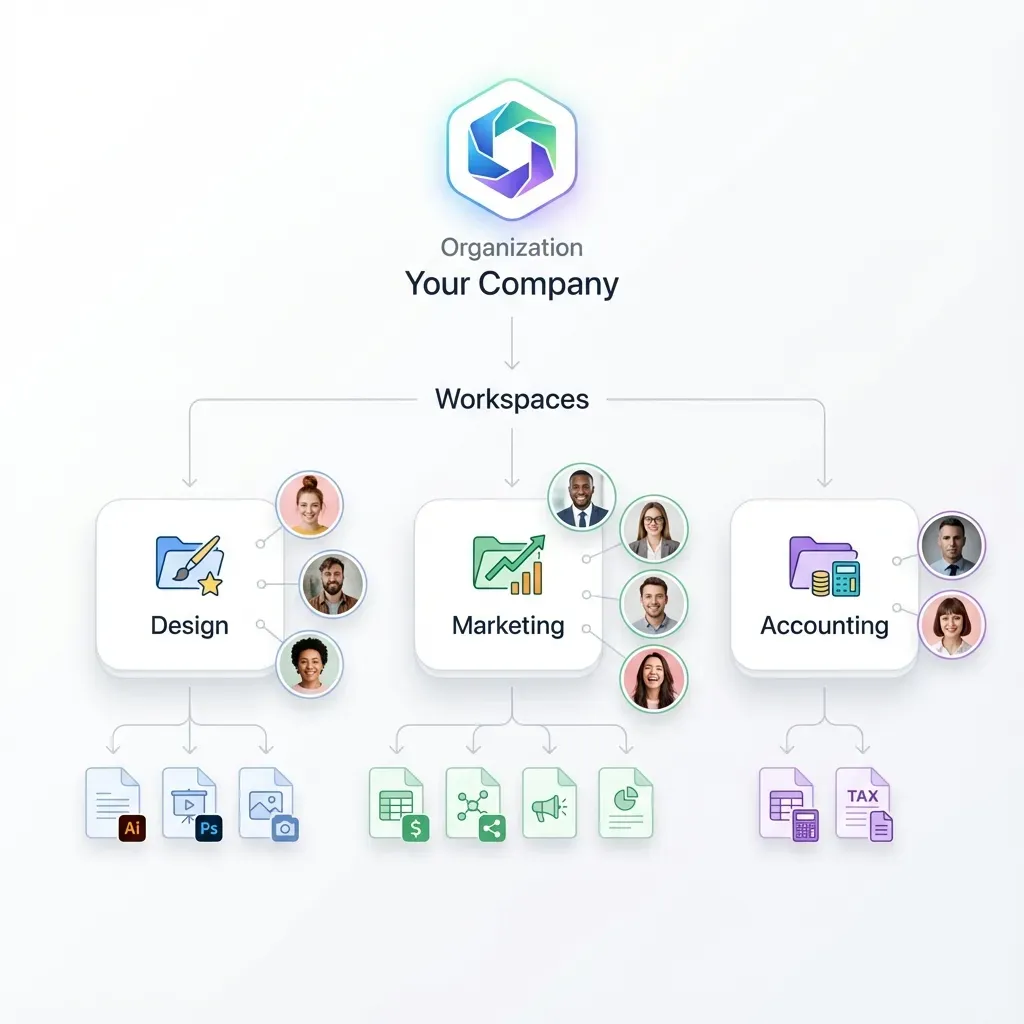
Fastio handles this with org, workspace, folder, and file-level permissions. You can create separate workspaces per confidentiality tier, or use folder-level restrictions within a single workspace. Either approach works, but the separate workspace model is cleaner for cases where the tiers have completely different user groups.
Download and Print Restrictions
Some protective orders prohibit printing certain document categories or require watermarking on all printed materials. Your data room should support:
- View-only access that blocks downloads entirely
- Download permissions that differ by user role
- Watermarking with the viewer's identity on displayed and downloaded documents
- The ability to revoke access to previously shared documents if a designation changes
Audit Trail Requirements
Courts expect parties to demonstrate they followed protective order terms. An immutable audit trail that logs every document view, download, print, and share, with timestamps and user identification, provides that evidence. If opposing counsel alleges a protective order violation, you need records showing exactly who accessed what and when.
Fastio's audit trails record every action within workspaces and shares. Activity summaries can be exported for court filings or privilege disputes, giving you a defensible record without manual logging.



Organize Your Case Documents in One Secure Workspace
Set up a litigation data room with granular permissions, audit trails, and AI-powered document search.
Privilege Review Workflows
Privilege review is where litigation data rooms diverge most sharply from deal rooms. In M&A, documents are curated before uploading. In litigation, you are often working with large collections that have not been pre-screened, and the consequences of producing a privileged document range from embarrassment to subject-matter waiver.
Setting Up a Privilege Review Process
A reliable privilege review workflow has three stages:
Pre-screening: Before human reviewers touch documents, run automated scans for attorney names, law firm domains, and privileged keywords (e.g., "attorney-client," "work product," "legal advice"). Flag these documents for priority review.
First-pass review: Reviewers examine flagged documents and make privilege calls. Each document gets tagged as privileged, not privileged, or needs senior review. Use consistent tagging conventions across the team to avoid conflicts.
Quality control: A senior attorney reviews a sample of privilege calls, plus all documents tagged for escalation. This catch layer is where you find the privilege calls that a junior reviewer missed, which happens more often than anyone wants to admit.
Building the Privilege Log
Federal Rule of Civil Procedure 26(b)(5) requires parties to describe withheld documents with enough specificity that opposing counsel can assess the privilege claim. A privilege log entry typically includes:
- Bates or control number
- Date of the document
- Document type (email, memo, letter)
- Author and recipients
- Subject matter description (without revealing privileged content)
- Privilege claimed (attorney-client, work product, joint defense)
- Basis for the claim
Maintain the privilege log as a living document within your data room. Update it as new privilege calls are made during rolling productions. Exporting the log as a CSV or spreadsheet from your document management system simplifies the required disclosures to opposing counsel.
Clawback Protocols
Even with careful review, privileged documents sometimes get produced accidentally. Federal Rule of Evidence 502(b) protects against inadvertent waiver if you took reasonable steps to prevent disclosure and promptly sought to rectify the error. Your data room should let you revoke access to a specific document immediately after discovering an inadvertent production, with an audit trail showing the clawback timeline.
Sharing Documents With Opposing Counsel
Producing documents to opposing counsel requires a controlled handoff. You need to share specific document sets without giving the other side access to your entire case file, work product, or privileged materials.
There are a few common approaches:
Dedicated production shares. Create a separate share or workspace for each production. Upload only the documents cleared for production, organized by Bates range. Grant opposing counsel view access (and download access where permitted by the protective order). This is the cleanest approach because production shares are completely isolated from your internal case workspace.
Export and transfer. Export the production set as a ZIP archive with a Bates-stamped load file, then transfer it via a secure share link with download tracking. This works when opposing counsel prefers to ingest documents into their own review platform.
Rolling productions. For cases with ongoing discovery, create a persistent production workspace and add new batches as they are produced. Name each batch folder with the production date and Bates range so both sides can track what was produced when.
Fastio's share types map well to these patterns. A Send share lets you package a production and deliver it with download tracking and expiration controls. A Room share works for persistent production workspaces where opposing counsel needs ongoing access. Both record who accessed which files and when.
For large productions, chunked uploads handle files of up to 100 GB on the Enterprise plan without browser timeouts. That matters when you are producing native email archives, database exports, or multimedia evidence files that smaller platforms choke on.
Expert Report Distribution
Expert reports often require restricted distribution under protective orders. Create a separate folder or share for expert materials with access limited to the parties and roles specified in the order. When rebuttal reports come in, add them to the same controlled space so all expert materials stay in one place with consistent access controls.
Choosing the Right Platform
The litigation data room market splits into three categories: dedicated e-discovery platforms, general-purpose VDRs, and workspace platforms that can be configured for litigation use.
Dedicated E-Discovery Platforms
Tools like Relativity, Everlaw, and Logikcull are purpose-built for document review. They include TAR (technology-assisted review), native Bates stamping, production formatting, and integrated privilege logging. If your case involves more than 100,000 documents, these platforms pay for themselves in review efficiency. Relativity announced in late 2025 that its AI-powered review and privilege tools would be included in standard RelativityOne pricing starting in 2026, making the AI tier more accessible.
The downside is cost. Processing fees, per-GB hosting charges, and per-user seats add up quickly. For smaller cases or matters with modest document volumes, you may be paying for capabilities you do not need.
General-Purpose VDRs
Platforms like iDeals, Firmex, and Intralinks offer strong security, audit trails, and access controls. They are popular with law firms already using them for M&A work, since the team knows the interface. But they lack litigation-specific features like Bates numbering, privilege log generation, and TAR. You would need to handle those workflows in a separate tool, then upload the processed documents.
Workspace Platforms
Fastio sits in this category. It provides the core infrastructure litigation teams need: granular permissions at the folder and file level, detailed activity logs, branded shares for document production, and AI-powered document search through its Intelligence feature. When Intelligence is enabled on a workspace, uploaded documents are automatically indexed for semantic search and AI chat, which means attorneys can ask questions like "find all documents mentioning the settlement deadline" and get results with page-level citations.
The tradeoff is that Fastio does not include native Bates stamping or integrated privilege log generation. Those workflows would happen in your e-discovery tool or document management system before uploading to Fastio for organized storage, controlled sharing, and client collaboration.
For cases where the primary need is secure document organization and controlled sharing rather than high-volume document review, a workspace platform is often the right fit. A 14-day Business Trial requiring a credit card makes it practical to spin up a case workspace quickly and evaluate features; see /pricing/ for details.
Decision Framework
Pick based on your actual needs:
- High-volume review (100K+ documents): Use Relativity or Everlaw for review, then export productions to a data room for sharing
- Mid-volume cases with active productions: A general-purpose VDR with strong access controls covers most needs
- Client collaboration and document sharing: A workspace platform like Fastio handles organization, controlled access, and AI-powered search without per-page pricing
- Hybrid approach: Use an e-discovery platform for review and processing, then move finalized productions to a workspace or VDR for long-term storage and sharing
Sources
References used to verify factual claims in this guide.
-
Document review accounts for over 80% of total litigation spend, equivalent to roughly $42 billion annually E-discovery processing costs range from $25 to $100 per gigabyte Relativity announced AI-powered review and privilege tools included in standard RelativityOne pricing starting in 2026
-
Per-document AI review costs have converged around $0.11 to $0.50, down from $1.50 to $3.00 for human reviewers
Frequently Asked Questions
What is a litigation data room?
A litigation data room is a secure virtual workspace used by legal teams to organize, review, and share case documents during litigation proceedings. It holds discovery materials, privilege logs, expert reports, deposition transcripts, and correspondence in a controlled environment with tracked access and permission-based sharing.
How do law firms organize litigation documents?
Law firms typically organize litigation documents in numbered folders that mirror case phases, such as pleadings, discovery, document productions, depositions, expert materials, and privilege logs. Within each folder, documents are identified by Bates numbers, which are unique sequential identifiers assigned to every page for tracking and reference during production.
What is the difference between a data room and e-discovery?
A data room is a secure storage and sharing environment for organizing documents and controlling access. E-discovery is the broader process of identifying, collecting, processing, reviewing, and producing electronically stored information in litigation. Data rooms are often used as part of the e-discovery workflow, particularly for storing processed documents and sharing productions with opposing counsel, but they do not replace the review and processing capabilities of dedicated e-discovery platforms.
How much does e-discovery cost per gigabyte?
E-discovery processing costs range from $25 to $100 per gigabyte depending on the platform and service tier. Document review, which accounts for over 80% of total litigation spend according to the American Bar Association, adds to the total. AI-powered review tools have brought per-document review costs down to $0.11 to $0.50, compared to $1.50 to $3.00 for manual human review.
What should a privilege log include?
A privilege log should include the Bates or control number, document date, document type, author and recipients, a subject matter description that does not reveal privileged content, the privilege claimed (attorney-client, work product, or joint defense), and the basis for the claim. Federal Rule of Civil Procedure 26(b)(5) requires enough specificity for opposing counsel to assess each privilege assertion.
Can you use a general data room for litigation?
Yes, general-purpose data rooms work well for litigation document organization and sharing, particularly for cases with moderate document volumes. The key requirements are granular folder and file-level permissions, immutable audit trails, and the ability to restrict downloads and printing. However, for high-volume cases requiring technology-assisted review or native Bates stamping, you will likely need a dedicated e-discovery platform for the review phase before moving finalized documents into a data room for storage and sharing.
Related Resources

Organize Your Case Documents in One Secure Workspace
Set up a litigation data room with granular permissions, audit trails, and AI-powered document search.