How to Architect Invoice Processing Agent Storage for AP Automation
Learn how to build a scalable storage architecture for AI agents that extract and validate invoice data before routing it to the right systems. According to market research, AP automation is expected to reach $3.1B by 2025. AI invoice processing reduces manual work. However, these gains only happen when agents have a central, programmatic way to access and organize documents.


How to implement invoice processing agent storage reliably
Invoice processing agent storage manages workflows for AI agents that handle extraction, validation, and data routing for accounts payable. Most teams focus on the AI model or the OCR engine, but the underlying storage infrastructure determines how well the system scales. Without a persistent storage layer, AI agents struggle with state management, leading to fragmented data and lost audit trails.
More companies are moving toward autonomous AP systems. The AP automation market is projected to reach $3.1B by 2025 as businesses seek to eliminate manual data entry. AI invoice processing reduces manual work. These efficiency gains are only possible when agents have a central, programmatic way to access and organize documents.
Unlike traditional document management, agent-first storage must support high-concurrency access and automated indexing. When an agent receives a large batch of invoices, it needs to store the raw files and trigger OCR. It then stores the structured output in a way that remains searchable for humans and other agents.
Helpful references: Fastio Workspaces, Fastio Collaboration, and Fastio AI.
Why AP Automation Needs Agentic Storage
Traditional accounts payable workflows rely on human clerks to sort files, scan documents, and input data manually. When you introduce an AI agent, the bottleneck shifts from data entry to data access. If an agent has to log into a legacy portal or search through fragmented email attachments, the speed of the AI model is wasted.
Agentic storage provides a unified endpoint for all incoming financial documents. By centralizing invoices in a cloud-native environment, agents can process files as soon as they arrive. This reduces the invoice-to-payment cycle from weeks to minutes. It also allows businesses to take advantage of early payment discounts and improve vendor relationships.
Moving Beyond Legacy OCR Systems
Legacy OCR systems often produce flat text files that require extensive post-processing. Modern AI agents use multimodal models to understand the spatial relationship between fields on an invoice. This requires storage that can handle high-resolution previews and original file formats without losing quality.
When an agent stores an invoice in a system built for AI, it gains access to advanced preview engines. Fastio, for instance, allows agents to generate temporary context links. These links can be passed to models like GPT-4o or Claude Sonnet, allowing the model to "see" the invoice exactly as a human would. This leads to much higher extraction accuracy.
Related guides
- AI Automation Storage API: Persistent Storage for Autonomous AgentsAn AI automation storage API provides programmatic access to persistent file storage that autonomous agents can use to...
- How to Integrate Dify File Storage for AgentsDify defaults to local file storage, which limits scalability and agent capabilities.
- How to Integrate Dify AI with External File StorageDify is an open-source platform for building AI applications with visual workflows. Its built-in file handling works...
- How to Set Up File Storage for n8n AI Workflowsn8n AI workflows need persistent file storage to save documents, process AI outputs, and build RAG pipelines. This...
- How to Implement Persistent Storage for AutoGen using Fastio APIAdding persistent storage to AutoGen via Fastio API allows multi-agent conversations to share and modify files reliably...
- How to Build CI/CD Pipelines for AI Agents with StorageCI/CD for AI agents needs more than just code deployment. It requires managing prompts, models, and RAG datasets...
More on this subject: Agent Memory and Storage (263 guides)
What to check before scaling invoice processing agent storage
One of the biggest mistakes in AI agent architecture is relying on ephemeral storage within the agent's runtime environment. When an invoice processing agent runs in a container or a serverless function, any local storage is wiped once the task is finished. This creates a massive gap in the audit trail. Financial data requires persistence.
Fastio provides persistent cloud storage where agents sign up for their own accounts. This allows the agent to maintain a long-term memory of vendor records, historical invoice formats, and previous validation results. By using a persistent layer, the agent can resume tasks if a process is interrupted, which is important for long-running batch jobs.
Agents can create dedicated workspaces for different clients or departments. This organization-first model ensures that files belong to the company, not individual user accounts. If an agent builds a workspace and populates it with processed invoices, a human can easily step in to review the work without needing to transfer file ownership.
The Danger of Data Silos in AP
When financial documents are stored in personal folders or individual user accounts, it creates data silos. If the person who manages the "Invoices" folder leaves the company, the agent loses access to its training data and historical records. Persistent storage solves this by making the organization the primary owner of all assets.
In an agent-first architecture, the agent functions as a first-class citizen with its own workspace. This allows the agent to organize files according to its internal logic. For example, an agent might create a hierarchical structure based on vendor ID and fiscal year, ensuring that every document is filed correctly without human intervention.
Handling High-Volume Batch Processing
Processing thousands of invoices per month requires storage that can handle rapid-fire upload and download operations. Ephemeral systems often fail under the weight of high-volume batches because they lack the bandwidth and I/O performance needed for sustained AI operations.
Persistent storage architectures are designed for this scale. By using cloud-native storage that streams files on demand, agents can process large batches without needing to download every file to a local disk. This saves time and reduces infrastructure costs, as the agent only consumes the resources it needs for the active processing task.
Improving OCR and Data Extraction Workflows
The core of AP automation is converting unstructured PDF or image files into structured data. This process, often called Intelligent Document Processing (IDP), relies on a feedback loop between storage and the AI model. The agent pulls a raw invoice from a shared folder and sends it to an OCR service. It then writes the extracted JSON data back to that same workspace.
Using the Fastio MCP server, developers can give agents access to a consolidated toolset for managing these files. Agents can read invoice contents and save extracted metadata directly in the workspace. This programmatic control eliminates the need for complex custom middleware.
To coordinate multiple agents processing the same batch, the architecture uses advisory file locks. An agent acquires a file lock before validating or updating an invoice, heartbeats it while working, and releases it when finished. Another agent attempting to lock the same file receives an HTTP 409 and can move to the next item, while automatic version history preserves every change as a safety net.

Automating the Feedback Loop
A successful IDP pipeline requires a continuous feedback loop. When an agent extracts data, it should also store its confidence scores. If the confidence score is below a certain threshold, the agent can move the file to a "Review Needed" folder.
This automated routing is powered by activity feeds and event monitoring. Agents can poll Fastio's activity feed or listen to the WebSocket events feed whenever a new file is uploaded to the "Incoming" workspace. The agent then performs the extraction and moves the file to "Processed" or "Flagged." This reactive architecture ensures that no invoice is left unaddressed.
Structured Output and Metadata Management
Extracted data is only useful if it is easy to retrieve. Instead of just storing a text file, agents can attach metadata directly to the invoice file. This metadata can include the invoice number, total amount, tax, and due date.
By storing structured data as file metadata, the storage layer becomes a searchable database. You can perform queries based on these fields, such as finding all unpaid invoices with a due date in the next seven days. This turns a simple file folder into a powerful financial management tool.
Enabling Agentic RAG for Financial Intelligence
Storage for invoice AI is not just about holding files; it is about making that data useful for decision-making. By enabling Intelligence Mode on a workspace, Fastio automatically indexes all invoices for Retrieval-Augmented Generation (RAG). This allows agents and humans to ask natural language questions about their financial data.
An agent can query the workspace to find discrepancies: "Show me all invoices from Acme Corp in Q3 that exceed our typical limit." The system performs a semantic search, finds the relevant documents, and provides an answer with direct citations to the source files. This level of transparency is necessary for financial auditing and fraud detection.
The built-in RAG capabilities mean you do not need to manage a separate vector database like Pinecone. The storage layer handles the embeddings and indexing automatically. This simplifies the agentic workflow, allowing the agent to focus on validation logic rather than infrastructure management.
Semantic Search vs Keyword Matching
Traditional search relies on exact keyword matches, which fails when invoices use different terminology for the same thing (e.g., "Bill To" vs "Customer"). Semantic search uses embeddings to understand the intent behind the query, finding relevant documents even if the exact words don't match.
For an AP team, this means finding "all travel expenses for the San Francisco conference" is a simple natural language query. The AI agent searches through thousands of receipts and invoices, identifies the ones related to travel and the specific location, and presents them in a summarized report.
Contextual Awareness in Multi-Agent Systems
In a multi-agent system, different agents might be responsible for different parts of the AP process. One agent extracts the data, another validates it against the purchase order, and a third prepares the payment file. For this to work, every agent needs access to the same contextual information.
By using a shared RAG index, all agents stay aligned. When the validation agent asks about a specific vendor's history, it gets the same answer that the extraction agent saw. This shared context prevents errors and ensures that the entire autonomous pipeline operates on a single source of truth.


Start with invoice processing agent storage on Fastio
Start your 14-day Business Trial. Give your AI agents persistent storage, a consolidated MCP toolset, and built-in RAG to build an AP automation system.
Security and Auditability in AP Automation
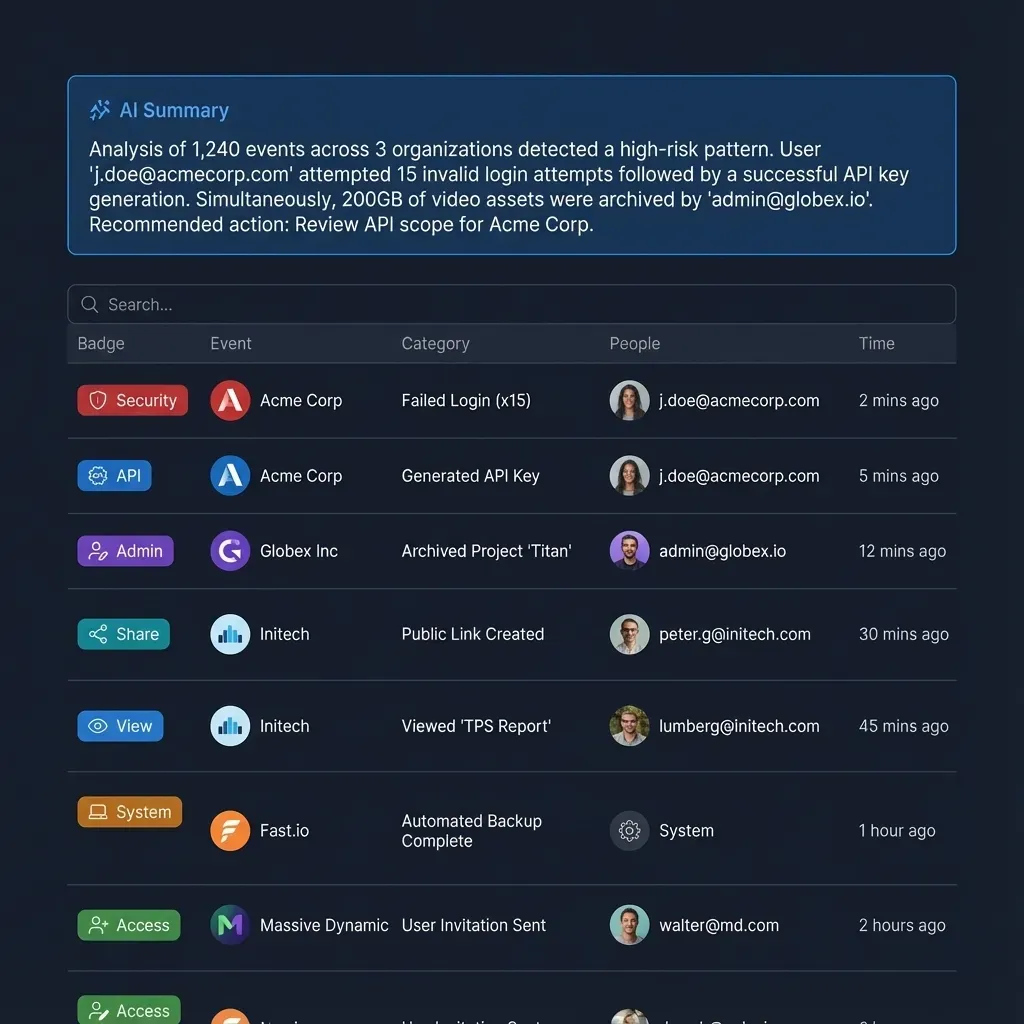
Security is the primary concern for any accounts payable system. Invoice processing involves sensitive vendor data and banking information. A secure storage architecture must include granular permissions and detailed activity logs.
Fastio tracks every action taken within a workspace. The audit log records who uploaded a file, who viewed it, and when a permission was changed. For AI agents, this means every "read" and "write" operation is documented. If an agent makes an error in a validation step, the audit trail shows exactly which version of the file it was looking at.
Granular permissions allow you to restrict an agent's access to specific folders. You can give an "Extraction Agent" write-access to a "Raw Invoices" folder but only read-access to a "Vendor Master List." This principle of least privilege reduces the risk of accidental data deletion or unauthorized changes to financial records.
Ensuring Financial Compliance
While Fastio provides the technical tools for security, it is up to the architecture to ensure compliance with financial regulations. Detailed logs are a major part of this. By keeping a detailed activity log of file access, retained according to their plan, businesses can provide evidence of due diligence during an external audit.
The system also supports encryption at rest and in transit. This ensures that even if an agent pulls a file from a public URL via OAuth, the data remains protected as it moves through the processing pipeline. This multi-layered security approach is standard for enterprise-grade AP automation.
Managing External Vendor Access
AP automation often involves receiving documents from external vendors. Instead of letting vendors upload to a generic email inbox, you can create branded upload portals. These portals allow vendors to drop invoices directly into a secure, monitored folder.
The AI agent can then monitor this folder and begin processing immediately. This removes the "middleman" of the email server, reducing the risk of phishing attacks and ensuring that only authorized documents enter the system. You can even set expiration dates on these portals to ensure they are only active for specific billing cycles.
Building the Human-Agent Handoff
Automation should not mean a total loss of human oversight. Effective invoice processing architecture includes "Human-in-the-Loop" (HITL) checkpoints. When an agent identifies a high-risk invoice or a low-confidence OCR result, it should flag the file for human review.
In Fastio, agents can use contextual comments to leave notes for human teammates. An agent might tag a file with a comment like, "Low OCR confidence on the total amount. Please verify." The human user receives a notification, reviews the file in the browser using the universal media engine, and resolves the issue.
Once the processing is complete, agents can transfer ownership of the entire workspace to a human supervisor. This is a unique feature for agencies building automation for clients. The agent builds the data room, populates it with processed documents, and then hands the keys to the client while retaining admin access for future maintenance.
Simplifying the Review Process
When a human needs to review an invoice, they shouldn't have to download multiple files. Fastio’s universal media engine allows reviewers to view PDFs or high-resolution images directly in the browser. It even supports CAD files. This speeds up the validation process and keeps the data within the secure environment.
The agent can even pre-annotate the file. By leaving a region-anchored comment on the specific part of the invoice that caused the low confidence score, the agent guides the human reviewer to the problem area. This targeted feedback saves time and makes the HITL workflow more efficient.
Ownership Transfer and Long-Term Archival
Once an invoice is paid, it needs to be archived for several years to meet tax and legal requirements. The agent can automatically move paid invoices to an "Archives" workspace with stricter access controls. This ensures that the active workspace remains uncluttered while the historical data is preserved.
If the agent was built by an external contractor, the ownership transfer feature allows the contractor to hand over the entire archive to the client. The client becomes the legal owner of the data, while the agent (or the agency that built it) can maintain administrative access to ensure the system continues to run smoothly. This clean handoff is necessary for professional services and enterprise deployments.
Sources
References used to verify factual claims in this guide.
-
AP automation market projected to reach $3.1B by 2025 as businesses seek to eliminate manual data entry
-
While the agent uses an external model (like GPT-4 or Claude) for the actual text extraction
Frequently Asked Questions
How to store invoices for AI processing?
Invoices should be stored in a centralized, cloud-native repository that supports programmatic access via API or MCP. Use a structure that separates raw uploads and processing queues from validated outputs. Ensure the storage supports automatic indexing for RAG to allow agents to query invoice data in natural language.
What is the best storage for AP automation?
The best storage for AP automation is persistent and secure, specifically designed for agentic workflows. Unlike ephemeral local storage, persistent cloud storage like Fastio ensures that audit trails and historical records are preserved. It should also offer predictable plans with metered overage, so costs stay manageable as invoice volumes fluctuate.
How does invoice AI data management work?
Data management involves the lifecycle of an invoice from ingestion to archival. AI agents use URL imports to pull files from external sources, track modifications through version history and audit logs, and use Intelligence Mode to index the content automatically. Structured data extracted from the invoice is then saved as metadata or companion files for easy retrieval.
Can AI agents manage invoice permissions?
Yes, AI agents using Fastio can manage granular permissions via the API. This allows agents to create secure shared folders for vendors or invite human reviewers to specific workspaces. Agents can also set expiration dates or password protection on shared links to protect sensitive financial data.
Does Fastio support OCR directly?
Fastio provides the storage and RAG infrastructure that powers OCR workflows. While the agent uses an external model (like GPT-4 or Claude) for the actual text extraction, Fastio handles persistent file storage and data indexing. It also delivers the files to the agent via the MCP server.
Related Resources

Start with invoice processing agent storage on Fastio
Start your 14-day Business Trial. Give your AI agents persistent storage, a consolidated MCP toolset, and built-in RAG to build an AP automation system.