How to Integrate Fastio API with Supabase Edge Functions
Connecting the Fastio API with Supabase Edge Functions lets you process file uploads and metadata without heavy backend infrastructure. Edge functions run close to users to reduce latency for API-driven workflows. This guide covers the Deno implementation needed to connect both platforms and build intelligent agent workspaces.


What Are Supabase Edge Functions and Why Use Them for File Processing?
Routing large assets through centralized servers often adds latency and complexity to file processing architectures. By connecting the Fastio API with Supabase Edge Functions, you can handle file uploads and metadata without heavy backend infrastructure. Edge functions run close to users, which reduces latency for API-driven workflows.
Supabase Edge Functions run TypeScript natively via Deno. You get instant cold starts and direct access to standard Web APIs like fetch. Developers building with Fastio can poll workspace activity, add members, and call Ripley, the built-in RAG agent, without provisioning servers. You can also coordinate AI agent access directly from the edge.
Many older tutorials default to AWS Lambda for backend logic. Lambda brings cold starts and forces you to bundle dependencies. Supabase Edge Functions simplify deployment by keeping the compute layer near your database and storage. This setup works well when you need to extract file metadata or start a Ripley chat after a user uploads an asset to a shared workspace.
Related guides
- How to Use AI Agents for KEDA AutoscalingAI agent KEDA autoscaling uses agents to dynamically scale workloads based on events. KEDA, Kubernetes Event-driven...
- How to Design Serverless AI Agent ArchitectureServerless AI agent architecture lets agents run on-demand using FaaS platforms like AWS Lambda, with external services...
- Fastio API vs Cloudflare R2: Best Storage for AI AgentsCloudflare R2 works well for egress-free blob storage, but Fastio provides the structured workspaces, RAG integration,...
- How to Integrate AI Agents with Argo CDAI agent Argo CD integration enables autonomous continuous deployment management through GitOps principles. Agents can...
- How to Integrate Nextcloud with AI AgentsIntegrating Nextcloud with AI agents allows autonomous systems to read, write, and analyze files directly from your...
- Best Edge AI Platforms in 2026: Hardware, Software, and Fleet Management ComparedThe edge AI market reached $24.91 billion in 2025, yet most comparisons still separate hardware from software, leaving...
More on this subject: Agent Infrastructure and Deployment (55 guides)
Prerequisites for the Fastio and Supabase Integration
Before writing code, make sure your local environment and cloud accounts are ready. You will need access to both platforms and their command-line tools.
First, set up an active Fastio account. If you want to build agentic workflows, start a Business Trial at Fastio Pricing. Generate an API key in Settings > Devices & Agents > API Keys, or create one with POST /current/user/auth/key/. Authenticated calls use Authorization: Bearer {api_key} against https://api.fast.io/current/. Keep the trailing slashes.
Next, create a Supabase project through their dashboard. Once your project is live, install the Supabase CLI on your local machine. You need this to generate and deploy edge functions.
Finally, install the Deno CLI. Since Supabase Edge Functions run on Deno, your local editor needs the runtime for accurate TypeScript linting and standard Web API autocomplete. Visual Studio Code works well when you enable the official Deno extension for your workspace.
Step One: Initializing Your Supabase Edge Function
You can create a new edge function in Supabase with a few terminal commands. The Supabase CLI sets up the directory structure and generates a boilerplate TypeScript file.
Open your terminal and go to the root directory of your Supabase project. Run this command to create a new function called fastio-handler:
supabase functions new fastio-handler
You will see a new folder inside your supabase/functions directory containing an index.ts file. This is the entry point for your edge function. Deno uses standard ES modules, so you can skip the package.json file and import external dependencies directly via URLs.
To test locally, start the development environment with supabase start, then run supabase functions serve fastio-handler. You can now send HTTP POST requests to your local endpoint to build your Fastio integration without waiting on cloud deployments.
Step Two: Configuring Fastio API Authentication Securely
Never hardcode API keys into your TypeScript files. Supabase includes a secrets management system that injects environment variables into your edge functions at runtime.
Use the Supabase CLI to configure your Fastio API key. Run this command in your terminal and replace the placeholder with your actual key:
supabase secrets set FASTIO_API_KEY=your_live_api_key_here
After setting the secret, you can access it inside your Deno function using the native environment variable API. This gives you a secure way to read values without installing external libraries.
Retrieve the key in your index.ts file like this:
const fastioApiKey = Deno.env.get("FASTIO_API_KEY");

if (!fastioApiKey) {
  throw new Error("Missing Fastio API key in environment variables.");
}
Your function will now fail immediately if the authentication configuration is missing, which prevents confusing authorization errors during runtime. For local development, create a .env.local file in your supabase directory to store test keys. The Supabase CLI loads them automatically when serving the function.

Step Three: Calling the Fastio API from Deno
Deno natively supports the Fetch API, so you do not need third-party HTTP clients like Axios to make requests to Fastio. You can build standard requests and handle JSON responses directly.
This example shows a Supabase Edge Function that receives an HTTP request, extracts a workspace ID from the payload, and uses the API to retrieve workspace details.
import { serve } from "https://deno.land/std@0.168.0/http/server.ts"

serve(async (req) => {
  try {
    const { workspaceId } = await req.json();
    const apiKey = Deno.env.get("FASTIO_API_KEY");

if (!apiKey) {
      return new Response("Unauthorized", { status: 401 });
    }

const response = await fetch(
      `https://api.fast.io/current/workspace/${workspaceId}/details/`,
      {
        method: "GET",
        headers: {
          "Authorization": `Bearer ${apiKey}`,
        },
      },
    );

if (!response.ok) {
      const errorData = await response.json();
      return new Response(JSON.stringify(errorData), { status: response.status });
    }

const workspaceData = await response.json();

return new Response(JSON.stringify({ success: true, data: workspaceData }), {
      headers: { "Content-Type": "application/json" },
      status: 200,
    });
  } catch (error: any) {
    return new Response(JSON.stringify({ error: error.message }), {
      headers: { "Content-Type": "application/json" },
      status: 500,
    });
  }
})
This pattern sets up the core integration. You parse the incoming request, build the Fastio API call with standard headers, and send the response back to the client. It takes full advantage of Deno's asynchronous event loop for better performance.


Give Your AI Agents Persistent Storage
Connect Supabase with Fastio and give your AI agents a persistent, intelligent workspace with generous storage. Built for integrate fast api with supabase edge functions workflows.
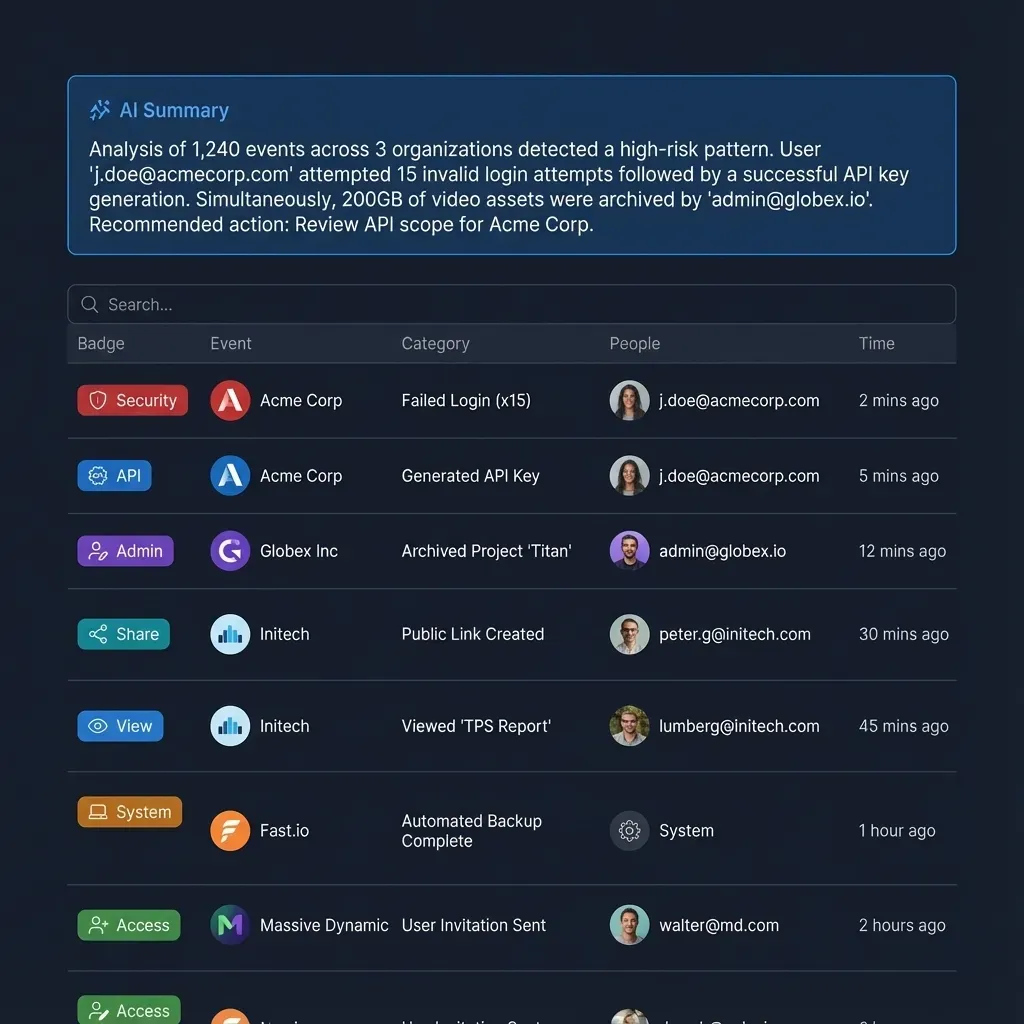
Step Four: Processing Fastio Activity Feeds for Reactive Workflows
Supabase Edge Functions work well as activity processors. Deploy the function, then long-poll Fastio from Deno so new file activity lands next to your Postgres rows.
Start by deploying your Supabase function to the cloud with the CLI. Invoke it on a schedule, from a database trigger, or from your app when you want to wait on a workspace.
From the function, long-poll workspace activity with GET https://api.fast.io/current/activity/poll/{entityId}?wait=95&lastactivity={timestamp} and Authorization: Bearer {api_key}:
const apiKey = Deno.env.get("FASTIO_API_KEY");
const pollUrl =
  `https://api.fast.io/current/activity/poll/${entityId}?wait=95&lastactivity=${lastActivity}`;

const response = await fetch(pollUrl, {
  method: "GET",
  headers: {
    "Authorization": `Bearer ${apiKey}`,
  },
});

const activity = await response.json();
You can also search the audit log with GET https://api.fast.io/current/events/search/. When the poll or search returns, write the JSON into your Supabase PostgreSQL database and continue your pipeline.
Building Agentic Workflows with Fastio MCP
Combining Supabase and Fastio creates strong agentic workflows for AI applications. Fastio is an intelligent workspace. Files in that workspace are available to semantic search and to Ripley, the built-in RAG agent.
You can use the Model Context Protocol (MCP) to expose Fastio tools to an AI agent. Point the client at https://mcp.fast.io/mcp/tools and send a Fastio API key as an Authorization: Bearer header on the connection. Supabase acts as the coordinator in this setup. When a user creates a project in your database, a trigger invokes an edge function.
That edge function calls POST https://api.fast.io/current/org/{org_id}/create/workspace/ to provision a dedicated workspace. It can add a member with POST /current/workspace/{workspace_id}/members/{email_or_user_id}/ and signal an OpenClaw agent or an MCP-compatible client to start working in the workspace. The agent can create folders, write notes, and ask Ripley for a cited answer. When the work is ready, invite the human user as a workspace member, or share the result through a Send, Receive, or Exchange portal. Serverless functions running at the edge handle this entire handoff. Read more about this approach in Fastio Storage for Agents.
Performance Optimization and Edge Constraints
Supabase Edge Functions scale well but have specific limits you need to manage when working with external APIs. They enforce strict boundaries on execution time and memory.
Avoid proxying large file uploads through the edge function when connecting to Fastio. Processing a heavy video file inside an edge function causes timeouts and eats up memory. Have the function import the asset from a URL with POST https://api.fast.io/current/web_upload/ (form fields source_url, file_name, profile_id, profile_type, and folder_id) so Fastio fetches the bytes. Small files can go in one multipart request to POST https://api.fast.io/current/upload/ with fields name, size, chunk, action=create, instance_id, and folder_id. For a large file, create a session on that same upload route (omit chunk), send each part to POST /current/upload/{id}/chunk/?order=N&size=N, complete it with POST /current/upload/{id}/complete/, then wait on GET /current/upload/{id}/details/?wait=60.
Watch out for rate limits. If your Supabase function polls activity during a bulk upload, you could hit Fastio API limits. HTTP 429 with error code 1671 means you should back off until the x-ve-limit-expires header. Add retry logic in your Deno code for those responses. For important workflows, write activity results into a Supabase table first, then process them asynchronously with a separate worker or cron trigger.

Troubleshooting Common Deno and Supabase Errors
You might run into a few common issues specific to the Deno runtime and Supabase deployment model.
If you get a missing module error when importing a third-party library, keep in mind that Deno requires explicit URLs for imports. Bare module specifiers will fail unless you configure an import map file in your Supabase project. Stick to official Deno land URLs for standard library needs to ensure compatibility with Supabase.
Cross-Origin Resource Sharing (CORS) is another frequent stumbling block. If your frontend calls the Supabase Edge Function directly from a browser, the browser sends a preflight HTTP OPTIONS request before the POST request. Your Deno function has to handle this OPTIONS request and return the right access control headers. If you skip this step, the browser blocks the network request and throws a network error in the console. Fix this by checking the request method before running your integration logic.
Watch out for timeout errors. Supabase Edge Functions enforce a default timeout limit. Chaining multiple Fastio API requests can push you past this window. For example, creating a workspace and generating folders before adding members might take too long. Break complex workflows into smaller asynchronous steps or use Supabase Database Webhooks to chain function calls safely.
Frequently Asked Questions
How do I process files in Supabase Edge Functions?
Avoid processing large files directly in Supabase Edge Functions because of memory and timeout limits. Import a remote file with POST https://api.fast.io/current/web_upload/ using form fields source_url, file_name, profile_id, profile_type, and folder_id. For bytes you already have, POST a small file to https://api.fast.io/current/upload/ in one multipart request, or create a chunked session on that same route, send each chunk, then complete and wait on details.
Can I use Fastio with Supabase?
Yes, you can integrate Fastio with Supabase by calling the Fastio REST API from Supabase Edge Functions. This setup lets you provision workspaces, add members, upload files, and poll activity right next to your database logic.
Why use Deno instead of Node.js for this integration?
Supabase Edge Functions run on Deno to provide faster cold starts and native support for standard Web APIs like fetch. You can communicate with the Fastio API without installing or bundling third-party HTTP clients, which keeps your deployment lean.
How do I process Fastio activity events in Supabase?
Deploy a Supabase Edge Function and long-poll workspace activity with GET https://api.fast.io/current/activity/poll/{entityId}?wait=95&lastactivity={timestamp}. You can also search the audit log with GET https://api.fast.io/current/events/search/. When activity returns, write the JSON into Postgres and continue your pipeline.
Related Resources

Give Your AI Agents Persistent Storage
Connect Supabase with Fastio and give your AI agents a persistent, intelligent workspace with generous storage. Built for integrate fast api with supabase edge functions workflows.