How to Manage Agent State with Fastio Workspaces
Fastio workspaces provide persistent state for multi-agent workflows, ensuring important data isn't lost between tool calls. This guide explains how to use workspace storage and the Model Context Protocol (MCP) to build stateful AI applications that scale without race conditions or memory loss.


What to check before scaling agent state in Fastio workspaces
Most AI agents operate without state. When a user sends a prompt, the agent receives the input, processes it through a large language model, and returns an output. Once that execution cycle completes, the agent forgets everything. This amnesia makes building complex, multi-step workflows difficult.
If you want an agent to remember user preferences, track the progress of a long-running research task, or coordinate with other specialized agents, you must build a persistence layer. Standard databases often fall short for these specific workloads. Relational databases require rigid schemas that do not fit dynamic agent outputs. Basic key-value stores struggle when multiple agents write data at the same time.
Fastio workspaces provide persistent state for multi-agent workflows. This ensures important data isn't lost between tool calls. By combining structured file storage with remote MCP access, workspaces allow developers to build agents that remember context over days, weeks, or months.
When an agent needs to pause a task and wait for user input, it writes its current state to a Fastio workspace. When the user replies, the agent wakes up, reads its state, and resumes exactly where it left off. This approach turns agents from single-turn query engines into long-term collaborative partners.
Helpful references: Fastio Workspaces, Fastio Collaboration, and Fastio AI.

Related guides
- How to Manage AI Agent State: Patterns for PersistenceState management is how agents save, retrieve, and sync their work, memory, and files across sessions. Without it,...
- Gemini Message Limits in 2026: Quotas, Cooldowns, and WorkaroundsA Gemini message limit restricts how many prompts or API requests you can submit within a rolling window. Learn the...
- How to Manage LangChain Token Limits: Memory, Pruning, and MCP WorkspacesUnderstanding the LangChain token limit helps developers prevent context overflow errors in complex LLM pipelines. This...
- How to Connect ChatGPT to MinIO: S3 Object Storage for AI WorkspacesConnecting ChatGPT to private MinIO object storage requires bridging OpenAI models with local or private cloud...
- How to Connect ChatGPT to Amazon S3: Direct Storage vs. Indexed WorkspacesConnecting ChatGPT to Amazon S3 bridges conversational AI with enterprise object storage. While direct connections via...
- LangGraph Recursion Limit: GraphRecursionError and State FixesA LangGraph GraphRecursionError occurs when a compiled graph exceeds its maximum allowed execution steps before hitting...
More on this subject: AI Agents: General Guides (190 guides)
How Fastio Manages Agent State
Fastio workspaces provide a centralized storage layer designed for multi-agent coordination and state management. Unlike ephemeral scratchpads or basic object storage buckets, workspaces provide structured file organization and version history for agent requests.
When multiple agents collaborate across sessions, standard databases might overwrite concurrent writes or lose track of state transitions. Fastio preserves full version history with restore and a detailed activity log. Every update is tracked, eliminating the risk of lost state or untracked revisions.
What are the benefits of Fastio workspaces versus standard key-value stores for agents?
- State Locality: Workspaces keep documents, intermediate results, and metadata in one organized location.
- Consistency: File version history tracks every modification sequentially, ensuring agents can review or diff prior states.
- Concurrency: Workspace permissions and detailed activity logs provide clear visibility into every agent action.
- Lifecycle: Workspaces persist indefinitely while providing instant access through remote MCP endpoints.
This combination of features makes Fastio a strong backend for agentic memory. Agents can coordinate writes using advisory file locks while the storage layer handles version tracking automatically.
Fastio's Intelligence Workspace Model
Fastio is an intelligent workspace, not just storage. Intelligence is native. When you upload a file or write a state object to a Fastio workspace, it is indexed once Intelligence is enabled for the workspace. The content becomes searchable by meaning and queryable through chat. Agents and humans share these exact same workspaces. Humans use the web interface, while agents use a consolidated MCP toolset via Streamable HTTP and Server-Sent Events (SSE).
This model provides a clear advantage for developer velocity. Instead of provisioning a separate vector database for Retrieval-Augmented Generation (RAG), you can toggle Intelligence Mode on a workspace. Files are indexed once Intelligence is enabled. An agent can then query its own historical state or reference documents using natural language.
The platform also supports ownership transfer. An agent can create an organization, build out several workspaces, configure the initial state, and then transfer ownership to a human client while retaining administrative access. This enables agency models where AI systems set up infrastructure for human operators.
Fastio offers transparent tiered plans: Starter ($9.99/mo), Business ($49.99/mo), and Enterprise ($199.99/mo) plans, with usage-based credits and seat allowances. Teams can evaluate agent memory using the 14-day Business Trial on monthly plans (credit card required).

Preventing Race Conditions with File Locks and Version History
In a swarm architecture, multiple agents run concurrently. If Agent A and Agent B both read a state file, modify its contents, and write it back to storage, uncoordinated writes can lead to state corruption.
Fastio handles this through advisory file locks alongside comprehensive file version history with restore.
The workflow operates cleanly:
- Lock Acquisition: Before modifying a shared file, an agent acquires a file lock via the
storagetool actionlock-acquire. If another agent already holds the lock, the request returns an HTTP 409 error, signaling the agent to wait or read. - Heartbeat and Modification: The agent heartbeats the lock while working and writes its updates.
- Release and Versioning: The agent releases the lock via
lock-release. If an agent disconnects, the lease expires or can be taken over by anyone with write permission, and every write is preserved in version history.
Integrating MCP Tools for Agent State
Connecting your AI agents to Fastio is easy using the remote MCP server at with a scoped API key. This provides zero-configuration access to a consolidated MCP toolset, enabling natural language file management.
For more advanced setups, you can connect directly to the Fastio MCP server. The server exposes a consolidated MCP toolset that maps directly to Fastio workspace capabilities. Every action a human can take in the browser, an agent can take via the API.
To implement persistent state, your agent should read its state file at the beginning of its execution loop. If the file does not exist, the agent initializes a new state schema and saves it. As the agent takes actions, it writes its updated state back to the workspace.
This pattern is useful for human-in-the-loop workflows. An agent can update a status document in the workspace. Team members review the output directly in the Fastio UI and leave region-anchored comments. The agent, monitoring the workspace activity feed or WebSocket events, detects updates and resumes its task.
Advanced Workflows: Cloud Imports and Event Feeds
Building stateful agents requires feeding them external data. Fastio streamlines this through cloud imports. An agent can instruct Fastio to import a file directly from a public URL or cloud services like Google Drive, Dropbox, or Box. Fastio imports the file server-side, making it available for semantic search once Intelligence is enabled for the workspace.
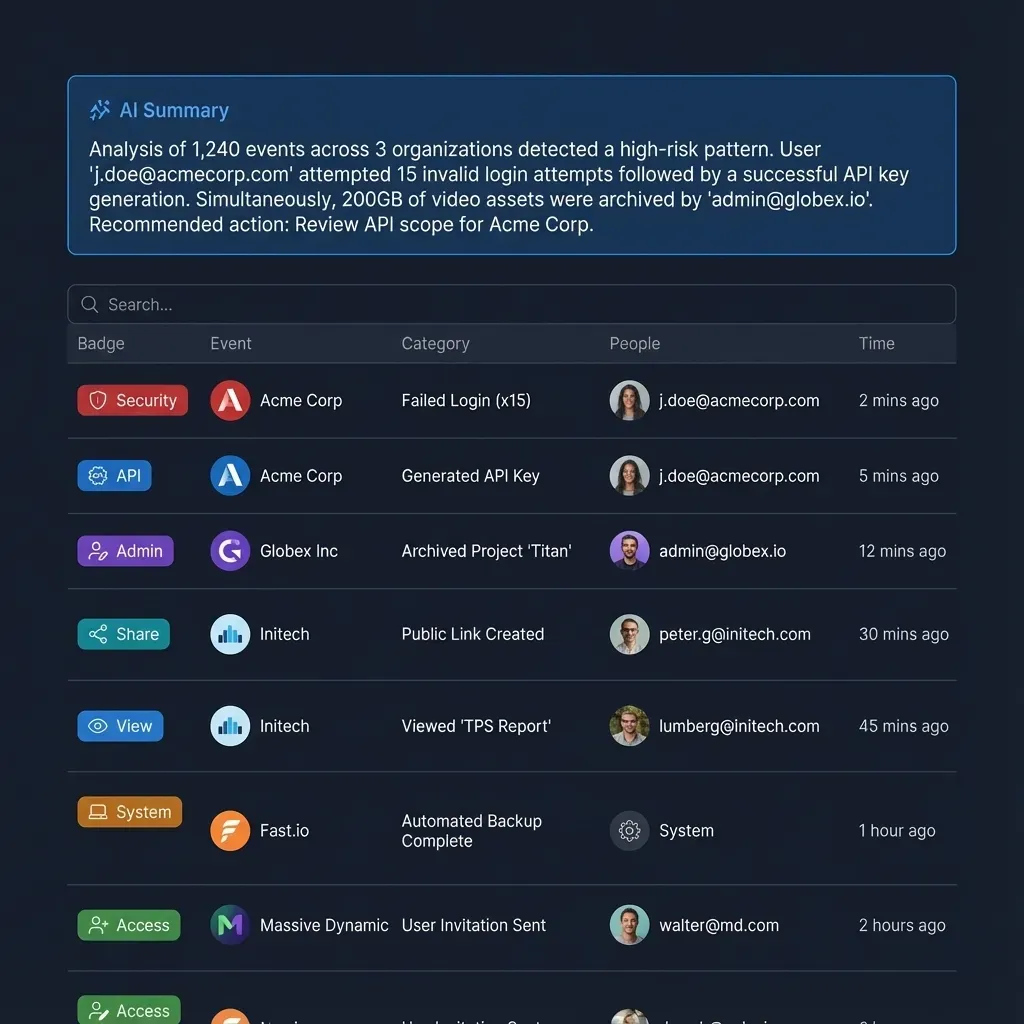
Fastio provides a WebSocket events feed and a pollable realtime activity feed for reactive workflows. Instead of an agent polling the server blindly to see if a new file has arrived, you can listen to the WebSocket events feed. When a file changes or a new state object is added, Fastio pushes the event directly to your application. This triggers downstream agent operations instantly, reducing latency and saving credits.
Scaling Agent State in Production Environments
As your multi-agent system grows, you must adopt practices for managing state at scale. The primary challenge is context window optimization. You cannot load a megabyte-sized state file into an LLM's prompt for every interaction.
Instead, you should structure your workspace state files hierarchically. Keep a small file that contains the high-level context required for every prompt. Store detailed interaction logs, large research payloads, and intermediate artifacts in separate files within the same workspace.
When an agent needs specific historical details, it should use Fastio's Intelligence Mode to search the workspace semantically once Intelligence is enabled, rather than loading the entire history. This RAG-based approach keeps prompts small, reduces token costs, and improves inference speed.
You must also implement reliable error handling. Network requests fail, and rate limits are a reality in distributed systems. Your agents should be programmed to catch HTTP errors, respect retry-after headers, and implement exponential backoff when interacting with the Fastio MCP server. By treating state persistence as a network boundary, you ensure your autonomous systems remain stable under load.
Frequently Asked Questions
How do AI agents maintain state across sessions?
AI agents maintain state by writing their context, memory, and task progress to external persistent storage like Fastio workspaces. When a new session begins, the agent reads this stored data via MCP to resume exactly where it left off without losing context.
How do Fastio workspaces support agent state persistence?
Fastio workspaces provide persistent cloud environments for agents. Agents read and write state documents via MCP tools, while Fastio automatically maintains file version history and a detailed activity log to prevent data loss across sessions.
How can developers evaluate Fastio for agent memory?
Fastio offers a 14-day Business Trial on monthly plans, requiring a credit card, providing full access to agentic workspaces, remote MCP connectivity, and built-in semantic search across Starter ($9.99/mo), Business ($49.99/mo), and Enterprise ($199.99/mo) plans.
How does the Fastio MCP server prevent multi-agent conflicts?
The Fastio MCP server helps agents coordinate writes with advisory file locks. An agent can acquire a file lock before writing, heartbeat it while working, and release it when done. Other agents attempting to lock the same file receive an HTTP 409 and can wait, while version history preserves every write as a safety net.
Does Fastio replace the need for a separate vector database?
Yes, Fastio can replace a separate vector database. Once Intelligence is enabled for the workspace, Fastio automatically indexes all uploaded files and state objects, allowing agents to perform semantic searches and built-in RAG without managing external infrastructure.
Related Resources

Give Your AI Agents Persistent Storage
Connect your agents to intelligent workspaces with a consolidated MCP toolset and built-in RAG today. Built for persistent agent state workflows.